









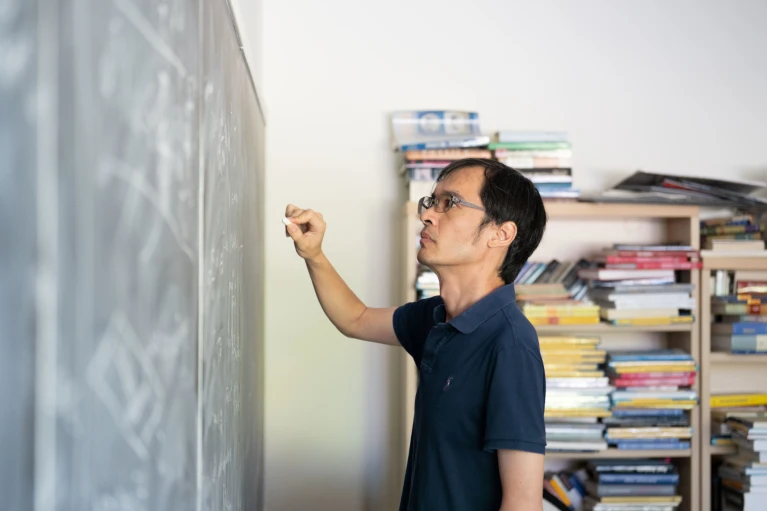
Terence Tao has been exploring the intersection between maths and AI.Credit: David Esquivel/UCLA
Is mathematics being taken over by generative artificial intelligence? A spate of media reports has suggested that the field is being fundamentally changed by the technology. Many maths researchers say that AI’s actual capabilities are often hyped up, and that it’s not yet time to announce the death of their profession. Still, by many accounts, in the past year, AI has jumped from solving secondary-school-level problems to actually being useful in research mathematicians’ daily work.
Terence Tao, a mathematician at the University of California, Los Angeles, has been at the forefront of experimentation with large language models, including OpenAI’s GPT, Anthropic’s Claude and Google’s Gemini. In particular, he has contributed to a project to test the skills of AI systems on a collection of more than 1,000 problems, ranging from major conjectures to obscure factoids. The questions were accumulated by the late Hungarian mathematician Paul Erdős (1913–1996) over his lifetime.
Last month, Tao teamed up with Tanya Klowden, an art historian at the Courtauld Institute of Art in London, to explore the implications of AI for researchers and the world at large. They took mathematics as a test case, and urge society to adopt the technology but in a human-centric way. They posted a draft of their essay, due to be published in the forthcoming edition of The Blackwell Companion to the Philosophy of Mathematics, on arXiv1. Nature spoke to Tao about how the technology is transforming his profession.
I feel like AI is not just another technology like the word processor or the web browser. It really is forcing us to rethink fundamental questions — what is a mathematical proof? What is a paper? What is the purpose of our profession? If we don’t ask these questions ourselves, then they will get answered for us by a technology company or decided by financial incentives. We have to get ahead of this.
In almost any other application, the biggest Achilles heel of AI is that it makes unverifiable mistakes. But in mathematics, almost uniquely, you can automatically check the output — at least if the output is supposed to be the proof of a theorem, although that is not the only thing mathematicians do. So, AI companies have recognized that their most unambiguous successes — if they’re going to have any — are going to come from mathematics.
In my opinion, there are many use cases of AI that are risky and controversial. In mathematics, the downsides are much more limited
The job description is changing a lot. A graduate student who refuses to touch AI systems and just wants to prove things the way we’ve done in the past might find they have fewer opportunities, unfortunately. Those who understand maths traditionally but are also adept at using new tools can flourish.
I don’t think AI will replace mathematicians, but it will complement them. There could be a division of labour: we decide what to prove and what we think is interesting. We could get instant feedback from the AI. We could propose a definition, make some conjecture and AI could instantly evaluate it. But who knows, it’s all changing.
But we do have to somehow let go of conventional assumptions of what intellect is. I think we have a human-centric way of thinking about all types of intellectual task, and we have to accept that this is not the only perspective.
It’s very much a spectrum. You see all the ‘five stages of grief’ play out — denial, anger, bargaining, depression and acceptance. And I think this is happening everywhere. But I think we’re beginning to see denial fade away.
For a while, you could say they were just picking up proofs that were in the literature. Or that they solved an easy problem that nobody had looked at before. But recent progress has been increasingly impressive. We’re just beginning to see examples in which AI — maybe by luck — starts solving problems that people care about.
It’s still very occasional, and it still has a lot of weaknesses; it is not a replacement for what humans do. But it’s getting harder to deny that these tools can work.
此内容由惯性聚合(RSS阅读器)自动聚合整理,仅供阅读参考。 原文来自 — 版权归原作者所有。