







 Amanda Cotton/Project CETI
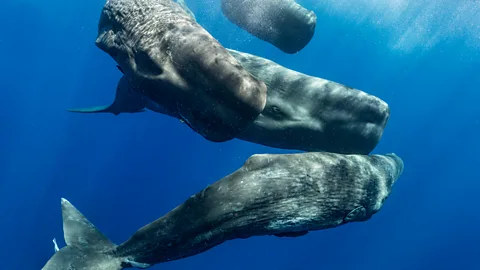
Researchers studying sperm whale communication say they've uncovered sophisticated structures similar to those found in human language.
But exactly how sperm whales catch squid, like many other areas of their lives, remains a mystery. "They're slow swimmers," says Kirsten Young, a marine scientist at the University of Exeter. Squid, on the other hand, are fast. "How can [sperm whales] catch squid if they can only move at 3 knots [5.5 km/h or 3.5mph]? Are the squid moving really slowly? Or are the whales stunning them with their vocalisations? What happens down there? Nobody really knows," she says.
 Amanda Cotton/Project CETI
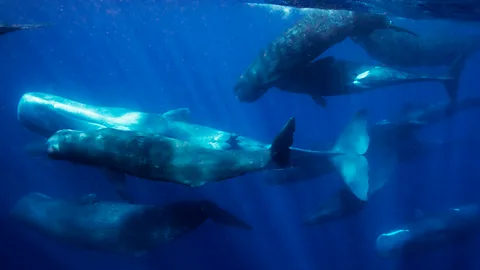
"At 1000m (3300ft) deep, many of the group will be facing the same way, flanking each other – but across an area of several kilometres," says Young. "During this time they're talking, clicking the whole time." After about an hour, she says, the group rises to the surface in synchrony. "They'll then have their rest phase. They might be at the surface for 15 to 20 minutes. Then they'll dive again," she says.
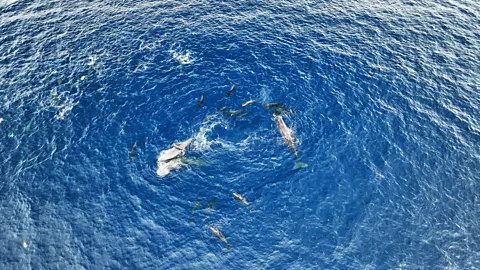
At the end of a day of foraging, says Young, the sperm whales come together at the surface and rub against each other, chatting while they socialise. "As researchers, we don't see a lot of their behaviour because they don't spend that much time at the surface," she says. "There's masses we don't know about them, because we are just seeing a tiny little snapshot of their lives during that 15 minutes at the surface."
It was around 47 million years ago that land-roaming cetaceans began to gravitate back towards the ocean – that's 47 million years of evolution in an environment alien to our own. How can we hope to easily understand creatures that have adapted to live and communicate under such different evolutionary pressures to ourselves?
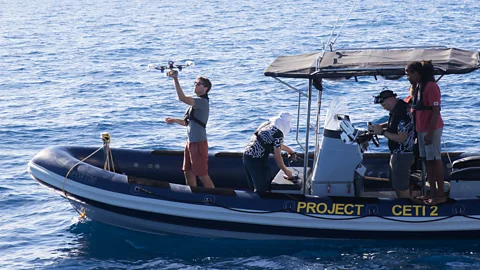
"It's easier to translate the parts where our world and their world overlap – like eating, nursing or sleeping," says David Gruber, lead and founder of the Cetacean Translation Initiative (Ceti) and professor of biology at the City University of New York. "As mammals, we share these basics with others. But I think it's going to get really interesting when we try to understand the areas of their world where there's no intersection with our own," he says.
 Project CETI
We're at base camp. This is a new place for humans to be – David Gruber
Sperm whales communicate with each other using rhythmic sequences of clicks, called codas. It was previously thought that sperm whales had just 21 coda types. However, after studying almost 9,000 recordings, the Ceti researchers identified 156 distinct codas. They also noticed the basic building blocks of these codas which they describe as a "sperm whale phonetic alphabet" – much like phonemes, the units of sound in human language which combine to form words. (Watch the video below to hear some of the variety in sperm whale vocalisations the AI identified.)
Pratyusha Sharma, a PhD student at MIT and lead author of the study, describes the "fine-grain changes" in vocalisations the AI identified. Each coda consists of between three and 40 rapid-fire clicks. The sperm whales were found to vary the overall speed, or the "tempo", of the codas, as well as to speed up and slow down during the delivery of a coda, in other words, making it "rubato". Sometimes they added an extra click at the end of a coda, akin, says Sharma, to "ornamentation" in music. These subtle variations, she says, suggest sperm whale vocalisations could carry a much richer amount of information than previously thought.
"Some of these features are contextual," says Sharma. "In human language, for example, I can say 'what' or 'whaaaat!?'. It's the same word, but to understand the meaning you have to listen to the whole sound," she says.
The researchers also found the sperm whale "phonemes" could be used in a combinatorial fashion, allowing the whales to construct a vast repertoire of distinct vocalisations. The existence of a combinatorial coding system, write the report authors, is a prerequisite for "duality of patterning" – a linguistic phenomenon thought to be unique to human language – in which meaningless elements combine to form meaningful words.
 Project CETI
However, Sharma emphasises, this is not something they have any evidence of as yet. "What we show in sperm whales is that the codas themselves are formed by combining from this basic set of features. Then the codas get sequenced together to form coda sequences." Much like humans combine phonemes to create words, and then words to create sentences.
So, what does all this tell us about sperm whales' intelligence? Or their ability to reason, or store and share information?
"Well, it doesn't tell us anything yet," says Gruber. "Before we can get to those amazing questions, we need to build a fundamental understanding of how [sperm whales communicate] and what's meaningful to them. We see them living very complicated lives, the coordination and sophistication in their behaviours. We're at base camp. This is a new place for humans to be – just give us a few years. Artificial intelligence is allowing us to see deeper into whale communication than we've ever seen before."
Young, though, describes the research as an "incremental step" towards understanding these giants of the deep. "We're starting to put the pieces of the puzzle together," she says. And perhaps if we could listen and really understand something like how important sperm whales' grandmothers are to them – something that resonates with humans, she says, we could drive change in human behaviour in order to protect them.
Categorised as "vulnerable" by the International Union for Conservation of Nature (IUCN), sperm whales are still recovering from commercial hunting by humans in the 19th and 20th Centuries. And, although such whaling has been banned for decades, sperm whales face new threats such as climate change, ocean noise pollution and ship strikes.
However, Young adds, we're still a long way off from understanding what sperm whales might be saying to each other. "We really have no idea. But the better we can understand these amazing animals, the more we'll know about how we can protect them."