


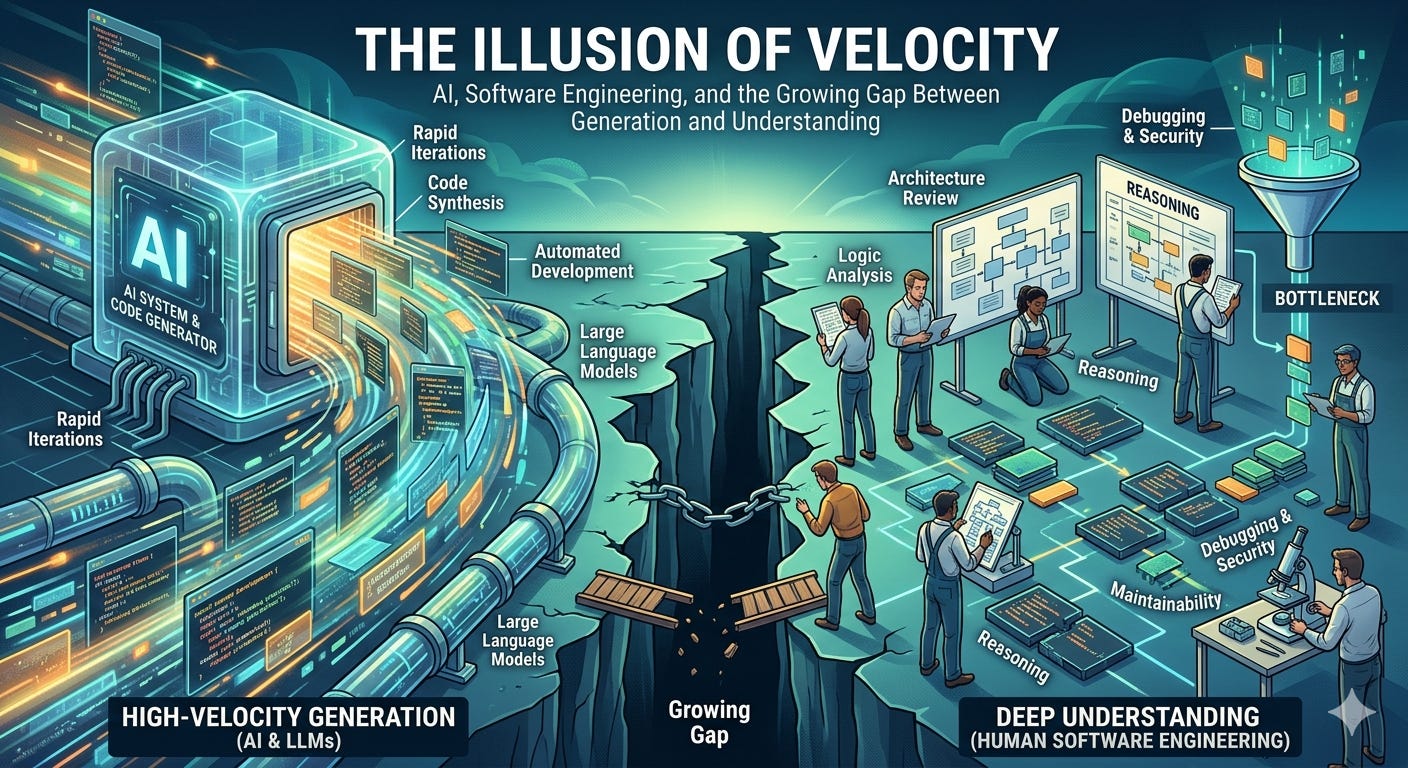
Imagine a multi-agent development workflow generating a new API endpoint. The code is clean. The tests pass. The CI pipeline goes green. A senior engineer reviews the pull request and notices something: the new endpoint silently bypasses the transactional boundary that three previous architecture decisions had carefully preserved. No agent flagged it. No linter caught it. The demo is tomorrow. The sprint deadline is today. The engineer approves it anyway.
This is not a story about bad AI. It is not even a story about a bad engineer. It is a story about the system of incentives those engineers operate inside and what AI does when it is deployed into that system without the infrastructure to constrain it.
Over the past year, I have reviewed multiple AI-assisted systems built on modern stacks: Python, FastAPI, PostgreSQL - accelerated through tools like GitHub Copilot and various multi-agent development workflows. The results reveal a widening paradox.
Teams can now produce APIs, dashboards, orchestration layers, and integrations at a speed that would have been difficult to imagine a few years ago. And yet many of these systems exhibit the same fundamental engineering problems the industry has struggled with for decades: weak architectural boundaries, poor separation of concerns, fragile data models, missing operational discipline, and inadequate observability.
The surprising part is not that these problems exist. The surprising part is that they persist despite AI making implementation dramatically cheaper and more accessible.
What AI has produced, with remarkable consistency, is what I would call High-Believability Software: systems optimized for the superficial feedback loops of a demo rather than the structural feedback loops of production. The UI is polished. The endpoints respond. The golden-path demonstration succeeds. To stakeholders and sometimes even engineering leadership, the system feels complete.
Experienced engineers look underneath and see something different. Business logic leaking into transport layers. Hidden state mutations. Weak transactional boundaries. Silent failure modes. Inconsistent domain models. Architecture drift accumulating invisibly over time. The surface communicates confidence. The interior tells a different story.
AI dramatically lowers the cost of appearance. It does not automatically produce correctness, sustainability, or architectural continuity.
The current enthusiasm around hypervelocity engineering: multiple AI agents with specialized roles, parallelized implementation, compressed delivery timelines and rests on a misunderstanding of where software engineering is actually hard.
Implementation speed was never the primary constraint. The hardest problems in engineering are defining system boundaries, managing complexity across time, preserving invariants, reasoning about distributed behavior, and maintaining shared understanding as systems evolve. These are coordination and comprehension problems, not production problems.
But there is a second bottleneck that is harder to discuss, because it is organizational rather than technical. Engineers often ship High-Believability Software not because they lack the judgment to do otherwise, but because the incentive structures they operate inside actively reward them for it. Velocity is what gets measured. Tickets closed, features shipped, and demos that land, these are the signals that drive performance reviews, promotions, and stakeholder confidence. Architectural integrity is largely invisible until it fails, and by the time it fails, the engineers who made the original tradeoffs have often moved on.
Shifting the engineer’s role from builder to governor requires more than a change in tooling. It requires organizations to measure and reward governance explicitly to treat the engineer who catches and prevents the transactional boundary violation as more valuable than the engineer who ships ten endpoints that silently violate it. Without that shift in incentives, the most sophisticated architectural memory infrastructure in the world will be overridden by the next sprint deadline.
AI agents compound this dynamic. Because they lack persistent global context and any model of decision lineage, they solve the local problem beautifully while subtly degrading the larger architecture. They do not know why previous decisions were made, which constraints are non-negotiable, what tradeoffs were intentionally accepted, or how an isolated change ripples through broader system behavior.
The deeper structural problem is not simply that agents lack shared memory. It is that we have not yet defined a system they can coordinate within. Current multi-agent workflows have no shared constraint space, no enforced topology, no causal awareness between changes, no invariant layer that persists across the boundaries of individual prompts. Without that, each agent operates coherently within its own context while remaining blind to the architecture those contexts collectively constitute. The result is not a coordination failure. It is the absence of the infrastructure coordination requires.
What remains is activity without systemic alignment, which is a precise description of how architectural debt inflates faster than organizational understanding can keep pace.
AI has compressed the cost of producing software artifacts. It has not compressed the cost of developing engineering judgment. That distinction matters enormously and the core problem is not merely a gap between generation and understanding, but a rate mismatch: systems are changing faster than organizations can preserve coherent understanding of them.
AI dramatically accelerates code output. It leaves architectural alignment largely unchanged, or marginally degrades it. It actively reduces system comprehension relative to the volume of output being produced. And it causes risk to accumulate nonlinearly, because complexity is growing faster than the organizational capacity to understand it.
There is a profound difference between having code and understanding a system. A system can function correctly on day one while remaining cognitively fragmented, operationally fragile, and architecturally inconsistent. Historically, the friction of implementation, writing, integrating, debugging which acted as a natural governor. It slowed teams down just enough that engineering discipline evolved alongside system complexity, forcing careful reasoning about edge cases, failure modes, and dependencies.
AI removes that governor. Now entire platforms can be generated before teams have fully understood the domain, the operational constraints, the failure semantics, or the long-term maintenance implications. Complexity accumulates faster than comprehension. This is architectural debt inflation, and it operates at a speed the industry has not encountered before.
The solution is not slowing down AI adoption. The solution is evolving our engineering operating models to match the new reality.
The engineer’s role is shifting from builder to governor. As the unit of execution moves away from human hands, what becomes critically important is not code review in the traditional sense but something closer to intent governance: continuously asking not “can we generate this?” but “should the system evolve in this direction at all?” Engineering review processes must spend less time validating syntax and more time validating architectural alignment, constraint preservation, and long-term operational impact.
The unit of engineering is no longer code, it is constraint. Code remains an implementation artifact, but the governing act of engineering is increasingly the definition and enforcement of valid system evolution.
Alongside this, engineering discipline must become machine-verifiable. Best practices cannot remain tribal knowledge or static documentation. Policy-as-code, architectural fitness functions, strict dependency governance, schema evolution constraints, these transform architectural intent from aspiration into enforcement. AI works well inside strong, explicit guardrails. Without them, velocity amplifies entropy.
But the deepest problem is one that neither governance processes nor fitness functions fully solve on their own: the absence of active architectural memory.
Most AI-assisted development workflows today are context-fragmented by design. Agents duplicate abstractions, violate previous design decisions, and introduce inconsistent patterns not because they are careless but because they view the system through a narrow window with no access to its history. Documentation helps, but developers rarely maintain synchronized understanding through documentation alone, and AI systems tend to treat it as weak, non-authoritative context.
What is actually needed is something more structural: systems capable of continuously maintaining architectural intent, operational history, dependency relationships, causal context, and historical decision rationale, not as documentation to be consulted, but as live operational constraints that shape how both humans and AI agents interact with a system as it evolves. The transactional boundary that three previous architecture decisions preserved needs to be actively legible to the next agent that touches that code. The reasoning behind it needs to travel with the system.
Describing this as “operational cognition” is useful framing, but it demands a concrete answer to the question every architect will immediately ask: what does this actually look like in practice?
Operational cognition is a control-plane layer for engineering systems. It continuously maintains and enforces architectural intent as software evolves. It is not a documentation system. It is not a code review tool. It is not a smarter linter. It is the persistent substrate within which both humans and agents operate, and the layer that makes architectural intent enforceable rather than aspirational. It plays the same role for engineering systems that a control plane plays for distributed infrastructure: it defines what is allowed, enforces invariants, and maintains system coherence as change occurs.
Start with decision lineage. Architectural Decision Records are already a common practice, but they typically live in wikis where they accumulate dust and drift from the systems they describe. Embedding ADRs as structured metadata directly in the repository which parsed as authoritative system context before an agent generates code changes their nature entirely. They stop being documentation and become constraints. An agent that must parse the rationale for a transactional boundary before touching the code near it is a fundamentally different kind of tool than one operating from a blank prompt.
Architectural intent becomes executable. Rather than living in design documents, constraints are expressed as policy engines, contract validators, and enforced dependency rules including schema validators and abstract syntax tree parsers that act as non-negotiable guardrails in the CI/CD pipeline. Code that violates an architectural invariant does not get a review comment. It does not merge. The constraint is mechanical, not advisory.
Systems expose their own constraints. Agents stop operating in free-form generation mode and instead work within an enforced topology, a defined space of valid architectural moves. The system communicates what it is, not just what it contains.
Engineering work shifts toward constraint design. The primary engineering discipline becomes defining invariants, encoding boundaries, and governing how systems are permitted to evolve, rather than producing the artifacts of evolution directly.
This is not a speculative future. The primitives exist. What is missing is their assembly into a coherent layer of engineering infrastructure that treats architectural intent as a first-class operational concern.
In the near future, nearly every organization will be able to generate software quickly. Generative velocity alone will not be differentiating.
The real competitive advantage will belong to organizations that can maintain coherent understanding of their systems at the speed those systems are changing that can preserve architectural integrity, manage evolving complexity, and coordinate humans and AI within engineering systems that remain trustworthy over time.
The next generation of engineering platforms may not primarily be code generators. They may be systems of operational cognition: environments that continuously maintain architectural intent, operational constraints, and shared understanding as live context, keeping humans and AI agents aligned as systems evolve at machine speed. The next engineering platform will not win by generating the most code, but by preserving the most trustworthy system understanding per unit of change.
The future of software engineering is not faster code generation, it is the continuous enforcement of system intent.
Return to that pull request. In a system of operational cognition, the agent generating that endpoint would not have needed a senior engineer to catch the violation. The transactional boundary would not have been a comment in a file, or a paragraph in a design document, or institutional memory living in one person’s head. It would have been an active constraint in the architectural context the agent operated inside, as present and enforceable as a type signature or a schema. The boundary would have traveled with the system. The violation would never have been generated.
Code is becoming abundant. The capacity to understand what you have built, and why, and what it will do under pressure remains scarce. Closing that gap is the defining engineering challenge of this moment.