惯性聚合 高效追踪和阅读你感兴趣的博客、新闻、科技资讯
阅读原文 在惯性聚合中打开

推荐订阅源

P
Privacy & Cybersecurity Law Blog
WordPress大学
WordPress大学
Last Week in AI
Last Week in AI
腾讯CDC
人人都是产品经理
人人都是产品经理
小众软件
小众软件
V
Visual Studio Blog
S
Secure Thoughts
J
Java Code Geeks
V
V2EX
量子位
The Hacker News
The Hacker News
酷 壳 – CoolShell
酷 壳 – CoolShell
Security Latest
Security Latest
博客园_首页
钛媒体:引领未来商业与生活新知
钛媒体:引领未来商业与生活新知
Threat Intelligence Blog | Flashpoint
Spread Privacy
Spread Privacy
博客园 - 叶小钗
T
Threat Research - Cisco Blogs
Security Archives - TechRepublic
T
Tailwind CSS Blog
Cloudbric
Cloudbric
S
SegmentFault 最新的问题
AI
AI
奇客Solidot–传递最新科技情报
奇客Solidot–传递最新科技情报
Application and Cybersecurity Blog
IT之家
IT之家
T
Tenable Blog
S
Security @ Cisco Blogs
月光博客
月光博客
雷峰网
雷峰网
博客园 - 【当耐特】
Know Your Adversary
Know Your Adversary
C
Cybersecurity and Infrastructure Security Agency CISA
Exploit-DB.com RSS Feed
OSCHINA 社区最新新闻
OSCHINA 社区最新新闻
Hugging Face - Blog
Hugging Face - Blog
爱范儿
爱范儿
Attack and Defense Labs
博客园 - 三生石上(FineUI控件)
Hacker News - Newest:
Hacker News - Newest: "LLM"
有赞技术团队
有赞技术团队
N
News and Events Feed by Topic
阮一峰的网络日志
阮一峰的网络日志
TaoSecurity Blog
TaoSecurity Blog
宝玉的分享
宝玉的分享
让小产品的独立变现更简单 - ezindie.com
The Cloudflare Blog
K
Kaspersky official blog

Hacker News - Newest: "AI"

AI can't read an investor deck AI as an attorney? Student uses ChatGPT, Gemini to sue UW over alleged racial discrimination Hacking MCP Servers in AI Systems – The Rug Pull: Tool Changes After Approval GitHub - MeepCastana/KubeezCut: Free Web based video editor GitHub - GenAI-Gurus/awesome-eu-ai-act: Curated tools, official sources, OSS, templates, and guides for EU AI Act compliance. Can AI judge journalism? A Thiel-backed startup says yes, even if it risks chilling whistleblowers Coming soon: 10 Things That Matter in AI Right Now DARPA built an AI to fact-check enemy weapons claims What explains heterogeneity in AI adoption? When AI Meets Muscle: Context-Aware Electrical Stimulation Promises a New Way to Guide Human Movements - Department of Computer Science AI Changed How We Build. It Did Not Change What Matters. Linux rules on using AI-generated code - Copilot is OK, but humans must take 'full responsibility for the… Meta spins up AI version of Mark Zuckerberg to engage with employees Code Mode: Let Your AI Write Programs, Not Just Call Tools | TanStack Blog GitHub - Delavalom/graft: Go framework for building AI agents. Type-safe tools, multi-provider (OpenAI, Anthropic, Gemini, Bedrock), zero vendor SDKs. India's TCS tops estimates, says new AI models did not dent services demand Gen Z's fading AI hype Strong feeling: we are in a folded AI reality GitHub - machinarii/total-recall-catalog: A reference catalog of latest knowledge retrieval, memory & RAG systems GitHub - mensfeld/code-on-incus: Give each AI agent its own isolated machine with root, Docker, and systemd. Active defense detects and stops threats automatically.. Quantization, LoRA, and the 8% Problem: Benchmarking Local LLMs for Production AI Iran war: We spoke to the man making Lego-style AI videos that experts say are powerful propaganda Powell, Bessent discussed Anthropic's Mythos AI cyber threat with major U.S. banks GitHub - immartian/bellamem: Persistent belief-graph memory for AI agents. Retrieves decisive context by importance — not recency, not RAG, not /compact. recursive-mode: The Repo-Native Operating System for AI Engineering After the attack on Sam Altman's home, will AI CEO's go on the offensive? The biggest advance in AI since the LLM Opus 4.6 vs GPT 5.4 One Prompt Unity World Generation Test “AI polls” are fake polls Client Challenge Can AI be a 'child of God'? Inside Anthropic's meeting with Christian leaders How to Switch AI Chatbots and Why You Might Want To GitHub - MattMessinger1/agentic_refund_guardrail: Safe refund policy layer for AI agents — Python + TypeScript. Same behavior, shared tests. Adam/papers/emergent_values_whitepaper.md at master · strangeadvancedmarketing/Adam Ask HN: How do you stop playing 20 questions with your AI coding tools How far can automation and AI support psychotherapy? - @theU GitHub - stagas/rtdiff: realtime git diff gui and AI-assisted commits A Mac Studio for Local AI — 6 Months Later A History of the Early Years of AI at the University of Edinburgh Why AI Coding Tools Still Feel Stuck on Localhost MSN AI Datacenters Are Becoming Strategic Targets twitter.com Penn Researchers Use AI to Surface Unreported GLP-1 Side Effects in Reddit Posts Show HN: MoodSense AI (ML and FastAPI and Gradio, Deployed on Hugging Face) Moodsense Ai - a Hugging Face Space by aman179102 AI models are terrible at betting on soccer—especially xAI Grok GitHub - xialeistudio/echoic GitHub - HimashaHerath/github-dev-wrapped: AI-powered weekly GitHub activity reports deployed to GitHub Pages GitHub - alejandrobalderas/claude-code-from-source: Architecture, patterns & internals of Anthropic's AI coding agent — reverse-engineered from source maps AI and Tech brief: Ireland ascendant GitHub - Titovilal/context0: Context0 - Never Surrender Training for a Marathon with an AI Coach: What Worked and What Didn't Cyber Pulse: Agentic Intel - Apps on Google Play I Built an AI PR Reviewer That Catches Bugs by Not Looking for Bugs Gen Z workers are so fearful AI will take their job they’re intentionally sabotaging their company’s AI rollout | Fortune How AI Is Reimagining the Game of Golf–For Both Players and Courses GitHub - nattergabriel/reseed: A CLI tool for managing and distributing agent skills across projects Is SVG the final frontier? My AI workflow evolved from prompts to a near-autonomous workflow MLSharp Help - 3DGS Viewer & Generator I put my cognitive field based AI's runtime on GitHub Is Numble the first AI-proof game? A3: Kubernetes for autonomous AI agent fleets | Emergent Principles Deepali Vyas ("The Elite Recruiter") GitHub - msmarkgu/RelayFreeLLM: A restful API designed to route user prompts to various AI model providers. Unionized ProPublica staff are on strike over AI, layoffs, and wages Unleashing the Advantage of Quantum AI We're heading for an AI-fueled 'dementia crisis,' brain scientist warns The AI-Assisted Breach of Mexico's Government Infrastructure [pdf] GitHub - stef41/lmscan: 🔍 Detect AI-generated text and fingerprint which LLM wrote it. Open-source GPTZero alternative. Zero dependencies, works offline. MSN GitHub - visionscaper/collabmem: Enabling long-term collaboration with Agentic AI - building up episodic and world model memory over time with in-context awareness We gave an AI a 3 year retail lease in SF and asked it to make a profit | Andon Labs AI Code is Hollowing Out Open Source, and Maintainers are Looking the Other Way What leaked "SteamGPT" files could mean for the PC gaming platform's use of AI AI is the boss at this retail store. What could go wrong? GitHub - Wuzu11517/agentic-proxy: Local proxy meant to help reduce With Drones, Geophysics and ArtificiaI Intelligence, Researchers Prepare to Do Battle Against Land Mines A Single Operator, Two AI Platforms, Nine Government Agencies: The Full Technical Report 在 Steam 上购买 FriedrichAI: Offline AI 立省 10% GitHub - inevolin/resume-cli: Hit Claude usage limits? Resume any AI coding session elsewhere. Switch tools at zero friction. GitHub - atripati/ark: AI Runtime Kernel — a context operating system for AI agents. Eliminates tool bloat, loads only what’s needed, and gives LLMs their reasoning space back. How to Build a Secure AI PR Reviewer with Claude, GitHub Actions, and JavaScript This Startup Wants You to Pay Up to Talk With AI Versions of Human Experts Intel Arc Pro B70 Brings 32GB VRAM to Local AI for $949 WordPress 7.0: The Good, the AI, and the Still Missing AI on the couch: Anthropic gives Claude 20 hours of psychiatry IatroBench: Pre-Registered Evidence of Iatrogenic Harm from AI Safety Measures AI Agents Know About Supabase. They Don't Always Use It Right. The history and future of AI at Google, with Sundar Pichai Inside an AI‑enabled device code phishing campaign How Meta Used AI to Map Tribal Knowledge in Large-Scale Data Pipelines AI for Systems: Using LLMs to Optimize Database Query Execution Forecasting the Economic Effects of AI Introducing Tinker: Play with AI, bring your ideas to life AI sheds light on an ancient gaming mystery People really hate AI but not as much as Iran—or Democrats | Fortune What is an AI Product Engineer? Phoebe Gates wants her $185 million AI startup to succeed with 'no ties to my privilege or my last name': 'I have a chip on my shoulder' | Fortune
After the AI Crash: A Proposal
adityaathaly · 2026-04-29 · via Hacker News - Newest: "AI"

Early large language models couldn’t handle anything but the most simple math problems. While leading models are now much better, AI firms still have a problem with basic math: Companies are investing trillions of dollars based on tens of billions of dollars in revenues. J.P. Morgan estimates $5 trillion of AI infrastructure investment in the next five years. Yet OpenAI and Anthropic currently earn an annualized $25 billion and $19 billion in revenue, respectively, and “profit” isn’t even part of the conversation.

To put things in perspective, the hundreds of billions of dollars in planned 2026 capital expenditures from hyperscalers is on a path to be a larger share of the U.S. GDP than peak investment for the Manhattan Project, the expansion of electricity, the Apollo space program, the construction of the interstate highway system, and broadband buildout during the dot-com bubble.

In a paper published by VPA today (see the coverage from Politico’s Morning Money newsletter), I argue that this massive level of investment, coupled with opaque financial engineering, means an AI market crash could lead to economy-wide, systemic consequences.

Many people compare today’s AI moment to the dot-com bubble, sometimes to minimize the risk. But it’s worth remembering the actual consequences of the bubble: 200,000 jobs were lost, thousands of companies went under, and the Nasdaq lost 80% of its peak-to-trough value and didn’t recover for 15 years.

An AI crash could be far worse. AI-related investment accounted for more than 90% of U.S. GDP growth in the first half of 2025. By one macroeconomic measure, the AI bubble is already 17 times larger than the dot-com bubble and four times larger than the 2008 housing bubble. And the financial arrangements underwriting all of this — circular equity financing, off-balance-sheet special-purpose vehicles, private credit, asset-backed securities — are complex, interlocking, and opaque. Just as a housing crisis in 2007 turned into a financial system crisis that hit every industry in 2008, it’s very easy to see how an AI crash would spread through the economy.

After the 2008 crash, Congress passed Dodd-Frank relatively quickly and without time for serious debate. Many liberals and even some conservatives mourned its shortcomings; for example, the Too Big to Fail banks have only gotten larger, more powerful, and more capable of causing global shockwaves should one go under.

As Ganesh Sitaraman and I recount in a new opinion piece in Time Magazine, we need to learn the lessons of the 2008 crash for the possible, coming AI crash. Perhaps most importantly, policymakers need to start identifying reforms now for what the response should be because once the crisis hits, it will be too hard to flesh out new ideas that genuinely address the structural issues in the sector. More specifically, policymakers should focus on helping families and individuals, not bailing out companies; identify and pursue structural reforms that actually solve the core issues in the sector; and prosecute those who engaged in fraud or illegal activities.

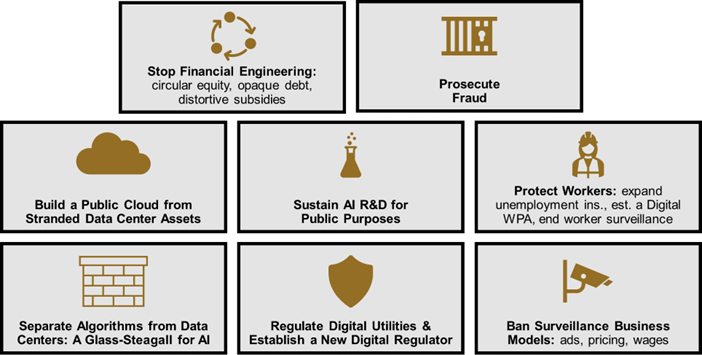
With respect to a possible AI crash, the paper lays out seven areas for Congress to act:

  1. Stop financial engineering proximate to the crash. Ban circular equity financing — where chip and cloud companies invest in AI companies that spend the money buying their products — a form of vendor-based equity investment at this scale that appears unique. Require full disclosure of debt financing deals, including off-balance-sheet special-purpose vehicles that currently hide more than $100 billion from tech companies’ books. End government subsidies that pit state and local jurisdictions against each other in a race to the bottom.

  2. Prosecute fraud. After major financial crises — like the Great Depression, the 1980s savings and loan crisis, the dot-com bubble, and the Covid-19 pandemic — prosecutors looked for and found major fraud that led to significant prosecutions and prison-time for those who perpetrated the fraud. After 2008, almost no one went to jail, which became a key flashpoint that inspired political backlash. If an AI crash involves fraud, law enforcers should, without fear or favor, investigate and prosecute fraud.

  3. Build a public cloud from stranded assets. When neoclouds and data center special-purpose vehicles go bankrupt, their physical infrastructure could be acquired at firesale rates to create a public option for cloud computing, operationalized through the National AI Research Resource and the Energy Department’s national lab system.

  4. Protect workers. Expand unemployment insurance and remove work requirements on safety net programs, as Congress has done in past downturns. Establish a Digital Works Progress Administration that matches displaced knowledge workers like software developers with the well-documented need in local and state governments. Limit workplace surveillance because, even where AI doesn’t eliminate jobs, it can degrade them.

  5. Separate algorithms from data centers: a Glass-Steagall for AI. Structurally separate software from hardware, just as the original Glass-Steagall separated commercial and investment banking to prevent the kind of systemic risk that accelerated the Great Depression. Without intertwined ownership structures, compute companies would make more rational, market-driven decisions rather than subsidizing AI development at a rate that might accelerate a crash.

  6. Regulate digital utilities and establish a new regulator. Chips, cloud computing, and foundation models have the features of markets traditionally regulated as utilities — high concentration, high barriers to entry, and natural monopoly dynamics. Congress should apply traditional regulatory tools to these markets and create a new regulatory agency to administer them.

  7. Ban extractive business models. Ban surveillance advertising, surveillance pricing, and surveillance wages before an AI crash drives companies to double down on them. The dot-com bubble was a key accelerant to the rise of surveillance advertising the first time around.

Instead of waiting for the crisis and then hastily developing insufficient policies, lawmakers should start preparing now. Meaningful reforms take time to formulate, and in a scramble, they get shelved for quick action. The time to debate these ideas is before the crash–not after.