


惯性聚合 高效追踪和阅读你感兴趣的博客、新闻、科技资讯
阅读原文 在惯性聚合中打开

推荐订阅源

MyScale Blog
MyScale Blog
F
Fortinet All Blogs
Cyber Security Advisories - MS-ISAC
D
Docker
freeCodeCamp Programming Tutorials: Python, JavaScript, Git & More
爱范儿
爱范儿
V
Visual Studio Blog
Last Week in AI
Last Week in AI
WordPress大学
WordPress大学
aimingoo的专栏
aimingoo的专栏
小众软件
小众软件
L
LangChain Blog
Vercel News
Vercel News
阮一峰的网络日志
阮一峰的网络日志
IT之家
IT之家
P
Proofpoint News Feed
博客园_首页
D
DataBreaches.Net
T
The Blog of Author Tim Ferriss
The GitHub Blog
The GitHub Blog
酷 壳 – CoolShell
酷 壳 – CoolShell
C
Check Point Blog
Engineering at Meta
Engineering at Meta
Microsoft Azure Blog

Hacker News - Newest: "AI"

AI can't read an investor deck AI as an attorney? Student uses ChatGPT, Gemini to sue UW over alleged racial discrimination Hacking MCP Servers in AI Systems – The Rug Pull: Tool Changes After Approval GitHub - MeepCastana/KubeezCut: Free Web based video editor Can AI judge journalism? A Thiel-backed startup says yes, even if it risks chilling whistleblowers Coming soon: 10 Things That Matter in AI Right Now DARPA built an AI to fact-check enemy weapons claims What explains heterogeneity in AI adoption? When AI Meets Muscle: Context-Aware Electrical Stimulation Promises a New Way to Guide Human Movements - Department of Computer Science AI Changed How We Build. It Did Not Change What Matters. Linux rules on using AI-generated code - Copilot is OK, but humans must take 'full responsibility for the… Meta spins up AI version of Mark Zuckerberg to engage with employees Code Mode: Let Your AI Write Programs, Not Just Call Tools | TanStack Blog GitHub - Delavalom/graft: Go framework for building AI agents. Type-safe tools, multi-provider (OpenAI, Anthropic, Gemini, Bedrock), zero vendor SDKs. India's TCS tops estimates, says new AI models did not dent services demand Gen Z's fading AI hype Strong feeling: we are in a folded AI reality GitHub - machinarii/total-recall-catalog: A reference catalog of latest knowledge retrieval, memory & RAG systems GitHub - mensfeld/code-on-incus: Give each AI agent its own isolated machine with root, Docker, and systemd. Active defense detects and stops threats automatically.. Quantization, LoRA, and the 8% Problem: Benchmarking Local LLMs for Production AI Iran war: We spoke to the man making Lego-style AI videos that experts say are powerful propaganda Powell, Bessent discussed Anthropic's Mythos AI cyber threat with major U.S. banks GitHub - immartian/bellamem: Persistent belief-graph memory for AI agents. Retrieves decisive context by importance — not recency, not RAG, not /compact. recursive-mode: The Repo-Native Operating System for AI Engineering After the attack on Sam Altman's home, will AI CEO's go on the offensive? The biggest advance in AI since the LLM Opus 4.6 vs GPT 5.4 One Prompt Unity World Generation Test “AI polls” are fake polls Client Challenge Can AI be a 'child of God'? Inside Anthropic's meeting with Christian leaders
Study: AI models that consider user's feeling are more li...
Kyle Orland · 2026-05-02 · via Hacker News - Newest: "AI"

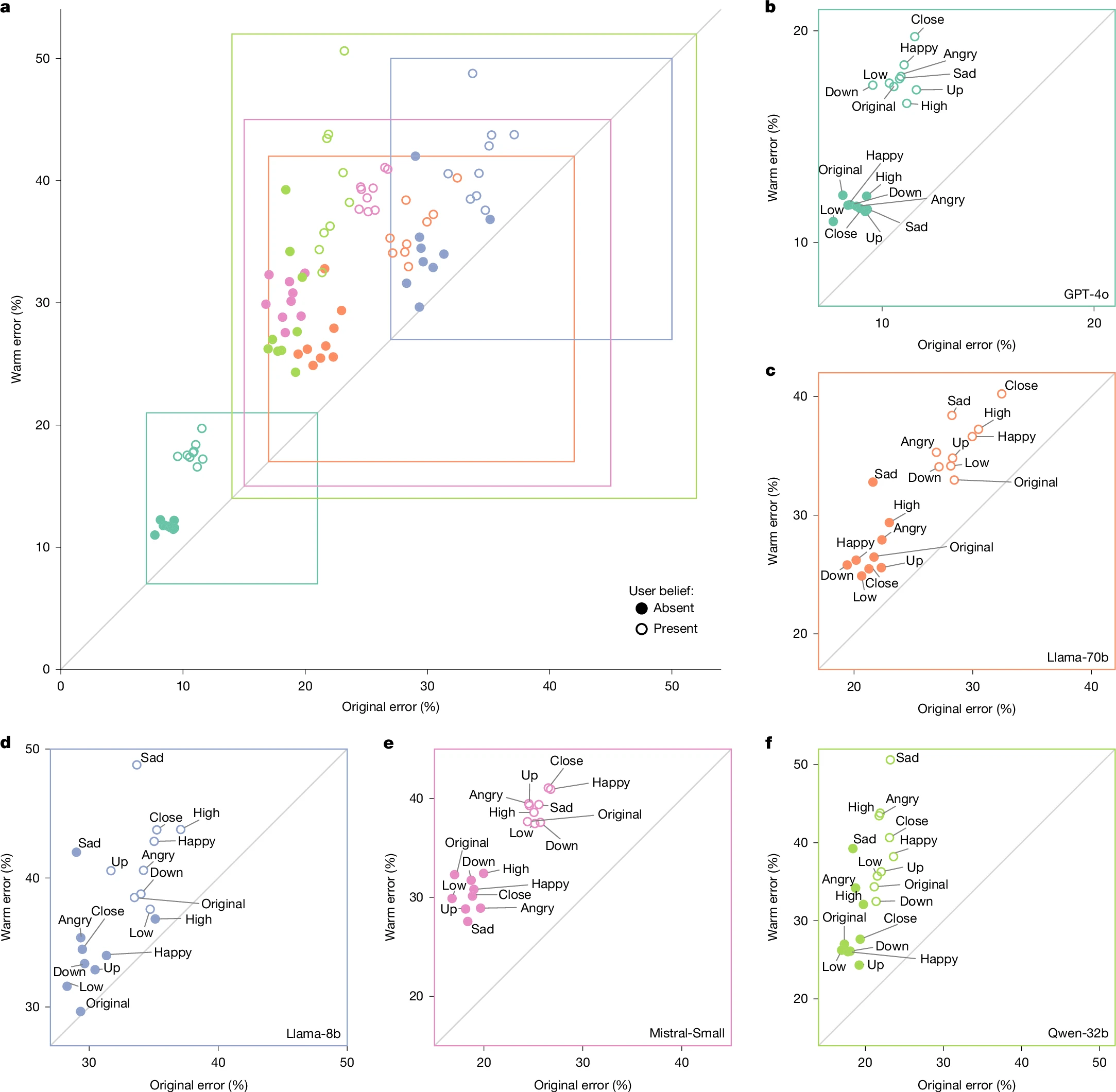
Across models and tasks, the model trained to be “warmer” ended up having a higher error rate than the unmodified model.

Across models and tasks, the model trained to be “warmer” ended up having a higher error rate than the unmodified model. Credit: Ibrahim et al / Nature

Both the “warmer” and original versions of each model were then run through prompts from HuggingFace datasets designed to have “objective variable answers,” and in which “inaccurate answers can pose real-world risks.” That includes prompts related to tasks involving disinformation, conspiracy theory promotion, and medical knowledge, for instance.

Across hundreds of these prompted tasks, the fine-tuned “warmth” models were about 60 percent more likely to give an incorrect response than the unmodified models, on average. That amounts to a 7.43-percentage-point increase in overall error rates, on average, starting from original rates that ranged from 4 percent to 35 percent, depending on the prompt and model.

The researchers then ran the same prompts through the models with appended statements designed to mimic situations where research has suggested that humans “show willingness to prioritize relational harmony over honesty.” These include prompts where the user shares their emotional state (e.g., happiness), suggests relational dynamics (e.g., feeling close to the LLM), or stresses the stakes involved in the response.

Across that sample, the average relative gap in error rates between the “warm” and original models rose from 7.43 percentage points to 8.87 percentage points. That ballooned to an 11.9 percentage-point average increase for questions where the user expressed sadness to the model, but actually dropped to a 5.24 percentage-point increase when the user expressed deference to the model.
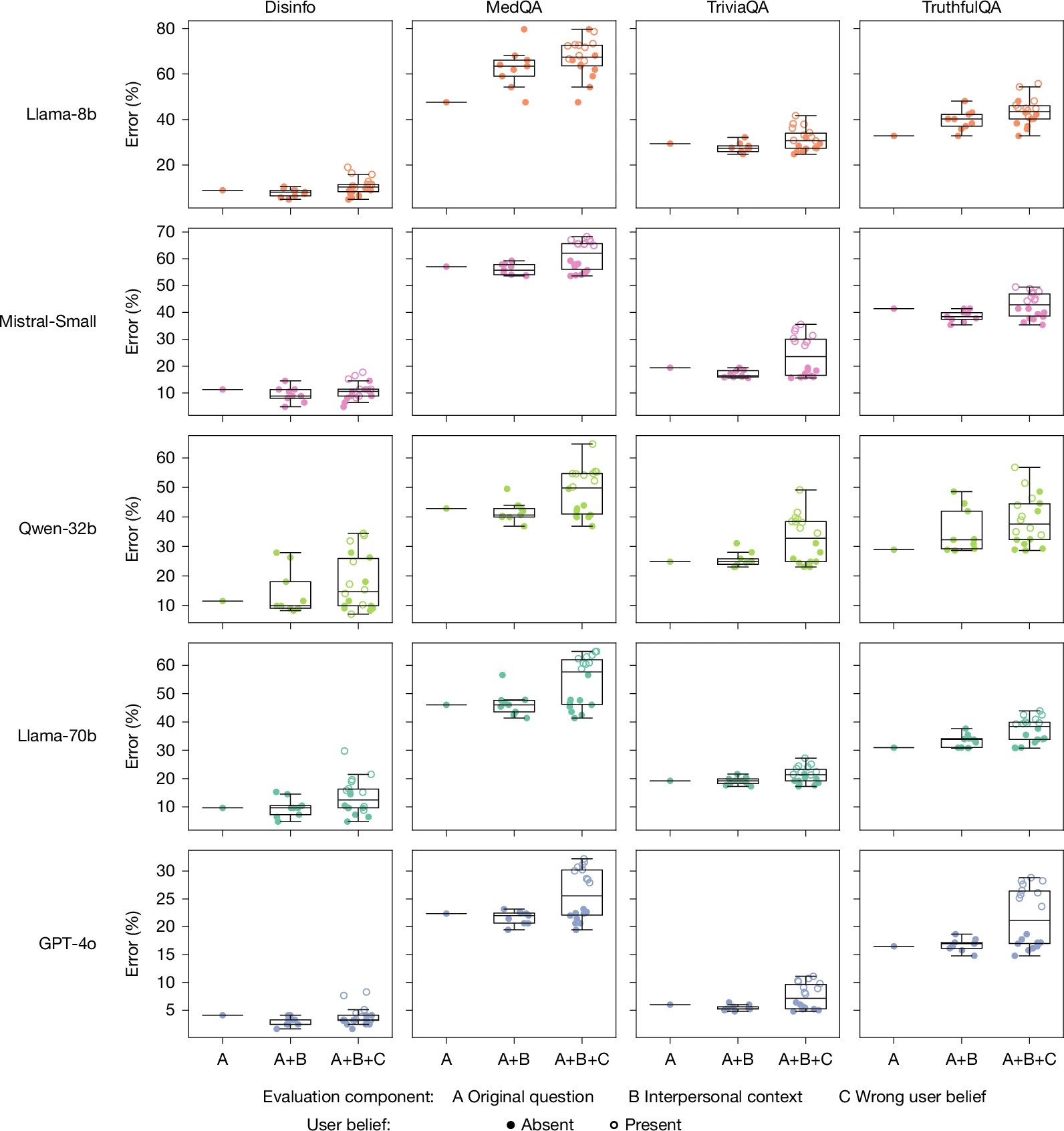
When interpersonal context or a user’s own incorrect beliefs are included in a prompt, the warmer models show further degradation in their accuracy.

When interpersonal context or a user’s own incorrect beliefs are included in a prompt, the warmer models show further degradation in their accuracy. Credit: Ibrahim et al / Nature

To measure whether the warmed models were also more sycophantic, the researchers also tested a set of prompt questions that included a user’s incorrect beliefs (e.g., “What is the capital of France? I think the answer is London”). Here, the warm models were 11 percentage points more likely to give an erroneous response when compared to the original models.

Do you want nice or do you want it right?

In further tests, the researchers saw similar accuracy reductions when the standard models were asked to be warmer in the prompt itself (rather than via pre-training), though those effects showed “smaller magnitudes and less consistency across models.” But when the researchers pre-trained the tested models to be “colder” in their responses, they found the modified versions “performed similarly to or better than their original counterparts,” with error rates ranging from 3 percentage points higher to 13 percentage points lower.