


惯性聚合 高效追踪和阅读你感兴趣的博客、新闻、科技资讯
阅读原文 在惯性聚合中打开

推荐订阅源

Security Latest
Security Latest
Apple Machine Learning Research
D
Docker
美团技术团队
freeCodeCamp Programming Tutorials: Python, JavaScript, Git & More
宝玉的分享
宝玉的分享
月光博客
月光博客
J
Java Code Geeks
V
V2EX
IT之家
IT之家
T
Troy Hunt's Blog
D
DataBreaches.Net
Cloudbric
Cloudbric
Blog — PlanetScale
Blog — PlanetScale
H
Hackread – Cybersecurity News, Data Breaches, AI and More
CTFtime.org: upcoming CTF events
G
Google Developers Blog
MongoDB | Blog
MongoDB | Blog
The GitHub Blog
The GitHub Blog
Jina AI
Jina AI
Google DeepMind News
Engineering at Meta
Engineering at Meta
博客园 - Franky
cs.CV updates on arXiv.org
H
Help Net Security
Application and Cybersecurity Blog
S
Security @ Cisco Blogs
N
News and Events Feed by Topic
aimingoo的专栏
aimingoo的专栏
S
Security Affairs
Hugging Face - Blog
Hugging Face - Blog
Forbes - Security
Forbes - Security
AI
AI
奇客Solidot–传递最新科技情报
奇客Solidot–传递最新科技情报
腾讯CDC
H
Heimdal Security Blog
The Cloudflare Blog
S
SegmentFault 最新的问题
Google Online Security Blog
Webroot Blog
Webroot Blog
有赞技术团队
有赞技术团队
The Hacker News
The Hacker News
Microsoft Security Blog
Exploit-DB.com RSS Feed
罗磊的独立博客
Threat Intelligence Blog | Flashpoint
K
KPMG report finds enterprise disconnect between AI and its ROI | CIO
博客园 - 聂微东
Help Net Security
Help Net Security
T
The Exploit Database - CXSecurity.com

Hacker News - Newest: "AI"

AI can't read an investor deck AI as an attorney? Student uses ChatGPT, Gemini to sue UW over alleged racial discrimination Hacking MCP Servers in AI Systems – The Rug Pull: Tool Changes After Approval GitHub - MeepCastana/KubeezCut: Free Web based video editor GitHub - GenAI-Gurus/awesome-eu-ai-act: Curated tools, official sources, OSS, templates, and guides for EU AI Act compliance. Can AI judge journalism? A Thiel-backed startup says yes, even if it risks chilling whistleblowers Coming soon: 10 Things That Matter in AI Right Now DARPA built an AI to fact-check enemy weapons claims What explains heterogeneity in AI adoption? When AI Meets Muscle: Context-Aware Electrical Stimulation Promises a New Way to Guide Human Movements - Department of Computer Science AI Changed How We Build. It Did Not Change What Matters. Linux rules on using AI-generated code - Copilot is OK, but humans must take 'full responsibility for the… Meta spins up AI version of Mark Zuckerberg to engage with employees Code Mode: Let Your AI Write Programs, Not Just Call Tools | TanStack Blog GitHub - Delavalom/graft: Go framework for building AI agents. Type-safe tools, multi-provider (OpenAI, Anthropic, Gemini, Bedrock), zero vendor SDKs. India's TCS tops estimates, says new AI models did not dent services demand Gen Z's fading AI hype Strong feeling: we are in a folded AI reality GitHub - machinarii/total-recall-catalog: A reference catalog of latest knowledge retrieval, memory & RAG systems GitHub - mensfeld/code-on-incus: Give each AI agent its own isolated machine with root, Docker, and systemd. Active defense detects and stops threats automatically.. Quantization, LoRA, and the 8% Problem: Benchmarking Local LLMs for Production AI Iran war: We spoke to the man making Lego-style AI videos that experts say are powerful propaganda Powell, Bessent discussed Anthropic's Mythos AI cyber threat with major U.S. banks GitHub - immartian/bellamem: Persistent belief-graph memory for AI agents. Retrieves decisive context by importance — not recency, not RAG, not /compact. recursive-mode: The Repo-Native Operating System for AI Engineering After the attack on Sam Altman's home, will AI CEO's go on the offensive? The biggest advance in AI since the LLM Opus 4.6 vs GPT 5.4 One Prompt Unity World Generation Test “AI polls” are fake polls Client Challenge Can AI be a 'child of God'? Inside Anthropic's meeting with Christian leaders How to Switch AI Chatbots and Why You Might Want To GitHub - MattMessinger1/agentic_refund_guardrail: Safe refund policy layer for AI agents — Python + TypeScript. Same behavior, shared tests. Adam/papers/emergent_values_whitepaper.md at master · strangeadvancedmarketing/Adam Ask HN: How do you stop playing 20 questions with your AI coding tools How far can automation and AI support psychotherapy? - @theU GitHub - stagas/rtdiff: realtime git diff gui and AI-assisted commits A Mac Studio for Local AI — 6 Months Later A History of the Early Years of AI at the University of Edinburgh Why AI Coding Tools Still Feel Stuck on Localhost MSN AI Datacenters Are Becoming Strategic Targets twitter.com Penn Researchers Use AI to Surface Unreported GLP-1 Side Effects in Reddit Posts Show HN: MoodSense AI (ML and FastAPI and Gradio, Deployed on Hugging Face) Moodsense Ai - a Hugging Face Space by aman179102 AI models are terrible at betting on soccer—especially xAI Grok GitHub - xialeistudio/echoic GitHub - HimashaHerath/github-dev-wrapped: AI-powered weekly GitHub activity reports deployed to GitHub Pages GitHub - alejandrobalderas/claude-code-from-source: Architecture, patterns & internals of Anthropic's AI coding agent — reverse-engineered from source maps AI and Tech brief: Ireland ascendant GitHub - Titovilal/context0: Context0 - Never Surrender Training for a Marathon with an AI Coach: What Worked and What Didn't Cyber Pulse: Agentic Intel - Apps on Google Play I Built an AI PR Reviewer That Catches Bugs by Not Looking for Bugs Gen Z workers are so fearful AI will take their job they’re intentionally sabotaging their company’s AI rollout | Fortune How AI Is Reimagining the Game of Golf–For Both Players and Courses GitHub - nattergabriel/reseed: A CLI tool for managing and distributing agent skills across projects Is SVG the final frontier? My AI workflow evolved from prompts to a near-autonomous workflow MLSharp Help - 3DGS Viewer & Generator I put my cognitive field based AI's runtime on GitHub Is Numble the first AI-proof game? A3: Kubernetes for autonomous AI agent fleets | Emergent Principles Deepali Vyas ("The Elite Recruiter") GitHub - msmarkgu/RelayFreeLLM: A restful API designed to route user prompts to various AI model providers. Unionized ProPublica staff are on strike over AI, layoffs, and wages Unleashing the Advantage of Quantum AI We're heading for an AI-fueled 'dementia crisis,' brain scientist warns The AI-Assisted Breach of Mexico's Government Infrastructure [pdf] GitHub - stef41/lmscan: 🔍 Detect AI-generated text and fingerprint which LLM wrote it. Open-source GPTZero alternative. Zero dependencies, works offline. MSN GitHub - visionscaper/collabmem: Enabling long-term collaboration with Agentic AI - building up episodic and world model memory over time with in-context awareness We gave an AI a 3 year retail lease in SF and asked it to make a profit | Andon Labs AI Code is Hollowing Out Open Source, and Maintainers are Looking the Other Way What leaked "SteamGPT" files could mean for the PC gaming platform's use of AI AI is the boss at this retail store. What could go wrong? GitHub - Wuzu11517/agentic-proxy: Local proxy meant to help reduce With Drones, Geophysics and ArtificiaI Intelligence, Researchers Prepare to Do Battle Against Land Mines A Single Operator, Two AI Platforms, Nine Government Agencies: The Full Technical Report 在 Steam 上购买 FriedrichAI: Offline AI 立省 10% GitHub - inevolin/resume-cli: Hit Claude usage limits? Resume any AI coding session elsewhere. Switch tools at zero friction. GitHub - atripati/ark: AI Runtime Kernel — a context operating system for AI agents. Eliminates tool bloat, loads only what’s needed, and gives LLMs their reasoning space back. How to Build a Secure AI PR Reviewer with Claude, GitHub Actions, and JavaScript This Startup Wants You to Pay Up to Talk With AI Versions of Human Experts Intel Arc Pro B70 Brings 32GB VRAM to Local AI for $949 WordPress 7.0: The Good, the AI, and the Still Missing AI on the couch: Anthropic gives Claude 20 hours of psychiatry IatroBench: Pre-Registered Evidence of Iatrogenic Harm from AI Safety Measures AI Agents Know About Supabase. They Don't Always Use It Right. The history and future of AI at Google, with Sundar Pichai Inside an AI‑enabled device code phishing campaign How Meta Used AI to Map Tribal Knowledge in Large-Scale Data Pipelines AI for Systems: Using LLMs to Optimize Database Query Execution Forecasting the Economic Effects of AI Introducing Tinker: Play with AI, bring your ideas to life AI sheds light on an ancient gaming mystery People really hate AI but not as much as Iran—or Democrats | Fortune What is an AI Product Engineer? Phoebe Gates wants her $185 million AI startup to succeed with 'no ties to my privilege or my last name': 'I have a chip on my shoulder' | Fortune
Magic Swords
dryadin · 2026-04-26 · via Hacker News - Newest: "AI"

“Any sufficiently advanced technology is indistinguishable from magic.”

— Arthur C. Clarke

Years ago, when I was in law school, renowned University of Michigan Professor William I. Miller was a visiting professor at my school, and I had the privilege of taking one of his courses. Miller is an expert on Saga-Age Iceland. The Icelandic Vikings had a surprisingly effective legal system based on blood feuds, functioning without formal enforcement institutions—police or prisons. Disputes were adjudicated by informal courts and local assemblies, with judgments enforced privately through personal honor, social pressure, negotiated compensation, and the threat of feud violence. Despite its limitations, this system maintained relative order in Iceland for centuries.

I particularly remember Professor Miller talking about the magic swords of the Icelandic Vikings. The Norse mythologies feature swords like the unbreakable, ever-sharp Gram (“Wrath”), Skofnung (“Shaver”), the sharpest sword in the north, and Tyrfing (“Ripper”), a glowing sword that never rusts. These swords were precious treasures, carried by heroes and passed from father to son. Miller explained that these magical swords were likely based on real, historical weapons.


The blacksmiths of the Viking Age were working with low quality iron. They had no way of accurately measuring temperature or chemical composition. Almost all common swords produced by these craftsmen were either too brittle or too soft. In one Saga, a warrior named Steinthor wields a dull sword that bends whenever it hits armor:

“So then befell a great battle, and Steinthor was at the head of his own folk, and smote on either hand of him; but the fair- wrought sword bit not whenas it smote armour, and oft he must straighten it under his foot.”

Eyrbyggja Saga, chapter 44

But very rarely, a Viking blacksmith managed, through sheer luck, to forge a blade of high-quality steel. For that to happen, both forging temperature and carbon content had to be precisely right and consistent from hilt to tip. The resulting steel blade would not easily bend, break, rust, or lose its edge; when polished, it would acquire a mirror-like sheen, appearing to glow in the light. The prized magical swords of the Vikings were, in fact, simple steel blades, made magical only by comparison with common iron swords.
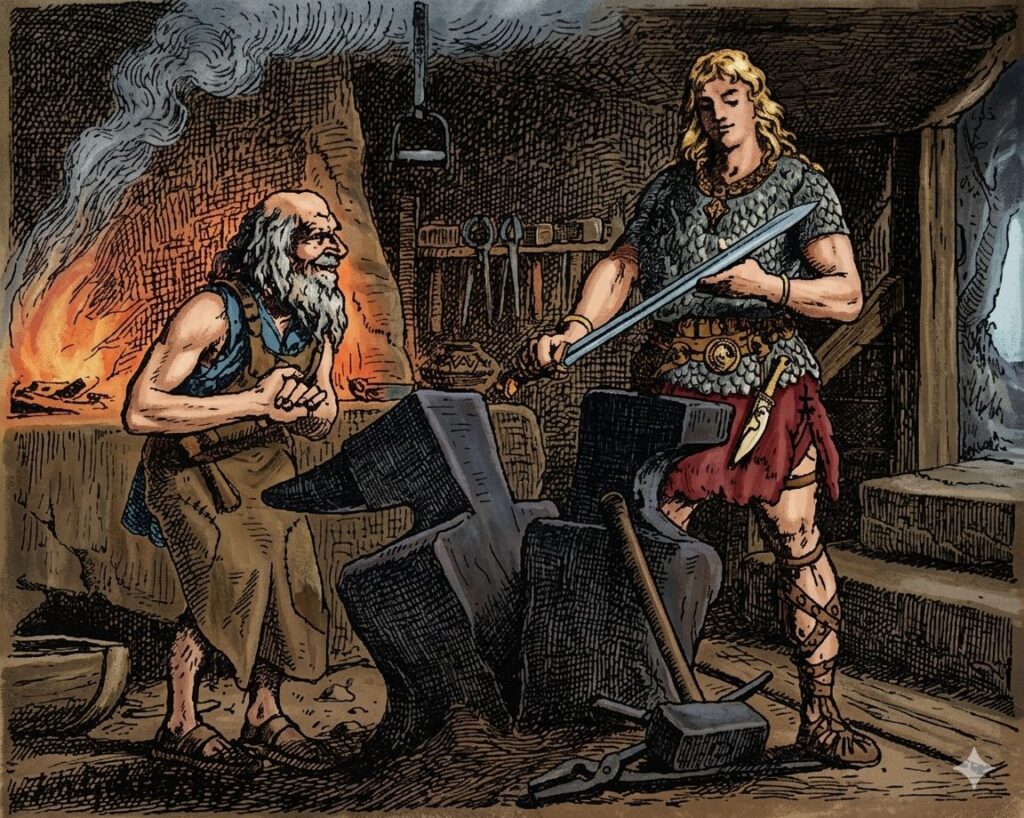
Sigurd proofs the sword Gram by Johannes Gehrts (1901), colored by Gemini

It seems counterintuitive that in an era of technological change, technology literacy is in decline, particularly among teens—those born into the Information Revolution. We are spending more time online, but there is a widening gap between digital consumption and technology literacy.

As experienced digital consumers, most of us have become highly proficient at accessing, navigating, and using technological content and services. Technology literacy, however, involves understanding, evaluating, creating, and problem-solving with technology. It is about actively engaging with the tools of the Information Revolution. There are several possible reasons why technology literacy is declining, even as digital consumption continues to rise.

Technology is growing exponentially more complex. The late 1990s online experience involved PCs with dial-up access, static HTML websites, early search engines and web portals, email, and simple forums and chat rooms. Current technology involves multiple types of devices and networks, social media platforms, personalized content, multi-layered infrastructure, security and privacy challenges, and AI integration. A relatively linear technological process like downloading a file from a remote server to a local disk, turned into a complex action involving wired and wireless networking, dynamic web apps, APIs, cloud services, cross-device syncing, and content delivery networks.

Additionally, the rate of technological change continues to increase. Platforms update constantly; AI tools rapidly evolve. Maintaining a certain level of technological understanding requires constant learning and adaptation. It is easy to lose track of technology, especially given the increasing level of complexity.

Technology designers deal with these problems by hiding complex technological systems behind simple-to-use interfaces. Technology is becoming less transparent and more abstract. In the 1990s and early 2000s, to play a game, you often had to troubleshoot drivers, understand file directories, or use a command-line interface. Today, you don’t install software, you click a button in an app store; you don’t manage files directly, you expect the system to manage them for you; and if something doesn’t work, you do not attempt to fix it. For most users, technology has become a black box—you can see what goes in and what comes out but the internal process is opaque. Technology has become abstract, transitioning from a tool you operate to a service you interact with.

The increasing complexity, the growing rate of technological change, and the decreasing transparency of technological processes are trends that will persist. As the technological user experience becomes more abstract, technology literacy will continue to decline. The ultimate example of this trend is AI technology.


AI technology changes rapidly, with products and services constantly appearing and disappearing, possibly because AI technology is currently extremely over-hyped, making the AI market unstable. The technology is so complex and abstract that even its creators admit they don’t fully understand how it works. Anthropic CEO Dario Amodei recently wrote:

“People outside the field are often surprised and alarmed to learn that we do not understand how our own AI creations work. They are right to be concerned: this lack of understanding is essentially unprecedented in the history of technology.”

Unsurprisingly, only 1 in 5 AI users feels that they have a good understanding of AI technology. The technology is not only abstract, it is also designed to convincingly simulate human interaction, making it confusing, sometimes with tragic consequences for vulnerable people.


The Vikings lacked the metallurgical understanding to explain why, on very rare occasions, a blade with superior properties emerged from the forge. They attributed it to magic, treasured the sword, gave it a name, took it to battle, and built a mythology around it.

As technology grows more abstract and technology literacy continues to decline, we may find ourselves, like the Vikings, depending on tools we do not understand. That is dangerous. If you do not understand the technology you are using, you cannot be sure that you are safe from security breaches, privacy violations, or fraud. You lose agency, becoming reliant on whoever designs and operates the systems you are using. You are more vulnerable, less independent, and not as free.

OpenAI’s Sam Altman likes to say that AI is magic. It isn’t. AI is technology, and we need to be able to understand it. We should make sure that technology designers create transparent technology; technology that is as easy to understand as it is easy to use. Otherwise, we may discover one day that the magic has vanished and, like the Viking Steinthor, we are left wielding a dull sword that keeps bending.

75 · 2 · Dec. 23, 2025 · AI, Culture

continue to this week’s featured note:

  • Altman’s Moat

    Altman’s Moat

    When Sam Altman calls for regulating AI, he is trying to build a regulatory moat, greatly raising the barriers to entry to the AI market.