





Pick any random Tuesday from three years ago.
You almost certainly cannot recall it. What you ate. Who you spoke to. What annoyed you on the way home. All gone.
And yet you still know your name. Your way home. The faces of the people you love. What you believe.
All of that was shaped by days just like that forgotten Tuesday.
The day is gone. What it taught you is not.
Your brain performs this trick constantly. It turns ordinary experience into the things that guide you later. You do not remember most of your days, but you are changed by them.
AI agents cannot do this yet.
They can use context. They can retrieve files. They can follow instructions across long workflows. But they do not reliably turn experience into lasting understanding. They do not wake up tomorrow meaningfully changed by what happened today.
This is the missing piece Demis Hassabis keeps coming back to.
Hassabis is very well placed to see the problem. He runs Google DeepMind, the AI lab behind AlphaGo, AlphaFold, and Gemini. But before he was building artificial intelligence, he was studying biological intelligence. His PhD focused on the hippocampus, the part of the brain deeply involved in memory.
Recently, Garry Tan, the CEO of Y Combinator, sat down with him to talk about agents: where they stand, what they can already do, and what still prevents them from becoming truly useful over long horizons. Hassabis was direct:
“Not having continual learning currently is one of the things holding back agents from doing full tasks. They’re really useful for aspects of tasks right now and you can patch them together and do some really cool things, but they don’t adapt well with the context that you’re in. And I think that’s the missing piece.”
Until that changes, AI agents will remain something strange and limited: systems that can act intelligently for a while, but cannot yet learn the way intelligence requires.
To see why this is so hard, look at what your brain was doing on all those Tuesdays you forgot.
What we call memory is not one thing. It runs on two systems with different speeds, and the trick of intelligence lives in how they cooperate.
The hippocampus, a small seahorse-shaped structure buried deep in the brain, learns fast. It can bind a single moment together in one shot: the geography classroom, the map of France, the teacher pointing at Paris, your boredom in the third row. One experience becomes one memory. Its traces are fragile, but it captures them immediately.
The neocortex, the wrinkled outer surface of the brain, learns slowly. It does not need to preserve any particular classroom. Across many lessons, maps, conversations, and trips, it extracts the general shape of things: France is a country, Paris is its capital, capitals are important cities. It needs many exposures. But once the knowledge settles, it is stable.
The remarkable part is what happens between them.
During sleep, the hippocampus reactivates patterns from recent experience. In simplified terms, it replays parts of the day to the neocortex, which absorbs what matters, connects it to what is already there, and updates your larger understanding of the world without having to relive every moment.
This is how the brain turns the days you forget into the knowledge you keep. Most episodes do not survive, but the pattern inside them does. After a year at a job, you understand the job even if you cannot reconstruct any single Tuesday at your desk. The workdays were the raw material. The understanding is what your brain distilled from them.
This is where the story returns to Hassabis.
Before DeepMind became known for AlphaGo and AlphaFold, Hassabis was studying the hippocampus: how the brain constructs scenes, recalls episodes, and binds experience into coherent memories.
One of the first techniques that put DeepMind on the map carried an echo of the same idea. Their 2013 Atari system combined deep neural networks with experience replay, a technique introduced by Long-Ji Lin in 1992. Instead of learning only from the latest moment in the game, the agent stored past interactions and trained on them again later. Replay made each experience more useful, and learning more stable. It was not human memory, but the resemblance was not accidental: a trick already working in the brain became a machine-learning standard.
The insight underneath both is the same. Intelligence does not just need experience. It needs a way to return to experience, extract what matters, and learn from it without destroying what it already knows.
Now look at AI agents today.
In a loose sense, they have something like a slow store: the weights of the model. That is where general knowledge sits, distributed across billions of parameters. But those weights were trained before you ever opened the product. When you use the agent, they are mostly frozen.
What is missing is the loop.
There is no fast memory system that captures today’s conversation as a specific episode, then feeds the important parts back into the slow store later. There is no equivalent of sleep. No replay. No consolidation.
What gets called “memory” in today’s products is something else entirely. It is a set of notes stored on the side, retrieved when relevant, and dropped back into the conversation. The notes sit beside the model. They never become part of it. The model that reads those notes today will still need to read them tomorrow.
And those notes get dropped into the same place everything else lives: the context window. The context window is the model’s working memory, what it can hold in mind during a single conversation. It is not what it remembers across conversations. Every few months an AI lab announces a bigger one and frames it as a leap forward in memory. It is not.
A million tokens of capacity is also not a million tokens of attention. Researchers have a name for what happens to information sitting deep in a long context: “lost in the middle.” Models lean on what sits at the beginning and the end, and miss what is buried between.
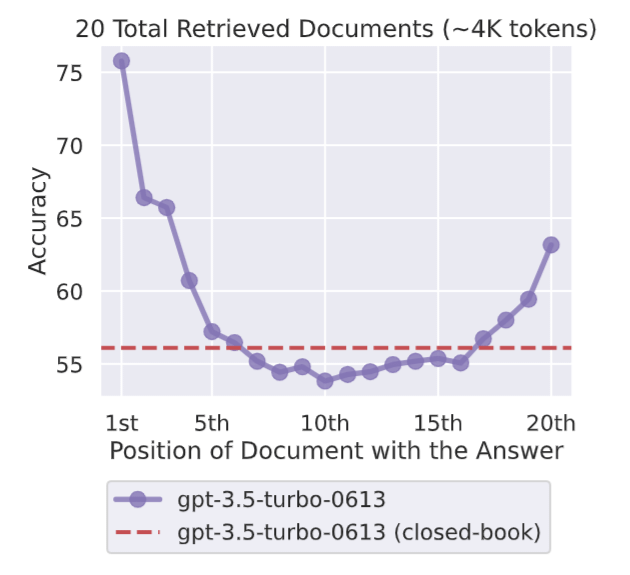
Stuffing more into working memory is not the same as learning.
This is the shape of anterograde amnesia. The system can operate in the present, but it cannot form lasting new memories from what just happened. When information falls out, it does not fall out because it was unimportant. It falls out because the window ran out of space, or because attention drifted past it. Repetition strengthens nothing. Absence weakens nothing. The system has no durable way to tell the difference between a fact the world keeps confirming and a fact it heard once.
This is why the agent you use does not become a coworker. It can be given more notes about you, propped up by workarounds, but it cannot be reshaped by you. Hand it the same project on Monday and again on Friday, and the Friday version is not smarter for what happened in between. Whatever ground you covered must be recovered, retrieved, or explained all over again.
The agent does not return. A stranger with the same name does.
For a long time, the bet was that scale would be enough. Bigger models, longer context windows, more data on the way in. The ability to be reshaped by experience was treated as a byproduct, something that would fall out on its own once the rest got big enough.
It did not. The models grew. The amnesia stayed.
So the question is shifting. Not how to give a model more to read in a single sitting, but how to let it be changed by what it reads. Not how to widen the window, but how to build something on the other side of it. A place where today’s conversation can leave a trace that tomorrow’s version actually carries.
Hassabis puts AGI around 2030 and gives roughly even odds that one or two more major ideas are still needed beyond scaling. Memory is firmly on his shortlist, and he is not alone. The people closest to the frontier have stopped treating this as a feature to bolt on and started treating it as a missing piece of the architecture.
What is striking is where the search is leading. Engineering is being pushed toward the same shape neuroscience has been describing for decades, because the constraint is the same one biology has always had to solve. Any learner that has to handle a changing world without erasing what it already knows runs into the same trade-off: plasticity versus stability. It needs to change, but not too much. It needs to remember, but not everything. Whether the learner is made of neurons or silicon, the problem is identical, and the shape of any solution will be too.
Brains found a way through. That is the strongest reason to think machines eventually will.

The first piece in this series ended with Leonard, the protagonist of Memento, reading his tattoos in the mirror.
The tattoos were never the goal. Leonard’s tragedy is not that his ink is imperfect. It is that the ink is outside him. A self that lives in writing on skin is no self at all. Real memory is the slow rewiring of the one who lives the life.
Right now, every agent on the market is Leonard. The notes get longer. The windows stretch. The writing stays outside.
The day a system can rewire itself the way a sleeping brain does, the metaphor breaks.
And the conversation we are having about agents becomes a different one entirely.
Further reading
Endel Tulving, “Episodic and Semantic Memory” (1972). The original distinction, still the cleanest place to start.
Long-Ji Lin, "Self-improving reactive agents based on reinforcement learning, planning and teaching" (Machine Learning, 1992). The original proposal of experience replay, two decades before deep learning made it famous.
James L. McClelland, Bruce L. McNaughton, and Randall C. O’Reilly, “Why there are complementary learning systems in the hippocampus and neocortex” (Psychological Review, 1995). The canonical theoretical account of why brains need two memory systems and how they cooperate.
Dharshan Kumaran, Demis Hassabis, and James L. McClelland, “What Learning Systems Do Intelligent Agents Need? Complementary Learning Systems Theory Updated” (Trends in Cognitive Sciences, 2016). The modern revisit, with explicit links to AI. Hassabis’s own clearest written statement of the architecture this essay is about.
Volodymyr Mnih et al., “Human-level control through deep reinforcement learning” (Nature, 2015). The DQN paper. Where Lin's experience replay was paired with deep neural networks and became a deep learning standard.
Susanne Diekelmann and Jan Born, “The memory function of sleep” (Nature Reviews Neuroscience, 2010). The standard reference on how sleep consolidates memory.
Robert Stickgold, “Sleep-dependent memory consolidation” (Nature, 2005). Accessible companion to Diekelmann and Born, shorter and good as a first read.
Erik Hoel, “The overfitted brain: Dreams evolved to assist generalization” (Patterns, 2021). An accessible and provocative angle on what dreams are computationally for.
German I. Parisi, Ronald Kemker, Jose L. Part, Christopher Kanan, and Stefan Wermter, “Continual Lifelong Learning with Neural Networks: A Review” (Neural Networks, 2019). The state of the field on the AI side. What’s been tried, what works, what still doesn’t.
Demis Hassabis, “Agents, AGI & The Next Big Scientific Breakthrough” (Y Combinator, 2026). The interview quoted throughout this essay.