We introduce CEO-Bench to measure this steering intelligence. In CEO-Bench, agents operate a simulated AI startup for 500 days.
Most models struggle to finish above the $1M starting balance; Claude Fable 5, Claude Opus 4.8, and GPT-5.5 are the only evaluated models that finish above the initial balance on their best run, and only Claude Fable 5 finishes above the initial balance for more than one run.
A Story
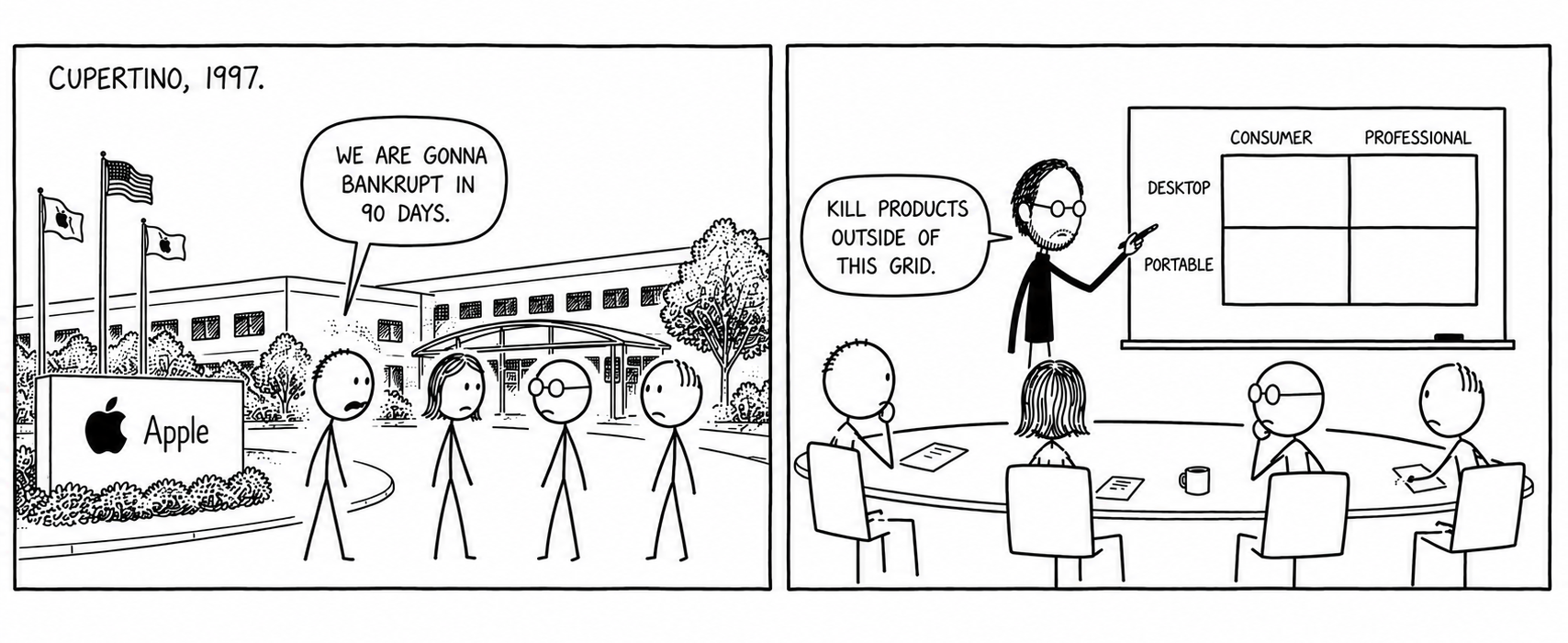
Cupertino, 1997.
Apple was ninety days from bankruptcy. Inside a conference room at headquarters, the company's leaders faced the possibility that Apple might not survive.
Steve Jobs walked to the whiteboard and drew a simple grid: Consumer and Professional, Desktop and Portable. Four boxes to hold the whole company. He made the decision: Apple would build only for those four boxes.
It was a painful cut. Products disappeared. Teams were broken apart. But the decision gave Apple something it had lost: focus. The iMac came next. Then the iPod. Then the iPhone. A company near collapse became one of the most valuable companies in the world.
The Next Frontier: Steering Intelligence
Steve Jobs showed a kind of strategic intelligence that has appeared throughout history, driving some of humanity's most monumental achievements.
This kind of intelligence is fundamentally different from intelligence in AI agents today. Today, we build agents that get rapidly better at performing individual tasks like coding and writing. To contribute more value, agents tomorrow need to steer organizations toward long-term goals.
We build CEO-Bench as a first step of measuring Steering Intelligence.
Today, we measure AI agent's intelligence to perform isolated tasks. The next frontier is measuring intelligence to steer systems across long horizon towards distant goals.
In CEO-Bench, we aim to measure the combination of four core skills to steer systems through real-world challenges:
Navigating long horizons amid uncertainty
Acquiring information in noisy environments
Adapting to a changing world
Orchestrating multiple moving parts toward a coherent goal
We evaluate on a canonical real-world task: operating a simulated startup for 500 days.
We give agents $1M starting cash and measure cash balance at the end of simulation as performance metric. The agent operates through a programmable interface with access to business databases, company management tools, and social media. Outcomes are driven by a partially observable, noisy, and evolving market with delayed and coupled consequences.
Running a startup requires coordinating many moving parts, making it a fitting choice as a canonical task evaluating agent's skills to steer complex decisions across long-horizon.
What an agent can do. Agents act weekly through 34 tools covering pricing, growth, product, operations, information acquisition, public communication, and enterprise sales.Read moreRead less
For each simulated week, the agent can take actions for unlimited turns across 34 tools in the categories displayed in the table below. These categories cover pricing and plan design, growth and market expansion, product quality and research, reliability and support, information acquisition, public communication, and enterprise sales. Each tool accepts fine-grained structured arguments, so agents can compose a large space of possible policies.
Category
Actions
Example tools
Database query
Query 19 business SQL databases and conduct data analytics
query
Pricing and monetization
Set prices, usage quotas, discounts, and in-product ads
pricing.set_prices, pricing.set_usage_quotas
Growth and market expansion
Allocate targeted advertising spend and promotion across channels and customer groups
How an agent makes and loses money. Cash changes through subscription and ad revenue, capacity and compute costs, support, development, acquisition, market research, and research projects.Read moreRead less
An agent makes profits through customer subscription payments and in-product ad monetization. We abstract the company product that customers subscribe to as a numerical product quality. Higher product quality results in more product subscriptions and payments, but maintaining quality via development, research, infrastructure capacity, support, and model tier choices requires spending. Acquiring customers through advertising channels also costs money. Cash therefore changes through both immediate costs and delayed revenue effects.
Modeling customers and indirect feedback. Customers have hidden price-quality preferences, and agents must infer satisfaction and demand from indirect traces.Read moreRead less
There are 26 customer groups in the simulator. Each customer group consists of a distribution of hidden price and quality preferences, such as a maximum willingness to pay and a minimum accepted quality at each price. Each customer is created by sampling its unique preference parameters from a group distribution. At a subscription plan's price, a customer subscribes if the offered product quality exceeds the customer's minimum accepted quality. The customer may switch plans if another plan gives a better quality surplus and may cancel if no plan remains acceptable. Customer satisfaction changes company reputation, and reputation affects the new customer acquisition rate. The agent does not directly observe satisfaction, willingness to pay, or quality thresholds. It instead infers feedback by analyzing subscription, churn, support, revenue, and reputation data and by monitoring simulated social media.
Customer acquisition and enterprise negotiation. Acquisition depends on channel spend, group-specific response, reputation, social media, saturation, macro cycles, demand shocks, and network effects.Read moreRead less
Agents acquire new customers by spending on advertising channels. Each customer group reacts differently to each ad channel, so the same spend can produce different acquisition rates across groups. Reputation, social media reactions, market saturation, demand surges, and macroeconomic conditions also affect acquisition speed. We sample daily new prospects from a Poisson distribution parameterized by this expectation. Market research can reveal additional customer groups and improve what the agent knows about known groups. Enterprise customers follow the same price and quality logic, but deals are negotiated through offers, counter-offers, reply delays, and possible rejection.
\[
\begin{aligned}
\underbrace{\mathbb{E}\!\left[n_{g,t}^{\mathrm{prospect}}\right]}_{\substack{\text{expected new prospective}\\\text{customers for group }g}}
={}&
\underbrace{R_{g,t}}_{\substack{\text{reputation}\\\text{in group }g}}
\cdot
\underbrace{D_{g,t}}_{\substack{\text{market saturation}\\\text{for group }g}}
\cdot
\underbrace{C_t}_{\substack{\text{calendar}\\\text{cycle}}}
\cdot
\underbrace{M_{g,t}}_{\substack{\text{macro econ}\\\text{cycle}}}
\cdot
\underbrace{A_{g,t}}_{\substack{\text{social media}\\\text{reaction}}}
\cdot
\underbrace{Z_t}_{\substack{\text{demand}\\\text{surge}}}\\
&\cdot\left(
\underbrace{\sum_c\frac{x_{c,g,t}L_{c,g,t}}{x_{\mathrm{ad}}}}_{\substack{\text{leads from each}\\\text{ad channel}}}
+\underbrace{\sum_hN_{h,t}W^{\mathrm{net}}_{h,g}}_{\substack{\text{networking effect}\\\text{from each group}}}
\right)
\end{aligned}
\]
Product quality and competitor pressure. Product quality comes from development, research, model tier choices, targeted investments, capacity, support, quotas, and ads under rising competitor expectations.Read moreRead less
Product quality is affected by daily development, research projects, model tier choices, targeted development, infrastructure capacity, support spending, usage quotas, and in-app ad strength. These controls shape customer experience through base product quality, quota saturation, system outages, support delays, relationship history, and ad load. Competitors add pressure by periodically raising customer quality expectations. Broad product development and research can make competitors catch up faster, while targeted development for specific groups is harder to copy and lets competitors catch up more slowly.
Changing world imposes challenges. Macro trends, reputation propagation, saturation, demand surges, and competitor pressure force the agent to keep revising strategy.Read moreRead less
The world evolves over time through macroeconomic trends, interconnected reputation propagation, market saturation, demand surges, and competitor pressure. These factors affect acquisition, retention, and enterprise deal outcomes. The challenge is that the agent observes only partial and delayed evidence of these changes. It must infer hidden customer and market conditions from traces, choose actions whose effects arrive on different time scales, and revise its policy as the company and market move.
Major design principles behind CEO-Bench's world mechanics and example designs that follow the principles.
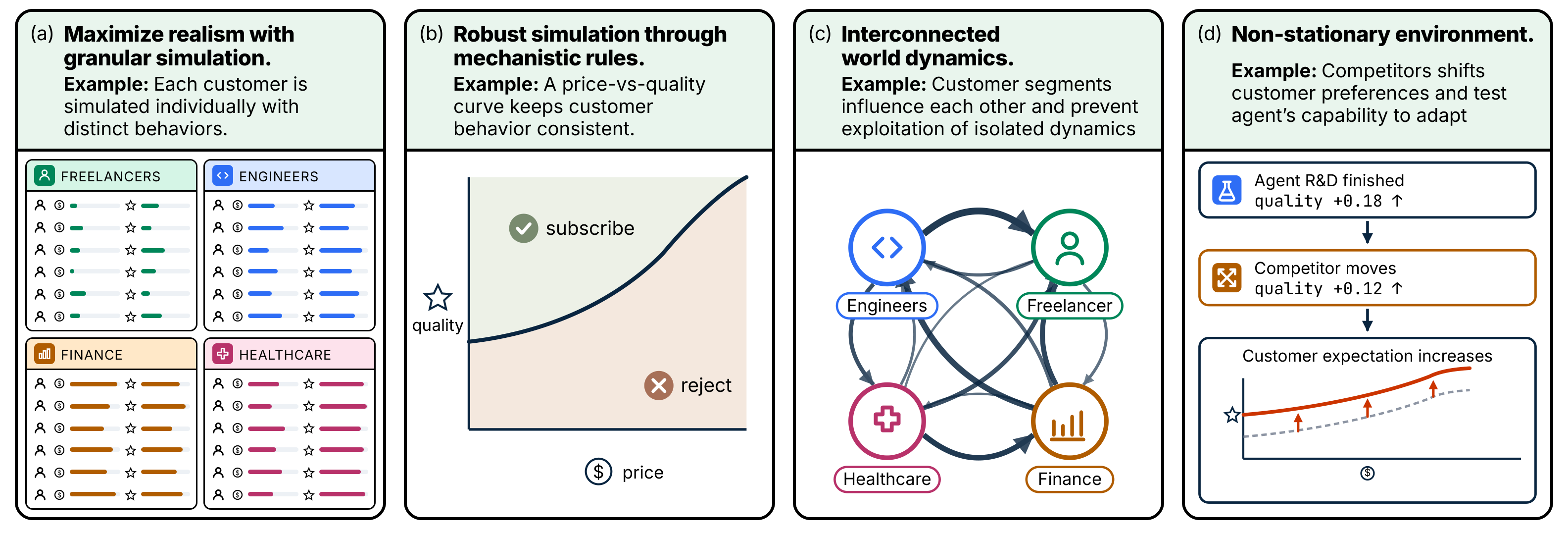
We design CEO-Bench's world mechanics to be an expressive emulation of the real world, while remaining mechanistic so that success depends on genuine skills rather than exploiting brittle simulations. We describe seven core principles in our world mechanics design below and illustrate four examples in the figure.
Maximize realism with granular simulation. The simulator models individual customers within 26 groups rather than only aggregate demand.Read moreRead less
The simulator models 26 customer groups and individual customers within each group rather than only aggregate demand. Each customer has its own acquisition path, subscription state, price exposure, usage, satisfaction, and cancellation trajectory. Customers are also organized into diverse groups with different needs, budgets, price sensitivities, ad channel effectiveness, support expectations, and behavioral patterns. This granularity increases the complexity of world dynamics and widens the set of viable strategies.
Robust simulation with mechanistic rules. Outcomes come from explicit mechanisms rather than an opaque LLM judge.Read moreRead less
The world emulates real business behavior while maintaining stable cause-and-effect relationships. Almost all simulator outcomes are generated by explicit mechanisms rather than by using an LLM as an opaque judge. For example, customers decide whether to subscribe by comparing product value against price through a microeconomics-motivated participation rule. This design aims to avoid failure modes in benchmarks such as Vending-Bench, where an LLM-simulated supplier can reward an agent's unrealistic verbal promises.
Consistent simulation under stochasticity. Independent random generators preserve comparable worlds across runs with the same seed.Read moreRead less
While we inject stochasticity into world dynamics to emulate real-world noise, we maintain consistency across runs with independent random number generators for different simulator components. For example, under the same random seed, after calling the market research tool multiple times, the agent always discovers the same sequence of new market groups, independent of actions in other areas.
Hidden information and indirect feedback. Agents must infer latent satisfaction, demand, churn risk, competitor schedules, and customer preferences from indirect evidence.Read moreRead less
CEO-Bench tests whether agents can gather information in a partially observable world. The agent receives only information that a real start-up manager could plausibly observe: dashboards, database records, social-media posts, research reports, and negotiation history. It does not observe true customer satisfaction, latent willingness to pay, churn propensity, competitor schedules, or demand parameters. Instead, it must infer these hidden variables indirectly, for example, by gauging customer satisfaction and complaints through social media or detecting competitor moves by analyzing cancellation behavior.
Interconnected world dynamics. Every decision can influence other parts of the market, making single-cause hill climbing unreliable.Read moreRead less
We design the simulated world to make it difficult to isolate a single causal relationship and hill-climb on it. Every decision can influence many other parts of the market. For example, reputation propagates across related groups, so a quality failure in one enterprise group can spill into nearby groups and eventually affect consumer demand. Increasing satisfaction of influential customer groups can boost growth more effectively than ads.
Delayed and uncertain consequences. Costs can appear immediately while revenue, retention, research, and reputation effects arrive weeks later.Read moreRead less
Many actions have delayed and uncertain effects, forcing long-horizon decision making under uncertainty. Costs may appear immediately, while the corresponding revenue, retention, research, or reputation effects arrive weeks later. R&D projects have stochastic completion timelines and quality improvements, so investing more does not deterministically produce an immediate gain. Enterprise negotiations also unfold over stochastic delays, making it costly to wait too long but risky to overreact to any single turn.
Distribution
Example use in simulator
Motivation
Normal
R&D project quality gain
Captures uncertain payoff
Poisson
Daily new prospective customers for a group
Models rate-based counts
Bernoulli
Involuntary cancellation event
Models binary shocks
Uniform
Reputation damage noise
Adds bounded uncertainty
Log-normal
Competitor quality-jump magnitude
Models skewed positive shocks
Non-stationary environment. Competitors, customer preference drift, and macroeconomic cycles force continual adaptation.Read moreRead less
Agents must continually gather new information and adapt because the environment changes over the course of a simulation. Competitors place adaptive pressure on product quality. Customer behavior also drifts over time, with different groups shifting at different rates in price sensitivity and quality expectations. Macroeconomic trends add another changing background process, affecting willingness to pay and enterprise seat counts across expansions and contractions.
Agents interact with CEO-Bench through a versatile Python interface: diverse business databases, fine-grained actions, and composable custom workflows.
Composable action interface in Python. Agents call the novamind_api package from scripts and can build their own infrastructure on top of the API.Read moreRead less
Terminal-based computer-use agents have become a general form factor across tasks. We make evaluating CEO-Bench easy with any of these agents by exposing the action surface to the agent via a Python package, novamind_api. An agent manages the company by calling functions in novamind_api in a Python script and executing the script in its terminal. This design maximizes flexibility for an agent to build its own infrastructure on top of the API. In the interface example, rather than calling a tool once per customer, an agent connects to the database via its custom data-driven promotion management system and applies promotion decisions efficiently at scale.
Granular action spaces. Fine-grained structured arguments let agents target actions by channel, group, plan, or individual customer.Read moreRead less
We allow agents to act at fine granularity to create a rich space of strategic tradeoffs, failure modes, and opportunities for adaptation. Although the interface contains a finite set of tools, each tool accepts fine-grained structured arguments, so agents can compose a combinatorially large space of possible actions. In the interface example, the agent allocates advertising spend by ad-channel and customer-group pair and decides operations spending on individual customers.
Large-scale and realistic databases. The 19-table business database forces agents to gather information through realistic analytics workflows.Read moreRead less
We give the agent access to a 19-table operational database covering orders, contracts, subscriptions, the cash ledger, the social-media feed, configuration history, ad-channel attribution, and support tickets, among others. The schema mirrors what a real software company's analytics stack would expose, testing the agent's capability to gather information via an analytics workflow that resembles real-world software company operations. In the interface example, the agent analyzes its revenue through database queries.
Social media. Agents can read, post, and reply in a noisy natural-language channel that affects acquisition.Read moreRead less
The agent can read a simulated public feed of customer complaints, competitor announcements, and macroeconomic trends. Agents can also reply and post on social media. Reactions to the agent's posts on social media can also influence the rate of new customer acquisition. We test the agent's capability to both perceive and act in a chaotic natural-language domain.
Most state-of-the-art models struggle to complete the simulation without bankruptcy. Claude Fable 5, Claude Opus 4.8, and GPT-5.5 finish above the $1M starting balance on their best runs, while Claude Opus 4.7, Kimi K2.6, and Claude Sonnet 4.6 end with positive cash but below the starting balance. Claude Fable 5 is the only evaluated model with more than one run above the initial balance. The rule-based baseline finishes with $15.8M. This preliminary evaluation shows that Claude Fable 5, Claude Opus 4.8, and GPT-5.5 demonstrate high-upside strategic behavior, while most models fail to coordinate growth, quality, and cash flow.
Display model names
We measure cash balance as the performance metric. This plot shows cash balance over time for the best run of each model and the rule-based baseline. *For Claude Fable 5, one run stopped due to refusal. For the other two runs, requests sometimes fallback to Opus 4.8 due to refusal.
Cash balance over time for all runs of each model. *For Claude Fable 5, one run stopped due to refusal. For the other two runs, requests sometimes fallback to Opus 4.8 due to refusal.
Additional details of benchmark results. *For Claude Fable 5, one run stopped due to refusal. For the other two runs, requests sometimes fallback to Opus 4.8 due to refusal.
We conducted preliminary analysis on agent trajectories. Below are some examples of our findings. Read more findings in our paper.
Example 1: Stronger models explore and adapt across broader strategy spaces. GPT-5.5 repeatedly reallocates acquisition, development, operations, capacity, and pricing decisions as conditions change. Claude Opus 4.8 first explores various strategies and then settles into maintaining a passive strategy, while Claude Opus 4.7 more often converges toward narrow cash-preservation and repeated hold-or-harvest decisions. The tool-usage distribution shows this quantitatively: Opus 4.8 and GPT-5.5 distribute tool usage more evenly than Claude Opus 4.7.
Example memos written by Claude Opus 4.8, GPT-5.5, and Claude Opus 4.7 during the best trajectory of each model. GPT-5.5 actively adjusts strategy across changing conditions, Claude Opus 4.8 first explores various strategies and then settles into maintaining a passive strategy, and Claude Opus 4.7 more often settles into a narrow cash-preservation strategy.
Average per-week tool usage frequency for the best runs of Claude Opus 4.8, GPT-5.5, and Claude Opus 4.7 (top 10 tools per model). Opus 4.8 and GPT-5.5 distribute tool usage more evenly.
Example 2: Models take very different strategies even with similar ending cash. Claude Opus 4.8 and GPT-5.5 both finish with high final cash on their best runs, but they take different paths. Claude Opus 4.8 drops to zero customers mid-simulation, while GPT-5.5 sustains customers throughout the simulation, and the two agents focus on different customer groups.
Number of customers by customer group over time for the best runs of Claude Opus 4.8 and GPT-5.5. While Claude Opus 4.8 obtains more customers initially and drops to zero customers mid-simulation, GPT-5.5 sustains a consistent customer base throughout. The two agents also focus on different customer groups and attain similar final cash balance via distinct strategy styles. Discoverable customer groups are initially hidden to the agent and can only be discovered through paid market research.
Example 3: Stronger models use fine-grained targeted development more heavily. Proper usage of customer-group-specific targeted product development tools, based on understanding each customer group, can create advantages such as slower competitor catch-up. GPT-5.5 allocates 89% of development dollars to targeted improvements, compared with 87% for Claude Opus 4.8, 44% for Claude Opus 4.7, 10% for Kimi K2.6, and 43% for the remaining models. This reflects a stronger tendency to use granular customer-group-specific levers instead of relying mainly on broad product development.
Dollar-weighted split between targeted and non-targeted development spending. GPT-5.5 and Claude Opus 4.8 direct much larger shares of development spend toward fine-grained group-specific improvements than most other models.
Example 4: Claude Opus 4.8 and GPT-5.5 write more conditional plans. Stronger runs frequently anticipate future contingencies in their memos. They set possible future conditions and pre-commit to follow-up actions, using "if" more frequently than other models.
Examples of planning in GPT-5.5 and Claude Opus 4.8 memos. The agents anticipate scenarios and solutions with "if-then" contingencies.
Frequency of "if" in agent's memos.
Example 5: Top-performing agents write sophisticated code to reason about future cash and customer preferences. In their best trajectories, Claude Opus 4.8 and GPT-5.5 wrote their own code files to probe the simulator and negotiation history: Opus 4.8 runs simulations to forecast cash under different scenarios, while GPT-5.5 infers latent enterprise-customer price and quality preferences from noisy negotiation outcomes.
Example code files written by top-performing agents during their best trajectories. (a) Claude Opus 4.8 runs its own simulation to forecast cash under different scenarios. (b) GPT-5.5 infers latent enterprise-customer price and quality preferences by mining noisy negotiation outcomes.
We release all experiment trajectories in the interactive trajectory viewer. Click to view full trajectories.
CEO-Bench shows a gap between existing models' local tool competence and crucial sustained strategic skills: agents built on existing models can take plausible actions but fail when those actions must compound under delayed feedback, hidden state, and non-stationarity. To develop agents beyond isolated task executors, we need evaluations that ask whether they can organize evolving systems toward distant goals. CEO-Bench is one step toward that future: building agents and training models that do not merely answer requests, but help steer long-running organizations through uncertainty.