


The closest analogies for compute are oil and electricity — commodities that are essential, volatile, and hard to store or transport, Silicon Data CEO Carmen Li told Semafor. While there’s enough price uncertainty to sustain a two-sided market, compute tends to depreciate in real time as new chips are rolled out. A GPU futures market helps connect players like CoreWeave, which rents out access to GPUs and needs to hedge against falling prices, with hyperscalers like Meta and Google that are impacted by rising prices. (AI-native startups that need tokens but can’t afford long-term contracts fall into this bucket, too.)
A futures market for compute would also invite big market-makers like Citadel Securities and Jane Street, and, inevitably, speculators looking for another way to bet on the AI boom.
“It’s like trying to establish the next West Texas Intermediate, a crude-oil analog for compute,” said Brett Harrison, a former Jane Street and FTX US executive whose exchange operator, called Architect, runs a futures market dedicated to compute trading and licenses Ornn data for some of its products.
West Texas became, along with the North Sea’s Brent oilfield price, the benchmark for oil markets in the 1980s and 1990s and set off the largest commodity bazaar in history.
Silicon Data’s Li told Semafor she’s less interested in retail traders, though the company’s prices are already used to resolve bets among Polymarket users. “This has to be a functional, usable product, not a casino,” she said.
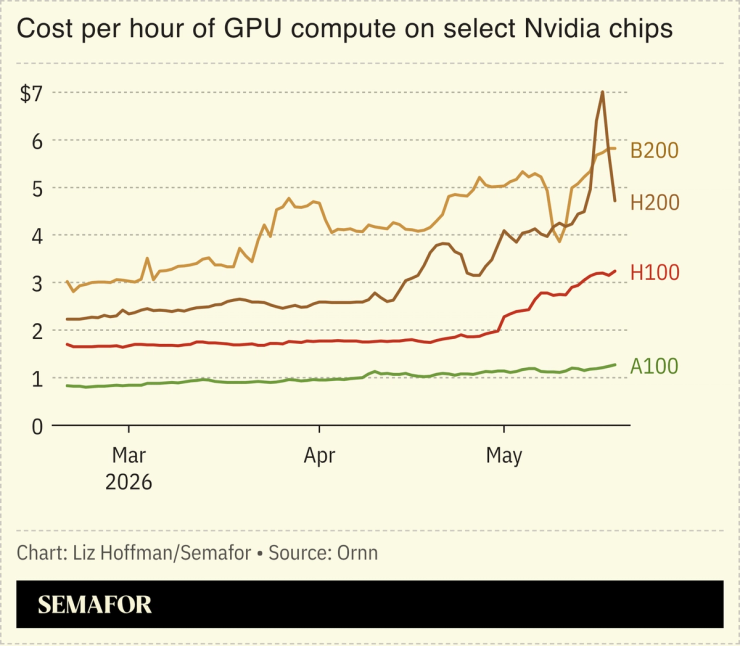
(You can, of course, already bet on the price of compute on prediction markets, with speculators on Kalshi assigning a 40% chance that Nvidia’s B200 chips rent for at least $5.91 an hour this coming Friday.)
此内容由惯性聚合(RSS阅读器)自动聚合整理,仅供阅读参考。 原文来自 — 版权归原作者所有。