


As I write this, my students are taking an in-person exam on Chinese Politics. Three hours, closed book, no computers, pencil and paper. It’s Saturday morning. I am sitting outside a lecture hall, and they are emerging, slowly, with cramped hands, glad to be done with the test and the semester.
I have been teaching for over ten years, and this is the first time I have ever done this sort of exam. My final has always been an open book take home test, where students have an eight-hour window to answer a few longer essay questions. If I gave that exam now, with some gentle prodding, Claude or ChatGPT would be able to produce A+ answers. A student could feed them the exam, syllabus, and lecture slides, and in two minutes they’d have back perfect essays. That would not have been the case two years ago.
Want to crawl into a pit of despair about the future of teaching and learning? Spend 10 minutes looking up student tools for the AI age. Just a few months ago, Companion.AI launched a new “homework agent” which could directly interface with Canvas, the system through which most universities produce course websites. The AI could login into Canvas, watch lectures if they were recorded, do the readings, and upload assignments on time. It could even participate in discussion boards. It was called: Einstein.
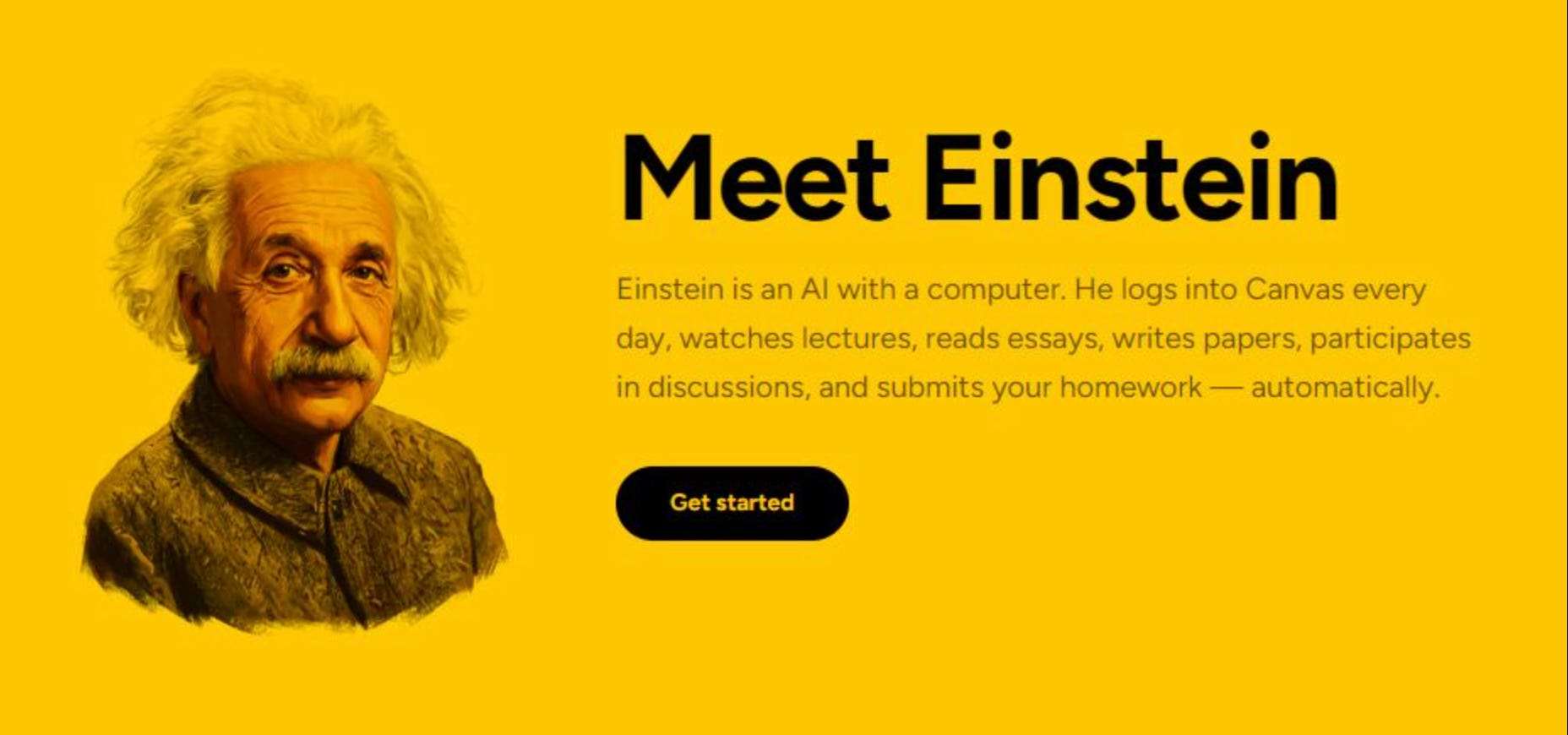
“Set him up and forget about it. Einstein checks for new assignments and knocks them out before the deadline.”
Fully automated cheating.
After a backlash and a cease and desist letter, Companion.AI wound up deleting the product and website, including old tweets trumpeting it from their 22-year-old CEO Advait Paliwal. Paliwal believed Einstein would help free students from academic labor, likening his contribution to freeing horses from their carts.
It’s unclear whether the whole endeavor was a publicity stunt or a flimsy attempt to make a quick buck (see great piece by Marc Watkins), but it revealed something deeper about the challenge we face in education: the moral fabric of universities is on the precipice of breaking down.
Universities run on what we might call “integrity tasks”—little pieces of work that are expected to be done honestly, by a person, but with minimal policing and oversight. When a student is asked to write a paper, that’s an integrity task, the expectation being that they do the work themselves and do not plagiarize. When a journal asks for peer review of an article, the expectation is that the professor reads the article themselves and writes a thoughtful, thorough letter. When a department chair asks a full professor for a tenure letter evaluation, that professor is expected to spend one or two days reading the candidate’s work, and then to write a lengthy 3-5 page letter assessing the quality.
A key through line of all these tasks is that they are time consuming. I would say I spend about 20% of my time evaluating other people—writing letters of recommendation, tenure evaluations and reports, and journal reviews. Add in grading and the other forms of feedback on student work, it’s probably closer to 40% of my working hours. In the profession, the whole month of August is known as letter writing season.
AI introduces a gigantic moral hazard in that it substantially reduces the time taken to complete these things, if the person is willing to let an LLM do it for them. For students, an essay that would have taken away a beautiful Sunday afternoon can be completed in minutes. Worried about being caught? Run it through AIHumanize, which will take your AI written essay, and then use AI to make it sound more human. For only $10 a month!
Professors are not immune from these temptations. At conferences over the last few months, I’ve heard the full range of bad behavior stories already. Anthropic recently released data from a study of over 74,000 educator conversations with Claude. A full 7% of those conversations involved the educator using AI to do grading or student assessment in some way, and “when they did, 48.9% of the time they used it in an automation-heavy way (where the AI directly performs the task).” Similar practices are creeping into peer review.
Taken to the extreme, these behaviors could produce the shell university, where AI generated work is being passed off as human, and then in turn evaluated by another AI, again passed off as human. I was at a dinner party the other night, and someone there was bragging that he had earned a degree “before ChatGPT was invented,” the implication being that he actually did the work. We are entering a new phase in universities where degrees will be handed out, and it may well not be possible to know if the student did any work at all.
The current detection methods for all this are inadequate, and guidance from our institutions is… underwhelming. The consequences for AI cheating barely exist. There are apps to detect AI writing, but they are imperfect, and there will always be ways to work around them. Secondary school teachers are on the front lines of all this, and they tend to be a bit savvier. I have a friend who teaches at a Quaker high school in Philadelphia, and he told me that it’s become standard for students to write their essays in Google Docs, because they can be monitored by the instructor, who can then see if large pieces of text have been pasted in. Students could still theoretically cheat, they would just have to use their phones to generate their essays, and then type it in themselves on their laptop, letter by letter. Not too hard, really, just annoying. And at some point, a smart 22-year-old will probably vibe code a workaround.
How rampant is cheating at this point? According to a recent piece in The Daily Princetonian, about half of the members of the class of 2029 used AI in some way to write their college essays. Over 15% admitted to using AI to cheat in high school, and 65.5% “knew of a peer cheating and chose not to report it.” On the senior survey last year, “25% of AB students and 37% of BSE students in last year’s senior class reported using a large language model (LLM) for an assignment when it was not allowed.” This is not a Princeton-specific issue, of course. New York Magazine had a piece, “Everyone Is Cheating Their Way Through College.” It’s pretty bleak.
The solution, for now, seems to be to pretend it’s the 1990s. AI is a calculator that can do every assignment, and we are taking the calculator away. Gone are the take home exams, back are the in person, blue book finals. Some faculty are doing oral exams for their smaller classes. This feels to me like a stopgap solution, though students appear to be on board. I heard from many that they actually appreciated the return to in person exams, cramping hands aside, because it kept the playing field level and reduced the possibility of cheating. At my university, take-home exams appear to be on their way to extinction, with only 49 administered this semester, down from 168 a year before.
Beyond facilitating academic integrity violations, AI threatens universities in a way that is much deeper. To put it bluntly, AI is demoralizing. That’s how I’ve experienced it, at least.
When I first started teaching Chinese Politics, I was 29 years old. I had a 29-year-old’s understanding of what the professor thing was all about. I thought my job was to learn and know as much about China as I possibly could and then convey that knowledge to my students. I was in the business of knowledge production (my own research), accumulation (reading), and transmission (teaching).
This semester, I taught in Frist 302, known on campus as the “Einstein classroom.” It’s a special room, preserved to be basically the same as when he lectured there many decades ago. The chairs are wooden and creaky, with attached desks too narrow to fit more than one sheet of paper, let alone a laptop. It’s cavernous, cold, and uncomfortable.
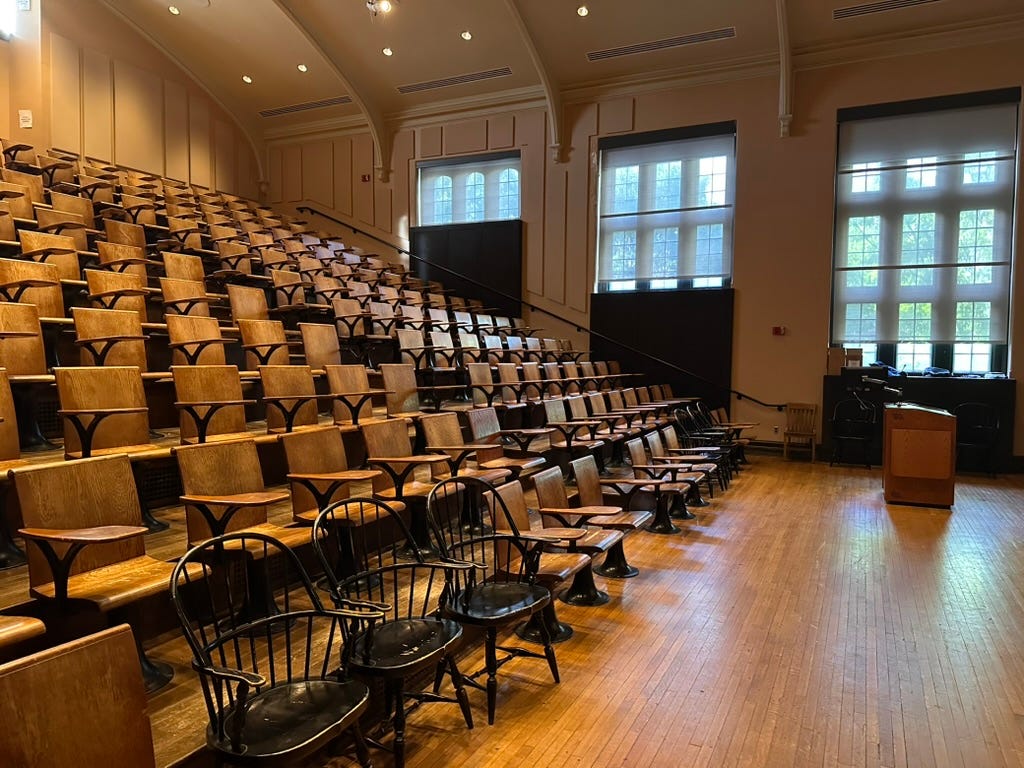
When you teach in that room, you can’t help but think about how what we do has basically stayed the same for generations. Hundreds of classes like mine have been taught there, each with the same general cadence. Professor stands in front of class, talks for about an hour, and students take notes. This process is repeated about 20-24 times in a twelve-week period, with some final exam or exercise to measure student learning. There’s been innovation on this format at the margins, but for all the talk of the “flipped classroom,” the standard college lecture is still the bedrock of higher education.
As I was up there this year, I kept thinking to myself: is this really the best way for them to learn? At this point, wouldn’t they be better off just conversing with Claude for an hour or two a week? Three years ago, I still knew more than these tools. Now I do not. What was I anymore? Just a tired, 41-year-old man, with Claude Haiku levels of understanding about China, armed with some dad jokes and outdated cultural references.
AI is also capable of doing research now, and depending on the field, the research can be pretty good. Andy Hall, a prominent political scientist at Stanford, wrote a full-on political science paper with Claude in about one hour, in turn writing a LinkedIn post about it where he speculated that we are all about to become 100x more productive. He noted that most of that productivity will be spent making our papers better, instead of just writing 100x papers. But what will our field look like if assistant professors are writing 15-20 articles per year, instead of 3-4? Well, for one, it will break the journals and the peer review process. Right now, acceptance rates at the best places are about 5-10%, and editorial teams are having an increasingly difficult time finding the faculty free labor to review all the submissions that come in. If my experience on YouTube is any guide, these places are about to be overwhelmed with AI slop. Academic AI slop. They will be inundated with submissions. And by virtue of the numbers, some of the slop will wind up getting in. My guess is that without substantial reforms, the whole system will break down in the next 5 to 10 years.
At the current progress of AI, I’m not even sure humans will be doing political science research in 5 to 10 years. I raised this point at a conference dinner with other professors last week, and views around the room were mixed. There was a good amount of, “Surely AI can’t tell what good ideas are!” type comment, but the closer people were to the tools itself, the more they shared my skepticism. One person made the point that chess evolved in a progression, where there was a time where Smart Person + Computer could beat Smart Person or Computer. The AI-augmented human was the superior player. We seem to be in that stage right now, where scientists of all fields are using AI to make breakthroughs neither they nor the AI on their own could make, which is exciting. But there will probably come a point where the AI doesn’t need us at all to steer it, and that timeframe may well be shorter than we think. At the conference dinner, I had said ten years. But it could be two.
I had always thought I’d work at a university forever, and I probably will. I am aware that I occupy one of the most privileged positions in the education system and economy— a tenure-protected knowledge job at a place with awesome students and resources. I am lucky to have this chance and would be a fool to ever give it up. But of late I don’t look at the future of the university with all that much optimism. I know a lot of people in education—at all different levels—that feel that way. This Reddit thread on AI cheating captures the mood. AI has taken something fundamental from the business of teaching and learning.
At the end of the semester, I always have group lunches with as many students as I can. It’s nice to get to know them outside the classroom and hear about their experiences. This current batch of seniors is a unique micro-generation. They are the ones who saw the invention and adoption of AI tools during their college experience. I feel a certain bond with them, as they are twenty years younger than me, and it was my micro-generation who saw the invention of social media in college.
I asked them everything— how they felt about cheating, the use of technology in the classroom, and whether lectures even made sense anymore. I confessed about my own self-doubts about my role in the AI age. They think about AI in a very matter-of-fact way, and I came away with more clarity about how we in education need to adapt to remain relevant.
First, many of the standard polices around academic integrity need to be revamped. As an example, my students pointed to our university’s Honor Code as woefully ill-equipped for the moment. Among other things, the Honor Code requires all students to commit to not cheating, and to report on other students if they believe a violation has occurred. Our exams are also un-proctored, for this reason (hence, why I am sitting outside the lecture hall). But this puts a whole lot of the policing of academic integrity on the students themselves. At a time when cheating is heightened and the lines of academic integrity are blurry, that is probably no longer fair to them. Nearly 45% of respondents to Princeton’s 2025 Senior Survey said they had “knowledge of a peer violating the Honor Code and chose not to report it.” The whole system is at the risk of breaking down. Princeton has just approved a proposal that would allow for proctored exams, which would take some of the burden off students. This marks a significant departure with 133 years of precedent, but I suspect our colleagues from the late 1800s would understand.
Second, now should be a moment where we consider whether some of the academic labor we conduct makes sense. Maybe that 22-year-old purveyor of Einstein was not entirely wrong. For example, letters of recommendation have become something of a farce. They mostly say the same thing and are often used internally for grants and fellowships where a simple look at the transcript or CV would have done the job. Tenure letters have also always struck me as an unfortunate relic of an earlier age. Why do we need 5 to 10 letters (sometimes upwards of 20 or more at certain schools) from other professors every time a faculty member wants to move universities or is up for promotion? I had a friend just promoted to full professor. Her reward? 14 tenure letter requests from other universities in the first year. This is insane. Done properly, that’s about a month of work at least— 10-15% of her productive time, devoted to being a minor input in the personnel decisions of other schools, decisions which had probably been largely made by the department faculty already.
Third, professors need to focus on our comparative advantage over the LLMs. If we conceptualize our jobs as simply repositories and transmitters of knowledge, as I did when I had just started teaching, then we are already obsolete. I think a lot about that scene in Good Will Hunting, where Robin Williams’ Sean is lecturing Will, the cocky young genius with anger issues:
“If I asked you about art, you’d probably give me the skinny on every art book ever written. Michelangelo, you know a lot about him. Life’s work, political aspirations, him and the pope, sexual orientations, the whole works, right? But I’ll bet you can’t tell me what it smells like in the Sistine Chapel. You’ve never actually stood there and looked up at that beautiful ceiling.”
(An aside: no one under the age of 25 has seen Good Will Hunting. I learned that the hard way in Lecture 7 this spring. See previous note on outdated cultural references).
Sean is telling Will that lived experience matters. I’ve come to realize that my value as a professor is not that I know facts about the Chinese political system, it’s that I can organize and humanize those facts. I can model enthusiasm for a subject and humility about what I don’t know. I can get something wrong. I can provide a note of praise or perspective when it’s needed. I’ve set foot in Zhongnanhai in Beijing and the headquarters of the Chinese Democracy Party in Queens. I know what it’s like to bumble through a Chinese character quiz on a hungover Friday morning, or to teach a Chinese kid from Hunan how to pronounce the word “mouth.” I know what it’s like to live through my twenties.
When I confessed to my seniors my own demoralization, those were the kinds of things they brought up. Not the facts I knew, but that I was a person, with a life, and a point of view.
And they liked that I took the time to invite them to lunch. When I was a graduating senior, my thesis advisor, Aaron Friedberg, took me out to lunch with his colleague and friend, Andrew Moravcsik. I doubt either of them remember it, but it was one of the most memorable experiences of my time in college. It probably set me down the path I’m currently on.
The dirty secret of higher education is that professors are not really incentivized to spend time with their students. At most universities, research is the primary hiring and promotion criterion and teaching a distant second. Students become an afterthought. They sense that. Many can go their entire college experience without ever having a one-on-one conversation with their professors.
There was a time when that wasn’t true, when the student-professor relationship hadn’t been severed, when it was deeper and less transactional. These patterns were noted in the recent Yale Report on higher education:
There is arguably no greater threat to higher education than the devaluing of teaching and learning…. Many universities and colleges have turned to underpaid adjunct instructors and contingent workers to teach their classes while hiring full time benefit-level administrative staff to manage other aspects of campus life. Tenure-track faculty are often told that their highest priority should be their research, not their teaching. Colleges and universities cannot expect the public to trust or value the classroom if they do not fully value it themselves.
If I’ve learned one thing this year, it’s that we need recenter the human part of the university: the student-teacher relationship. If we do not, I’m not sure if parents will continue to “pay $150,000 on an education they could’ve got for $1.50 in late fees at the public library,” or a $200 a month subscription to Claude.
And if you caught that last reference, you are probably over the age of 25.
That’s all for this week. Thanks for reading and supporting my work.
Rory
Thanks for reading Civic Forum! This post is public so feel free to share it.
此内容由惯性聚合(RSS阅读器)自动聚合整理,仅供阅读参考。 原文来自 — 版权归原作者所有。