







There have been AI booms before.
From the 1950s to 1970s, as technologists at Dartmouth predicted that human-level intelligence was just a generation away.
By the mid-1970s, the first AI winter had set in. But, by the 1980s, “Expert Systems,” an attempt to codify human knowledge, became all the rage.
The systems proved mostly useless, and the second AI winter settled by the 1990s.
In 1997, IBM’s Deep Blue defeated world chess champion Garry Kasparov, reigniting hope in the potential of machines, but Deep Blue was a better example of machine learning than artificial intelligence.
The 2010s saw Deep Neural Networks create Big Data, as we know it.
And today, Generative AI and The Agentic Era is the latest frontier.
In every instance, there has been a gap between rhetorical claims made by AI pioneers and technical reality.
The Mind Is Not A Digital Computer Program
In his 1972 manifesto “What Computers Can’t Do: A Critique of Artificial Reason,” Hubert L. Dreyfus pointed out the metaphysical assumption fundamental to today’s AI scaling narrative revolves around that intelligence can be reduced to formalizable rules or statistical patterns.
Nonetheless, today’s “agentic” systems still need human scaffolding for context and edge cases, which Dreyfus anticipated.
“The assumption that the brain is a digital computer amounts to the claim that the mind can be described as a program,” Dreyfus wrote. “This is the psychological assumption.”
Dreyfus believed that human intelligence depended upon situated, embodied “know-how” context, as well as relevance that is irreducible to formal rules lacking context without falling into infinite regress, a sequence of propositions, causes, or justifications that never reaches a stopping point.
Scaling & Reality
Gary Marcus wrote “Deep Learning Is Hitting a Wall” in March 2022–after GPT-3 but before the consumer LLM boom. Prominent scaling advocates ridiculed Marcus’ work, in which he chronicled radiology systems lacking clinical context, autonomous driving edge cases outside training data, GPT-3 creating nonsensical and harmful outputs when it comes to basic reasoning prompts.
In 2016, computer scientist Geoffrey Hinton, who has been called the “Godfather of AI,” infamously predicted that AI would put radiologists out of work within five years, comparing them to a “coyote that’s already over the edge of the cliff but hasn’t yet looked down” because AI would do a better job than them.
“Few fields have been more filled with hype and bravado than artificial intelligence.” Marcus wrote.
Deep learning today remains best used in low-stakes perceptual tasks, with high-stakes applications failing to execute on systematic generalization, compositionality, and robust reasoning.
Mimicry Devoid Of Understanding
In their paper, “On the Dangers of Stochastic Parrots: Can Language Models Be Too Big?” Emily M. Bender, Timnit Gebru, Angelina McMillan-Major, and Shmargaret Shmitchell were so controversial, it led to the departure of co-authors from Google.
They argued that, while LLMS produces coherent text sans a model of the world, reader intent, and truth, the impressive nature of the outputs does not correlate to authentic comprehension–perhaps the primary cause of hallucinations in agentic AI outputs.
The paper claimed that the current architectures are not on an easy path to robust reasoning or reliable agents.
“Contrary to how it may seem when we observe its output, an LM is a system for haphazardly stitching together sequences of linguistic forms it has observed in its vast training data, according to probabilistic information about how they combine, but without any reference to meaning: a stochastic parrot,” they wrote.
The Real-World
In “Consulting the Record: AI Consistently Fails the Public,” the AI Now Institute succinctly threw water on AI jubilance.
“AI’s benefits are overstated and underproven,” the AI Now Institute states. “Zealous claims that AI technologies will have transformative effects on particular sectors, and society at large, are circulated by AI developers as nearly incontrovertible.”
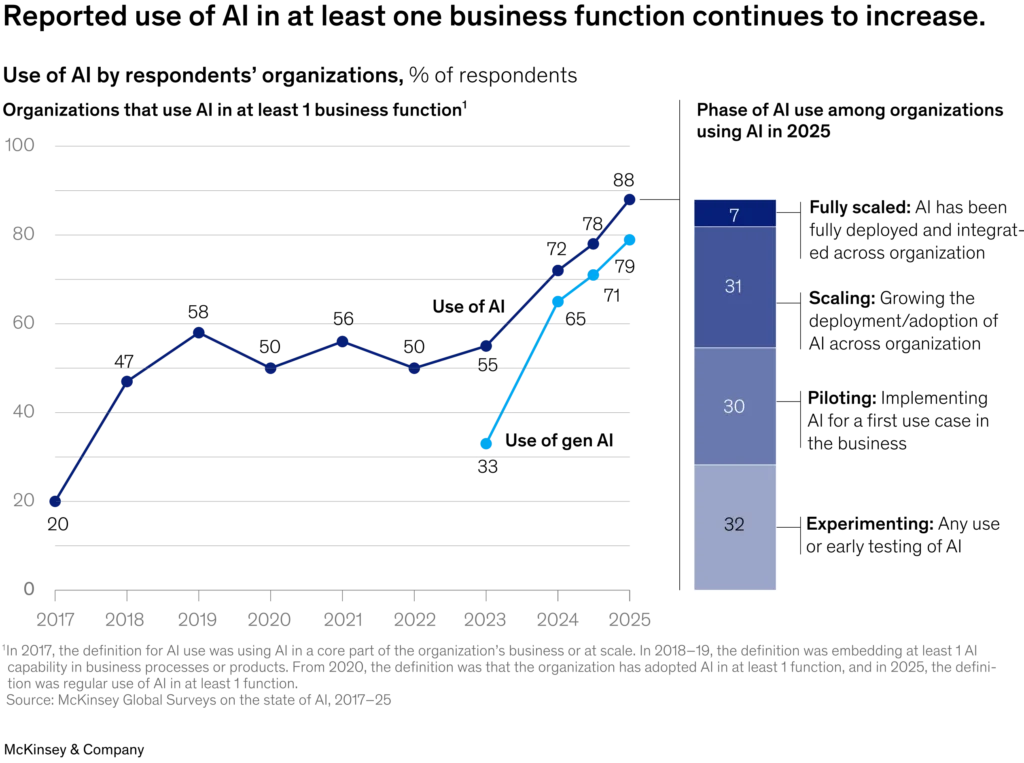
In enterprise settings across industries, most AI pilots do not make it to production, with Boston Consulting Group finding at least 74 percent end up in pilot purgatory.
McKinsey found just 7 percent of AI integrations in enterprise have been fully scaled.
That the promises of AI stretch beyond its true capability has been documented for decades by those who do not stand to profit from AI adoption, with industry professionals often scoffing, and even firing, those who step out of line.
Cover Image: Ford Europe of Freddie Ford, a 9-foot touring robot made from Ford car parts