







Most organisations are not failing at AI because of models; they are failing because no one owns the path from output to outcome.
Over the past few years, companies have invested heavily in building AI capability through better data infrastructure, capable models, and more accessible tooling. That effort has largely worked. In many environments, generating useful outputs is no longer the primary constraint. Systems can produce answers that are directionally correct, often faster and more consistently than before.
Yet outcomes have not moved proportionally.
Efficiency improvements show up in isolated pockets, costs do not fall in line with effort saved, and delivery models remain largely unchanged. The organisation becomes better at producing answers, but not meaningfully better at acting on them. The gap is not in intelligence; it lies in what happens after.
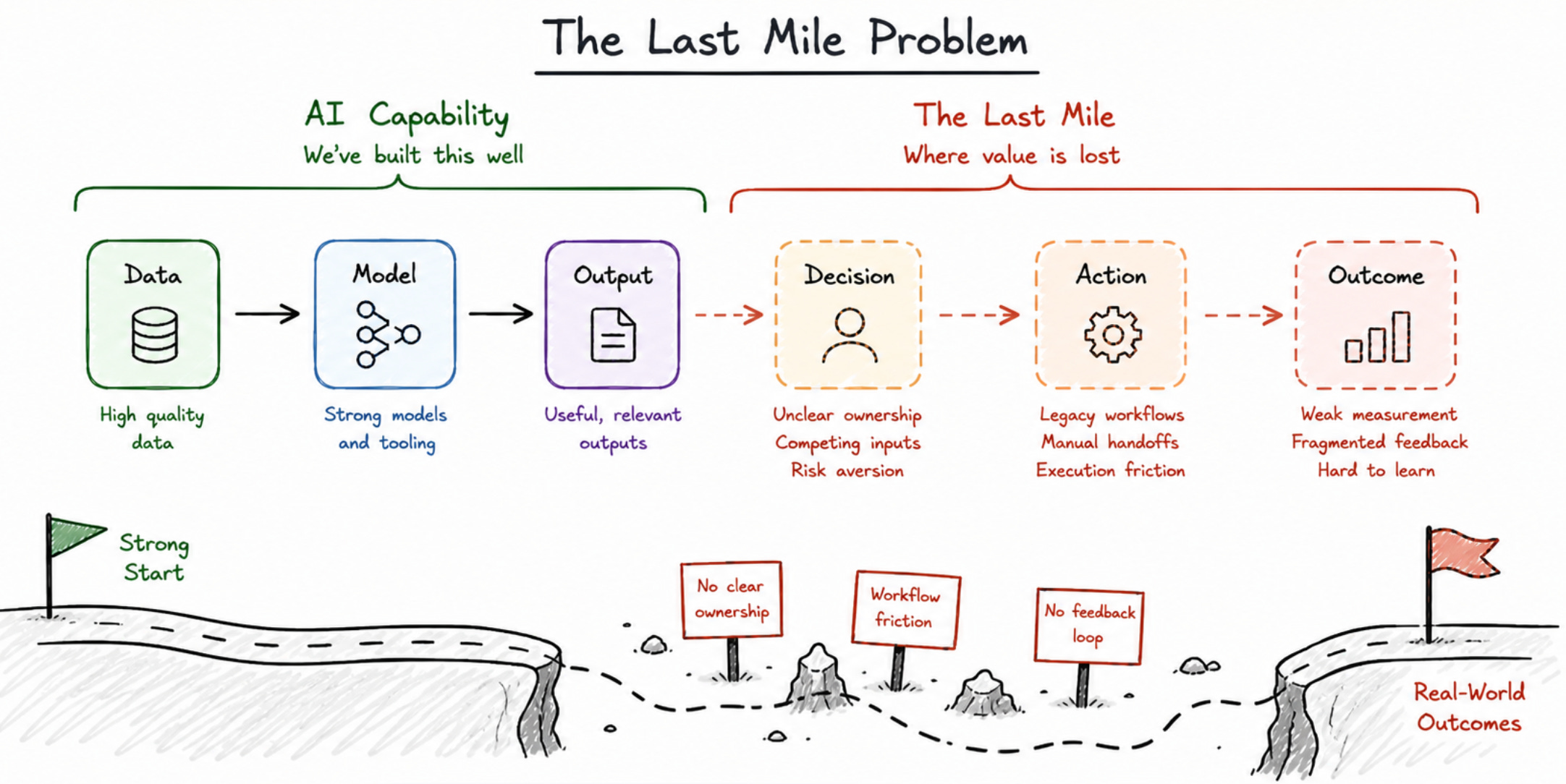
Most discussions of the AI value chain stop at the point where a model produces an answer. The implicit assumption is that better outputs will lead to better decisions and, in turn, better outcomes. In practice, that connection is weak.
Once an output is generated, it enters an organisational system that was not designed around it. It competes with existing judgement, established workflows, and informal authority structures. In most cases, it is treated as an additional input, not a driver of action.
This is where the first loss occurs. Outputs accumulate but do not consistently translate into decisions. Responsibility is diffuse, and no single role is accountable for acting on the output. As a result, it sits alongside existing processes rather than reshaping them.
Even when decisions are influenced, the next step breaks down again. Execution relies on workflows that predate AI. These workflows assume human validation, coordination, and approval at key points, and they are rarely redesigned when AI is introduced. The result is predictable: decisions do not move cleanly into action. The organisation continues to operate with the same friction, even when the underlying analysis has improved.
The final stage, linking action to outcome and feeding that information back into the system, is often the weakest. Measurement focuses on usage and activity rather than decision effectiveness, and feedback loops are fragmented. The system improves in isolated components but does not learn coherently.
Taken together, this creates a consistent pattern:
The front of the value chain, data and models, advances quickly
The back of the chain, decision, action, and feedback, remains largely unchanged
The result is an incomplete value chain, a system that produces intelligence but does not reliably convert it into outcomes. This is not a technical limitation; it is a structural one.
Organisations were designed to support human decision-making. Information flows were built to inform people, who then interpret and act within existing processes. AI changes that dynamic by producing outputs that can be acted on directly, but the surrounding system, including workflows, ownership, and incentives, remains the same.
As a result, the organisation increases the supply of intelligence without increasing its capacity to act on it.
The constraint is rarely technical; it is economic and structural.
Acting fully on AI outputs reduces the effort required to deliver work, but in regulated environments that action cannot be fully automated. Organisations respond by inserting human validation steps, rather than redesigning the surrounding workflow.At the same time, revenue, headcount, and influence often remain tied to that effort. Workflows, funding models, and team structures preserve it by default.
The result is a system where AI improves analysis, but the path from decision to action remains constrained, fragmented, and effort-heavy. The system therefore resists completion by design.
This explains why many initiatives show strong local performance while failing to generate broader impact:
The technology works within its defined scope
The organisation does not adapt around it
AI becomes a layer on top of existing operations rather than a force that reshapes them
Completing the value chain is not about improving models further; it requires redesigning the system around them.
At a minimum:
Decision ownership must be explicit : Someone must be accountable for converting outputs into decisions, not just generating analysis
Workflows must be rebuilt around action, not validation : AI outputs should directly inform execution paths, with human intervention focused on exceptions, controls, and risk boundaries.
Feedback loops must connect decisions to outcomes :Measurement must shift from usage to effectiveness, closing the loop between action and learning
Without these changes, improvements in model capability will continue to outpace improvements in performance.
The limiting factor is no longer the ability to generate answers. It is the organisation’s willingness to redesign itself around them.
Until that happens, the value chain remains incomplete, and the impact of AI will continue to fall short of its potential.