

惯性聚合 高效追踪和阅读你感兴趣的博客、新闻、科技资讯
阅读原文 在惯性聚合中打开

推荐订阅源

G
Google Developers Blog
云风的 BLOG
云风的 BLOG
Google DeepMind News
让小产品的独立变现更简单 - ezindie.com
博客园 - 三生石上(FineUI控件)
V
Visual Studio Blog
爱范儿
爱范儿
宝玉的分享
宝玉的分享
人人都是产品经理
人人都是产品经理
大猫的无限游戏
大猫的无限游戏
博客园 - 聂微东
月光博客
月光博客
雷峰网
雷峰网
L
LangChain Blog
Stack Overflow Blog
Stack Overflow Blog
B
Blog RSS Feed
有赞技术团队
有赞技术团队
T
Tailwind CSS Blog
阮一峰的网络日志
阮一峰的网络日志
V
V2EX
CTFtime.org: upcoming CTF events
C
Check Point Blog
N
Netflix TechBlog - Medium
罗磊的独立博客
博客园 - 司徒正美
OSCHINA 社区最新新闻
OSCHINA 社区最新新闻
F
Full Disclosure
Security Archives - TechRepublic
V
Vulnerabilities – Threatpost
H
Help Net Security
博客园 - 【当耐特】
博客园_首页
Microsoft Security Blog
小众软件
小众软件
Hugging Face - Blog
Hugging Face - Blog
L
Lohrmann on Cybersecurity
C
Cybersecurity and Infrastructure Security Agency CISA
P
Privacy International News Feed
Blog — PlanetScale
Blog — PlanetScale
C
CERT Recently Published Vulnerability Notes
P
Privacy & Cybersecurity Law Blog
酷 壳 – CoolShell
酷 壳 – CoolShell
Cisco Talos Blog
Cisco Talos Blog
K
Kaspersky official blog
D
Darknet – Hacking Tools, Hacker News & Cyber Security
Cyberwarzone
Cyberwarzone
S
Schneier on Security
S
SegmentFault 最新的问题
C
Cyber Attacks, Cyber Crime and Cyber Security
S
Securelist

Hacker News - Newest: "AI"

AI can't read an investor deck AI as an attorney? Student uses ChatGPT, Gemini to sue UW over alleged racial discrimination Hacking MCP Servers in AI Systems – The Rug Pull: Tool Changes After Approval GitHub - MeepCastana/KubeezCut: Free Web based video editor GitHub - GenAI-Gurus/awesome-eu-ai-act: Curated tools, official sources, OSS, templates, and guides for EU AI Act compliance. Can AI judge journalism? A Thiel-backed startup says yes, even if it risks chilling whistleblowers Coming soon: 10 Things That Matter in AI Right Now DARPA built an AI to fact-check enemy weapons claims What explains heterogeneity in AI adoption? When AI Meets Muscle: Context-Aware Electrical Stimulation Promises a New Way to Guide Human Movements - Department of Computer Science AI Changed How We Build. It Did Not Change What Matters. Linux rules on using AI-generated code - Copilot is OK, but humans must take 'full responsibility for the… Meta spins up AI version of Mark Zuckerberg to engage with employees Code Mode: Let Your AI Write Programs, Not Just Call Tools | TanStack Blog GitHub - Delavalom/graft: Go framework for building AI agents. Type-safe tools, multi-provider (OpenAI, Anthropic, Gemini, Bedrock), zero vendor SDKs. India's TCS tops estimates, says new AI models did not dent services demand Gen Z's fading AI hype Strong feeling: we are in a folded AI reality GitHub - machinarii/total-recall-catalog: A reference catalog of latest knowledge retrieval, memory & RAG systems GitHub - mensfeld/code-on-incus: Give each AI agent its own isolated machine with root, Docker, and systemd. Active defense detects and stops threats automatically.. Quantization, LoRA, and the 8% Problem: Benchmarking Local LLMs for Production AI Iran war: We spoke to the man making Lego-style AI videos that experts say are powerful propaganda Powell, Bessent discussed Anthropic's Mythos AI cyber threat with major U.S. banks GitHub - immartian/bellamem: Persistent belief-graph memory for AI agents. Retrieves decisive context by importance — not recency, not RAG, not /compact. recursive-mode: The Repo-Native Operating System for AI Engineering After the attack on Sam Altman's home, will AI CEO's go on the offensive? The biggest advance in AI since the LLM Opus 4.6 vs GPT 5.4 One Prompt Unity World Generation Test “AI polls” are fake polls Client Challenge Can AI be a 'child of God'? Inside Anthropic's meeting with Christian leaders How to Switch AI Chatbots and Why You Might Want To GitHub - MattMessinger1/agentic_refund_guardrail: Safe refund policy layer for AI agents — Python + TypeScript. Same behavior, shared tests. Adam/papers/emergent_values_whitepaper.md at master · strangeadvancedmarketing/Adam Ask HN: How do you stop playing 20 questions with your AI coding tools How far can automation and AI support psychotherapy? - @theU GitHub - stagas/rtdiff: realtime git diff gui and AI-assisted commits A Mac Studio for Local AI — 6 Months Later A History of the Early Years of AI at the University of Edinburgh Why AI Coding Tools Still Feel Stuck on Localhost MSN AI Datacenters Are Becoming Strategic Targets twitter.com Penn Researchers Use AI to Surface Unreported GLP-1 Side Effects in Reddit Posts Show HN: MoodSense AI (ML and FastAPI and Gradio, Deployed on Hugging Face) Moodsense Ai - a Hugging Face Space by aman179102 AI models are terrible at betting on soccer—especially xAI Grok GitHub - xialeistudio/echoic GitHub - HimashaHerath/github-dev-wrapped: AI-powered weekly GitHub activity reports deployed to GitHub Pages GitHub - alejandrobalderas/claude-code-from-source: Architecture, patterns & internals of Anthropic's AI coding agent — reverse-engineered from source maps AI and Tech brief: Ireland ascendant GitHub - Titovilal/context0: Context0 - Never Surrender Training for a Marathon with an AI Coach: What Worked and What Didn't Cyber Pulse: Agentic Intel - Apps on Google Play I Built an AI PR Reviewer That Catches Bugs by Not Looking for Bugs Gen Z workers are so fearful AI will take their job they’re intentionally sabotaging their company’s AI rollout | Fortune How AI Is Reimagining the Game of Golf–For Both Players and Courses GitHub - nattergabriel/reseed: A CLI tool for managing and distributing agent skills across projects Is SVG the final frontier? My AI workflow evolved from prompts to a near-autonomous workflow MLSharp Help - 3DGS Viewer & Generator I put my cognitive field based AI's runtime on GitHub Is Numble the first AI-proof game? A3: Kubernetes for autonomous AI agent fleets | Emergent Principles Deepali Vyas ("The Elite Recruiter") GitHub - msmarkgu/RelayFreeLLM: A restful API designed to route user prompts to various AI model providers. Unionized ProPublica staff are on strike over AI, layoffs, and wages Unleashing the Advantage of Quantum AI We're heading for an AI-fueled 'dementia crisis,' brain scientist warns The AI-Assisted Breach of Mexico's Government Infrastructure [pdf] GitHub - stef41/lmscan: 🔍 Detect AI-generated text and fingerprint which LLM wrote it. Open-source GPTZero alternative. Zero dependencies, works offline. MSN GitHub - visionscaper/collabmem: Enabling long-term collaboration with Agentic AI - building up episodic and world model memory over time with in-context awareness We gave an AI a 3 year retail lease in SF and asked it to make a profit | Andon Labs AI Code is Hollowing Out Open Source, and Maintainers are Looking the Other Way What leaked "SteamGPT" files could mean for the PC gaming platform's use of AI AI is the boss at this retail store. What could go wrong? GitHub - Wuzu11517/agentic-proxy: Local proxy meant to help reduce With Drones, Geophysics and ArtificiaI Intelligence, Researchers Prepare to Do Battle Against Land Mines A Single Operator, Two AI Platforms, Nine Government Agencies: The Full Technical Report 在 Steam 上购买 FriedrichAI: Offline AI 立省 10% GitHub - inevolin/resume-cli: Hit Claude usage limits? Resume any AI coding session elsewhere. Switch tools at zero friction. GitHub - atripati/ark: AI Runtime Kernel — a context operating system for AI agents. Eliminates tool bloat, loads only what’s needed, and gives LLMs their reasoning space back. How to Build a Secure AI PR Reviewer with Claude, GitHub Actions, and JavaScript This Startup Wants You to Pay Up to Talk With AI Versions of Human Experts Intel Arc Pro B70 Brings 32GB VRAM to Local AI for $949 WordPress 7.0: The Good, the AI, and the Still Missing AI on the couch: Anthropic gives Claude 20 hours of psychiatry IatroBench: Pre-Registered Evidence of Iatrogenic Harm from AI Safety Measures AI Agents Know About Supabase. They Don't Always Use It Right. The history and future of AI at Google, with Sundar Pichai Inside an AI‑enabled device code phishing campaign How Meta Used AI to Map Tribal Knowledge in Large-Scale Data Pipelines AI for Systems: Using LLMs to Optimize Database Query Execution Forecasting the Economic Effects of AI Introducing Tinker: Play with AI, bring your ideas to life AI sheds light on an ancient gaming mystery People really hate AI but not as much as Iran—or Democrats | Fortune What is an AI Product Engineer? Phoebe Gates wants her $185 million AI startup to succeed with 'no ties to my privilege or my last name': 'I have a chip on my shoulder' | Fortune
The Carbon Footprint Of AI - Sustainable Software
Will Buchanan · 2026-06-22 · via Hacker News - Newest: "AI"

Artificial Intelligence (AI) has the potential to transform how we fight climate change. However, it also increasingly contributes to it: the carbon footprint of AI will grow exponentially over the next decade, and is projected to grow at a CAGR of nearly 44% globally through 2025.

The industry is trending towards bigger models (e.g. GPT-3): these require ever-growing datasets, compute budgets, and incur massive energy bills over the model lifecycle. Computational costs of AI models have been doubling every few months, resulting in an estimated 300,000x increase from 2012-2018. In the past two years, the number of parameters have grown 170X. Currently, training a single 213M parameter NLP deep-learning model through an architecture search can generate the same carbon footprint as the lifetime of five American cars, including gas.
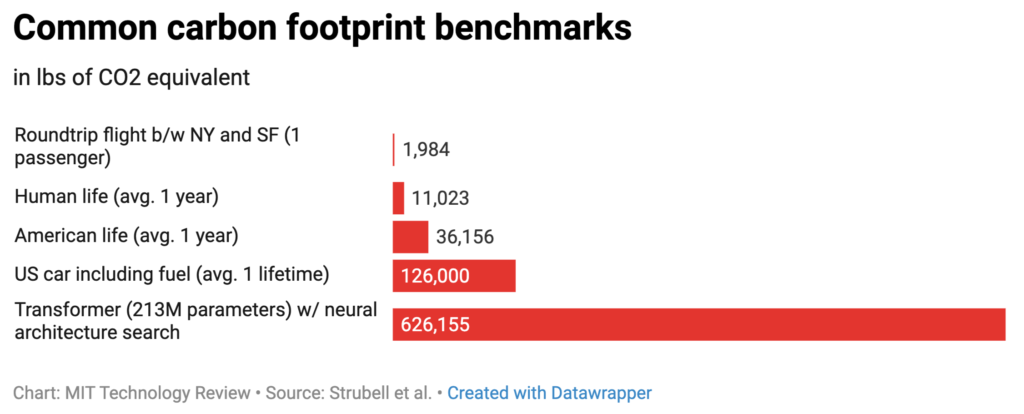
Carbon Footprint Of AI
One NLP model has the same carbon footprint of five cars, including gas.

Source: Emma Strubell, Carnegie Mellon University

Environmental sustainability should be considered as one of the principles towards responsible development and application of AI. The benefits of using such technology should outweigh its drawbacks, and it’s time to bring the conversation about the hidden costs of AI to the forefront.

‘Data Is The New Oil’

According to Gerry McGovern’s book World Wide Waste, 90% of data is not used – merely stored (which is cheap). He argues that because of this, the IT landscape is ~90% waste: 91% of pages analyzed got zero traffic from google, and more people have been to the top of Everest than the 10th page of search results. It’s no surprise that companies are seeking capitalize on this unprecedented amount of data collection. AI provides a way to make sense of massive amounts of data, but the current state-of-the-art requires a massive amount of data for training & validation. The more weights a model has, the more data it needs.

“The AI industry is often compared to the oil industry: once mined & refined, data, like oil, can be a highly lucrative commodity. Now it seems the metaphor may extend even further” – MIT Technology Review

There are promising, but emergent methods such as ‘few-shot learning’ and ‘less than zero-shot learning’ which will allow ML systems to learn & reason from a handful of examples. However, in the interim, the industry is currently trending towards increasingly large datasets, which require massive computational training budgets.

Bigger Is Not Always Better

The human brain is remarkably efficient; it can learn from a single example and apply this knowledge in a wide variety of contexts for the rest of its life. It requires relatively little energetic input: the brain only requires 20W to operate, and the global average of a human life requires around 8,000 lbs Co2/year.

Nature has done a significantly better job of engineering a brain than we have with AI. This represents significant potential for improvement: according to some of the brightest minds in the industry, ‘Artificial Intelligence’ isn’t yet close to being intelligent in any meaningful sense of the word. ML systems learn to perform a specific task by observing lots of examples, and pattern matching data by what can be viewed as a brute-force computational approach.

This requires staggering amounts of energy (data & compute resources) to perform pattern matching & superhuman statistical analysis. As a result, state-of-the-art approaches to AI are engaged in a computational arms race to achieve the next benchmark performance. A 2018 analysis led by Dario Amodei and Danny Hernandez of the California-based OpenAI research lab, an organization that describes its mission as ensuring that artificial general intelligence benefits all of humanity, revealed that the compute used in various large AI training models had been doubling every 3.4 months since 2012 — a wild deviation from Moore’s Law, which puts this at 18 months — accounting for a 300,000× increase.
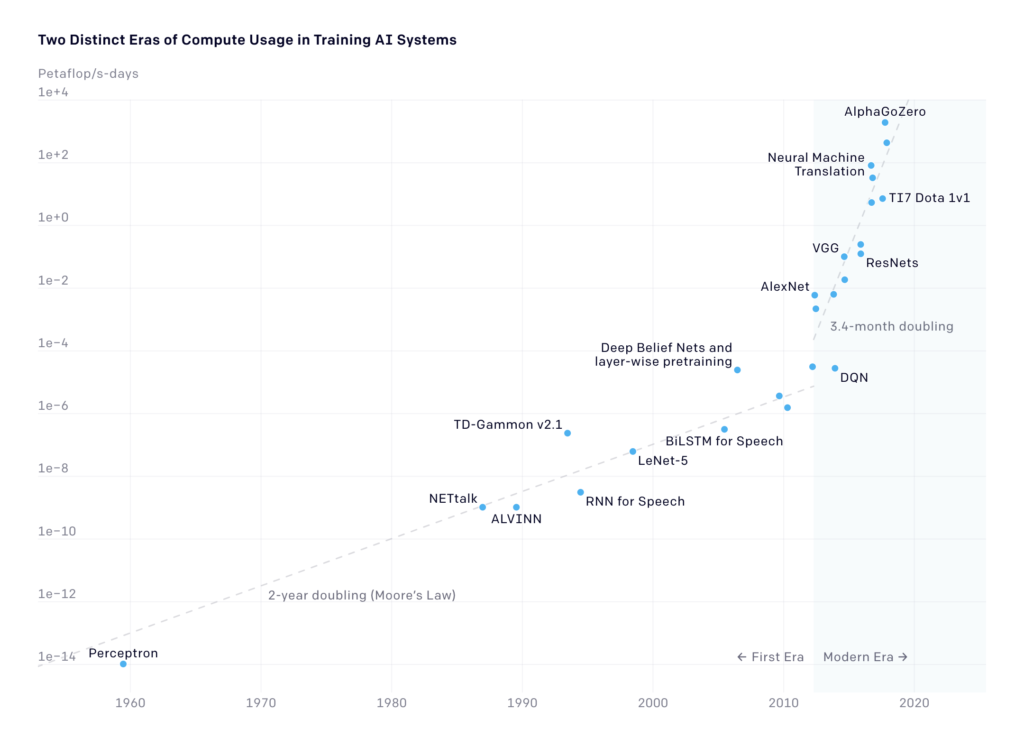
AI & Compute

Source: https://openai.com/blog/ai-and-compute/

It is noteworthy that there have been major efficiency gains in recent years: According to OpenAI, compute cost has been halving every 16 months for equivalent model performance. Since 2012, the same model requires 44X less compute. However, we’re rapidly approaching outrageous computational, economic, and environmental costs to gain incrementally smaller improvements in model performance. For the moment, computational cost has a linear relationship with the amount of data, epochs, and hyperparameters involved in training. The state-of-the-art advances are primarily achieved through scale: bigger datasets, larger models, and more compute.

“I think the best analogy is with some oil-rich country being able to build a very tall skyscraper. Sure, a lot of money and engineering effort goes into building these things. And you do get the ‘state of the art’ in building tall buildings. But…there is no scientific advancement per se.”Guy Van den Broeck, UCLA

The AI industry is currently what researcher Roy Schwartz (Allen Institute For AI & Hebrew University of Jerusalem) has deemed ‘RedAI’: performance & accuracy at the expense of efficiency (speed, energy cost).

A McKinsey report from 2017 indicated that 88% of ML projects never reach production, suggesting that many experimentation paths are dead-ends with a corresponding carbon footprint. Even if a ML project does mature to production/publication, it will have required many different tunings/trials to achieve the max performance, likely exceeding 10-20 training runs to produce a single model with the highest accuracy.

Model training represents only a portion of the total carbon footprint: it is important to holistically analyze the footprint across all phases of an ML project.

Deployment & Lifecycle

While deployed, model inference has an outsized footprint: NVIDIA has estimated that inferencing constitutes 80-90% of total carbon cost of a ML model. This warrants a cross-industry framework for a full Life Cycle Analysis (LCA) to evaluate embodied carbon across the ML lifecycle.

GreenAI

There are ways to make machine learning greener, a movement that has been dubbed ‘GreenAI’, initiated by Natural Language Processing researchers. This community is pushing for efficiency as a core metric. Some conferences (below) now require submissions to fill out forms that include information about the computational budget used to generate the reported results.

GreenAI is in its infancy, and presents both numerous research opportunities and industry partnership potential. By bringing visibility & accountability into our ML efforts, we can begin to prioritize reporting and efficiency measures to incentivize sustainable AI practices. In future posts, I will dive into particularly promising approaches (such as reporting & efficiency methods). In the interim, here are some resources that can get you started in the community:

Get Involved

OSS packages to start tracking the carbon footprint of your experiments:

Conferences:

Category

Topics

Author

Will Buchanan

Driving decarbonization of AI within Microsoft