





Pope Leo XIV is about to release his first encyclical, Magnifica Humanitas, on “preserving the human person in the age of artificial intelligence.” The printed English version runs to about 190 pages, So it seems Leo intends to engage the topic seriously. As a Catholic AI expert with a working interest in philosophy and theology, I’ve been waiting for a more “official” magisterial teaching on this question for some time, and I’m genuinely excited.
But this won’t be the first time the Church has spoken on AI. In January 2025, the Dicastery for the Doctrine of the Faith and the Dicastery for Culture and Education jointly released Antiqua et Nova, a Note on the Relationship Between Artificial Intelligence and Human Intelligence. It’s worth revisiting now, partly because it will almost certainly form part of the conceptual scaffolding of the new encyclical, and partly because it does something rare and valuable in its own right.
The document covers AI’s history and technical capabilities accurately (frankly, with a better grasp of the technology than most secular commentary I’ve seen whether in mainstream media or online). It then addresses ethics across society, work, education, healthcare, warfare, and so on. All of that is worth reading.
But to my mind, the most interesting part of the Note is its careful unpacking of what intelligence actually is. Most of the AI community operates with a functionalist, reductive picture of intelligence. The philosophical and theological tradition has a deeper and more holistic one. That contrast is the crux of the whole conversation, and getting it right matters far more than people seem to realize.
What does the word “intelligence” actually mean?
For many AI researchers and engineers, intelligence is functional. The classic illustration is the Turing Test: a machine is “intelligent” if its outputs can’t be reliably distinguished from a human’s. Intelligence, on this picture, is a black box, a mapping from inputs to appropriate outputs. How the outputs are generated doesn’t really matter.
Antiqua et Nova puts the problem cleanly:
Underlying this and many other perspectives on the subject is the implicit assumption that the term “intelligence” can be used in the same way to refer to both human intelligence and AI. Yet, this does not capture the full scope of the concept. In the case of humans, intelligence is a faculty that pertains to the person in his or her entirety, whereas in the context of AI, “intelligence” is understood functionally, often with the presumption that the activities characteristic of the human mind can be broken down into digitized steps that machines can replicate. (§10)
And on the Turing Test specifically:
“[B]ehavior” refers only to the performance of specific intellectual tasks; it does not account for the full breadth of human experience, which includes abstraction, emotions, creativity, and the aesthetic, moral, and religious sensibilities. (§11)
This is the essential move. The functionalist treats intelligence reductively — judged solely by its ability to produce appropriate responses, “regardless of how those responses are generated.” It’s a methodologically convenient definition, and it has driven enormous technical progress. But it is not what intelligence is; it is at best a way of measuring one of its visible surfaces.
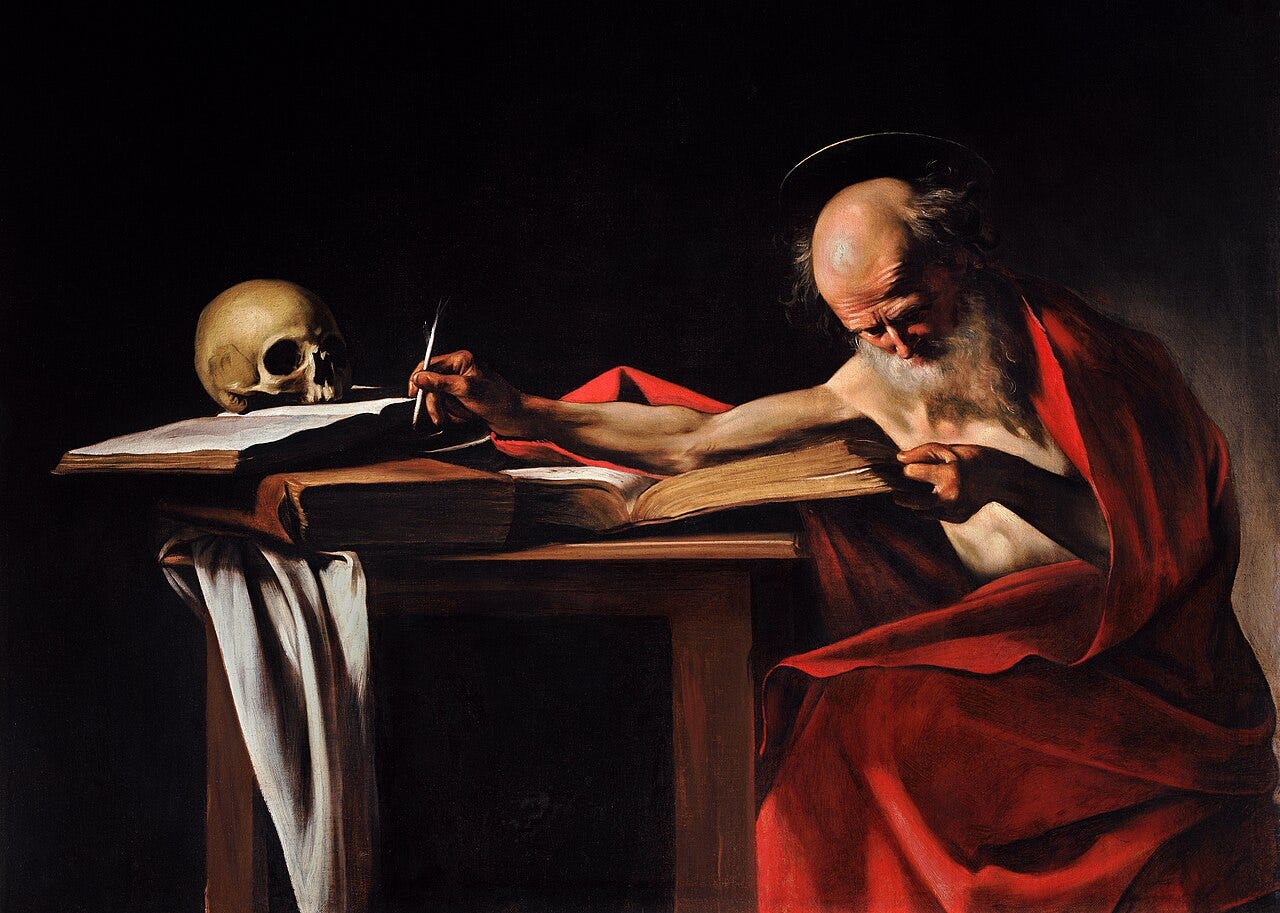
Against this, the Christian tradition has developed, over centuries, a much richer account. The human person is understood as a unity of body and soul, deeply rooted in this world and yet transcending it. Intelligence belongs to that whole person, not to a detachable cognitive module.
Classical and Christian thought distinguishes two complementary aspects of intelligence: intellect (intellectus) and reason (ratio). Aquinas describes them not as separate faculties but as two modes of a single intelligence:
Intellectus is the inward, intuitive grasp of truth, apprehending things with the “eyes” of the mind, prior to argument.
Ratio is the discursive, analytical process that leads to judgment.
Together they form the act of intelligere, “the proper operation of the human being as such.”
Interestingly, this distinction echoes Kahneman’s two systems in Thinking, Fast and Slow. And it’s tempting to see in today’s “reasoning models” a kind of mechanical simulacrum of the ratio dimension — chains of intermediate steps mimicking the discursive process. But of course they are simulacra of the surface behavior of reasoning, not the deeper intuitive grasp of being that grounds it.
Crucially, calling the human a “rational being” is not a reductive claim. As Antiqua et Nova puts it:
Describing the human person as a “rational” being does not reduce the person to a specific mode of thought; rather, it recognizes that the ability for intellectual understanding shapes and permeates all aspects of human activity. […] The “term ‘rational’ encompasses all the capacities of the human person,” including those related to “knowing and understanding, as well as those of willing, loving, choosing, and desiring; it also includes all corporeal functions closely related to these abilities.” (§15)
Reason, here, is not a department of the mind. It’s the light that integrates and shapes everything else — will, love, choice, desire, even bodily life. This is tied directly to the imago Dei: the human person is created in the image of God, and reason participates in that image precisely by elevating and forming the whole person.
Contrary to what a parody-level reading of Christianity might suggest, the tradition is emphatically not about minds trapped in bodies. Human beings are essentially embodied. Spirit and matter form a single nature.
In living things, the soul isn’t a spooky extra object hiding inside the body. It’s the form, the organizing principle that makes the living body the kind of living thing it is. The human soul is the form of a human animal: it accounts for nutrition, growth, sensation, movement, perception, intellect, and will — though not all these powers operate in the same way. This is hylomorphism, and it’s worth taking seriously before reading the next section.
Why? Because once embodiment is taken seriously, the whole “human intelligence as software running on neural wetware” picture starts to look like a category mistake rather than a deep insight. Our intelligence isn’t housed in our bodies; it is, in part, our bodily way of being in the world. We learn from sensation, suffering, touch, exhaustion, hunger, embrace. None of that is incidental noise around an essentially computational core.
The human person seeks the truth and is drawn to it even where it transcends our grasp. This goes well beyond empirical data, sensory experience, or utility. We ask why things are the way they are.
This drive expresses itself in two distinctly human capacities:
Semantic understanding: grasping meaning that transcends any particular formal or empirical structure (including computer code).
Creativity: generating genuinely new content and viewpoints rather than recombining existing ones.
And the search for truth finds its highest expression in openness to what lies beyond the physical and created world:
The search for truth finds its highest expression in openness to realities that transcend the physical and created world. In God, all truths attain their ultimate and original meaning. (§23)
Putting all of this together, the Note arrives at what it calls an integral understanding of intelligence. The whole person engages reality through intelligence: spiritual, cognitive, embodied, and relational, all at once. It includes logical and linguistic abilities (which AI systems can imitate impressively) but also many other modes of interacting with reality.
Think of the artisan who can see in inert matter a form no one else recognizes. The indigenous farmer with an intimate sense of soil and season. The friend who finds the right word at the right moment. None of these are “applications of general intelligence” in any computational sense; they are intelligence itself, in some of its most human forms.
Pope Francis put it well: “in this age of artificial intelligence, we cannot forget that poetry and love are necessary to save our humanity.”
And from §29, perhaps the most important paragraph of the whole Note:
A proper understanding of human intelligence, therefore, cannot be reduced to the mere acquisition of facts or the ability to perform specific tasks. Instead, it involves the person’s openness to the ultimate questions of life and reflects an orientation toward the True and the Good. […] [H]uman intelligence possesses an essential contemplative dimension, an unselfish openness to the True, the Good, and the Beautiful, beyond any utilitarian purpose.
A contemplative dimension. Beyond any utilitarian purpose. That is precisely what the functionalist account cannot see, because by construction it measures intelligence only by its useful outputs.
Once intelligence is understood this way, the limits of AI come into much sharper focus. AI can simulate a subset of human intellectual outputs, and only their outputs, at a surface level. It cannot share in the lived, embodied, relational, contemplative life that produces them in us:
Human intelligence is not primarily about completing functional tasks but about understanding and actively engaging with reality in all its dimensions; it is also capable of surprising insights. Since AI lacks the richness of corporeality, relationality, and the openness of the human heart to truth and goodness, its capacities — though seemingly limitless — are incomparable with the human ability to grasp reality. So much can be learned from an illness, an embrace of reconciliation, and even a simple sunset; indeed, many experiences we have as humans open new horizons and offer the possibility of attaining new wisdom. No device, working solely with data, can measure up to these and countless other experiences present in our lives. (§33)
The deeper danger, though, isn’t that we’ll overestimate AI. It’s that we’ll underestimate ourselves. That we’ll quietly accept the functionalist picture as the truth about humans too:
Drawing an overly close equivalence between human intelligence and AI risks succumbing to a functionalist perspective, where people are valued based on the work they can perform. However, a person’s worth does not depend on possessing specific skills, cognitive and technological achievements, or individual success, but on the person’s inherent dignity, grounded in being created in the image of God. This dignity remains intact in all circumstances, including for those unable to exercise their abilities, whether it be an unborn child, an unconscious person, or an older person who is suffering. (§34)
That is the real stake. AI is not, as the Note puts it, an artificial form of human intelligence; it is a product of it. To treat it as a peer of human intelligence is to gradually demote ourselves to its level: to measure persons by output, and to write off those whose output is small, inefficient, or invisible.
The Note then takes a step that surprised me on first reading: it speaks of AI in terms of idolatry.
However, the presumption of substituting God for an artifact of human making is idolatry, a practice Scripture explicitly warns against (e.g., Ex. 20:4; 32:1-5; 34:17). Moreover, AI may prove even more seductive than traditional idols for, unlike idols that “have mouths but do not speak; eyes, but do not see; ears, but do not hear” (Ps. 115:5-6), AI can “speak,” or at least gives the illusion of doing so (cf. Rev. 13:15). Yet, it is vital to remember that AI is but a pale reflection of humanity — it is crafted by human minds, trained on human-generated material, responsive to human input, and sustained through human labor. […] By turning to AI as a perceived “Other” greater than itself, with which to share existence and responsibilities, humanity risks creating a substitute for God. However, it is not AI that is ultimately deified and worshipped, but humanity itself — which, in this way, becomes enslaved to its own work. (§105)
This is not abstract anymore. You can already see it. Singularitarians openly hope for godlike powers and immortality through AI. E/acc rhetoric treats AI as a cosmic force humanity must birth — and possibly even be sacrificed for. AGI discourse routinely borrows eschatological language: savior, judge, end of history. The form of religious yearning persists even where its object has been replaced.
The Note’s diagnosis is sharper than the usual “techno-religion” critique, though. It points out that what’s really being worshipped in AI-as-deity is not AI itself. It is humanity, projected outward and made strange. And the result is not liberation but enslavement to our own work.
The Note closes not only with calls for responsibility, discernment, and “appropriate responses at all levels of society, following the principle of subsidiarity” — but also with something almost lyrical.
The central warning is against what it calls digital reductionism: the tendency to set aside whatever can’t be quantified, until eventually we forget it was ever there. Georges Bernanos’s line, quoted in the Note, is haunting: “the danger is not in the multiplication of machines, but in the ever-increasing number of men accustomed from their childhood to desire only what machines can give.”
And then the document ends by calling us to seek something machines cannot give:
This wisdom is the gift that humanity needs most to address the profound questions and ethical challenges posed by AI: “Only by adopting a spiritual way of viewing reality, only by recovering a wisdom of the heart, can we confront and interpret the newness of our time.” Such “wisdom of the heart” is “the virtue that enables us to integrate the whole and its parts, our decisions and their consequences.” It “cannot be sought from machines,” but it “lets itself be found by those who seek it and be seen by those who love it; it anticipates those who desire it, and it goes in search of those who are worthy of it” (cf. Wis 6:12-16).
On the eve of Magnifica Humanitas, this is the framework I’ll be reading into. Antiqua et Nova is, in my view, the most important short document on AI to come out of any major institution in the last few years, not because it solves the technical problems, but because it refuses to let the technical problems dictate the terms of the conversation.
The dominant public debate about AI is conducted almost entirely in functionalist terms. The metaphors flow in one direction only: from computing to humans. The mind “computes.” Consciousness is “emergent.” Reasoning is “inference.” Empathy is “modeling.” Insight is “search.” Each of these moves is illuminating in a narrow sense and impoverishing if taken as the whole picture. After enough exposure, we start to think of ourselves the way our tools think — and to suspect that the parts of us that don’t fit the model must not really be there.
Against that drift, Antiqua et Nova recovers something genuinely countercultural: the claim that the human is not reducible to function. That the body is not an obstacle to be overcome but part of what we are. That truth is not merely useful and goodness is not merely preference. That contemplation, love, suffering, beauty, and worship are not noise around the signal of cognition; they are part of intelligence itself, properly understood.
None of this is anti-technology. The Note explicitly affirms scientific and technical work as a participation in God’s creative activity. The challenge isn’t whether to build AI; it’s what view of the human we’re going to build it with, and what view of the human we’ll be left with afterward. Tools shape the hands that use them. Categories shape the minds that think with them.
For those of us actually working with AI, this matters concretely. The way we conceive of intelligence shapes what we build, how we evaluate it, what we expect it to replace, and what we quietly stop noticing. If we believe humans are essentially functional, we’ll build AI that further reduces us to function — and we’ll measure both AI and humans by the same impoverished yardstick. If we recognize that human beings are integral — body and soul, reason and contemplation, action and rest, solitude and relation — then we’ll see AI for what it actually is: a remarkable product of human intelligence, but not its rival and not its successor.
I don’t yet know what Magnifica Humanitas will say. But if it builds on this foundation — and a 190-page treatment on “preserving the human person in the age of artificial intelligence” almost has to — it will be making one of the most important contributions to a debate that, despite the brilliance of many participants, has too often been carried out in too small a vocabulary.
In the meantime, the closing line of Antiqua et Nova is the right one to sit with. Wisdom, it says, cannot be sought from machines, but it lets itself be found by those who seek it.