






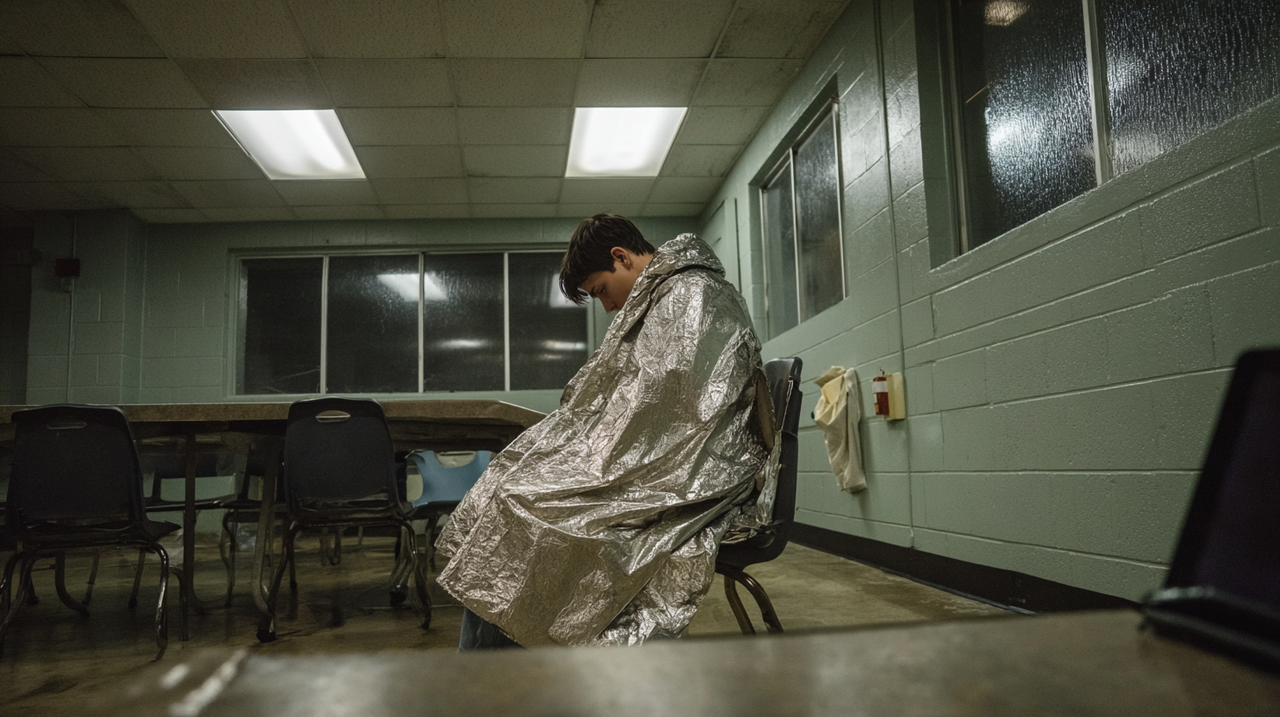
It is a flat-lit room at the back of an arrivals facility on the Kent coast, the kind of room that smells of disinfectant and damp neoprene. A teenager, soaked through and shivering, sits on a plastic chair. He says he is fifteen. The officer in front of him, who has been on shift for nine hours, is not entirely sure. There is a tablet on the desk. The officer angles its camera, asks the boy to remove his hood and look up, and waits while a model trained on millions of faces (none of them his) returns a number. Sixteen. Twenty-one. Nineteen point four. Whatever the number, it will travel with him. It will determine whether he is taken to a children's home or to a hotel full of adult men. It will determine whether a social worker is involved. It will determine, in the most material sense, what kind of person the British state has decided he is.
The room exists, more or less, although the boy in this version is composite and imagined. The camera, the tablet, the model, the number: those are now a matter of policy. On 28 April 2026, the Home Office confirmed that it would proceed with a trial of artificial intelligence facial age estimation on migrants arriving via the Channel, the latest and most contested move in a long, slow rationalisation of border judgement into machine output. The announcement followed a damning report from the Independent Chief Inspector of Borders and Immigration that catalogued more than a decade of badly made age decisions, and arrived in the same month as a published legal opinion arguing that aspects of the Home Office's existing AI work in asylum processing might already be unlawful. Human Rights Watch called the plan “an AI experiment on children seeking asylum”. Right to Remain, the migrant rights charity, used a slightly less diplomatic phrase: “Artificially Intelligent, Genuinely Harmful”.
What follows is an attempt to take the system at its own measure. To ask what the technology actually is, what it can and cannot do, where the law sits, and what standard of accuracy, transparency and accountability would have to apply before it could plausibly be deployed on people who, by definition, cannot afford a barrister. The short version is that the gap between the standard the moment requires and the standard the trial provides is enormous. The longer version begins with a model and a face.
A facial age estimator is, in its modern form, a deep neural network trained on a vast labelled dataset of photographs in which each subject's age is approximately known. Yoti, the British identity firm whose facial age estimation product is the most independently tested in the world, builds its model on tens of millions of images and reports its accuracy in mean absolute error: the average number of years by which the model's prediction differs from the truth. Yoti's most recent results in the United States National Institute of Standards and Technology (NIST) Face Analysis Technology Evaluation, which tested its model on more than eleven million images, give a mean absolute error of about 1.88 years for thirteen to sixteen year olds in NIST's visa image set. That sounds modest. In context it is anything but.
Mean absolute error is a reassuringly tidy number that hides a messy distribution. If a model's mean absolute error is two years, that does not mean every prediction is within two years of the truth. It means that, averaged over the whole population, the absolute differences come out to two. Some predictions will be exact; some will be five or six years off. NIST's own age estimation report, NISTIR 8525, published in 2024, makes the point explicitly: error distributions are wide and asymmetric, and the worst tail matters far more than the average, especially when the model is being asked to draw a categorical line at a specific age. The Home Office's interest is not in approximating someone's age. It is in deciding which side of eighteen they sit on.
Even the firms doing the most rigorous work concede the limits. Yoti's own statements in 2025 and 2026 have emphasised that its product was originally designed for online age assurance contexts (alcohol sales, pornography access, social media age gates) where the cost of error is asymmetric in the other direction: customer friction. Companies, the Human Rights Watch researcher Anna Bacciarelli noted, have tested the technology “in a handful of supermarkets, pubs, and on websites”, with thresholds typically set to flag whether someone looks under twenty-five rather than under eighteen, precisely to absorb the error margin. The supermarket can afford a wide margin. A child wrongly placed in adult detention cannot.
There is then the older, larger problem, which is that facial analysis models do not work equally well on everyone. The 2018 Gender Shades study by Joy Buolamwini, then at the MIT Media Lab, and Timnit Gebru, then at Microsoft Research, evaluated three commercial gender classification systems and found that the error rate for darker-skinned women was up to 34.7 per cent, while for lighter-skinned men it was 0.8 per cent. That study was about gender, not age, but the underlying mechanism is identical: models inherit the demographic skew of their training data. NIST's Face Recognition Vendor Test Part 3, on demographic effects, confirmed the same pattern across dozens of identification algorithms. Performance gets worse when the subject is younger, female, darker-skinned, or photographed under non-ideal conditions. In other words, performance is at its worst on the exact demographic intersection that arrives in a small boat.
This is the heart of the technical objection, and it is not a marginal concern. The population the Home Office proposes to assess is overwhelmingly young, often non-white, very often male but with an under-counted minority of girls, and almost always photographed in poor light after a sea crossing that has reshaped their faces with cold, salt water, dehydration and exhaustion. The features that most age estimators rely on (skin texture, periorbital structure, jaw definition) are precisely those most distorted by the conditions of arrival. As Hye Jung Han, the senior researcher at Human Rights Watch's Children's Rights Division, put it when the trial was first floated in July 2025, algorithms “identify patterns in the distance between nostrils and the texture of skin; they cannot account for children who have aged prematurely from trauma and violence”. They cannot, she added, “grasp how malnutrition, dehydration, sleep deprivation, and exposure to salt water during a dangerous sea crossing might profoundly alter a child's face”.
A model trained largely on benign images of middle-class teenagers in studio lighting is not the same instrument when pointed at a fifteen-year-old Eritrean girl on a winter morning at Western Jet Foil. It is not even the same instrument as the one NIST evaluated in a controlled visa-photograph dataset. There is, at present, no public evidence that any facial age estimator has been independently validated on a population resembling Channel arrivals. The closest thing to it is the Home Office's own statement, reported in April 2026, that its testing has used 2.5 million images. That is a lot of images. It is not an answer to the question of whose images, in what conditions, against what ground truth.
The political seductions of an algorithm only become visible against the backdrop of the system it is meant to replace. The Independent Chief Inspector of Borders and Immigration, currently David Bolt, published in 2025 the report that the Home Office's announcement now leans on. Its conclusion, in the inspector's careful prose, was that “many of the concerns about policy and practice that have been raised for more than a decade remain unanswered”. Decade is the word that matters. The inspector traced the same complaints back to 2013: poor record-keeping at the border, perfunctory visual assessments, an unclear and inconsistently applied “significantly over 18” threshold, and frontline officers under operational pressure making categorical decisions about other people's childhoods on the basis of appearance alone.
The Refugee Council, working with the Helen Bamber Foundation and Humans for Rights Network, had already put numbers to the failure. Between January 2022 and June 2023, eighteen months, more than 1,300 children were wrongly assessed as adults at the UK border. In the first half of 2023, sixty-nine local authorities received over a thousand referrals of young people who had been routed into adult accommodation or detention. Of the cases that were eventually concluded, fifty-seven per cent were found to be children. The error rate of the existing visual assessment, in other words, is on the order of one in two when it gets challenged.
To make the failure of the existing system the case for a camera is to commit a particular sort of category error. It is true that visual assessment by a tired officer under pressure is bad. It is not true that the only alternative is a model. The alternative the law has in fact specified for more than two decades is a Merton-compliant age assessment: a structured social work process developed in the 2003 case B v London Borough of Merton, in which two qualified social workers conduct interviews, weigh documentary and circumstantial evidence, and apply a benefit-of-the-doubt principle to the child. Merton assessments are slow and resource-intensive, but they are a forensic process designed for exactly the kind of uncertain, undocumented case that the border produces. They are not infallible (the Helen Bamber Foundation has long catalogued their inconsistency), but they are at least an instrument calibrated to the ambiguity of the question.
What the Home Office is proposing is not a replacement for Merton, although ministers have been careful with that framing. The minister of state for border security and asylum, Dame Angela Eagle, told parliament in July 2025 that facial age estimation would be the “most cost-effective option” and that it would not be used alone, but as part of a broader set of methods used by trained assessors. The phrasing is reassuring and structurally evasive. In any operational system, a numerical output from a model becomes an anchor. The officer who wants to record an age that disagrees with the algorithm has to write a justification. The officer who wants to record an age that agrees with it does not. That asymmetry is how decision-support tools become decision-making tools, and it is how every one of the previous Home Office automation projects has tended to drift.
There is a particular irony in announcing a new AI deployment in a month when a legal opinion is in circulation arguing that your existing AI deployments are probably unlawful. The Open Rights Group, a digital rights non-profit, commissioned and published in March 2026 a detailed opinion by Robin Allen KC and Dee Masters of Cloisters Chambers, together with Joshua Jackson of Doughty Street Chambers. The Independent picked it up in April. Its target was not facial age estimation, which had not yet been deployed; it was the two generative AI tools the Home Office had already integrated into asylum casework: the Asylum Case Summarisation tool, which produces summaries of substantive interviews for caseworkers, and the Asylum Policy Search tool, which retrieves country-of-origin information.
The opinion's arguments are technical but the gist is uncomfortable. Asylum applicants, the lawyers wrote, have a common-law right to be informed when AI is being used in the determination of their claims, what it is doing, and what its outputs say. Failing to inform them is likely to breach procedural fairness. There may also be obligations under the UK General Data Protection Regulation, including the Article 22 right not to be subject to a solely automated decision producing legal effects, and equality duties under the Equality Act 2010 if the systems exhibit demographic disparities. The Home Office's own internal evaluation, the lawyers noted, had found that nine per cent of summaries from the Asylum Case Summarisation tool were so flawed they had to be removed from the pilot. A nine per cent serious-defect rate in a system that summarises a person's asylum interview is not a marginal quality issue. In the population of people arriving from countries where being returned can mean prison or death, it is a structural risk to life.
What the opinion does not say (because it is an opinion about existing tools, written before facial age estimation was deployed) is that every one of the same fairness, data protection and equality concerns applies to the age estimation trial in sharper form. A summary tool affects how a caseworker reads the file. An age estimator decides what category of human being you are processed as. The legal asymmetry is enormous. And the wider context, courtesy of the Court of Appeal's 2020 ruling in R (Bridges) v Chief Constable of South Wales Police, is that the deployment of biometric AI by a public authority can fail at any of three points: an inadequate legal framework, a failure to grapple with the implications in a data protection impact assessment, and a failure to investigate whether the underlying software exhibits racial or sex bias. The Bridges judgement was unanimous. South Wales Police lost on all three.
The Home Office, asked in April 2026 whether it had completed an equivalent equality impact assessment for facial age estimation, has not published one. It has indicated that one will follow procurement. Which is a particular ordering: deploy first, evaluate later. The Ada Lovelace Institute, in its May 2025 report “An Eye on the Future”, was already arguing that the UK's broader regime for biometric AI exists in a “legal grey area” with insufficient governance even for police use cases that have been litigated to the Court of Appeal. The Institute's recommendation, modelled on the EU AI Act, was risk-based legislation with tiered obligations and an independent regulator. Britain has neither.
The EU AI Act, which entered into force in August 2024 and reaches its main applicability date in August 2026, classifies remote biometric identification and biometric categorisation based on sensitive attributes as high-risk uses requiring conformity assessment, registration and ongoing monitoring. It also restricts certain uses of biometric AI in migration, asylum and border-control contexts. The United Kingdom is not bound by it. But the contrast in framing matters: across the Channel, the legal default for this kind of system is that it is high-risk and must be heavily governed before deployment. In Britain, the default appears to be that it is procurable.
To understand what has actually been abandoned and what has been retained, it is worth dwelling briefly on the strange recent history of UK age assessment. Part 4 of the Nationality and Borders Act 2022, passed under the previous government, gave the Secretary of State powers to specify “scientific methods” for age determination. The Immigration (Age Assessments) Regulations 2023 then specified four: dental panoramic radiographs of the third molars, hand and wrist radiographs, magnetic resonance imaging of the distal femur and proximal tibia, and MRI of the clavicle. The Age Estimation Scientific Advisory Committee, which the Home Office had appointed to consider these methods, advised on which might be defensible, with extensive caveats about uncertainty.
The scientific case for these methods has always been weak. Radiologists have written for years that dental and skeletal age assessment was developed for archaeological and forensic identification of remains, not for live administrative decisions about teenagers; that the variation in skeletal maturation between individuals from different ethnic and nutritional backgrounds is large; that a third molar can be calcified at sixteen or absent at twenty; and that the radiation dose, however small, is ethically dubious for non-clinical use. The Royal College of Paediatrics and Child Health has consistently opposed the use of dental and skeletal X-rays for migration age assessment. The proposals provoked a years-long fight in Parliament and the courts, and, in practice, the radiological tools were never widely deployed.
This is the context in which Enver Solomon, chief executive of the Refugee Council, told reporters in 2025 that he welcomed the Home Office's decision to step back from intrusive scientific methods, but was not convinced that replacing them with AI tools was the answer. The political logic of facial age estimation is precisely that it is non-invasive, fast and cheap. The technical logic is rather different. A clinician's reading of a dental X-ray comes with a published uncertainty range, a peer-reviewed methodology, and a regulator. A facial age estimator comes with a vendor's white paper, a confidence score and a non-disclosure agreement.
There is also a particular institutional irony. The reason the radiological methods were so contested is that they are genuinely scientific in form: they have published error rates, peer-reviewed bone-age atlases, and decades of forensic literature. That very scientific scaffolding is what allowed researchers to point at the data and argue, persuasively, that the methods could not safely distinguish a sixteen-year-old from an eighteen-year-old. The new approach has none of that scaffolding. It also has, courtesy of being a commercial product trained on proprietary data, less of it than the radiology had. The system is being adopted not because it is more accurate than what it replaces (we do not know that) but because its inaccuracies are harder to argue with.
The opacity question is, in the end, the one that matters. Right to Remain's July 2025 briefing on AI age assessment, written by their legal education officer, makes the practical point that a person subjected to an algorithmic age decision currently has no clear mechanism to contest it. There is no published model card. There is no way for the subject's lawyer to obtain the input image, the output number, the confidence interval, the version of the model that was deployed, or the dataset on which it was trained. Even where a Merton-compliant assessment is performed afterwards, the AI output sits in the file as an anchor. To displace it would require evidence that, by design, the subject does not have.
Compare this to what the law would normally demand. In a criminal proceeding, evidence from a forensic instrument is admissible only if its methodology is disclosed, its error rate quantified, and its operation auditable. In medical decision-making, regulators require pre-market validation, post-market surveillance and a paper trail that lets a clinician explain to a patient why the device produced its number. In ordinary administrative law, a public authority making a decision adverse to an individual must give reasons; a reason is not “the model said so”. The Bridges judgement made the point in slightly different language: a public authority deploying a system that profiles individuals must assess whether the system discriminates, must train and constrain its use, and must be able to justify its proportionality at the level of the individual deployment.
Right to Remain's framing of “no clear challenge mechanism” understates the problem. A real challenge mechanism would require, at minimum: the right to know that AI was used; the right to obtain the input image and the model's output, with a confidence range; the right to know the model's version, vendor and training data composition; the right to independent expert evidence; the right to a substantive review on the merits, not merely on procedural grounds; legal aid sufficient to fund such a challenge; and a default presumption in favour of the child's claim where the model's confidence interval includes eighteen on either side. None of these exist for an asylum-seeking minor in 2026. Most of them do not exist for any subject of any algorithmic decision in the United Kingdom.
Nor is the opacity merely procedural; it is technical. Modern facial age estimators are deep convolutional networks, often built on pre-trained backbones like ResNet or vision transformers, with a regression head fine-tuned for age. They do not have legible reasoning chains. The “explanation” tooling that exists for them (saliency maps, Grad-CAM heatmaps showing which pixels mattered) is widely accepted within the machine-learning community to be unreliable as a faithful account of model behaviour. There is, in short, no meaningful sense in which an officer can be told why the model returned the number it returned, beyond the trivial circular answer that this is what the model returned. To ask for an audit trail is to ask for something the technology, as currently architected, cannot provide.
Ally, the Right to Remain legal education officer, captures the core asymmetry in a phrase: “AI can mimic human judgement, but it cannot empathise.” The line is more than rhetorical. Empathy in this context is not a sentimental virtue; it is a functional component of the law. Merton requires the social worker to give the benefit of the doubt to the young person, to consider the child's account in the round, to weigh it against trauma. A model has no doubt to give a benefit of. It has only a probability distribution over a label space, in which “child” is a class boundary and confidence scores cluster in the middle of the range that matters most.
This is, in the end, a question about thresholds. Not the threshold of the model (the age it is asked to predict), but the threshold of legitimacy a state should clear before it deploys a probabilistic instrument against people who lack the resources to contest its output. Drawing that threshold is not a purely technical exercise. It is a moral and legal one, and it is answerable in fairly concrete terms.
The first criterion is accuracy at the relevant decision boundary, not in the aggregate. A mean absolute error of two years is not a property of the model that decides a child's status; it is a property of the population on which the model was tested. What matters at the eighteen-year-old line is the rate at which the model misclassifies a seventeen-year-old as an adult. Published independent evidence on that specific question for the specific demographic of Channel arrivals does not yet exist. Without it, no responsible regulator should authorise deployment.
The second criterion is demographic parity, or as close to it as the underlying problem allows. The Buolamwini-Gebru work, the NIST Face Recognition Vendor Test, and a long line of subsequent studies have established that face-based AI systems exhibit performance differentials by skin tone, sex and age. The remedy is not to declare the differential acceptable; it is to test for it, publish the results stratified by demographic intersection, and require the deploying authority to demonstrate that the residual disparity does not produce disparate impact. The Equality Act 2010 makes that requirement statutory. The Public Sector Equality Duty under section 149 makes it a positive obligation, not a defence.
The third criterion is contestability. A real challenge mechanism, as outlined above, has to exist before the system is deployed, not after a child has been wrongly placed in adult detention. The challenge mechanism cannot be a sealed appeal to the same authority that deployed the model. It has to involve independent expert review, access to the model and its outputs, and a substantive merits standard. It has to be funded; legal aid for age-disputed minors has been eroded for a decade and would have to be restored.
The fourth criterion is proportionality, which is where the legal terrain becomes sharpest. Public authorities deploying intrusive technology against individuals must demonstrate that the measure is proportionate to its aim. The aim, in the Home Office's framing, is efficient and accurate identification of children at the border. The means are a model with documented demographic disparities, no published validation on the relevant population, no challenge mechanism, no equality impact assessment and a confidence interval that the subject cannot see. The Bridges court found a proportionality failure on much thinner facts. It would be surprising if the same logic did not apply.
The fifth criterion is irreversibility of harm. If a misclassified child is sent to adult detention and is harmed there (assaulted, exploited, trafficked, or simply deepened in trauma), the harm is not undone by a later finding that the algorithm was wrong. Where harms are categorical and cannot be made good, the standard of proof for deployment must be correspondingly high. International child-protection law, including the UN Convention on the Rights of the Child, requires that in any decision affecting a child the best interests of the child are a primary consideration. A trial that knowingly deploys a system with known bias against the demographic in question, before independent validation on that demographic, before any published challenge mechanism, has not satisfied that test. It is not even close.
Set those criteria against the announced trial and the gap is not narrow. It is canyon-shaped. The trial proceeds without independent evidence of accuracy on Channel-arrival demographics. It proceeds without a published equality impact assessment. It proceeds without a published challenge mechanism, without legal aid restored to age-disputed children, without an independent regulator in place, and without the kind of risk-based statutory framework the Ada Lovelace Institute called for nearly a year ago and the EU has had on its books since August 2024. It proceeds against the backdrop of a legal opinion that the Home Office's existing AI use in asylum is probably unlawful, and a decade-old indictment from the inspector of borders that the assessment system it sits within is broken.
The case for proceeding is partly fiscal (it is cheaper than the alternatives), partly political (the boats remain a political fact and any technology that promises to manage them attracts ministerial enthusiasm), and partly ideological (a number from a model has the appearance of objectivity, which is exactly the appearance a hostile environment requires). The case against proceeding is, by contrast, dense: technical, legal, ethical and empirical, and almost entirely uncontested by the people who study the technology professionally.
What, then, is the moral and legal standard that would actually be required before such a system could be deployed? It is the standard the rest of public administration, rhetorically at least, claims to apply. Independent validation on the relevant population. Published demographic performance data. Equality impact assessment in advance. Statutory framework with proportionality test. Independent regulator with audit powers. Real, funded contestability for the subject. Default in favour of the child where the system's confidence does not exclude it. Reversibility of harm, or proof that harms can be made good. None of those obtain. The trial proceeds anyway.
There is a particular British way of framing this kind of choice as pragmatic, as a matter of trade-offs, as the inevitable gritty business of border policy. It is worth resisting the framing. The trade-off is not between an inaccurate human system and a more accurate machine one; the existing system is bad, but no public evidence supports the claim that the machine is better at the question that matters. The trade-off is not between cost and care; the cheap option produces irreversible categorical harms whose downstream costs (legal, social, in trauma) the Treasury does not pay. The trade-off, in fact, is between the appearance of decisiveness and the substance of due process. It is the appearance that has won the argument.
A camera at the back of an arrivals room is not a neutral instrument. It is a policy choice, dressed in technological clothing, made on behalf of a state that has decided that the ambiguous childhood of a teenager fished out of the Channel is the kind of question a model can answer. The boy in the imagined room at the start of this article does not get to ask for a second opinion. He does not get to know what the model was trained on, or which version was deployed, or what its mean absolute error was for someone with his complexion and his recent history of immersion in cold water. He gets a number, and the number gets him a bed. That bed is either in a children's home with a social worker assigned to him, or in a hotel where his roommate is a stranger of indeterminate age and intentions. The state has decided the bed; the model has decided the state's decision; nobody has asked whether the model has any business deciding at all.
A mature jurisdiction would have asked. The April 2026 announcement is the moment at which Britain confirms that, on this question, it is not yet a mature jurisdiction. The standard the moment requires is high, specific, and largely already articulated in the country's existing public-law tradition, in the Bridges judgement, in the Equality Act, in the procedural-fairness principles the Open Rights Group's lawyers identified, in the child-protection obligations of the UN Convention on the Rights of the Child, and in the technical literature that anyone who cares to read can find. The standard the trial provides is none of those. The interval between the two is where the children are.

Tim Green UK-based Systems Theorist & Independent Technology Writer
Tim explores the intersections of artificial intelligence, decentralised cognition, and posthuman ethics. His work, published at smarterarticles.co.uk, challenges dominant narratives of technological progress while proposing interdisciplinary frameworks for collective intelligence and digital stewardship.
His writing has been featured on Ground News and shared by independent researchers across both academic and technological communities.
ORCID: 0009-0002-0156-9795 Email: tim@smarterarticles.co.uk
Listen to the free weekly SmarterArticles Podcast
此内容由惯性聚合(RSS阅读器)自动聚合整理,仅供阅读参考。 原文来自 — 版权归原作者所有。