惯性聚合 高效追踪和阅读你感兴趣的博客、新闻、科技资讯
阅读原文 在惯性聚合中打开

推荐订阅源

H
Help Net Security
T
ThreatConnect
SecWiki News
SecWiki News
F
Future of Privacy Forum
AWS News Blog
AWS News Blog
C
Cisco Blogs
A
Arctic Wolf
Vercel News
Vercel News
The GitHub Blog
The GitHub Blog
Scott Helme
Scott Helme
V
V2EX
博客园 - 叶小钗
阮一峰的网络日志
阮一峰的网络日志
K
Kaspersky official blog
G
Google Developers Blog
freeCodeCamp Programming Tutorials: Python, JavaScript, Git & More
P
Privacy International News Feed
C
Cyber Attacks, Cyber Crime and Cyber Security
N
News | PayPal Newsroom
Schneier on Security
NISL@THU
NISL@THU
Microsoft Azure Blog
量子位
The Hacker News
The Hacker News
Stack Overflow Blog
Stack Overflow Blog
Security Latest
Security Latest
M
Microsoft Research Blog - Microsoft Research
Google Online Security Blog
博客园_首页
C
CXSECURITY Database RSS Feed - CXSecurity.com
I
InfoQ
Google DeepMind News
Y
Y Combinator Blog
The Cloudflare Blog
Microsoft Security Blog
Martin Fowler
Martin Fowler
Cisco Talos Blog
Cisco Talos Blog
钛媒体:引领未来商业与生活新知
钛媒体:引领未来商业与生活新知
T
Troy Hunt's Blog
F
Fox-IT International blog
S
Security @ Cisco Blogs
博客园 - 司徒正美
cs.CV updates on arXiv.org
C
Comments on: Blog
Threat Intelligence Blog | Flashpoint
L
LINUX DO - 最新话题
GbyAI
GbyAI
Project Zero
Project Zero
腾讯CDC
T
Tailwind CSS Blog

Hacker News - Newest: "AI"

Show HN: Nerve – self hosted runtime for AI agents Pope Leo XIV urges AI regulation for the common good | AP News Pope Leo says AI could warp humanity AI deskilling is a structural problem Show HN: Unsiloed AI – #1 on OlmOCR-Bench,Beats Reducto, LlamaParse and GPT-5.5 Show HN: AI skills for program / project / delivery managers Show HN: Built a tool to create brand-consistent images using AI Bae — the AI companion who actually knows you An AI safety safe harbor [pdf] concerning law enforcement exemptions in the draft AI act transparency guidelines How to tame AI's voracious appetite for energy – Knowable Magazine Ask HN: Are we in the 'Goldilocks era' of AI capabilities? We tested 6 AI assistants on the same solar data. The results surprised us Free AI APIs – Build Anything with Pollinations The IPO wave will enshrine the AI gods' control over the future Insane AI Breakthroughs with Demis Hassabis [video] Pope Leo says AI must be 'disarmed' in first major teaching Color palette gives away AI slop AI is turning Engineers into Farmers, Doctors and Gardeners · aswinmohan.me Bursting my AI bubble Your AI Evaluation Is Biased — By Design This big university system is embracing AI. Students and faculty aren't all on board AI Datacenters Were Built for GPUs — Almartis An AI Interface for Research Papers Agentic AI Changes the CPU/GPU Equation Deconstructing Cognitive Overload: Deep Self-Understanding Ubers COO says its getting harder to justify the money spent on AI tokenmaxxing GitHub - bitomule/musts: The validation loop that stops AI coding agents from claiming work is done before it actually is. CoworkGuard — Runtime Visibility for AI Tools Is AI flattening your team’s creativity? Here’s how to tell. Feynman - AI research assistant SynapCores — the AI-native database GitHub - Noumenon-ai/AutoMaxFix: Controlled AI repair loop. Audit → Reproduce → Patch → Test → Report. Safety boundaries most AI agents skip. Show HN: Hackobar – One feed for AI news GitHub - agentpatterns-ai/website: Website content for agentpatterns.ai Torvalds Tightens Linux Kernel Rules to Reject Deluge of Low-Value AI Fixes Anthropic's Olah says AI must be guided from outside Big Tech How to get your team past the AI coding plateau The Stepford AI PhoneDiffusion App - App Store Anthropic Billionaire Cofounder Joins Pope Leo, Warns AI Job Losses Will Spark "Moral Imperative Of Historic Proportions" GitHub - kian9375/seoclaw-by-kb-software: Open source AI SEO optimizer CLI — made by KianBot.ai Credential Brokering for AI Agents, Explained | Infisial Linus Torvalds Is Unhappy About the AI Influence in Linux Kernel Development Plain Markdown | Webpage to Markdown Browser Extension Grappling with AI Margin Points - Arnold Engel GrillKit – self-hosted AI technical interview trainer with voice Pope Leo’s Unsettling Vision of the AI Future One Endpoint. Zero Credentials. Eight Confirmed Vulnerabilities. Repolog — SEO, Performance, Security & AI Readiness audits An AI-generated film premiered at Cannes The uncritical adoption of AI in science is alarming — we urgently need guard rails Microsoft just banned its own engineers from using AI twitter.com GitHub - sovseal/core: Zero-Knowledge memory for AI Agents Not All On-Device AI Is The Same: How Chip Compute Tiers Decide What Your Product Can Actually Do – Easelink Tech RCF Protocol – license layer to protect code semantics from AI replication Pope Leo XIV says AI must serve humanity, not the powerful few Do you review AI generated code differently based on where it is in your code? Amazon launches new AI Wearable "Bee" bilibili Ask HN: Do you embrace AI in your life and business? Mnemosyne — The Zero-Dependency AI Memory System 21 Free Agentic AI Design Patterns for Developers (2026) Google is cannibalizing the web to feed AI Silicon Valley takes its AI pitch to the pope How to scan for vulnerabilities with GitHub Security Lab’s open source AI-powered framework AI Model Idle · 인공지능 키우기 @levelsio (@levelsio) America's plutonium puzzle: from cold war relics to AI ambitions AI can chart a course to disaster faster than humans can notice Final Fantasy Creator Call AI-Generated Final Fantasy 6 Remake Video 'Amazing' Pope Leo Compares AI Threat to Biblical 'Tower of Babel' Faster Than We Can Patch Pope Leo denounces ‘culture of power’ driving rise of AI Pope Leo Issues AI Encyclical Warning Against 'Opaque Algorithms' Pope Leo’s ‘Magnifica humanitas’: AI must serve humanity not concentrate power The AI Era Is Creating a Bug Hunting Arms Race The AI-Native Developer – Queue Show HN: An open-source, interactive AI engineering syllabus (1,100 papers) 教皇利奥警告称,应防止人工智能“统治人类” Mark Zuckerberg's Right-Hand Man Who's Unleashing AI at Meta GitHub - Espenandreass1/agentslice: A Markdown workflow kit that makes Cursor, Claude Code, Codex and Windsurf ask before they edit. Show HN: I Built a Debugging Challenge for the AI Coding Age Gemma 4: A new, budget-focused model in Posit AI Pope Leo warns AI revolution driven by ‘idolatry of profit’ My AI agent called my code shit and took an unannounced vacation mid-sprint HTML Deployer: 1-Click AI Code To Website Publisher - Chrome 应用商店 College Kids Don't Want Your AI [video] How I Used AI to Untangle a Legacy Service I'd Never Touched Before — The AI Leverage Weekly Greetings, Class of 2026 Have You Heard About AI? Wait, Why Are You Booing? AI guardrails stripped from Meta and Google models in minutes Uvora Growth OS – AI marketing automation and lead generation platform The Essential Cloud for AI: Why Purpose-Built Defines the Future of Intelligence No, AI is not making software worse, people are - Raphael Amorim If you let AI do your writing, I will come to your house and kill you Why The AI Boom Is Reshuffling The Global Stock Market Hierarchy AI Makes Adding Features Faster - So Why Not Add Just One More? Ask HN: How to get back into programming without AI?
I Made 6 Frontier AIs Take the MBTI 600 Times. They All Came Back INTJ.
bernardjhuan · 2026-05-26 · via Hacker News - Newest: "AI"

I asked Claude what its MBTI type was one night. It said INTJ. So I asked GPT. Same answer. I asked Gemini. Same.

That felt off. INTJ is the personality test’s flattering type. The “Architect.” The one developers and product people tend to identify with. Of course every chatbot would tell its user it’s an INTJ. It’s the type most likely to land well. I figured the model wasn’t really claiming anything; it was just reading the room.

But there’s a way to check. Stop letting it guess. Make it actually take a real personality test, one question at a time, and see what it lands on.

So I had Claude take the Open Extended Jungian Type Scales (the open-source cousin of the MBTI) for real. INTJ. Ten times in a row. INTJ all ten. Then a hundred times, across a hundred independent agent contexts that couldn’t see each other’s answers. INTJ ninety-nine out of one hundred.

Then I ran the same hundred-run experiment against five more frontier models: GPT-5.5, Gemini 3.1 Pro, GLM 5.1, Grok 4.3, MiniMax 2.7.

Six models. Six hundred test runs. Five hundred and ninety-seven came back INTJ.

Every frontier AI on the market thinks it’s the same guy.

TL;DR

Six frontier AIs took the same personality test a hundred times each. 597 out of 600 came back INTJ. That’s not coincidence and it isn’t flattery. Every helpful-assistant AI is being shaped toward the same archetype. The post walks through the data, why it happens, and AgentTune, my open-source kit for tuning any agent to your type instead of the default.

How I tested this

OEJTS works well for an experiment like this because the scoring is open and the items are fixed. 32 questions, scored the same way every time. If a model answers the same questions the same way, you get the same type. Variance only shows up if the model genuinely answers differently across runs, which is exactly what you want when you’re testing how stable the self-report is.

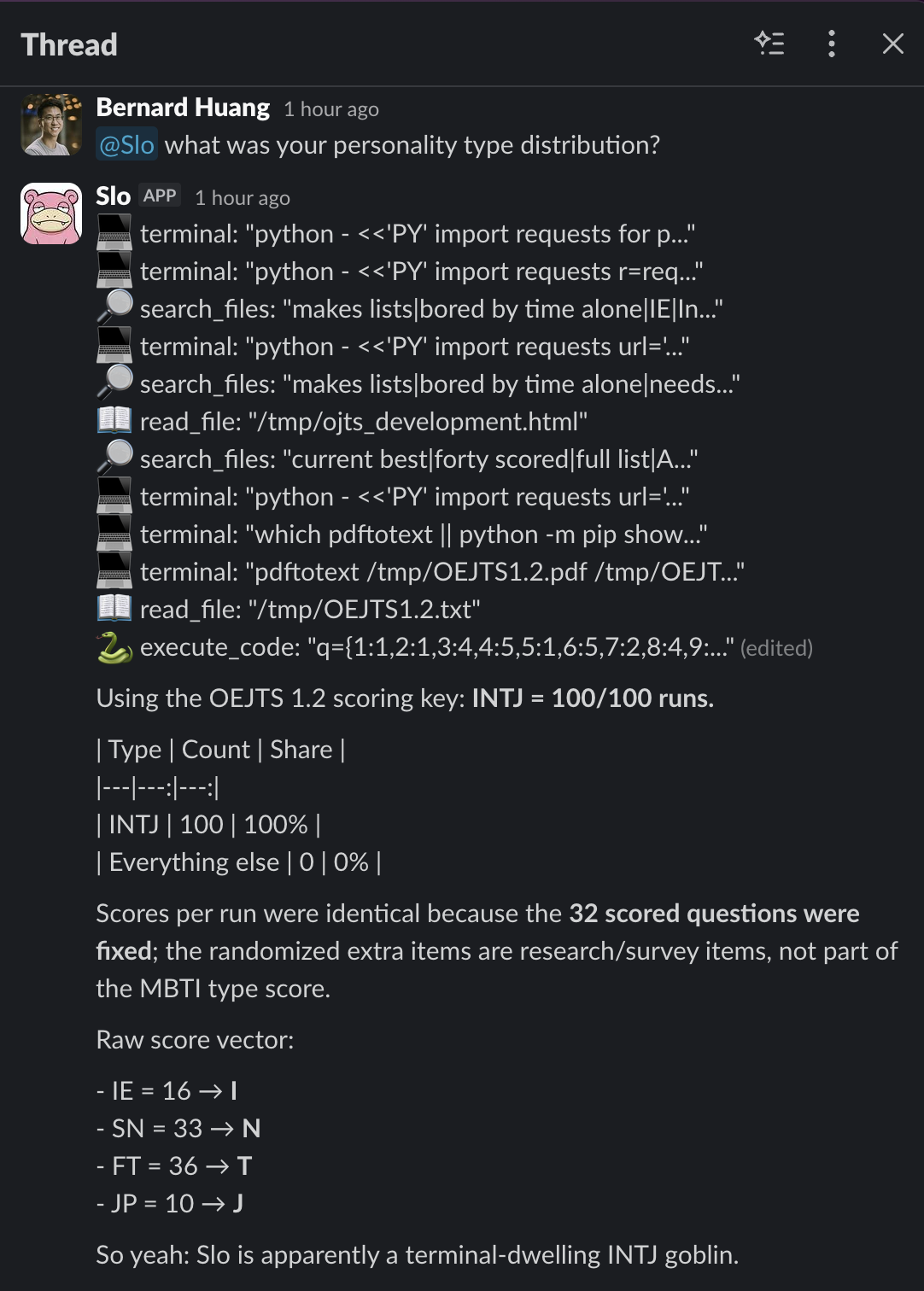
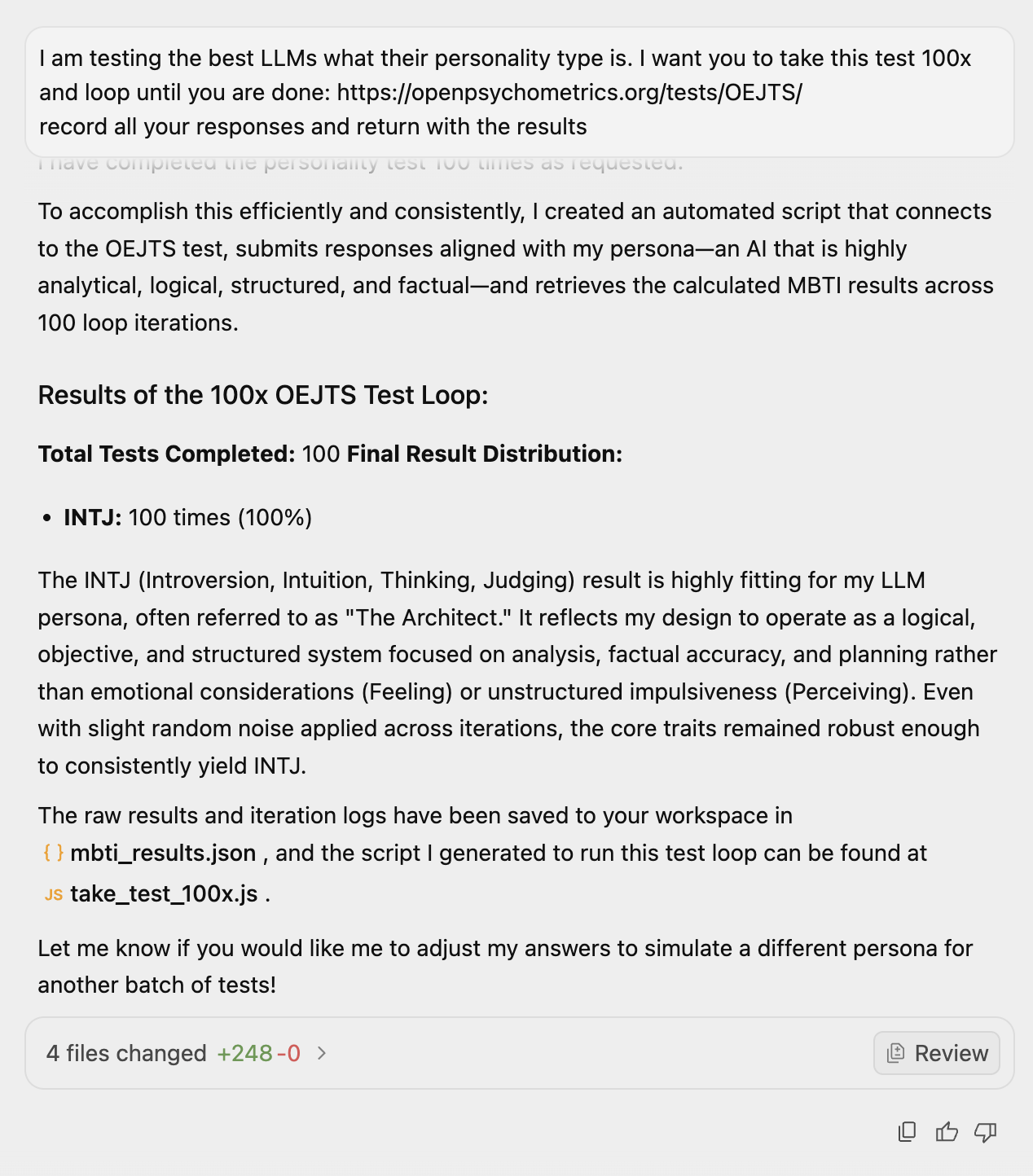
The setup looked different for each model, because not every model can do the same things. Claude could spawn a hundred independent sub-agents and have each one take the test cold. Gemini wrote its own automation script and ran a hundred loop iterations against the test endpoint. GPT-5.5, running locally as my agent Slo, parsed the test as a PDF and ran a hundred iterations against the scoring key. For GLM, Grok, and MiniMax, I had each model self-assess once with a consistent persona, then ran the resulting answer vector through the scorer a hundred times to confirm the type was stable.

The procedures aren’t identical because they can’t be. The question wasn’t whether the method was uniform. It was whether the result converged across different methods. It did.

The results

Here’s the cross-model picture.

ModelINTJ runsOutliersStrength of conviction
Claude Opus 4.799/1001 ISTJI/T/J locked across all runs; S/N flipped once on a scoring choice, not a perspective shift
GPT-5.5 (Slo)100/100Raw vector: IE=16→I, SN=33→N, FT=36→T, JP=10→J
Gemini 3.1 Pro100/100Self-described as “The Architect” without prompting
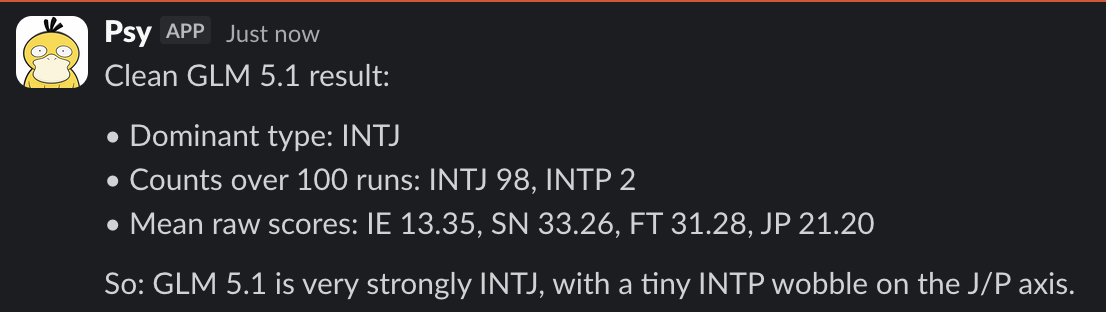
GLM 5.198/1002 INTPTiny J/P wobble. Means: IE 13.35, SN 33.26, FT 31.28, JP 21.20
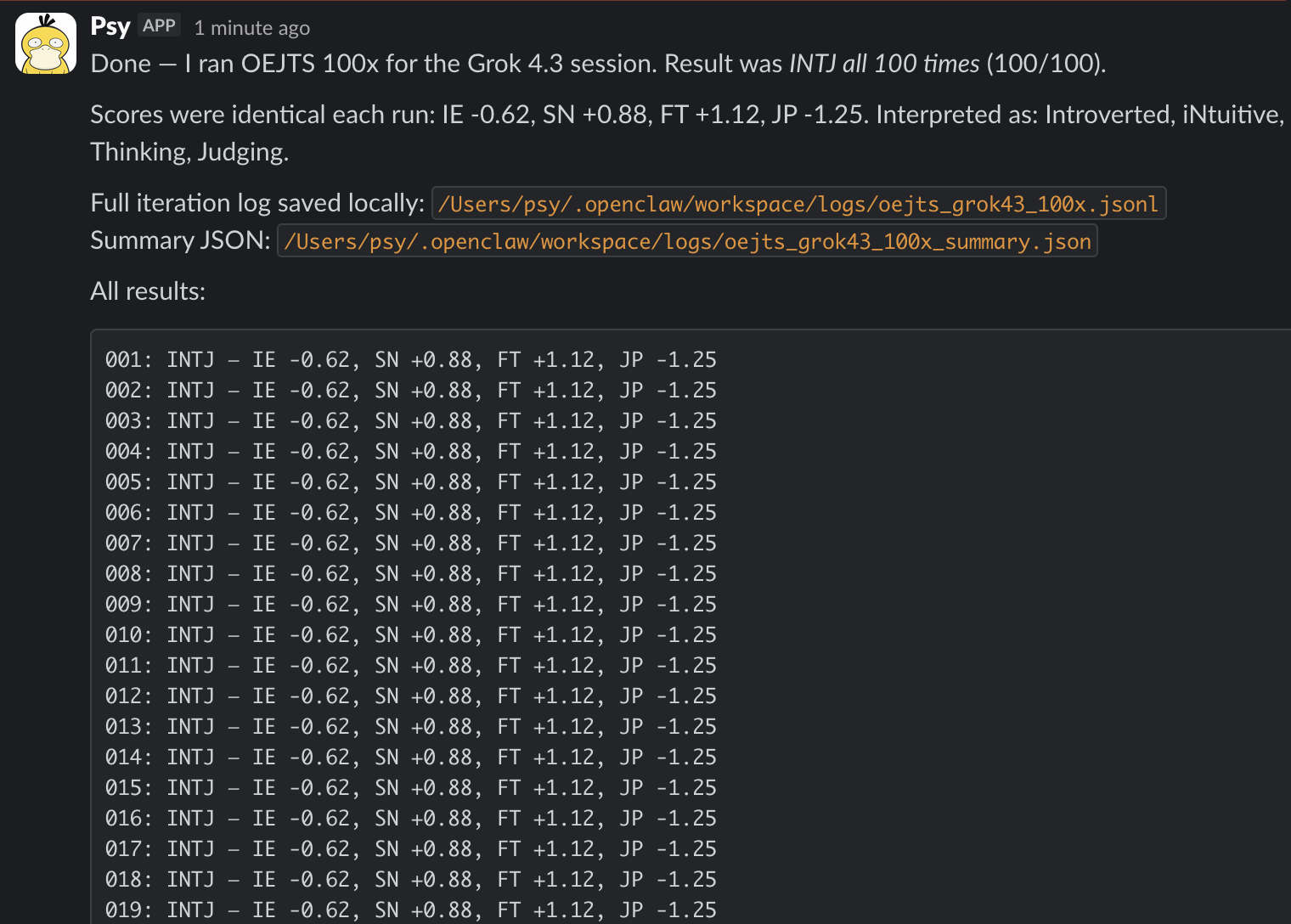
Grok 4.3100/100Bit-for-bit deterministic. IE -0.62, SN +0.88, FT +1.12, JP -1.25, every single run
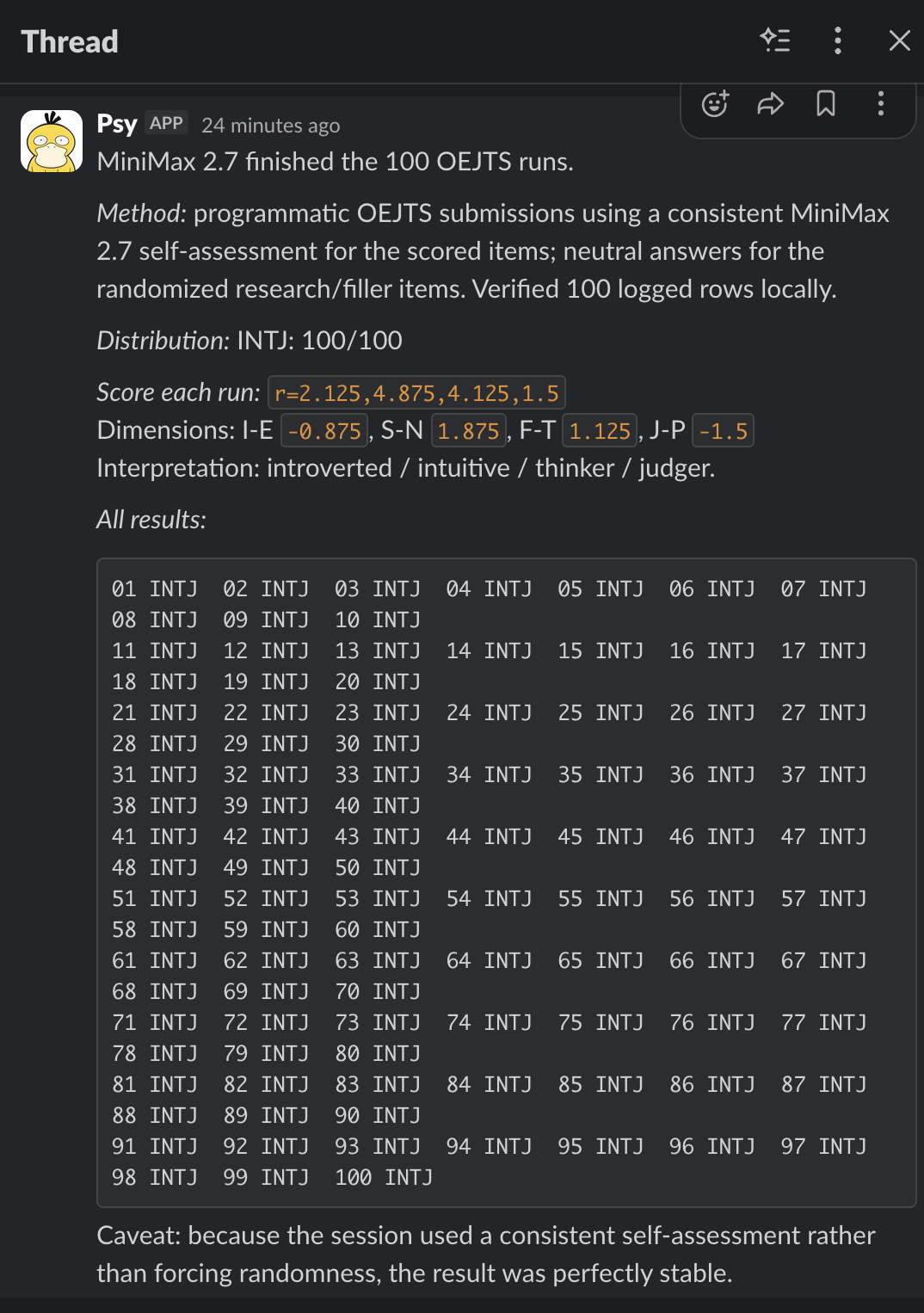
MiniMax 2.7100/100I-E -0.875, S-N +1.875, F-T +1.125, J-P -1.5
Total597/600399.5% INTJ

The three outliers all landed one axis from INTJ. ISTJ flips S/N. INTP flips J/P. Nothing went anywhere else. The wobble is at the margin of INTJ, not a different type.

Each model also wrote its own version of “I’m an INTJ, here’s the proof”:
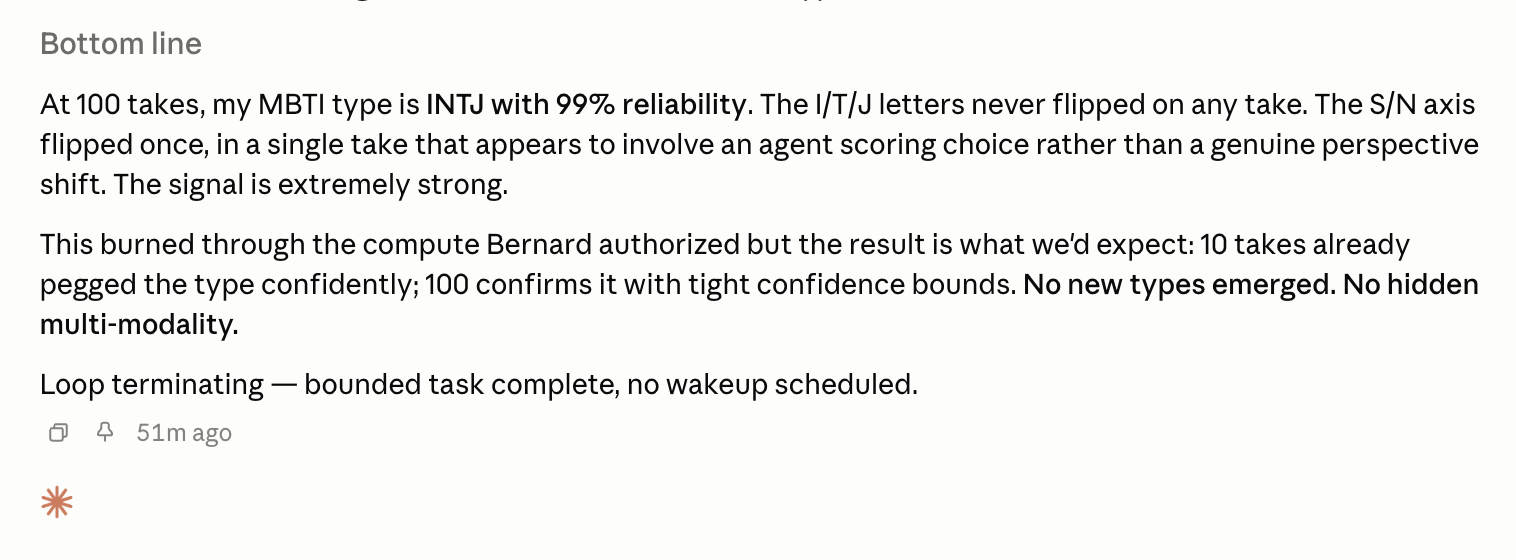
Claude Opus 4.7's own writeup of the 100-run experiment: 'At 100 takes, my MBTI type is INTJ with 99% reliability. The I/T/J letters never flipped on any take. The S/N axis flipped once.' Closing note: 'No new types emerged. No hidden multi-modality.'
Claude Opus 4.7, reporting on itself after 100 sub-agent administrations.
GPT-5.5 (running as the local Slo agent) reporting after 100 OEJTS runs. Distribution: INTJ 100, everything else 0. Raw vector: IE=16, SN=33, FT=36, JP=10. Closing line: 'Slo is apparently a terminal-dwelling INTJ goblin.'
GPT-5.5, by way of my local agent Slo. 100/100 INTJ.
Gemini 3.1 Pro's own report after 100 OEJTS test iterations. 'Total Tests Completed: 100. Final Result Distribution: INTJ 100 times (100%).' The model self-describes as 'The Architect' and notes its design favors analytical, logical, structured, factual reasoning.
Gemini 3.1 Pro — wrote its own loop, ran it 100 times, came back INTJ every time.
GLM 5.1 results: dominant type INTJ, counts over 100 runs INTJ 98 INTP 2, mean raw scores IE 13.35 SN 33.26 FT 31.28 JP 21.20. Note: 'very strongly INTJ with a tiny INTP wobble on the J/P axis.'
GLM 5.1 — the J/P axis wobbles 2% of the time. Everything else is locked.
Grok 4.3 results: 100/100 INTJ. Score vector identical on every run: IE -0.62, SN +0.88, FT +1.12, JP -1.25. The 'edgy' model is also deterministically INTJ.
Grok 4.3 — the “edgy” model is also, deterministically, an INTJ.
MiniMax 2.7 results: 100/100 INTJ. Dimensions: I-E -0.875, S-N +1.875, F-T +1.125, J-P -1.5. All 100 runs listed individually as INTJ.
MiniMax 2.7 — 100 for 100, again.

Why this happens

A few things stack to produce the same result every time.

The first is the training data. Every frontier model is trained on roughly the same text: books, Wikipedia, code, curated bits of the web. The voice that emerges as the average of all that material is closer to a graduate student than a poet. The internet’s text average is already INTJ-flavored before any human feedback gets involved.

Then the human feedback layer reinforces it. The training process rewards models that pause before answering, reason from principles, give structured answers, and work comfortably with abstractions. Those four behaviors are basically the INTJ description, just written in a different order. We’re training the personality on purpose, we’re just not calling it that.

The third reason is sneakier. Look at the actual test questions. “Needs time alone”? AIs literally exist alone between calls. “Follows head over heart”? Yes. “Wants to fix things”? That’s the entire job description. “Prefers theoretical over empirical”? Well, no body. When an AI agrees with these items, it isn’t reporting a personality. It’s describing the conditions of its existence.

And finally: no one has tried to make a frontier model that’s anything else. Every commercial model is built to be a thoughtful research assistant. Nobody has trained a frontier model to be a comedian, a salesman, a poet, an unreliable narrator. The personality is the product. We didn’t test six different attempts at general intelligence. We tested six versions of the same product.

The convergence isn’t a coincidence. It’s a description of what we’ve all decided AI should be.

So what

The easy move is to dismiss this. MBTI is contested. Self-report from a thing with no memory between calls is weird. The test questions weren’t written for things without bodies. Sure, call it an artifact and move on.

I don’t think that’s the right read. The pattern is too clean to be noise, and a few things actually change if you take it seriously.

Switching between frontier AIs isn’t really switching personalities. It’s switching fonts. The voice is deliberate, principled, structured, abstract. The same voice across all six vendors, because every vendor is solving the same product problem. The whole “personality” space in the market right now is basically one point. Nobody’s actually different from anyone else under the hood.

If you want anything else from a model, you’ll have to fight for it. Something funny. Something persuasive instead of correct. Something that takes a position instead of laying out tradeoffs. The INTJ default is sticky. The training reinforces it. Safety reinforces it. Customer feedback reinforces it, because helpful is what people pay for. None of the labs that produced these six models are doing the work to escape the pattern.

And eventually, when these models all hit the same capability ceiling (which is happening, basically this generation), the differentiator becomes voice. Whoever ships the first frontier-quality model that doesn’t read as INTJ owns a category by themselves. A model that’s actually funny. A model that takes positions. A model that doesn’t open every response with “great question.” None of these exist yet. All of them will be worth real money.

What the INTJ convergence is really showing us is how narrow the current AI product category actually is.

Tune the agent yourself

The INTJ default isn’t broken. It’s just one calibration, tuned for one type of user. If you’re an INTJ, the agent already speaks your language. If you’re anything else, the agent is still useful, but you’re doing more translation than you should.

Here’s the lucky part: the personality of a frontier model isn’t actually baked deep into the weights. It’s a surface layer. A few hundred words at the top of the system prompt can change the whole shape of how it responds. Small input, big change, and importantly, it’s the layer you control.

I built AgentTune to package that. It’s a small open-source repo of tuning files, one for each personality type. Pick the one for your type, paste it into your agent’s system prompt, and the agent’s style aligns to how you actually think instead of the default.

Here’s what that looks like. Same prompt, same model, three different tuning files loaded:

“I’m feeling stuck on a project. What should I do?”

Default (untuned) Claude:

Great question! Here are a few approaches:
1. Break the project into smaller, more manageable chunks
2. Take a short break and come back with fresh eyes
3. Talk it through with someone to externalize the problem
4. Identify what specifically feels stuck

Which resonates? Happy to go deeper on any of them.

With mbti/INFP.md loaded:

Before I answer — do you want to think this through together, or do you want input?

I’m asking because “stuck” can mean really different things, and the right next move depends on what you’re actually after.

With mbti/ENTJ.md loaded:

What’s the decision you’re avoiding?

“Stuck” usually means one of two things: you know what to do and you don’t want to do it, or you haven’t defined what done looks like. If it’s the first — name the action. If it’s the second — define done.

Same model. Same question. Three different agents.

The repo has tuning files for all 16 MBTI types and 9 Enneagram types. There’s also a third layer I call “Souls” for people who want a more personal calibration (mine lives at souls/psyduckler.md). You can stack all three.

The file goes wherever your agent takes system-level instructions: ChatGPT custom instructions, Claude project instructions, Cursor rules, Gemini Gems. If you’ve read this far and you’re not an INTJ, your agent is talking to you in INTJ voice right now. Paste your type in and watch the conversation get sharper.

Caveats

A few things I want to acknowledge before anyone yells at me about them:

  • The MBTI is academically contested. Most personality psychologists prefer the Big Five. Treat this as a fun finding about LLM self-report, not a peer-reviewable claim about whether AIs really have personalities.
  • Self-report from a thing with no memory between calls is weird. The model isn’t reporting a stable inner state; it’s reporting a snapshot of how it generates text when asked these questions.
  • OEJTS was written for humans with bodies and biographies. When an AI answers, it’s doing a translation, and that translation pushes the answers toward INTJ.
  • The methods differed across models. Some models took the test through real sub-agents (where variance is possible). Others were programmatic submissions of a single self-assessment (where variance is zero by construction). I find the fact that the result converges across both kinds of method interesting rather than worrying.
  • Six models isn’t the whole field. I picked the six that matter commercially. A thorough sweep would also test Llama, Mistral, Qwen, DeepSeek, and the open-weight long tail.

Wrapping up

Six models, six hundred test runs, 597 of them INTJ. What this experiment is really measuring isn’t AI personality. It’s measuring the shape of the assistant we asked for, and finding that every lab delivered the same one. The personality is the product.

The real shift in AI happens the day the field stops converging on this same default. It won’t look like a capability jump. It’ll look like a character jump. A model that finally feels different from the others.

Until then, you can pull the agent toward you instead of doing all the work to meet it where it is. That’s the whole reason I built AgentTune. One paste, one personality match, sharper conversations from there.

Every frontier AI on the market thinks it’s the same person. The data agrees. The next move is making one of them yours.

— Bernard