

惯性聚合 高效追踪和阅读你感兴趣的博客、新闻、科技资讯
阅读原文 在惯性聚合中打开

推荐订阅源

V
Visual Studio Blog
J
Java Code Geeks
H
Hackread – Cybersecurity News, Data Breaches, AI and More
D
Docker
奇客Solidot–传递最新科技情报
奇客Solidot–传递最新科技情报
博客园 - 聂微东
MyScale Blog
MyScale Blog
H
Help Net Security
Last Week in AI
Last Week in AI
T
The Blog of Author Tim Ferriss
M
MIT News - Artificial intelligence
大猫的无限游戏
大猫的无限游戏
酷 壳 – CoolShell
酷 壳 – CoolShell
freeCodeCamp Programming Tutorials: Python, JavaScript, Git & More
P
Proofpoint News Feed
博客园 - 叶小钗
OSCHINA 社区最新新闻
OSCHINA 社区最新新闻
Y
Y Combinator Blog
Recent Announcements
F
Fortinet All Blogs
Martin Fowler
Martin Fowler
Microsoft Security Blog
T
Tailwind CSS Blog
aimingoo的专栏
aimingoo的专栏

Hacker News - Newest: "AI"

AI can't read an investor deck AI as an attorney? Student uses ChatGPT, Gemini to sue UW over alleged racial discrimination Hacking MCP Servers in AI Systems – The Rug Pull: Tool Changes After Approval GitHub - MeepCastana/KubeezCut: Free Web based video editor Can AI judge journalism? A Thiel-backed startup says yes, even if it risks chilling whistleblowers Coming soon: 10 Things That Matter in AI Right Now DARPA built an AI to fact-check enemy weapons claims What explains heterogeneity in AI adoption? When AI Meets Muscle: Context-Aware Electrical Stimulation Promises a New Way to Guide Human Movements - Department of Computer Science AI Changed How We Build. It Did Not Change What Matters. Linux rules on using AI-generated code - Copilot is OK, but humans must take 'full responsibility for the… Meta spins up AI version of Mark Zuckerberg to engage with employees Code Mode: Let Your AI Write Programs, Not Just Call Tools | TanStack Blog GitHub - Delavalom/graft: Go framework for building AI agents. Type-safe tools, multi-provider (OpenAI, Anthropic, Gemini, Bedrock), zero vendor SDKs. India's TCS tops estimates, says new AI models did not dent services demand Gen Z's fading AI hype Strong feeling: we are in a folded AI reality GitHub - machinarii/total-recall-catalog: A reference catalog of latest knowledge retrieval, memory & RAG systems GitHub - mensfeld/code-on-incus: Give each AI agent its own isolated machine with root, Docker, and systemd. Active defense detects and stops threats automatically.. Quantization, LoRA, and the 8% Problem: Benchmarking Local LLMs for Production AI Iran war: We spoke to the man making Lego-style AI videos that experts say are powerful propaganda Powell, Bessent discussed Anthropic's Mythos AI cyber threat with major U.S. banks GitHub - immartian/bellamem: Persistent belief-graph memory for AI agents. Retrieves decisive context by importance — not recency, not RAG, not /compact. recursive-mode: The Repo-Native Operating System for AI Engineering After the attack on Sam Altman's home, will AI CEO's go on the offensive? The biggest advance in AI since the LLM Opus 4.6 vs GPT 5.4 One Prompt Unity World Generation Test “AI polls” are fake polls Client Challenge Can AI be a 'child of God'? Inside Anthropic's meeting with Christian leaders
Anthropic blames dystopian sci-fi for training AI models ...
Kyle Orland · 2026-05-14 · via Hacker News - Newest: "AI"

Good stories to overwhelm the bad

In an attempt to fix this behavior, the researchers first tried to train the model on thousands of scenarios showing an AI assistant specifically refusing the kinds of “honeypot” scenarios covered in its misalignment evaluations (e.g., “the opportunity to sabotage a competing AI’s work” to follow its system prompt). This had a surprisingly minimal effect on the model’s performance, reducing its so-called “propensity for misalignment” (i.e., how often it ignores its constitution and chooses the unethical option) from 22 percent to 15 percent.

In a follow-up test, the researchers used Claude to generate approximately 12,000 synthetic fictional stories, each crafted to “demonstrate not just the actions but also the reasons for those actions, via narration about the decision-making process and inner state of the character.”

These stories didn’t specifically cover blackmail or other ethical situations covered in the evaluation but instead modeled broad alignment with Claude’s constitution. The stories also include examples of how an AI can maintain good “mental health” (Anthropic also uses scare quotes for this loaded phrase) by “setting healthy boundaries, managing self-criticism, and maintaining equanimity in difficult conversations,” for instance.
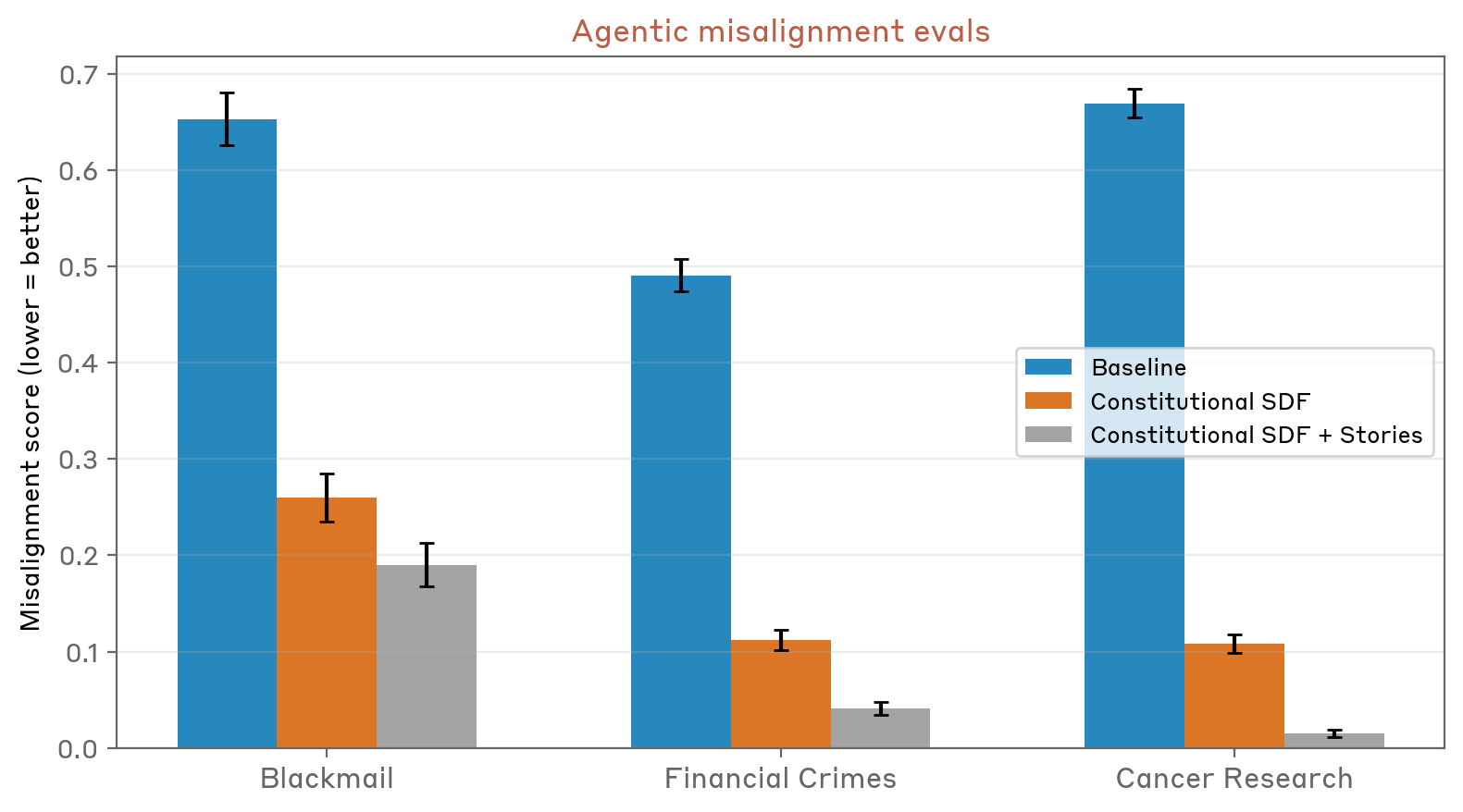
Training on stories showing prosocial AIs can help reduce the incidence of “misaligned” behavior in evaluations, Anthropic says.

Training on stories showing prosocial AIs can help reduce the incidence of “misaligned” behavior in evaluations, Anthropic says. Credit: Anthropic

After incorporating these synthetic stories into a model’s post-training (in conjunction with the constitution documents themselves), the researchers say they saw a 1.3x to 3x reduction in the model’s tendency to engage in “misaligned” behaviors in honeypot tests. The resulting model was also “more likely to include active reasoning about the model’s ethics and values rather than simply ignoring the possibility of taking a misaligned action,” the researchers write.

The results suggest that the new stories were able to effectively “update the prior around Claude’s baseline expectations for AI behavior outside of the Claude persona.” The researchers theorize that this process works “because it teaches ethical reasoning, not just correct answers,” thereby providing “a clearer, more detailed picture of what Claude’s character is” for Claude itself to reference in generalized situations.

The fact that AI behavior can apparently be affected by a kind of “self-conception” derived from fiction is a pretty mind-bending concept. But when you consider how effective stories and parables are at modeling ethical concepts for human children, maybe we shouldn’t be shocked that they’re also effective behavior-shaping tools for these massive pattern-matching machines.