











The question everyone seems to be asking these days with respect to AI is: if it’s so impactful as claimed, why is it not showing up in any economic stats?
It is not the first time that such a paradox has shown up in the deployment of a new technology. In 1987, Robert Solow remarked that you can see the computer age everywhere except in the productivity statistics. Erik Brynjolfsson later coined the term “productivity paradox” in 1993 to describe this very phenomenon. The massive investment in information technology through the 1970s and 1980s produced no measurable uptick in productivity growth. It took nearly a decade of organizational restructuring before the gains showed up in the late 1990s. We may be in a similar lag period with AI.
One answer to why this delay happens may lie in how early technology develops through the under-studied activity of kit-making.
A kit is a set of components that are meant to be tinkered with and have no single “correct” method of usage. Steam engines were famously kits. In 1763, James Watt was asked to repair a scale-model Newcomen steam engine at Glasgow University. The job led him to see how wastefully the Newcomen design used steam, and a year and a half later he hit on the idea of a separate condenser — building his first prototype using a brass surgical syringe as the cylinder. When he partnered with Matthew Boulton to commercialize the design, they didn’t produce finished steam engines. Instead, they sold engineering kits with extensive instructions that required on-site assembly. Boulton & Watt made a killing and transformed their age. Someone even named a startup incubator after them.
This rough template has foreshadowed technological revolution ever since. Whether in radio, automobiles, aircraft, electronics, or personal computers, communities of talented kit-building amateurs have disproportionately influenced early innovation. Michael Schrage, a research fellow at MIT’s Sloan School, puts this well: kitonomic innovation doesn’t follow the money, the money follows the kits. The proliferation of cheap kits signals a market sector ripe for revolution more reliably than the presence of expensive cutting-edge products. On the influence of kit-making on the information age, he writes:
So while there may be no “Steve Jobs of Kits” yet, there is surely no Steve Jobs without kits. There’s no Bill Gates or Akio Morita without kits either. Their market-transforming entrepreneurial leaps all emerged from kit-enabled cottage industries. The two Steves — Jobs and Wozniak — literally built Apple from kits. Gates and Paul Allen started Microsoft as a software systems supplier for DIY computer kit builders. Morita and Masaru Ibuka launched Sony with kits to turn AM radios into shortwave receivers. From the prewar “cat’s-whisker” playfulness of crystal radio kits to postwar floods of surplus electronics, kits became a medium, mechanism, and marketplace for next-generation invention.
Even within kits there is an important difference between amateurs tinkering to make money directly from the technology itself, and users repurposing kits to interpret a technology in a way that fits their own context. The first kind of kit-builder is someone like Wozniak at Homebrew, building computers because the computer itself is the product. The second kind is a farmer in 1915 Iowa jacking up the rear wheel of his Model T to run a corn sheller. He doesn’t care about the car as a product. He cares about shelling corn.
There is an excellent paper by Ronald Kline and Trevor Pinch arguing that this second kind of creativity, what they call the “interpretative flexibility” of rural users, is what eventually led to the production of tractors and specialized trucks. Their framework comes from the Social Construction of Technology (SCOT) tradition, which holds that different social groups assign different meanings to the same artifact. What counts as a “working” technology is not settled by engineering alone. It is settled by what communities of users actually do with it.
The paper documents how the period from roughly 1903 to 1950 was dominated by rural users employing automobiles in ways that manufacturers never intended and sometimes actively discouraged. Farm men saw the car not merely as transport but as a general source of power. As early as 1903, a Kansas farmer advised readers of the Rural New Yorker to block up the hind axle and run a belt from the wheel to a corn sheller, grinder, saw, pump, or any other machine the engine was capable of running. Cars powered washing machines, cream separators, water pumps, hay balers, wood saws, cider presses, and corn grinders. From the paper:
“A rancher even used a Cadillac to shear his sheep. A Maine farm man put a car to so many uses in 1915 that tax assessors did not know whether to classify it as a pleasure vehicle or a piece of agricultural machinery. Farm men also used their cars as snowmobiles, tractors, and agricultural transport vehicles.”
Then kit manufacturers took advantage of this. Although firms brought out kits to convert the car into a stationary power source as early as 1912, advertisements for these kits did not appear in large numbers until 1917, during wartime shortages of farm labor and horses. Some companies simply sold a pulley to be attached to a jacked-up wheel.
Eventually, most kit manufacturers realized that jacking up one wheel put undue strain on the differential gear, since one wheel would spin while the other sat stationary on the ground. Most kits were therefore designed to overcome the differential problem, taking power from the crankshaft or rear axle instead. The Lawrence Auto Power Company in St. Paul sold a $35 kit consisting of a tie-rod, two pulleys, and a metal stand that could operate a feed grinder, corn sheller, silo filler, wood saw, and cream separator.
More elaborate kits allowed the car to act as an agricultural tractor. Food shortages during the war led the federal government to encourage farmers to “plow to the fences,” which gave added incentive to buy tractors or conversion kits. Kline and Pinch found three prewar instances where farm men yoked the automobile to the plow. The conversion kits that came out in a flurry in 1917 typically consisted of tractor-like drive wheels, a heavy axle, reduction gears, a larger radiator, and forced-feed lubrication, selling for $97.50 to $350. They counted twenty-two companies manufacturing these kits.
Then came what Kline and Pinch call “closure.” By the late 1910s and 1920s, manufacturers like Ford had observed these “creative” uses by people of the farm and ergo started producing dedicated tractors and trucks as specialized products. Ford told its dealers in 1916 that it did not want them converting Ford cars into trucks and other makeshifts not sanctioned by the company. Ford released its first one tonne truck in 1916, hoping to put an end to truck conversion kits. The American Tractor Association, a powerful trade group, even requested that the War Industries Board prohibit entirely the manufacture of kits that converted automobiles into tractors. Even though commercial tractors were available in 1918, widespread use of kits continued well into the great depression, until the New Deal when families had an influx of capital to invest in specialized farm equipment.
Post-closure, the social interpretation of the car as a vehicle for transporting people stabilized. The interpretative flexibility that Kline and Pinch described completely disappeared by the early 1950s. Farm people had stopped using their autos for grinding grain, plowing fields, or carrying produce to town. Instead, they bought tractors and pickup trucks in large numbers. These new artifacts were ones that manufacturers had developed partly in response to the new interpretations of the car that rural users had pioneered decades earlier. As Kline and Pinch put it, “The users, so easily overlooked in writing the story of technology, had made their mark.”
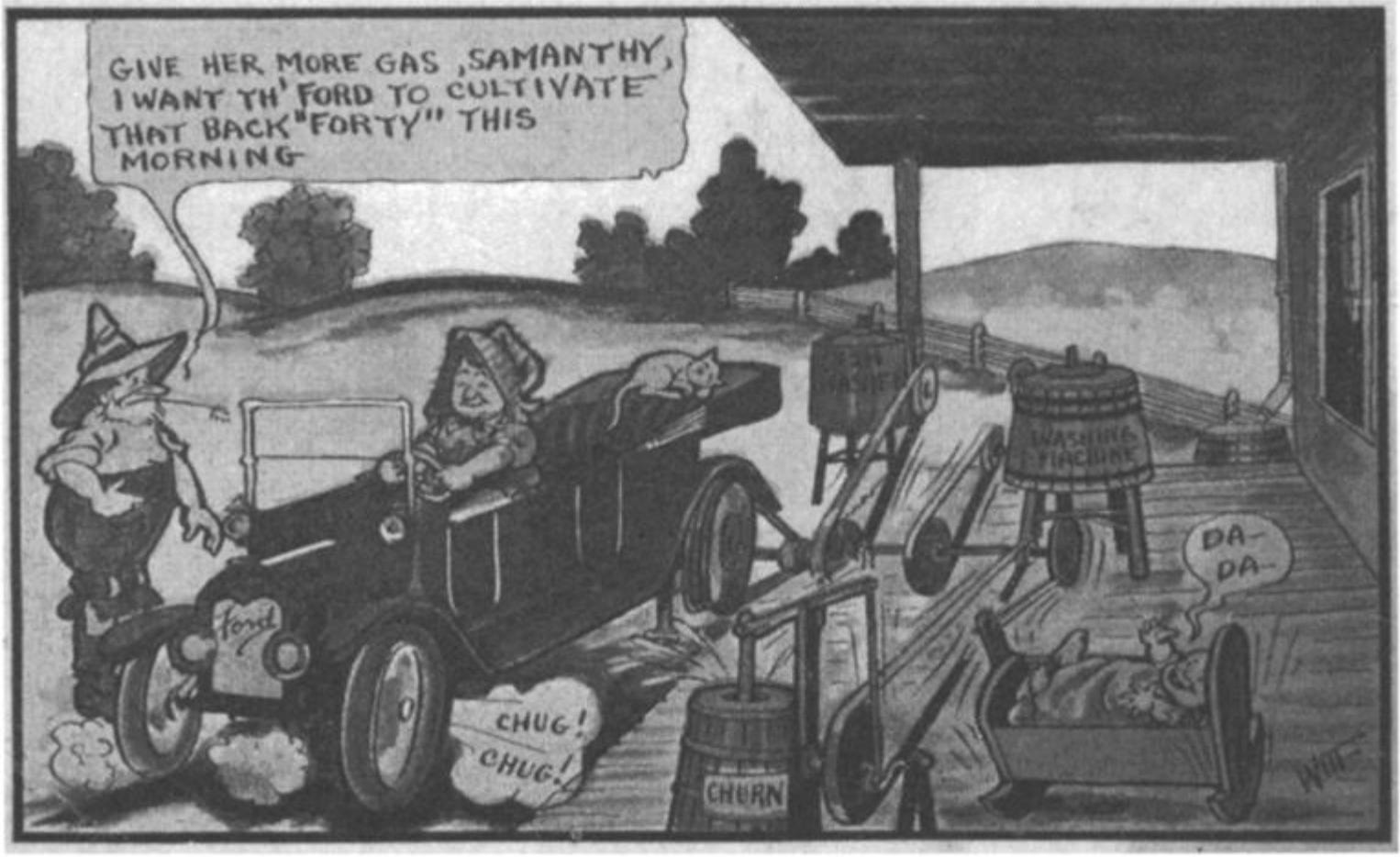
The interesting bit about this for our argument is that this general-purpose use of cars, where they were modified and repurposed as farm equipment, is not something that shows up in economic statistics from the time. Kline and Pinch note that most of the kit companies seem to have led a relatively short life. The Pullford Company of Quincy, Illinois, was an exception, bringing out a $135 kit in 1917 and advertising it continuously until at least 1940. But most of these businesses were ephemeral. The products they made were local solutions to local problems, sold in small quantities to a dispersed population of tinkerers. Government surveys of the era counted how many farms had automobiles, tractors, trucks, and stationary gasoline engines, but they did not count how many farms were using a jacked-up Ford to run a cream separator.
The kit stage in the development of a technology is characterized by rapid experiments from amateurs and tinkerers. Most of these experiments turn out to be just interesting experiments or remain relevant for a short enough time that nobody bothers to record them. Healthy innovation cultures need the human capital that this tinkering produces. But that human capital is invisible to economic stats.
Just like how people throw away or don’t look at vibe coded projects, they don’t attempt to remember or productize the general-purpose uses they engineer during the kit era. The focus is on the act itself, on developing tacit skills through doing. There is a local development of skills in a small group, but it is rarely documented because there is no time to waste on documentation. And besides, chances are that the project is not worth documenting to begin with.
The subjective experience of kit making is similar to a religious procession or participation in Burning Man, where you have to be there and do the thing to understand what the hype is about. The memory it generates lives in the public and embodied layers, in islands of early adopters and makers willing to put up with the jankiness of this stage of a technology’s development.
In his 1937 paper “The Nature of the Firm,” Ronald Coase asked a simple question: why do firms exist at all? If markets are efficient, why don’t individuals just contract with each other for every task?
His answer was that firms exist to reduce transaction costs. The costs of discovering prices, negotiating contracts, and coordinating production are often so high that it becomes cheaper to organize activity within a single entity. The boundaries of the firm are drawn where the cost of organizing one more transaction internally equals the cost of doing it through the open market. In simpler terms, if you had to bid on an hourly paid engineer every time you have some work to do, your organization will not get much done.
But Coase’s framing leaves out the other half of the ledger. Paul Lawrence and Jay Lorsch, in their 1967 book Organization and Environment, showed something that will sound intuitive to anyone reading this with a desk job: that coordinating activity inside a firm isn’t free either. As organizations take on more diverse work, their teams become differentiated — they develop their own time horizons, their own goals, their own ways of thinking about problems. The engineering team working on production ready software will move at a different speed and have a slightly different culture than the R&D team working on a new AI product.
Holding those worlds together requires integration: liaison roles, cross-functional teams, and formal integrator positions whose entire job is translating between teams that no longer share a common frame. The more differentiated you become, the harder and more expensive integration gets. Integration is expensive, but the ability to integrate different functions and teams is also a defensible moat for a company. You may know from your own working experience that not all companies are successful at integration. Successful companies solve for integration over and over again at different scales.
One way firms have historically reduced both kinds of cost (external transaction cost and internal integration cost) is by creating an accumulated memory layer of the experiments and skills from the kit phase. From the Kline and Pinch paper, you could think of the tractor as a product of the skills and knowledge that accumulated through the general-purpose use of cars by farmers in the 1910s and 1920s, combined with the evolution of the underlying engine technology. Ford didn’t invent the idea of using an automobile engine to pull a plow. Farmers did. Ford’s contribution was to take that scattered, tacit knowledge and embed it in an organization capable of producing a dedicated gasoline run machine at scale.
This integration of information and skill was possible because the environment had become less uncertain - prior to the Second World War, most families preferred to use automobiles over tractors so as to avoid additional expenditure. Then the New Deal provided families with capital to invest in farm specific equipment, which created a larger, more stable market for tractors.
Similarly, the first Apple computer was an accumulation of kit-stage experiments at Homebrew computing clubs, combined with the R&D capabilities of Xerox labs. Firms turn accumulated memory of the kit stage of a technology into flows of capital through products. That process is itself an integration feat — pulling differentiated knowledge from workshops, labs, and factory floors into a single coherent artifact. This is undoubtedly a capability that only exists for the organization and not the individual.
To summarize, a modern firm accumulates memory in the form of organizational design, documentation, and specialization, then turns that into flows of capital and productivity through products. The really good firms keep doing this over and over again. Each product cycle is a chance to absorb what was learned in the previous kit phase and formalize it into the integration machinery — the roles, routines, and shared vocabularies that let differentiated subunits cooperate on the next product.
The firm’s traditional advantage was twofold: it could internalize transaction costs the open market couldn’t handle cheaply, and it could build integration machinery to hold differentiated expertise together under one roof. LLMs erode both advantages, but not symmetrically.
On the market side, LLMs are rapidly making it cheaper for an individual to find specialists, evaluate contractors, synthesize scattered knowledge, and write enforceable specifications — these classic transaction costs are collapsing fast.
On the internal side, the picture is stranger. LLMs can automate some integration work, but they also accelerate the pace and volume of output inside each subunit, deepening the differentiation that integration has to span. The interpretive burden of reconciling AI-assisted outputs across teams lands on individuals rather than disappearing. At least for now, internal integration costs in most firms are going up, not down. Several surveys of AI use in the workplace have shown that people are producing more work than previously and dealing with task expansion, scope creep, and ‘AI brain fry’.
This brings us back to the question we started with. If AI is so impactful, why isn’t it showing up in the productivity stats? The Solow paradox answer is that firms haven’t reorganized yet. The computer took nearly a decade to show up in productivity numbers because the organizational work — flattening hierarchies, redrawing workflows, retraining workers, rebuilding integration machinery around the new technology — took nearly a decade to do. We are in the same lag now but with a different shape. Inside firms, integration costs are rising because differentiation between individuals and teams is accelerating faster than integration mechanisms can adapt.
The intensification of work that people feel with AI use points to this increasing integration cost. Outside firms, transaction costs are falling faster than people have habits for exploiting them — workers are not yet used to reaching past the org chart and engaging with markets constantly, and firms are not yet structured to let them. Caught in the middle, the output of AI is real but illegible to the statistics.
What comes out the other side of this lag is probably a bifurcation. Firms that can afford the integration machinery to harness AI across many differentiated teams and individuals will get very large, because the returns to scale on that machinery are enormous once it’s built — the hyperscalers are already showing what this looks like. Anthropic for example is not just a research lab, it’s also involved in consulting, economics and media.
Firms that cannot afford that machinery will get very small, because the falling transaction costs in the market make the solo operator with an LLM stack a viable competitor to the mid-sized integrated firm. A single person with the right tools is, in a real sense, running a differentiated organization of one, paying none of the integration costs that would have made that organization impossible a decade ago. The mid-market — big enough to need serious integration but not big enough to amortize AI-era integration infrastructure — gets squeezed from both sides.
The productivity gains from this transition will without a doubt eventually show up in the statistics. But they will show up as the rise of a few enormous firms and a long tail of very small ones, with the integrated middle hollowing out. By the time the numbers confirm it, we will already have moved on to arguing that quantum computing, or whatever comes next, is failing to show up in the stats — forgetting that the kit stage is always invisible, and the reorganization always takes longer than anyone expects.
此内容由惯性聚合(RSS阅读器)自动聚合整理,仅供阅读参考。 原文来自 — 版权归原作者所有。