







I work on the topic of AI and jobs for a living, which means I am often asked one particular question. Someone at a dinner, in a hallway or at a conference, leans in, hopeful, and asks: Can’t we just retrain people for the new jobs?
I understand the pull of that question and why people gravitate to it. The mental model is straightforward: over here is a big group of jobs that AI is threatening to take, and over there are the jobs that will survive and the new ones that will be created. Can’t we just ferry people from the risky shore to the safe one? Retrain them, match them, help move them across? It’s intuitive, it’s tidy, and it seems doable.
Believe me, I wish I could say yes, that we could do this at the scale required. It would make me a lot less worried about the “Messy Middle” if we could. But my honest answer is that we can’t. Put simply: we are not going to retrain our way out of the economic disruption ahead.
Here is the heart of what I've come to believe, and the argument of this essay. What we face is not a transition to a stable new shore. It is an economic transformation of historic scale, one that threatens the best jobs we have and the very notion of work as we know it. For decades, technology hollowed out the middle and lifted the top, so "retrain people for the jobs on the rise" made intuitive sense. AI threatens to flip that logic, coming first for the jobs we have always told people to climb toward, and it won't stop there. Once the disruption reaches the safe harbor itself, there is no higher ground left to send people to, and no map for a shore that keeps moving. That is not a problem retraining was built to solve.
To be clear, I am not arguing against retraining. We absolutely should improve our workforce system and our adjustment policies. I am excited about several promising new efforts that are trying to do just that. Plenty of people will need help moving into jobs, and we need better ways to help them get there. Any serious strategy for AI’s economic impacts will have training somewhere in it.
What I am arguing is a matter of emphasis. If we convince ourselves that training is the answer, the main lever, the thing we can all agree on and fund and point to, we risk giving ourselves false comfort and avoiding the bolder, harder, messier work that this moment demands.
It is easy to see how this could happen. The promise of retraining is seductive. It offers a practical, employer-friendly solution that appeals across the aisle in large part because it asks nothing of anyone with power. We could let the technology rip, let the companies and shareholders reap the gains, benefit from the growth and the geopolitical edge that follow, and then, after the fact, move the people on the losing end into something new, and presumably good. No one has to slow down, or wrestle with hard tradeoffs, or challenge the status quo.
We have been seduced by this promise before. A few generations ago we made a grand bargain about trade. Political leaders pledged that retraining would carry the displaced safely to the other side of a changing economy. We are still dealing with the fallout.
Three decades ago, America was gripped by a fierce debate over an earlier economic disruption, much as we are now over AI. The fight over trade and NAFTA dominated the 1992 presidential election, with third-party candidate Ross Perot warning of a “giant sucking sound” of good manufacturing jobs draining south to Mexico. On one side was the fear of job loss. On the other were the arguments for expanded trade: competitiveness, growth, new jobs, cheaper goods. Those arguments won.
In September 1993, four presidents stood together on a single White House stage to vouch for NAFTA, two Republicans and two Democrats.
In his remarks that day (video below), President Clinton met the jobs fear head on. He named the wound plainly, noting that economic change "has often been cruel to the middle class," and then made the turn: "we have to make change their friend." Then came the grand bargain to displaced workers, centered on the promise of retraining:
“We no longer need an unemployment system, we need a reemployment system. And we have to create that. And that’s our job.”
The centerpiece of that reemployment strategy was Trade Adjustment Assistance, or TAA. Created under Kennedy in 1962 and expanded for the NAFTA era, it was the government’s designated bridge for workers displaced by trade: enhanced income support while you looked for work, and funding to retrain you for something new.
The real test came a few years later, when Clinton signed the legislation that opened the door to China’s entry into the WTO. That decision, far more than NAFTA itself, is where the employment shock landed. And the bridge did not hold.
The consequences were devastating. Rising Chinese imports erased an estimated two to 2.4 million jobs. According to the definitive paper on the “China shock”, economists David Autor, David Dorn and Gordon Hanson found that in the hardest-hit towns of the Midwest and Southeast, the job losses were never replaced: employment fell one-for-one (as jobs did not rise to replace them), wages and labor-force participation stayed depressed for over a decade, and the displaced mostly did not move or recover. The promised “reemployment” response never came. At its peak, TAA reached only about 130,000 people on average per year, a tiny fraction of those who were displaced.
The social toll that followed was just as severe. As I noted in my recent Substack, a generation was lost to deaths of despair, opioid addiction, family dissolution, declining male labor force participation, a crisis of meaning that Case and Deaton and others have documented exhaustively. A widespread sense of abandonment fueled a powerful political backlash and a right wing populist rise that endure today.
Studies of TAA's effects conflict, but the broad consensus three decades later is that the country's trade adjustment and retraining programs failed to live up to their promise.
While noting this failure, some experts have pointed to execution flaws, not the fundamental premise of retraining, as the culprit. In a recent essay for Equitable Growth, Jacob Leibenluft noted that the program reached only a sliver of the workers it was meant for, moved at the speed of paperwork, and spent more energy keeping the wrong people out than getting the right ones in. By learning from these past mistakes, perhaps a future iteration can do better.
But step back from TAA to the wider evidence on retraining and the picture does not brighten much. Across decades of careful evaluation, the record is mixed, and modest, at best.
To see why, start with one town that did everything right. When General Motors padlocked its Janesville, Wisconsin plant two days before Christmas in 2008, thousands of laid-off workers went back to school, just as we tell people to. The local technical college steered people toward the fields the labor data called hot, won a federal earmark, and brought in local employers to say what they needed. If retraining works anywhere, it should have worked here.

Amy Goldstein, then a journalist at the Washington Post, spent years digging into what happened next. In addition to telling the stories of displaced workers in her outstanding book Janesville, she also teamed up with two labor economists and tracked the numbers. They found that the workers who retrained ended up no better off than the neighbors who didn’t, and by most measures worse: less likely to be working, earning less, with nearly four in ten earning nothing at all. And the part that should stop the policy world cold: the people who trained for the promising fields, the jobs the data pointed straight at, were no more likely to be employed than anyone else. They had trained for the future, and in a town that had just lost its anchor, the future wasn’t hiring.
That is the trap retraining walks into. Not bad teaching, but the plain reality that you cannot train your way into a job that isn’t there. As the economist Anthony Carnevale put it to Goldstein, “if there’s no demand for magic, there’s no demand for magicians.”
And yet retraining is the answer nearly everyone reaches for, at every turn. Janesville was not a backwater no one was watching. It was the model everyone pointed to. Barack Obama had stood inside that very plant in 2008 telling workers that with the right support it could run for another hundred years. By 2012, with the plant cold, the cure had become bipartisan gospel. Obama, Mitt Romney, and Paul Ryan, Janesville’s own congressman and that fall’s Republican vice-presidential nominee, were all promising from their podiums to retrain the displaced and ready them for the jobs of the future. Even as left and right agreed on almost nothing that year, they agreed on this.
And they still do. This month, Ryan co-launched a high-profile bipartisan commission on AI and work with Gina Raimondo, Biden’s commerce secretary. The new version is sharper, more grounded in evidence, more honest about how little we can predict, and it deserves credit for that. But at its center sits the same promise Clinton made in 1993: that we can build a bridge across the disruption and walk people over to safe ground on the far side.
Retraining endures, but not because the evidence keeps vindicating it. The most comprehensive synthesis we have, David Card and colleagues’ meta-analysis of more than 200 studies, illustrates a wider finding in the data: the average effect is small. They find that training does close to nothing in the first year, and that its longer-run payoff, two to three years out, lands somewhere around 5 to 10 percentage points on the odds of being employed. That is real, and I do not want to wave it away. But to put it in perspective, the authors themselves size it at roughly the effect of finishing a community college degree. A useful nudge at the margin, but not a bridge across a chasm.
There is one consistent bright spot, and it is strong enough that I want to give it its full weight rather than a passing nod. Sector-based training, bound tightly to real, identified demand from employers in fields like health care, IT, or the skilled trades, can genuinely work. This is backed by real evidence from randomized trials of programs like Year Up, Project QUEST, and Per Scholas, which have found earnings gains that are large, that persist, and in several cases that grow over time, the rare social program that clears the bar economists set highest. The evidence shows that training does work under a specific condition: the jobs are concrete, someone is waiting to hire, and the curriculum is built backward from that demand. Sectoral training succeeds precisely because the demand is already there and already known.
The thing that makes retraining succeed is the very thing shocks like trade, and next AI, can destroy. Sector-based training works when there is strong demand for jobs people can, and are willing to, step into. The moment a shock destroys the demand, or scrambles which jobs are safe, or creates a clash with the jobs people truly want, the very mechanism that makes sectoral training work is the mechanism that breaks.
In the communities hollowed out by trade, the strong demand was for the jobs that just died: a specific type of middle class, unionized, family sustaining job that provided identity and dignity. Millions of jobs in this middle rung were wiped out. What rose in their place was something else – something employers may have demanded, but the workers who lost jobs didn’t. I worry this is exactly the pattern that AI will replicate.
These new jobs failed the displaced on three counts at once.
Crucially, most of it didn’t pay what the old work paid. The manufacturing jobs that supported a household on one income were largely replaced by lower-wage service jobs – in food service, retail, grocery – with no union, no pension, and little economic stability.
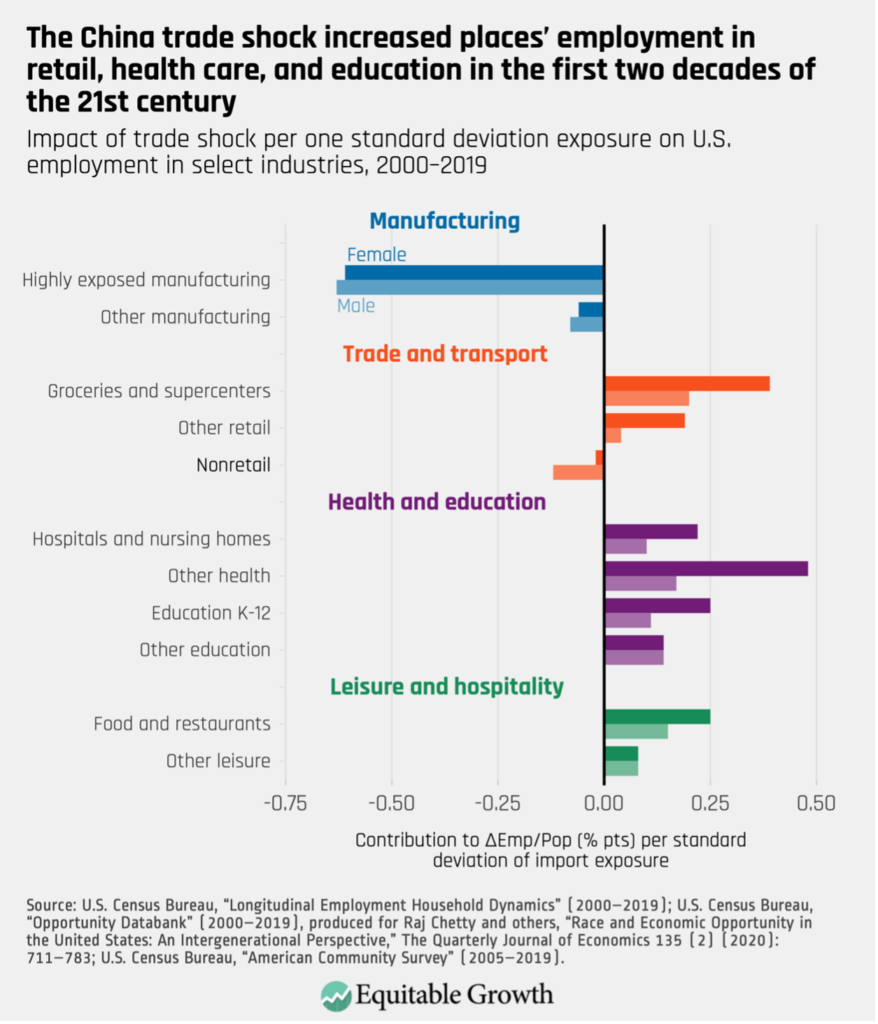
Source: Autor, Dorn and Hanson (Equitable Growth)
Second, it wasn’t where the people were. A lot of the new, well paid work clustered in booming metros, not in the towns where the plants had closed, and the people mostly did not follow.
Third, it wasn’t the work they wanted. Janesville showed the trap from one side, where people trained for the right thing and no job was waiting. This is the other side: the jobs appear, but they're the wrong ones. Many of the jobs that grew during the period of manufacturing job losses were in health care, education and caring professions. By and large, the men who had lost factory work did not take many of them. Not because they couldn’t be trained to, but because a laid-off machinist may not have seen himself becoming a nurse, and no amount of advising changed that. Women moved into those growing “pink collar” jobs in far greater numbers, while a significant share of men simply left the labor force altogether.
It is tempting to read that as stubbornness. But look at the American labor market and you find occupational segregation that is just as stubborn: by gender, by class, by status and identity. People do not experience a job as an interchangeable slot, but as part of who they are. Professional identities have proven remarkably sticky.
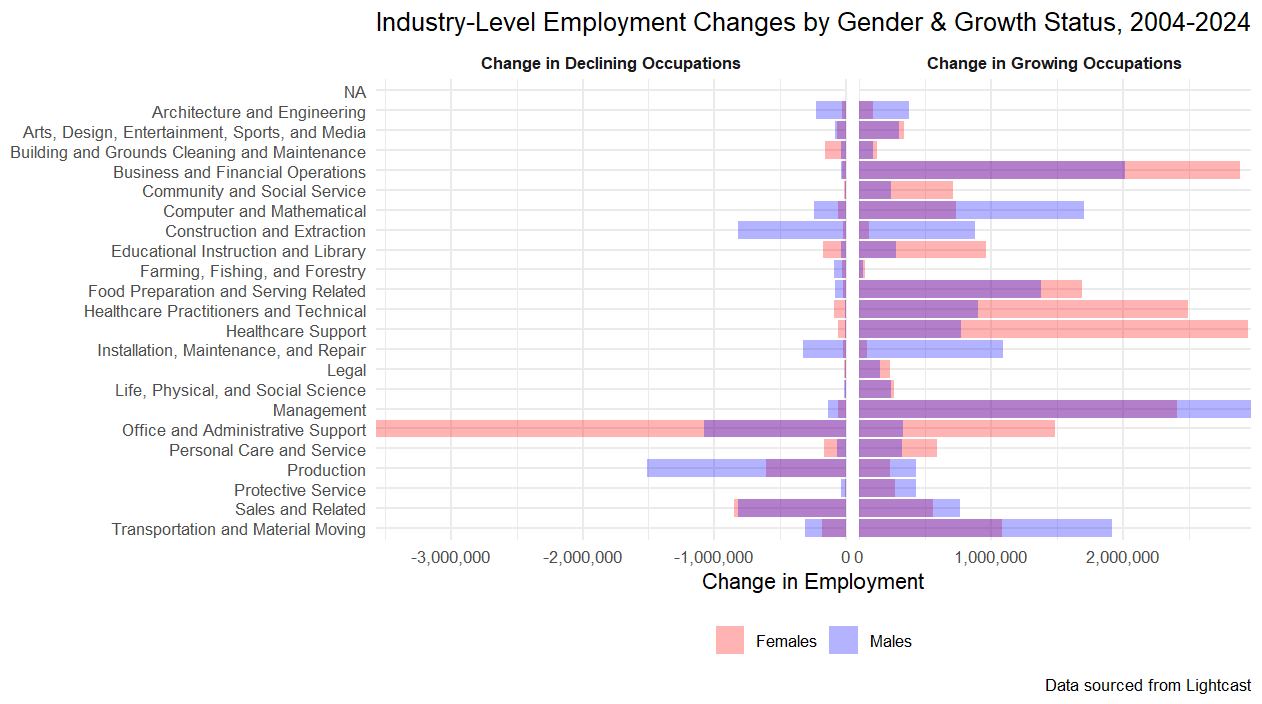
For instance, in the table above, made by my stellar former research assistant Eve Devens, the gender segregation is unmistakable: bars that stretch pink (female) or light purple (male). Professional and managerial positions are now strikingly integrated (dark purple), as women have flocked to higher education and now outnumber men on college campuses. But employment in fields like construction, health care, installation and repair, production, transportation, computer and clerical work remains remarkably gender segregated, just as it has been for decades.
The whole apparatus of retraining operates on the person: train her, re-skill her, relocate her. But every one of the three things that failed the displaced during industrialization was a fact about the job, not the worker. Which is why the framing was the error, never the worker.
The deeper lesson of deindustrialization, which took the country a generation to absorb, is that the problem was not primarily a skilling problem, it was a composition problem. The economy lost a particular kind of stable, middle class job, and workers did not want a different career. They wanted the kind of life their old career had made possible. No political candidate was going to win an election promising to retrain heartland men into respiratory therapists.
That is why the most consequential American policy for workers over the last decade has been industrial policy, not workforce policy: CHIPS, the IRA, infrastructure. The past two administrations spent hundreds of billions of dollars to rebuild the coveted work those men had lost: in manufacturing, infrastructure, the trades, masculine and well-paid and rooted in place. We (correctly) treated their preference, their pay, and their place as real things, worth honoring at enormous public cost. The implicit theory is that we need to manufacture good jobs, not retrofit workers.
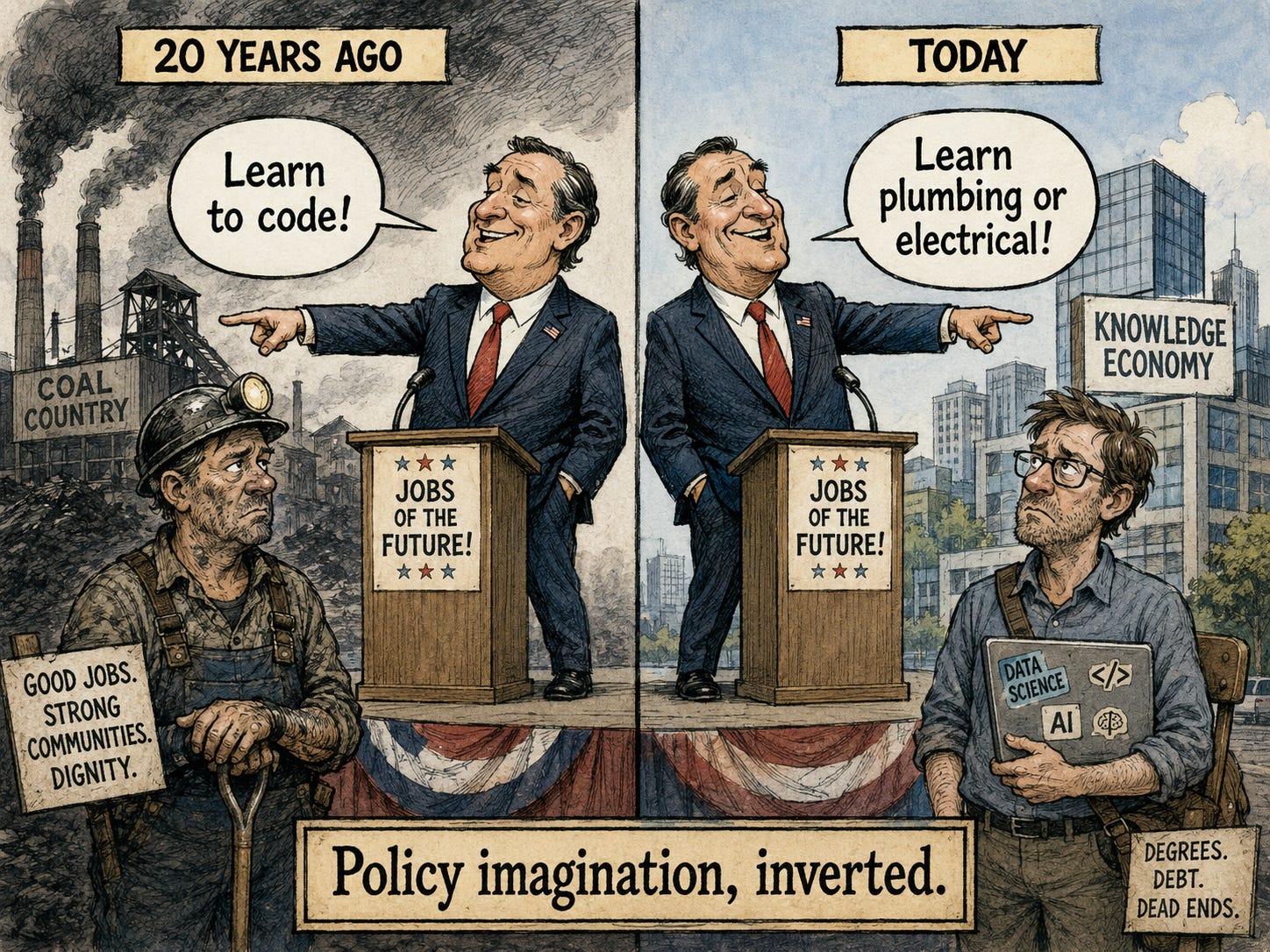
And now, as we face the next big economic disruption, I see us repeating past mistakes, but inverted. Twenty years ago the fantasy was turning coal miners into coders. Today it is turning coders into plumbers and electricians. We point to the data centers rising across the country and the line workers they will need and call them the jobs of the future. The current administration’s AI action plan does exactly this, gesturing at the good trades jobs the build-out will create.
The people living closest to AI’s job risks do not buy it. In interviews over the past year, I have asked bank tellers, customer service managers, medical coders, college students and knowledge workers: are you interested in training to be an electrician, or in HVAC at a data center? Not once have I heard yes. The displaced bookkeeper is no more likely to become a high-voltage electrician than the steelworker was to become a nurse. Today, the jobs now most exposed by AI are disproportionately held by women and the college-educated, while the trades and the infrastructure jobs we point them toward are about as exclusively male as work gets.
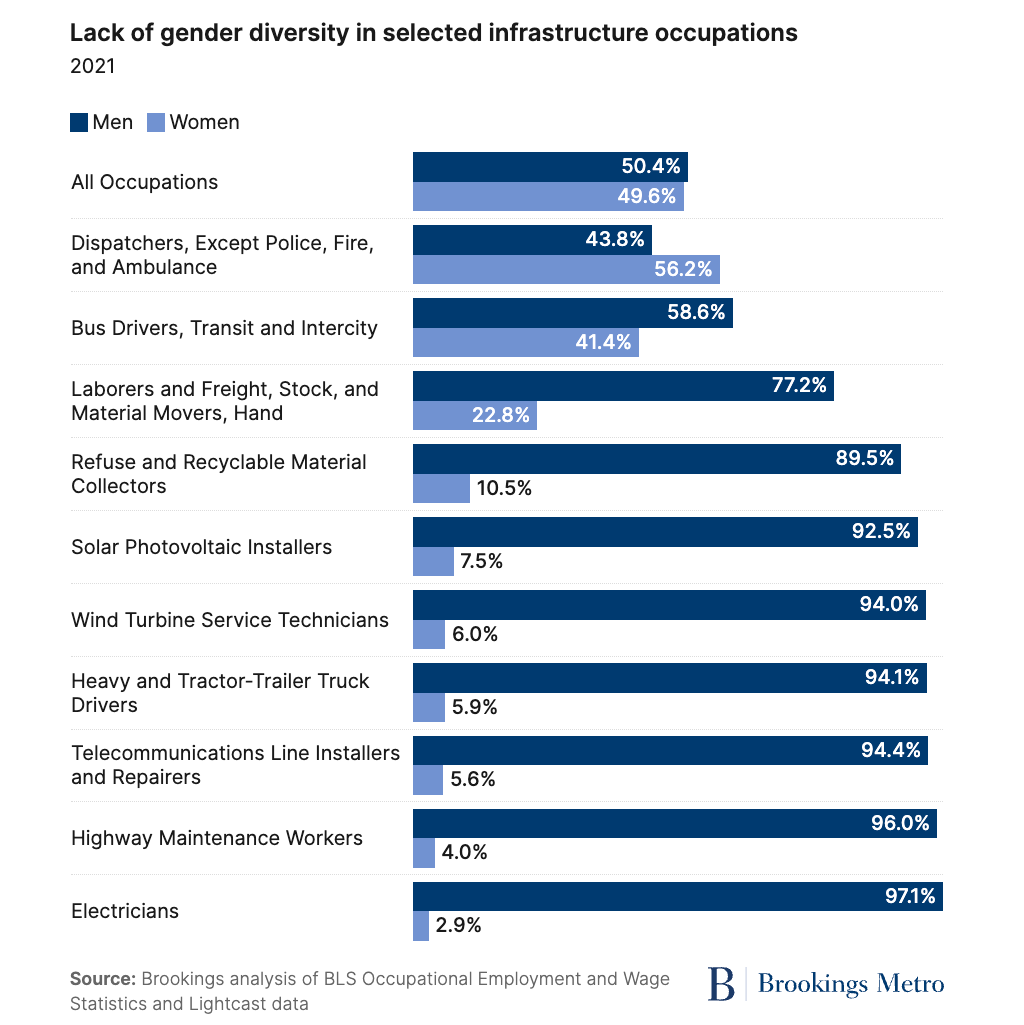
Source: Joe Kane (Brookings)
If anything, the ask is about to get harder. Many of the jobs newly in question with AI are high-paid, high-status, and saturated with identity: the screenwriter, the lawyer, the engineer. “Learn to code” was glib when we said it to a machinist. “Learn a trade,” said to a displaced knowledge worker or a recent graduate who just spent hundreds of thousands of dollars to fund his education, is the same glibness in a hard hat.
When I look at the academic evidence on retraining, I see an even bigger problem. Across virtually all of the studies, the participants of retraining programs are the same: the welfare-attached, the unemployed worker without a college degree, the disadvantaged. There is almost no rigorous evidence on retraining already-credentialed knowledge workers whose careers AI now threatens, for the simple reason that until now they were never displaced at scale.
And here is the part that worries me most: we never built a retraining or workforce system for them in the first place. Our whole retraining apparatus –- WIOA, TAA, the career-pathways infrastructure –- was designed to move the disadvantaged or the laid-off non-degree worker into entry-level employment. There is no part of it whose purpose is to catch a forty-five-year-old lawyer, analyst, or coder and move her into safe work of comparable pay and standing.
Thus the training infrastructure we would hand workers displaced by AI today was built for a different worker, with a different problem, a long time ago. When I ask the people I respect most in the workforce development space whether our existing systems are suited for the kind of disruption AI will bring, universally I hear no.
Here’s why. What I think we are heading into, in this Messy Middle and beyond, is not a one-time job shock like the China shock, and not a tidy, time-bound transition. I believe it is the largest economic transformation of our lifetimes, one in which cognition itself is commoditized and the disruptions - first LLMs, then robotics — never end. Not only will this pose an existential threat to the best compensated, most economically secure work in the economy, but it upends the entire premise of our retraining system.
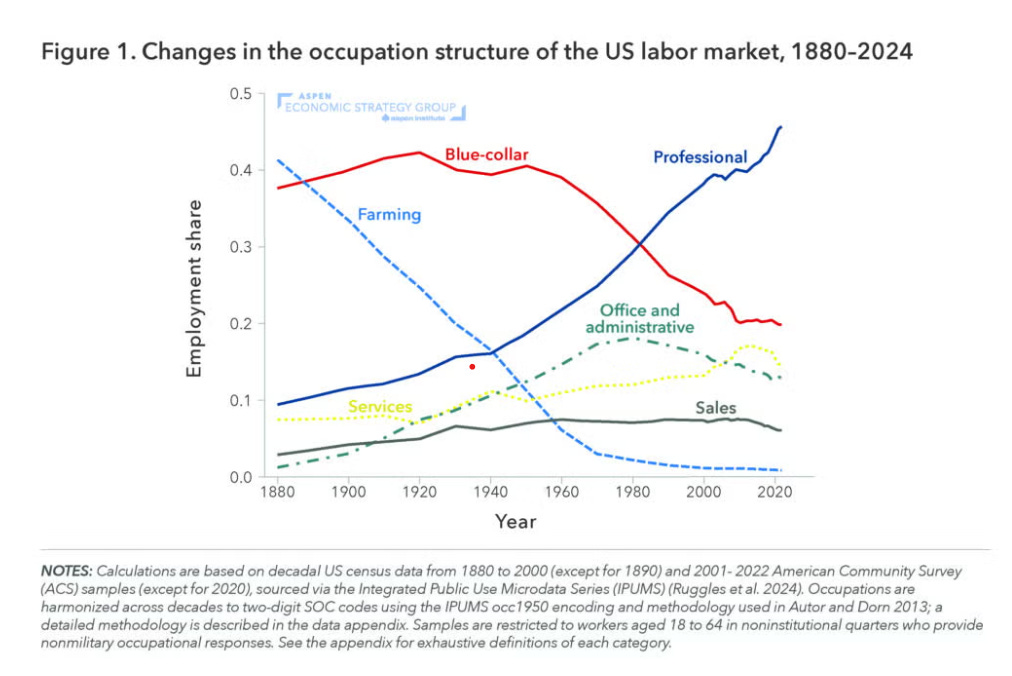
Go back to Bill Clinton’s pledge of a “reemployment system” for the workers on the losing end of NAFTA. He was responding to a labor market that was already pulling apart: the good jobs in the middle hollowing out (the falling red and green lines below), while college-educated knowledge work climbed and climbed (the rising dark blue line).
Source: Deming and Summers
For decades our labor market has run on what economists call skill-biased technological change. In plainer terms, technology was a headwind for routine, middle-class work and a tailwind for high-paid knowledge work. In a market splitting like that, “retraining” and “upskilling” carried an intuitive logic. The jobs on the rise paid well and demanded more skill, so helping workers climb toward them looked like a sensible way to navigate change.
AI now threatens to flip that logic on its head. If the models keep climbing, moving from complementing the most skilled and educated workers to substituting for them in the years ahead, as their own developers predict, then it is the dark blue line that should begin to bend. While I am not claiming to know which knowledge jobs will fall, or what new work might rise in their place, I am concerned that the direction of disruption is the reverse of almost every one before it. And as in deindustrialization, the hardest problem it brings is not that workers lack skills: it is that the economy is losing whole swaths of job, including the best kind we have.
It is precisely this “Messy Middle” scenario that I see coming like a freight train. And it is the one I simply don’t see how we retrain our way out of, or career matching/ job navigation tool our way through. Retrain for what, exactly? Lower paid jobs? Is this, in essence, asking workers to de-skill? We have spent half a century building a system to move people up the skill ladder. For the first time, we could be asking them to climb down it, and calling that a solution.
What does “retraining” mean for a newly minted college graduate who just got a terminal degree in computer science or finance, but the rug has now been pulled out under er before she even started. Are we really asking her to now start a skilled trade apprenticeship?
The toolkit I see so many people reaching for was built for the previous era: career and skilling pathways that could move individuals with less education into better paying, higher skilled work. Yet today is the people who have the most education that are now facing some of the biggest disruption - a reality the system was never designed to address.
Of course, it is entirely possible that new jobs will come online and that they will be great! That they will be the right pay, place and preference.
After all, the optimists could be proven correct. Every prior wave of automation destroyed jobs and summoned new ones no one had pictured. My grandparents, born on farms in Ireland a century ago, could not have foreseen the software engineer or social media manager jobs today, or even that their granddaughter would be publishing this essay online on something called Substack. Maybe an economy with powerful AI will create good jobs we simply cannot name yet.
If that is true, it would be the best possible news. It would also be the whole solution: figure out what the new jobs are, and start pointing people toward them.
The trouble is that no one can do the first part. There is no credible way to forecast what the new jobs will be, and the optimist’s own argument is what gives the game away. If the new work is truly unimaginable, then it is, by definition, work we cannot train anyone for. The very unpredictability that makes the optimist hopeful is what makes the bridge impossible to build.
This is where I feel the most humility, and I feel it viscerally. We are not just bad at naming the jobs that will appear, we are bad at the whole forecast, in both directions at once. For generations, we have over-called the deaths.
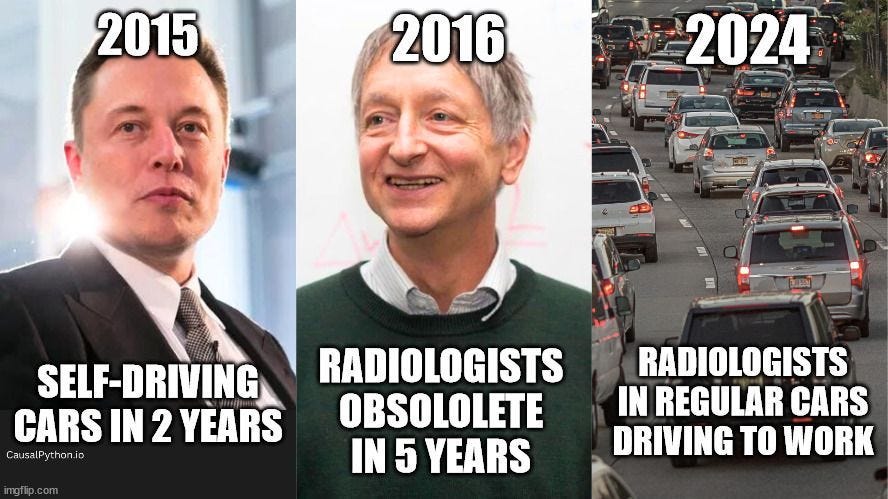
But we also mis-call the safe harbors, which is the error that should unnerve anyone betting on retraining, because retraining needs to know which jobs are safe destinations.
I am leaning on “we” on purpose here, because I, too, got it wrong. Nearly a decade ago, I was working on these questions at New America and engaging local communities in preparing for a future of work that technology was changing. I used the best data any of us had at the time to guide this work, including McKinsey’s numbers and the famous Frey and Osborne study on the “future of employment”. Their 2013 ranking had a clear and confident logic: machines were good at routine work, but not at the kind of intellectual work that defined knowledge work, or creativity, or empathy. So the safe harbors were the creative, the interpersonal, the college-educated.
When ChatGPT was launched just over three years ago, I watched that logic invert instantly. Some of the professions that were deemed close to 0% risk of “computerization” in these studies were now on the frontlines of disruption: writers, software developers, animators, mathematicians. My very first case study on AI and workers was on Hollywood writers, featuring an NYU graduate who had exactly the kind of creative, credentialed work the old framework had called secure.
And I will never forget the morning I first got access to ChatGPT’s advanced voice mode while sitting on a subway train on my commute into work. The first thing I did, to test whether it could really do a person’s job, was ask it to be my therapist, a role the 2013 rubric had pegged at a fraction of one percent risk of computerization. Even in that rudimentary conversation on a crowded train, I was floored. Today millions of people use AI chatbots for exactly that.
So I do not say this to mock the forecasters. I was one of them, in good faith, with the best data going, and it wasn’t enough.
The vertigo goes wider than my own forecasts. For a decade, the entire workforce ecosystem, foundations, governments, and well-meaning programs pointed people toward what looked like the unmistakable safe harbor: learn to code. Coding bootcamps were the great hope, the future-proof skill, the answer for the displaced machinist and the striving first-generation student alike. Now software developers sit among the occupations most exposed to the very tools they helped build. I don't say this to indict anyone, as the bet was reasonable on the evidence we had. I say it because the surest harbor we could name, the one we steered a generation toward, is being redrawn one model release at a time. A quiet reckoning is underway across this field, and anyone honest about it feels the ground moving.
And the difficulty is compounding, not easing. The tools are improving on something close to an exponential curve: by METR's measure, the length of tasks AI systems can reliably complete on their own has been doubling roughly every few months. Sit with what that means for anyone trying to forecast future jobs. I literally do this work full time, I'm immersed in these tools daily, and I have three young children whose working lives I have every personal reason to try to map — and I find it genuinely humbling. Most people are still barely wrapping their heads around chatbots while agents that act on our behalf are already arriving, and robotics could remake whole sectors we haven't even brought into the conversation.
We cannot ferry people to a shore we cannot find. And the shoreline is being constantly redrawn faster than any forecast can hold.
None of this means we give up on retraining. We should pour energy and invention into it. Some of it will get better: AI itself may help us skill people faster, and the knowledge workers now in the crosshairs arrive with savings, networks, and credentials the laid-off machinist never had. We need to try all of it.
But after everything we’ve walked through, we should not hang our hat on it. Not because retraining is worthless, but because of the three things this essay has shown: the track record is poor, we cannot name the jobs we’d be training people for, and the system we’d hand them was built for a different worker, with a different problem, a long time ago.
So I want to suggest a different posture. We should assume, going in, that we will not retrain our way out of this. Treat it as a working premise, not a prediction. The moment we let ourselves believe training is the answer, we stop looking for the others. If we admit it isn’t enough, we’re forced into the harder, less comfortable work this moment demands.
It also changes who is on the hook. Retraining, at bottom, asks everything of the worker and nothing of anyone with power. It says: go reskill, go relocate, go become someone new. That may be a fair ask when the disruption is small and there’s somewhere obvious to land, but is a cruel one when neither is true. We cannot put the full weight of a transformation this size on the backs of individual workers and call it a plan.
I won’t lay out a full agenda here. But let me sketch the territory that opens up the moment we stop treating retraining as the answer.
Before I do that, I owe you a piece of honesty, because I've demanded it of others all essay. I've held retraining to a punishing standard: show me the evidence, show me the jobs are really there. It would be a cheat to now wave in ideas of my own that meet none of those tests. So let me say it plainly: everything I'm about to propose is a bet, not a proven remedy. The humility I asked of the forecasters I owe myself: I can't promise these bets will work, only that they're aimed at the real problem, while the comfortable alternative is aimed at one we wish we had.
Start with the jobs themselves. Much of the work most exposed to AI is among the most coveted we have: it pays well, confers standing, supports a family. If we lose those jobs at scale, no obvious, easy fix waits on the other side. We don’t get to shatter the most valued rungs of the ladder and glue them back together after the fact. Which raises an uncomfortable question: what if the most valuable thing we can do is slow down and keep some of those jobs in the first place, by being deliberate about the pace at which people lose their livelihoods? The tools to get there run a wide range, from carrots like tax credits that reward firms for keeping and augmenting workers, to sticks like regulations and standards that set a higher floor, to bolder ideas like token taxes that make the technology itself more expensive.
I won’t pretend everyone will like this. Managing the pace of disruption collides with the competitiveness argument, the fear that any friction hands someone else an edge, and it asks something real of the people building and deploying these systems, who so far have been asked for nothing. But when the jobs on the line are the ones people care about most, there is no painless option. This is exactly the conversation we should be having, and mostly aren’t.
Second, we will need to think bigger about economic security, where the public is well ahead of the policy world. People are frightened of losing their work, and the evidence, including David Shor’s polling, is that they are not asking for a check. They want something sturdier: job guarantees, protected employment, real insurance against losing the income a household is built on, guardrails and accountability. (Putting on my wonky hat, there is a lot of urgent work that needs to be done to figure out the policy mechanisms that work best, beyond soundbites.)
Third, and biggest: we have to create jobs that people want, not just retrofit workers to chase them. Here the last disruption taught us something, even if it took a generation to learn. The lesson of deindustrialization was not that we retrained the heartland too clumsily. It was that the answer, when it finally came, was to manufacture good jobs rather than remake the people who had lost them. Across the bitterest partisan divide of our time, Trump and Biden shared this one instinct and spent hundreds of billions of dollars on it. Its focus honors the three things retraining ignores: rebuilding the right jobs, at the right pay, in the places where people already lived.
So here is the question that has been on my mind. Where is the equivalent for the people in AI’s path now? For the knowledge workers, who have sunk decades into their education and expertise. For the bookkeeper and HR assistant and those in the back office in towns across the country, who hold the best office jobs for women without degrees. For the young person who did everything right and still can’t find the first rung. We spent hundreds of billions manufacturing good work for the men we had failed, and the factories are rising even if the production jobs haven't yet followed What would it take to be as ambitious for cognitive work as we were for physical work? Where are the moonshot bets, the new creative and entrepreneurial and social sector jobs worthy of the people who need them, the kind of work in which they could still see the American Dream their parents were promised?
And that points to the hardest question underneath all the others. If AI is going to generate enormous wealth by automating human work, who decides where that wealth flows, what gets built, and for whom? We need to be asking much bigger questions than what skills people need: how do ordinary people benefit from the incredible wealth AI is about to create, and how do we best capture some of the surplus and steer it into the work people want? We could ask what these systems are being designed to do, and to whom, and expect more of the companies building them and the employers deploying them than we do today. None of it is a comfortable conversation. All of it is more honest than insisting we can retrain our way around it after the fact.
So here is where I have landed. A transition is a logistics problem: find the safe shore, move people to it. We have been treating a transformation as though it were a transition. But the hard reality is that we are going to have to build the solid ground itself, and decide together what it is made of, and who it is for. That is far harder than retraining, but it is also the only thing equal to the size of what is coming.