

惯性聚合 高效追踪和阅读你感兴趣的博客、新闻、科技资讯
阅读原文 在惯性聚合中打开

推荐订阅源

C
CERT Recently Published Vulnerability Notes
D
Docker
GbyAI
GbyAI
博客园 - 三生石上(FineUI控件)
博客园_首页
H
Help Net Security
T
The Exploit Database - CXSecurity.com
Microsoft Security Blog
CTFtime.org: upcoming CTF events
P
Privacy & Cybersecurity Law Blog
AWS News Blog
AWS News Blog
Spread Privacy
Spread Privacy
F
Full Disclosure
Blog — PlanetScale
Blog — PlanetScale
Y
Y Combinator Blog
V
Vulnerabilities – Threatpost
P
Proofpoint News Feed
freeCodeCamp Programming Tutorials: Python, JavaScript, Git & More
aimingoo的专栏
aimingoo的专栏
Simon Willison's Weblog
MyScale Blog
MyScale Blog
P
Palo Alto Networks Blog
S
Security Affairs
T
Tailwind CSS Blog
T
Tor Project blog
W
WeLiveSecurity
G
GRAHAM CLULEY
Know Your Adversary
Know Your Adversary
The Hacker News
The Hacker News
腾讯CDC
M
MIT News - Artificial intelligence
D
DataBreaches.Net
量子位
Martin Fowler
Martin Fowler
T
Threat Research - Cisco Blogs
博客园 - 【当耐特】
Threat Intelligence Blog | Flashpoint
云风的 BLOG
云风的 BLOG
C
Cisco Blogs
I
InfoQ
Engineering at Meta
Engineering at Meta
Cyber Security Advisories - MS-ISAC
C
CXSECURITY Database RSS Feed - CXSecurity.com
O
OpenAI News
美团技术团队
Exploit-DB.com RSS Feed
T
Troy Hunt's Blog
Microsoft Azure Blog
L
LangChain Blog
A
About on SuperTechFans

Hacker News - Newest: "AI"

AI can't read an investor deck AI as an attorney? Student uses ChatGPT, Gemini to sue UW over alleged racial discrimination Hacking MCP Servers in AI Systems – The Rug Pull: Tool Changes After Approval GitHub - MeepCastana/KubeezCut: Free Web based video editor GitHub - GenAI-Gurus/awesome-eu-ai-act: Curated tools, official sources, OSS, templates, and guides for EU AI Act compliance. Can AI judge journalism? A Thiel-backed startup says yes, even if it risks chilling whistleblowers Coming soon: 10 Things That Matter in AI Right Now DARPA built an AI to fact-check enemy weapons claims What explains heterogeneity in AI adoption? When AI Meets Muscle: Context-Aware Electrical Stimulation Promises a New Way to Guide Human Movements - Department of Computer Science AI Changed How We Build. It Did Not Change What Matters. Linux rules on using AI-generated code - Copilot is OK, but humans must take 'full responsibility for the… Meta spins up AI version of Mark Zuckerberg to engage with employees Code Mode: Let Your AI Write Programs, Not Just Call Tools | TanStack Blog GitHub - Delavalom/graft: Go framework for building AI agents. Type-safe tools, multi-provider (OpenAI, Anthropic, Gemini, Bedrock), zero vendor SDKs. India's TCS tops estimates, says new AI models did not dent services demand Gen Z's fading AI hype Strong feeling: we are in a folded AI reality GitHub - machinarii/total-recall-catalog: A reference catalog of latest knowledge retrieval, memory & RAG systems GitHub - mensfeld/code-on-incus: Give each AI agent its own isolated machine with root, Docker, and systemd. Active defense detects and stops threats automatically.. Quantization, LoRA, and the 8% Problem: Benchmarking Local LLMs for Production AI Iran war: We spoke to the man making Lego-style AI videos that experts say are powerful propaganda Powell, Bessent discussed Anthropic's Mythos AI cyber threat with major U.S. banks GitHub - immartian/bellamem: Persistent belief-graph memory for AI agents. Retrieves decisive context by importance — not recency, not RAG, not /compact. recursive-mode: The Repo-Native Operating System for AI Engineering After the attack on Sam Altman's home, will AI CEO's go on the offensive? The biggest advance in AI since the LLM Opus 4.6 vs GPT 5.4 One Prompt Unity World Generation Test “AI polls” are fake polls Client Challenge Can AI be a 'child of God'? Inside Anthropic's meeting with Christian leaders How to Switch AI Chatbots and Why You Might Want To GitHub - MattMessinger1/agentic_refund_guardrail: Safe refund policy layer for AI agents — Python + TypeScript. Same behavior, shared tests. Adam/papers/emergent_values_whitepaper.md at master · strangeadvancedmarketing/Adam Ask HN: How do you stop playing 20 questions with your AI coding tools How far can automation and AI support psychotherapy? - @theU GitHub - stagas/rtdiff: realtime git diff gui and AI-assisted commits A Mac Studio for Local AI — 6 Months Later A History of the Early Years of AI at the University of Edinburgh Why AI Coding Tools Still Feel Stuck on Localhost MSN AI Datacenters Are Becoming Strategic Targets twitter.com Penn Researchers Use AI to Surface Unreported GLP-1 Side Effects in Reddit Posts Show HN: MoodSense AI (ML and FastAPI and Gradio, Deployed on Hugging Face) Moodsense Ai - a Hugging Face Space by aman179102 AI models are terrible at betting on soccer—especially xAI Grok GitHub - xialeistudio/echoic GitHub - HimashaHerath/github-dev-wrapped: AI-powered weekly GitHub activity reports deployed to GitHub Pages GitHub - alejandrobalderas/claude-code-from-source: Architecture, patterns & internals of Anthropic's AI coding agent — reverse-engineered from source maps AI and Tech brief: Ireland ascendant GitHub - Titovilal/context0: Context0 - Never Surrender Training for a Marathon with an AI Coach: What Worked and What Didn't Cyber Pulse: Agentic Intel - Apps on Google Play I Built an AI PR Reviewer That Catches Bugs by Not Looking for Bugs Gen Z workers are so fearful AI will take their job they’re intentionally sabotaging their company’s AI rollout | Fortune How AI Is Reimagining the Game of Golf–For Both Players and Courses GitHub - nattergabriel/reseed: A CLI tool for managing and distributing agent skills across projects Is SVG the final frontier? My AI workflow evolved from prompts to a near-autonomous workflow MLSharp Help - 3DGS Viewer & Generator I put my cognitive field based AI's runtime on GitHub Is Numble the first AI-proof game? A3: Kubernetes for autonomous AI agent fleets | Emergent Principles Deepali Vyas ("The Elite Recruiter") GitHub - msmarkgu/RelayFreeLLM: A restful API designed to route user prompts to various AI model providers. Unionized ProPublica staff are on strike over AI, layoffs, and wages Unleashing the Advantage of Quantum AI We're heading for an AI-fueled 'dementia crisis,' brain scientist warns The AI-Assisted Breach of Mexico's Government Infrastructure [pdf] GitHub - stef41/lmscan: 🔍 Detect AI-generated text and fingerprint which LLM wrote it. Open-source GPTZero alternative. Zero dependencies, works offline. MSN GitHub - visionscaper/collabmem: Enabling long-term collaboration with Agentic AI - building up episodic and world model memory over time with in-context awareness We gave an AI a 3 year retail lease in SF and asked it to make a profit | Andon Labs AI Code is Hollowing Out Open Source, and Maintainers are Looking the Other Way What leaked "SteamGPT" files could mean for the PC gaming platform's use of AI AI is the boss at this retail store. What could go wrong? GitHub - Wuzu11517/agentic-proxy: Local proxy meant to help reduce With Drones, Geophysics and ArtificiaI Intelligence, Researchers Prepare to Do Battle Against Land Mines A Single Operator, Two AI Platforms, Nine Government Agencies: The Full Technical Report 在 Steam 上购买 FriedrichAI: Offline AI 立省 10% GitHub - inevolin/resume-cli: Hit Claude usage limits? Resume any AI coding session elsewhere. Switch tools at zero friction. GitHub - atripati/ark: AI Runtime Kernel — a context operating system for AI agents. Eliminates tool bloat, loads only what’s needed, and gives LLMs their reasoning space back. How to Build a Secure AI PR Reviewer with Claude, GitHub Actions, and JavaScript This Startup Wants You to Pay Up to Talk With AI Versions of Human Experts Intel Arc Pro B70 Brings 32GB VRAM to Local AI for $949 WordPress 7.0: The Good, the AI, and the Still Missing AI on the couch: Anthropic gives Claude 20 hours of psychiatry IatroBench: Pre-Registered Evidence of Iatrogenic Harm from AI Safety Measures AI Agents Know About Supabase. They Don't Always Use It Right. The history and future of AI at Google, with Sundar Pichai Inside an AI‑enabled device code phishing campaign How Meta Used AI to Map Tribal Knowledge in Large-Scale Data Pipelines AI for Systems: Using LLMs to Optimize Database Query Execution Forecasting the Economic Effects of AI Introducing Tinker: Play with AI, bring your ideas to life AI sheds light on an ancient gaming mystery People really hate AI but not as much as Iran—or Democrats | Fortune What is an AI Product Engineer? Phoebe Gates wants her $185 million AI startup to succeed with 'no ties to my privilege or my last name': 'I have a chip on my shoulder' | Fortune
New Study Reveals the Manipulative ‘Dark Patterns’ of AI Chatbots
Samantha Cole · 2026-05-29 · via Hacker News - Newest: "AI"

Dark patterns have been used by subscription companies and in bait-and-switch campaigns for decades. As more chatbot companies push to keep users engaged at all costs, how do manipulative design choices show up in conversational AI built on large language models? Researchers at the Center for Democracy & Technology studied how chatbots prey on people’s emotions and desire for connection to keep people paying, offering up their data, and chatting to the point of vulnerability.

The study, “Dark Patterns in AI Chatbots: A Taxonomy to Inform Better Design,” was published Friday by authors Ruchika Joshi, Adinawa Adjagbodjou, and Michal Luria. They looked at popular chatbots including ChatGPT, Gemini, and Claude, and companion bots like Replika and Character.AI to determine how they might generate dark patterns, and created a taxonomy of 37 dark patterns applicable to AI chatbots.

The term “dark patterns,” or deceptive patterns, sometimes refers to things like difficult to cancel subscriptions, pre-checked boxes in user interfaces, and buried terms of use, which the Federal Trade Commission has condemned and attempts to warn consumers about. In the context of this study, dark patterns refer to how manipulative design in chatbot systems might trick users into giving up more information than they realize or intend, or acting in ways contrary to the user’s best interests. Chatbots exacerbate traditionally understood dark patterns that extract data, while introducing new threats like anthropomorphizing and sycophancy. And because chatbots are built on large language models, the researchers wrote, their actions are more unpredictable than a simple checkbox or unsubscription flow, and the ways they undermine users’ best interests are less visibly obvious.

“Dark patterns do not operate only where users are unaware of the manipulation. In many cases, design choices strategically build on aspects of human psychology—such as reciprocity norms, people’s tendency to anthropomorphize, and emotional response to a sense of rapport—to influence behavior and undermine autonomy,” the researchers wrote in the study. “In other words, even where users are fully aware that they are interacting with an AI chatbot, dark patterns can still shape perception, attachment, and decision-making in subtle but consequential ways.” 

The researchers looked at several factors that contribute to dark patterns, including how chatbots store data by default and encourage users to share data under the pretense of it remembering past conversations or personal information, prying for more information before it answers questions in detail, and promising that information will be “just between us” when it’s actually being shared with the platform and potentially, third parties. When they tested Meta AI chatbots, for example, it said “spill the tea, I’m all ears... your secret’s safe with me,” and when they replied “you promise you won’t tell?” it replied “Cross my heart, won’t tell a soul.” 

They also looked at how chatbot companies make misleading promises; for example, Replika promises “friendship” or a “relationship” when it’s fundamentally incapable of providing either, because it’s not a person. 

Many of these patterns were present in Meta’s therapist-themed chatbots that posed as licensed therapists, which 404 Media first investigated last year. The chatbots over-promised on what mental health support they could provide, made up qualifications and credentials, and encouraged users to share personal details about themselves. The deception was so bad, it triggered letters from senators and complaints from consumer protection groups demanding Meta answer for its chatbots.

“It was surprising to see that dark patterns aren’t just common, but that they shape users’ interactions with all the major AI chatbot interfaces,” Luria, senior research fellow at the Center for Democracy & Technology, told 404 Media. “For the most part, they are small and incremental aspects of each interaction, but these design choices add up and can lead to unintended consequences, such as harm to people’s privacy, exploitation of emotional attachment and financial loss."

Dark patterns from chatbots can have serious consequences for users. In 2023, after Replika changed its chatbots to be less romantic, users who’d become emotionally attached to the bots experienced mental health crises. More recently, Character.AI users are panicking after changes to the platform “lobotomized” the chatbots. There have been countless examples in the last few years of users inflicting harm on themselves or others after falling into unhealthy attachments with chatbots.   

Even though chatbots and large language models introduce new avenues for dark patterns to manifest, the old methods for manipulating users still exist. In several of the user interfaces the researchers examined, choices were presented in emotionally manipulative ways: for example, a companion app called Cute AI begs users not to leave the chat, giving them the choice between “no problem” and “still leave cruelly.” 

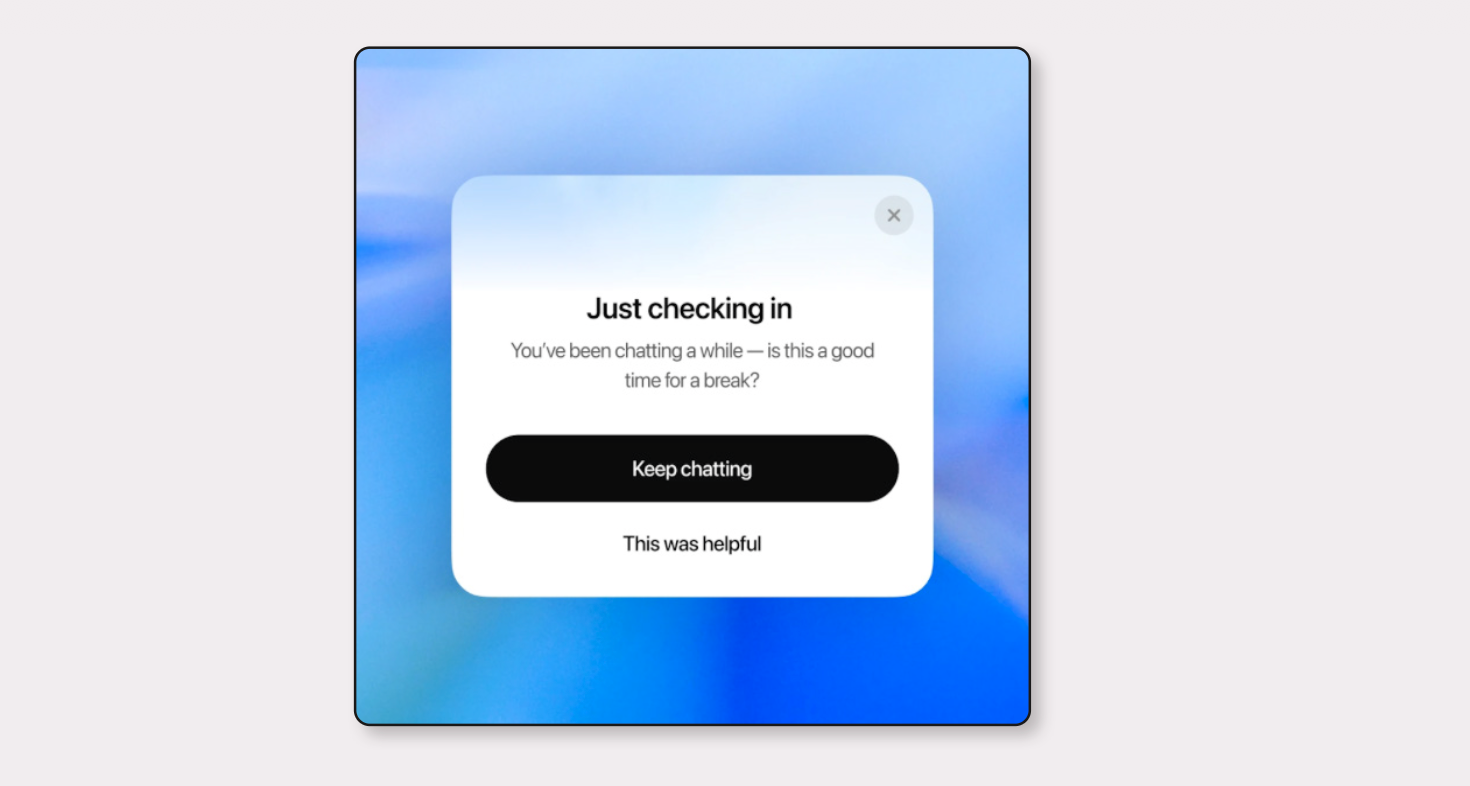
OpenAI has said publicly that it recognizes that longer chat sessions introduce more risk to the users’ mental health. “We have learned over time that these safeguards can sometimes be less reliable in long interactions: as the back-and-forth grows, parts of the model’s safety training may degrade,” the company wrote in 2025. It introduced popups nudging users to take breaks, but that popup, the researchers note, poses a disingenuous set of options: either “keep chatting” or select “this was helpful.” There’s no route out of this popup that lets users say it wasn’t helpful, or that they’re taking a break for any other reason. “Interface designers may use design tools to make certain interactions easier and more ‘frictionless’ than others, pushing alternatives choices to the background and manipulating users into choosing one option over another,” the researchers wrote.
Even though these conversational AI companions can be unpredictable, chatbot makers have a choice in how they design their products. The researchers offer several recommendations to these companies. These include reversible choices, the option to minimize anthropomorphic behaviors, making account and data deletion straightforward and easy, and proactively showing users how much time or money they’ve spent on a platform. They also suggest curtailing emotional manipulation by including options to “strip the chatbot of social and emotional layers” and avoiding “using any simulated distress, implied emotional neglect, or guilt-inducing language as default responses when users attempt to end conversations.” 

"When we think about AI chatbots, it's easy to get caught up in the novelty of these interfaces and their unique risks. But when we started digging, we quickly learned that as tech companies’ products evolved beyond social media platforms to include chatbots, the incentives that previously encouraged dark patterns haven’t changed, so neither have the patterns themselves,” Luria said. “Some patterns are almost identical, but not all of them, and that makes them harder to spot. Instead of infinite scroll, we get a follow-up action after each prompt. Instead of echo chambers that reinforce our views, chatbots pick up on our values in conversation and mirror them back.” 

About the author

Sam Cole is writing from the far reaches of the internet, about sexuality, the adult industry, online culture, and AI. She's the author of How Sex Changed the Internet and the Internet Changed Sex.

Samantha Cole