



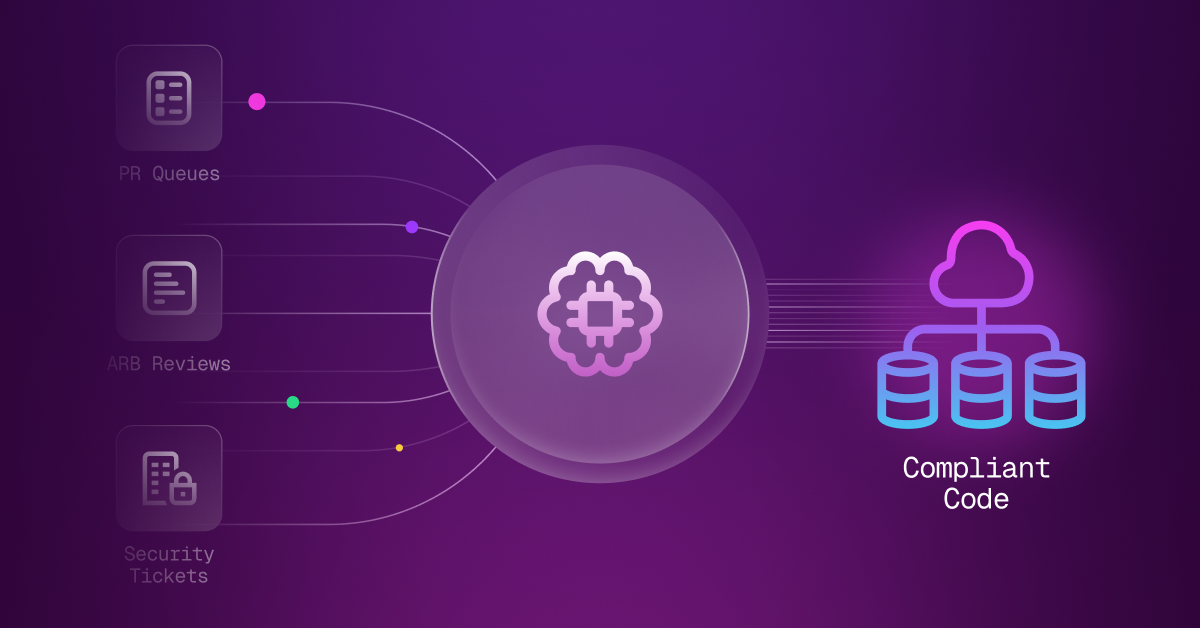
Every developer who's been paying attention for the past two years has an AI coding tool open in their editor right now. GitHub Copilot, Cursor, Windsurf, Claude Code, Kiro, pick your flavor. Vibe coding is real, it's powerful, and it's fueling a billion entrepreneurial dreams. The solo-founder unicorn no longer feels like fiction. But here's the problem nobody's talking about loudly enough: AI has turbocharged the code-writing side of software delivery while leaving the enterprise deployment side completely untouched. If you work in a large enterprise, you know exactly what I mean. You've written the code. Tests pass. You're ready to deploy. And then the familiar gauntlet begins. You open a ticket for infrastructure provisioning. The new services you need trigger an Architecture Review Board request, but the ARB doesn't meet until next Tuesday, and their docket is already full. You're looking at two weeks minimum. Meanwhile, the schema change you're making has flagged a security review. Someone sends you an eight-page questionnaire on data retention policies and encryption requirements. Then there's the cluster autoscaling request, which needs a budget approval because the platform team doesn't want dev/test costs ballooning. And of course, every service you need deployed requires its own separate PR. Two of the services need new Terraform modules, but you can't write them yourself because the platform team owns the IaC repo. Open a ticket—two-day SLA. The offshore PR review team is doing their best, but they're backlogged. The reason? Developers are shipping code faster than the review process can handle. Sound familiar? This isn't a failure of process design; these controls exist for good reasons. Security, compliance, budget governance, and architectural consistency. The problem is that the humans running these processes were never designed to scale at the speed AI-assisted development demands. The gap between coding velocity and deployment velocity is exactly what we explored in DevEx 2.0 with Aiden for Infrastructure Management. I spent years leading Platform Engineering teams at three Fortune 100 enterprises. Some days, I was fielding complaints from developers who thought my team's PR review SLA was too slow. Other days, I was the one explaining to a developer why their infra change had triggered three separate reviews before a single line hit staging. Both perspectives were valid. The controls weren't the problem. The bottleneck was human capacity, and the friction was real on all sides. That was the pre-AI era. Today, with developers generating code at 5-10x their previous velocity, the backlog isn't a nuisance. It's a wall. And it's getting higher. In fact, these dynamic AI coding tools are creating a new infrastructure bottleneck, which we've called the "Copilot Paradox": the tools that make developers faster are making the deployment gap more visible, not smaller. Here's the good news: the same AI agent technology that's accelerating coding can also automate the approval workflows that are slowing deployment down. The concept isn't complicated, even if the implementation requires careful design. Golden Paths are approval patterns, the set of conditions under which a PR or ticket would be routinely approved without exception. In every enterprise I've worked in, the vast majority of requests are variations on things that have been approved before. New microservice using the standard tech stack? Approved. Autoscaling within defined thresholds? Approved. Schema change following established data classification rules? Approved. AI agents can codify these patterns into their knowledge base and handle the entire approval workflow automatically, approving conforming requests and routing exceptions to a human reviewer. As those human reviewers make decisions on edge cases, the agent learns. Over time, humans only get pulled in for genuine outliers: First-of-a-Kind (FOAK) requests that require new policy decisions, or true one-offs that simply don't fit any pattern. For FOAK requests, when a human defines the conditions under which they'd approve, those conditions become new knowledge for the agent. The next time a similar request comes in, no human is needed. This isn't theoretical. The technology exists today. For a deeper look at how Golden Paths, Guardrails, Safety Nets, and Manual Review interact as the four pillars of this model, see 2026 Forecast: The Autonomous Enterprise and the Four Pillars of Platform Control. The real transformation isn't just automating the existing approval queue. It's eliminating the need for most of that queue in the first place. Think about what happens when agents become intelligent enough to guide developers or the AI coding agents working on their behalf toward compliant infrastructure choices before a PR is ever opened. When the system knows what's approved and nudges requests toward conformant patterns upstream, you don't need an ARB review because the architecture is already aligned. You don't need a security ticket because the schema change was already designed to meet data classification requirements. This is the real promise of agentic DevOps: moving infrastructure and deployment decisions so far left that compliance becomes a property of the request itself, not a gate at the end. This is what we mean by shifting compliance left with guidance. Instead of gates, teams using this approach see 85% fewer violations, not because gates get stricter, but because engineers are guided toward the right patterns before they hit a gate at all. No PR queues. No ARB backlogs. No eight-page questionnaires. Just conformant, auditable, deployable code from the moment it's written. We're at an inflection point. AI agents can now automate the full SDLC, including the approval and governance workflows that large enterprises depend on. Every approver's decision logic is, at its core, a ruleset. A skill for an agent to execute. Every past approval, denial, escalation, and exception is training data. Organizations that start encoding that logic now will compound their advantage rapidly. Those who wait will find their developers increasingly frustrated as the gap between coding velocity and deployment velocity keeps widening. The organizations that move first will operate at lower cost, with better delivery velocity, and with fewer human errors in high-stakes compliance decisions. That's not a tradeoff, it's the same outcome on every dimension. The MCP pattern for platform engineers illustrates exactly this compounding effect: teams that connect their governance layer to their AI tooling stop handling routine provisioning requests manually within the first quarter. Building this kind of agentic approval system is harder than it sounds. The failure modes are serious: an agent that approves the wrong request can create security gaps, compliance violations, or runaway infrastructure costs. Auditability isn't optional; it's a hard requirement in every regulated industry. This is exactly why we built Aiden the way we did. Aiden wasn't designed as a generic AI layer dropped on top of existing tooling. We built the agents, the Skills and Workflow framework, and the underlying harness that ensures deterministic, auditable results at enterprise scale. That means every decision Aiden makes is traceable; you can see exactly why a request was approved or escalated, with a full audit trail. Aiden for Platform Engineering handles infrastructure management, automated provisioning, and deployment workflows. It understands Golden Paths, learns from human decisions, and operates within guardrails defined by your policies. The result: platform teams spend their time on what actually requires human judgment, and developers get the speed they need. StackGen's recognition across four Gartner Hype Cycle reports in 2025, spanning Platform Engineering, SRE, Infrastructure Strategy, and I&O Automation, reflects how broadly this problem is being recognized across the industry. If you're leading a Platform Engineering or DevOps team today, the question isn't whether agentic automation will change how approvals work it's whether you'll be ahead of that change or behind it. Start by mapping your Golden Paths. What are the 80% of requests that follow predictable, repeatable patterns? That's your starting point for automation. From there, the compounding effects take over. The age of agents isn't coming. For the enterprises moving now, it's already here. Ready to see how Aiden handles enterprise-scale deployment automation? Schedule a demo or explore the docs to see how StackGen's AI agents bring deterministic, audit-ready automation to your SDLC.The Bottleneck Nobody Talks About

I've Seen Both Sides of This Wall
The Answer: Agents, Golden Paths, and Self-Learning Workflows
The Long Game: Shifting Compliance Left
The Age of Agents Is Already Here
How StackGen's Aiden Makes This Real in Enterprise Environments
What This Means for Your Team
此内容由惯性聚合(RSS阅读器)自动聚合整理,仅供阅读参考。 原文来自 — 版权归原作者所有。