







America | Tech | Opinion | Culture | Charts

The AI Alarmist, “Permanent Underclass” panic isn’t a convincing story. It isn’t even a new story. It’s the “lump-of-labor” fallacy, with updated branding.
The “lump-of-labor” fallacy claims there is a fixed amount of work to be done. It assumes a zero-sum competition between existing workers, and anyone or anything that may do the same job—whether that’s other workers, machines, or in this case, AI. If there is a fixed amount of useful work that needs doing, then if AI does more, humans must do less.
The problem with that premise is that it defies everything we know about people, markets and economics. Human wants and needs are anything but fixed. Keynes famously predicted almost a century ago that automation would lead to a 15-hour work-week, but of course Keynes was wrong. He was right that automation created a “labor surplus,” but rather than just sit back and enjoy the ride, we found new and different productive endeavors to fill our time.
Of course AI will absolutely eliminate some tasks and compress some roles (and there’s some evidence that that may already be happening). The shape of the labor market will change, as it always does when a transformational technology is unlocked. But the claim that AI will produce economy-wide, permanent unemployment is unhelpful marketing, bad economics and worse history. To the contrary, productivity gains should increase demand for labor, because labor becomes more valuable.
Here is our argument why.1
We agree with the doomers—and, frankly, anyone with their eyes open—that the price of cognition is collapsing. AI is getting better and better at what, until recently, was considered the exclusive domain of the human brain.
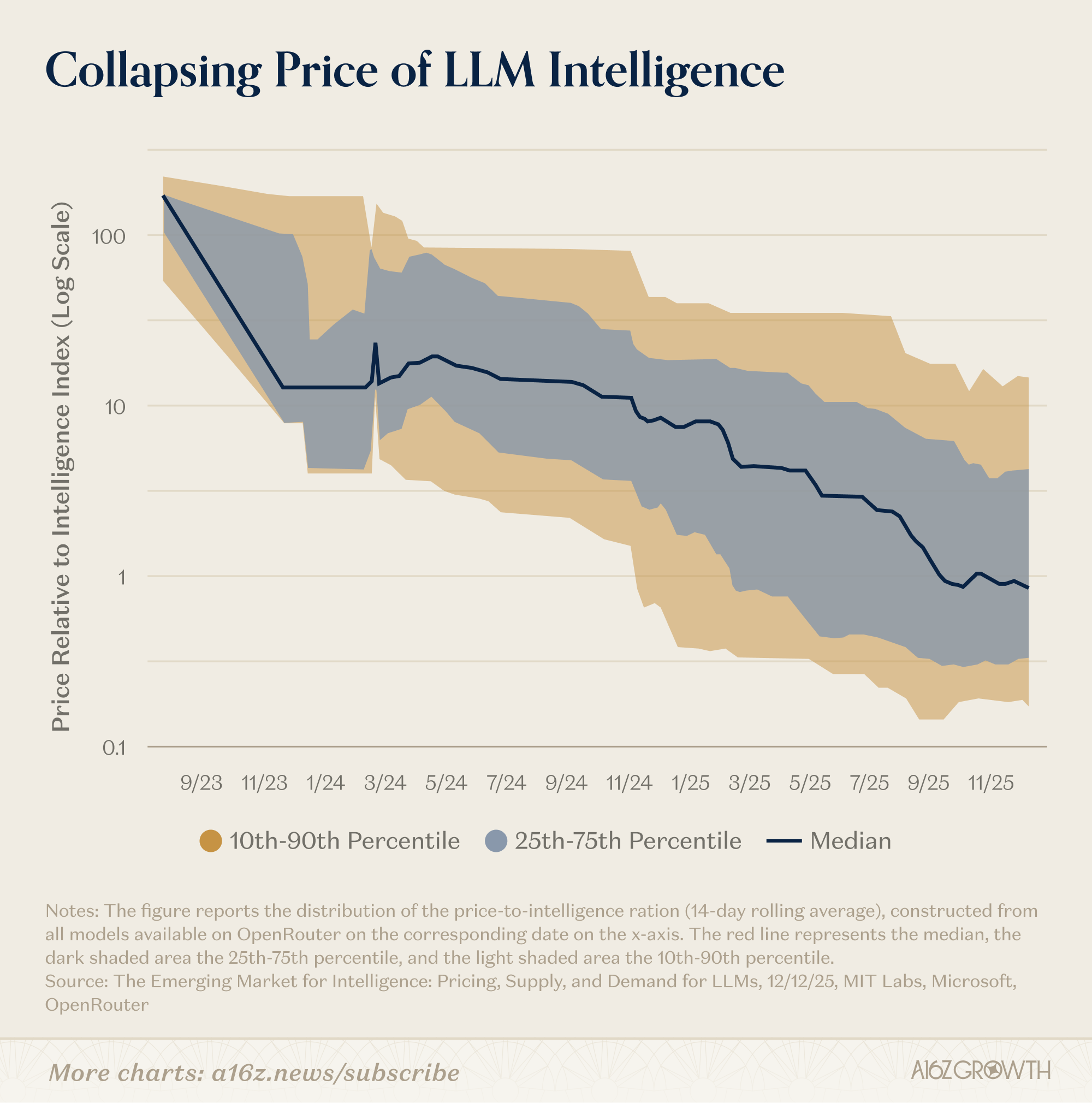
The doomer argument goes, “If AI can do our thinking for us, then humanity’s ‘moat’ evaporates and our terminal value goes to zero.” Checkmate, humans. Apparently, we’ve done all the thinking we’re ever going to need or want, and now that AI will carry an increasingly large share of the cognitive load, humans slide into obsolescence.
Here’s the thing, though: precedent (and intuition) shows that when the cost of a powerful input falls, the economy does not politely stand still. Costs fall, quality rises, speed rises, new products become viable, and demand moves outward.2 Jevons Paradox reigns supreme. When fossil fuels first made energy cheap and plentiful, we did more than just put whalers and woodchoppers out of business; we invented plastics!
Contra-doomers, there’s every reason to expect that AI will have a similar effect. Now that AI will carry an increasingly large share of the cognitive load, humans are free to tackle even more ambitious frontiers than ever before.
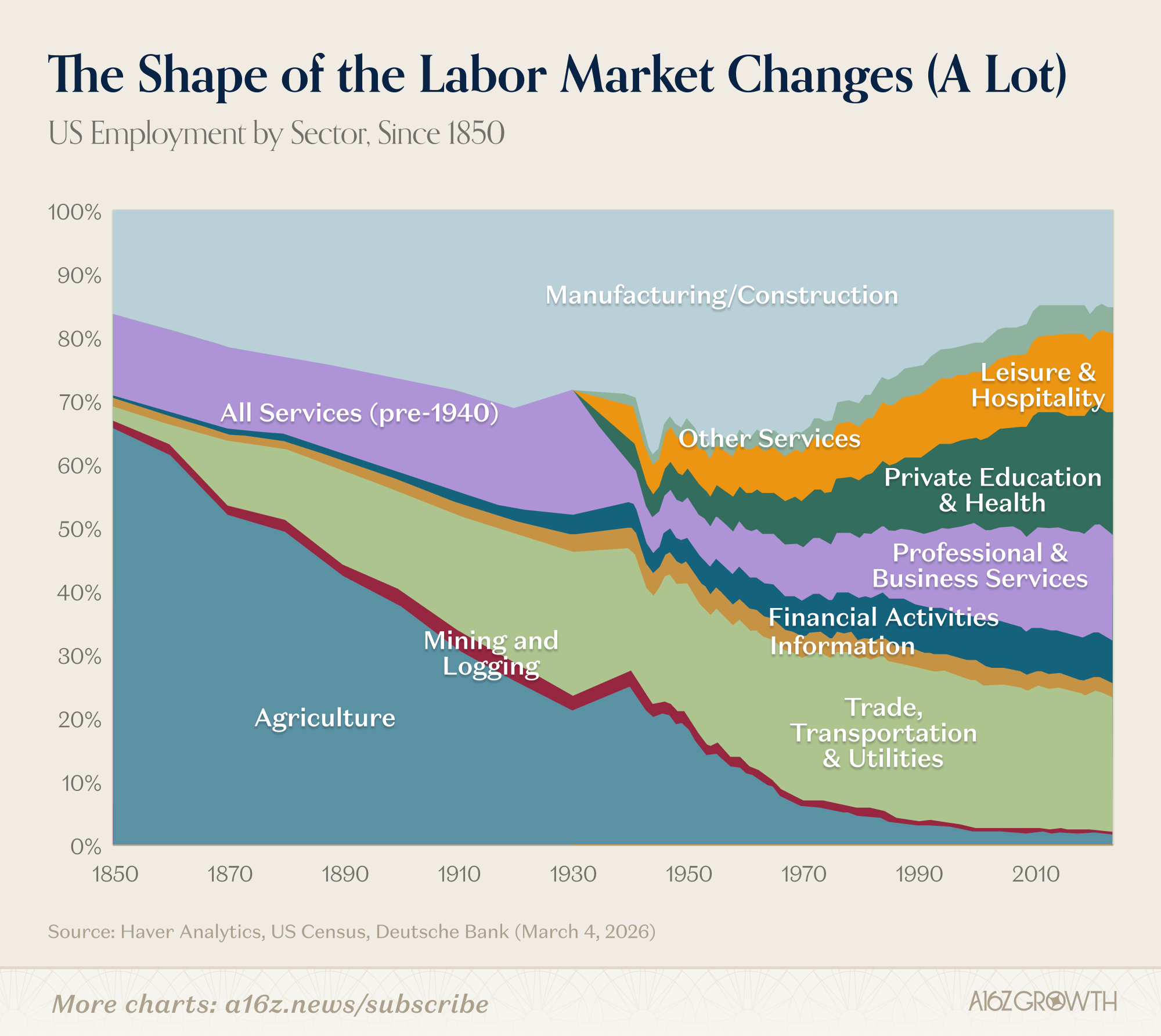
If history is any guide, we can expect that technological transformation will enlarge the size of the pie.
Every “dominant economic sector” has given way to an even larger successor . . . which, in turn, has made the economy only that much larger.
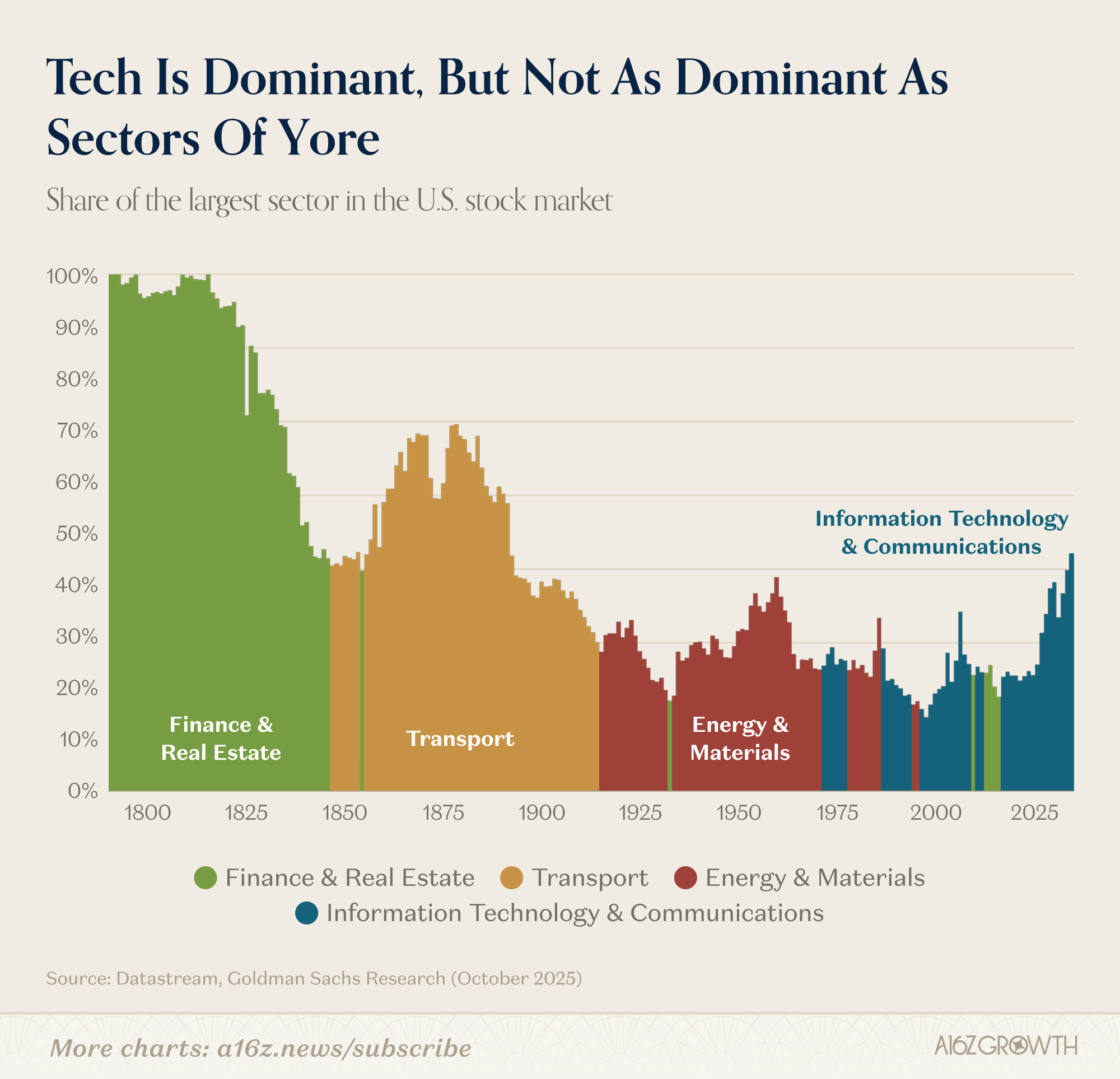
Tech today is bigger than finance, railroads, or industrials ever were, but still smaller as a fraction of the economy or the market as a whole. Far from being negative-sum, productivity gains have been a positive-sum force on steroids. The net result of having delegated so much of our efforts to machines is that the economy and labor market have only gotten bigger, more diverse, and more complex.
Doomers want you to ignore the history of innovation, freeze-frame the collapsing cost of cognition, and call it the whole movie. They see task-substitution and just stop.
“We’re going to 10x our cognitive output, but rather than do more thinking, we’re going to pat our tum-tums and hit lunch early, and so is everyone else,” reflects not only a massive failure of imagination, but of basic observation. Doomers call it “realism,” but it’s just not what happens, ever!
Let’s take a look at what does actually happen, when great leaps forward in productivity ripped through the economy.
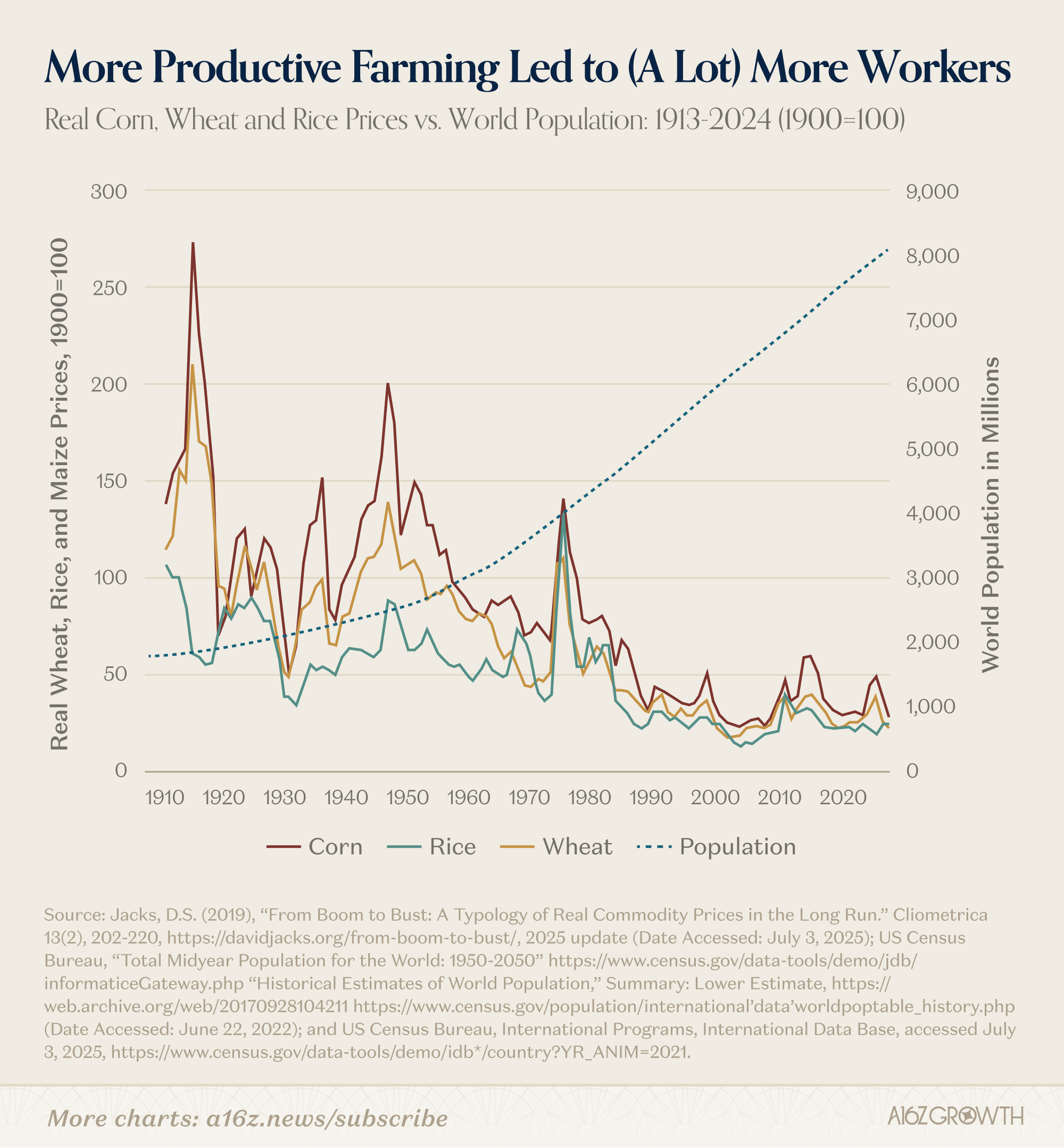
In the early 20th century before widespread adoption of farm mechanization, roughly a third of U.S. employment was in farming. By 2017, it was about 2 percent.
If automation caused permanent unemployment, the tractor should have broken the labor market forever. Instead, farm output almost tripled, which supported a massive increase in population—and far from being permanently unemployed, those workers flowed into previously unimagined industries, factories, stores, offices, hospitals, labs, and eventually services and software.
So, sure, you could say that technology upended the career prospects for the median farmhand, but in doing so, it unlocked a global labor (and resource) surplus, and an entirely new economy.
Electricity tells a similar story.
Electrification did not just swap one power source for another. It replaced shafts and belts with individual motors, forced factories to reorganize around entirely new workflows, and created entirely new categories of consumer and industrial goods.
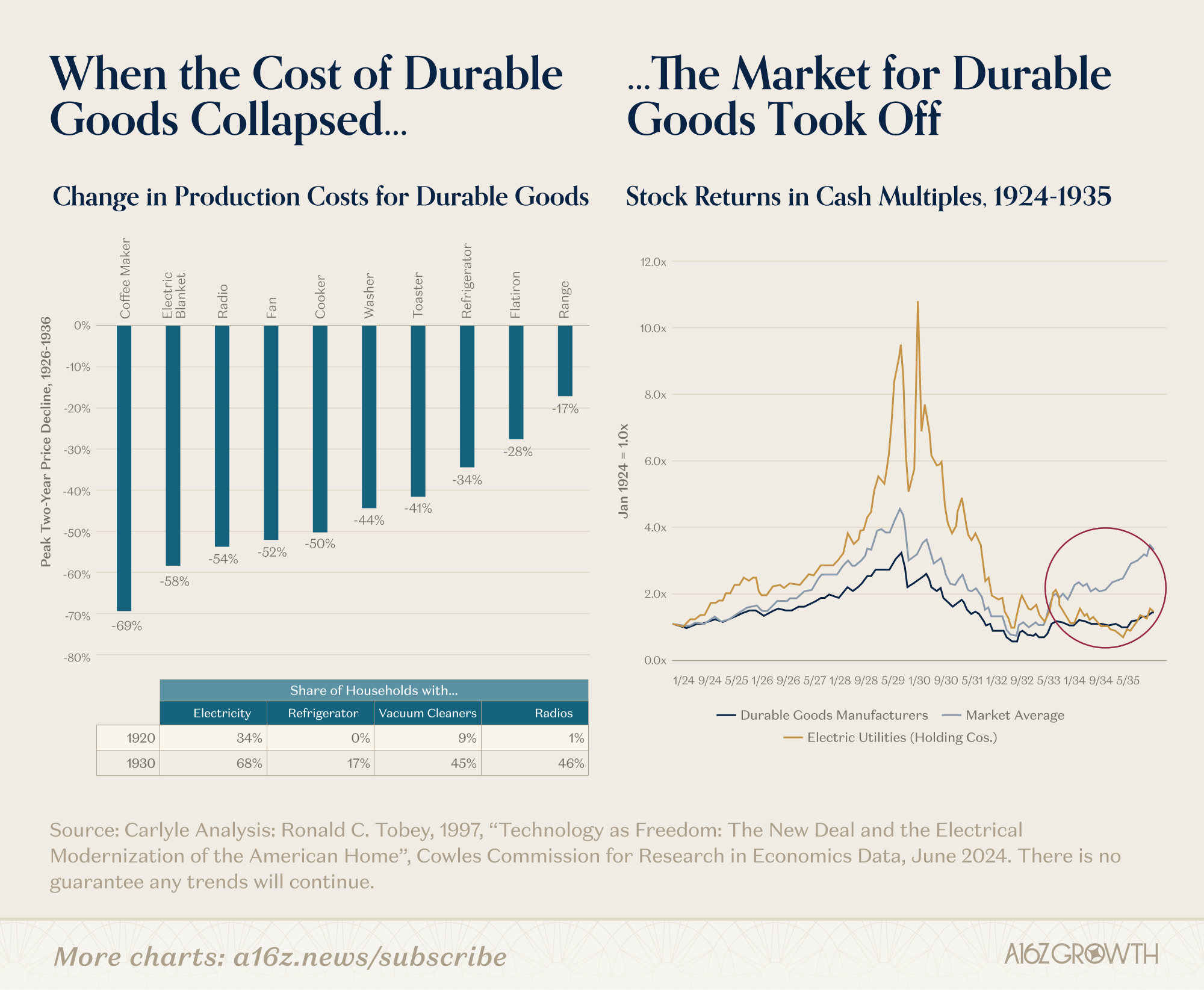
This is exactly what we expect to see during the distinct phases of technological revolutions, as documented by Carlota Perez in Technological Revolutions and Financial Capital: huge upfront investment and financial interest, huge declines in the costs of durable goods, and then a generational run for durable goods manufacturers.
It took time for electricity to work its productive magic. At the turn of the 20th century, only 5 percent of American factories used electricity to power their machines, and fewer than 10 percent of homes had electricity at all.
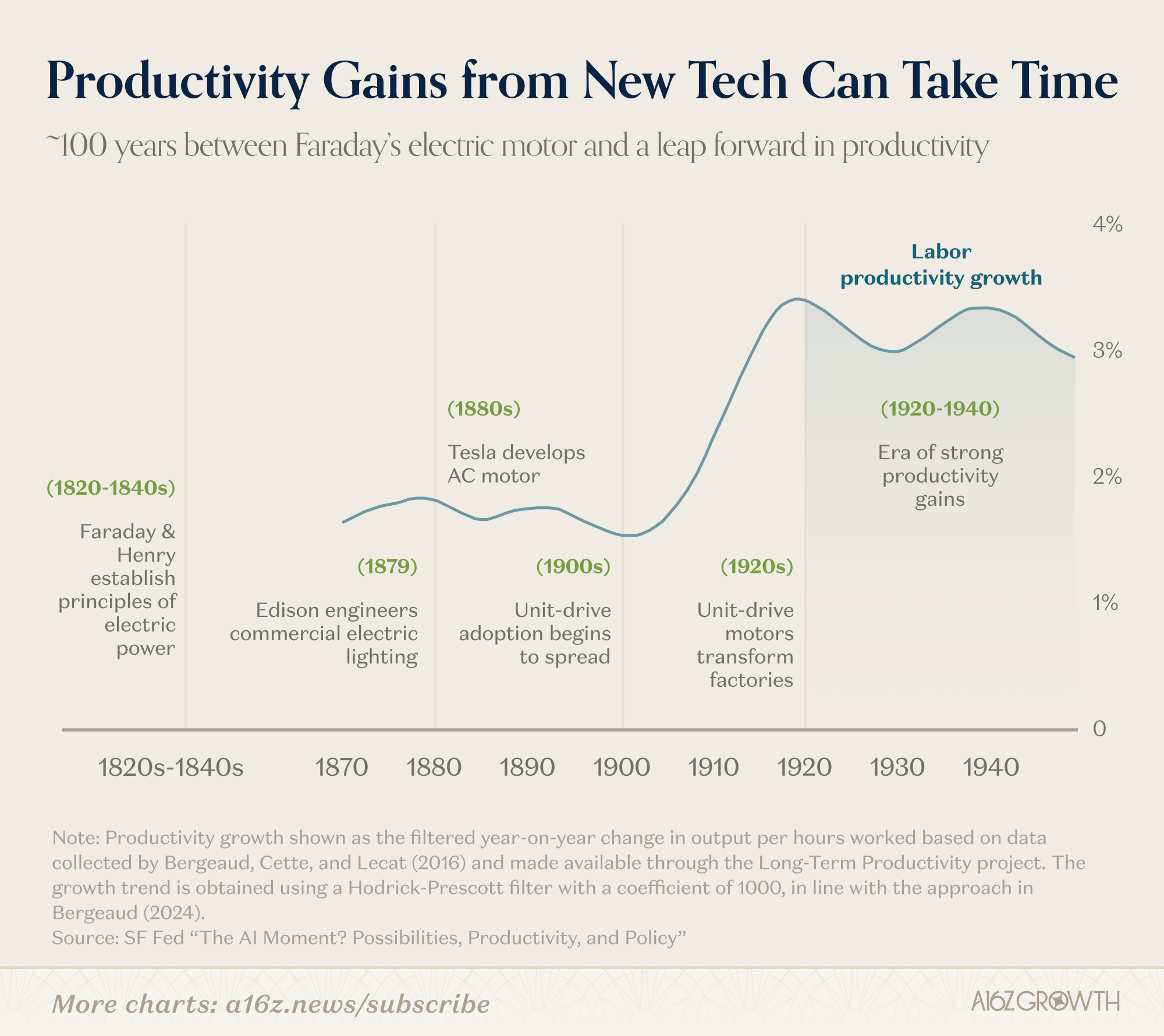
By 1930, electricity supplied almost 80 percent of manufacturing power, and labor productivity growth doubled for decades.
Far from destroying demand for labor, more productivity meant more manufacturing, more salespeople, more lending, and more commercial activity—not to mention the second-order effects of labor-saving devices, like washing machines and cars, both of which pulled more people into higher value endeavors than was previously possible.
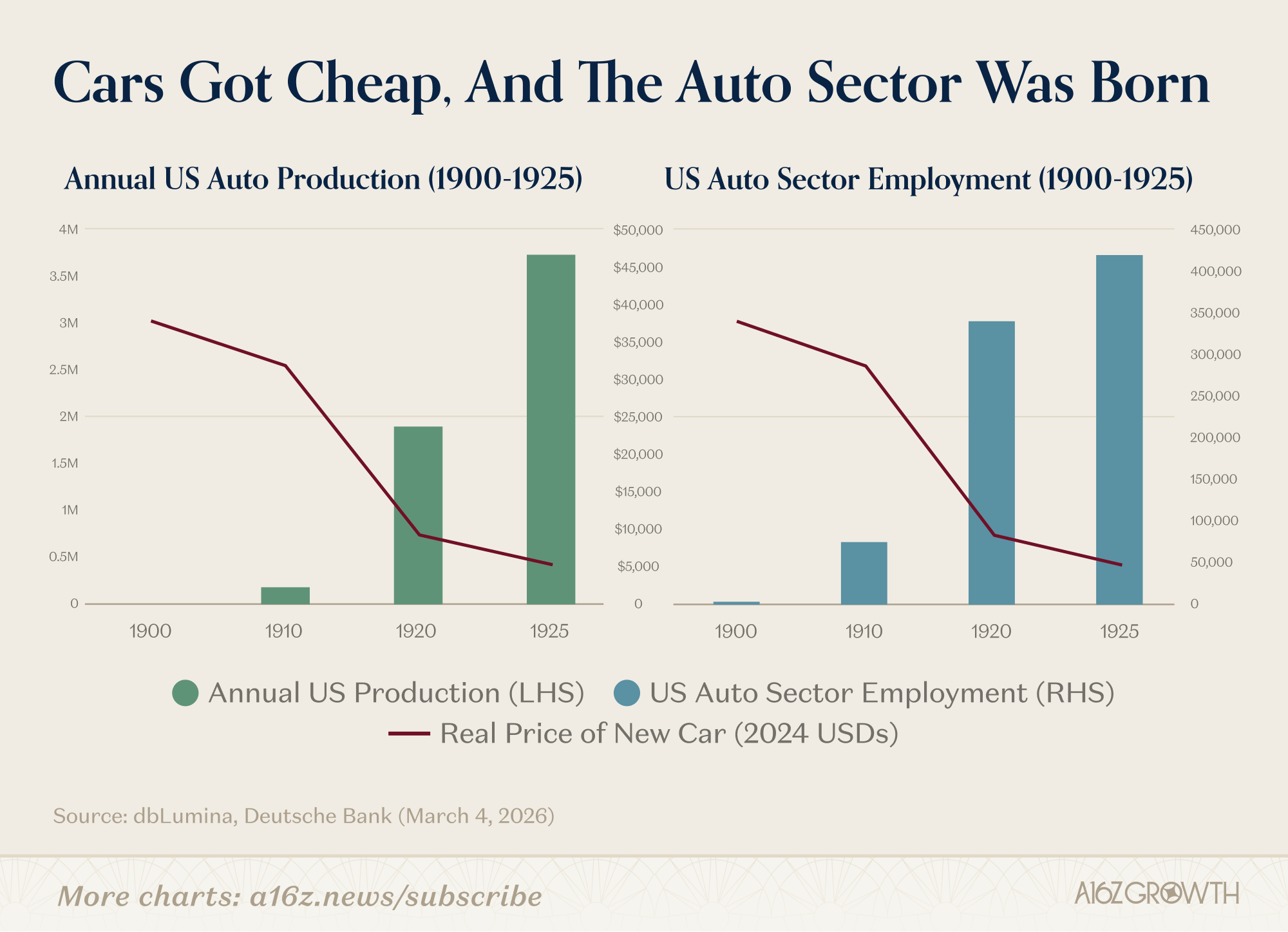
As prices for cars fell, both auto production and employment exploded.
That is what a real general-purpose technology does: it reorganizes the economy and expands the frontier of useful work.
We see this again and again. Did VisiCalc and Excel doom the bookkeepers? Emphatically, no. Vastly more efficient computational technology led to an explosion of bookkeepers, and created an entire industry of FP&A.
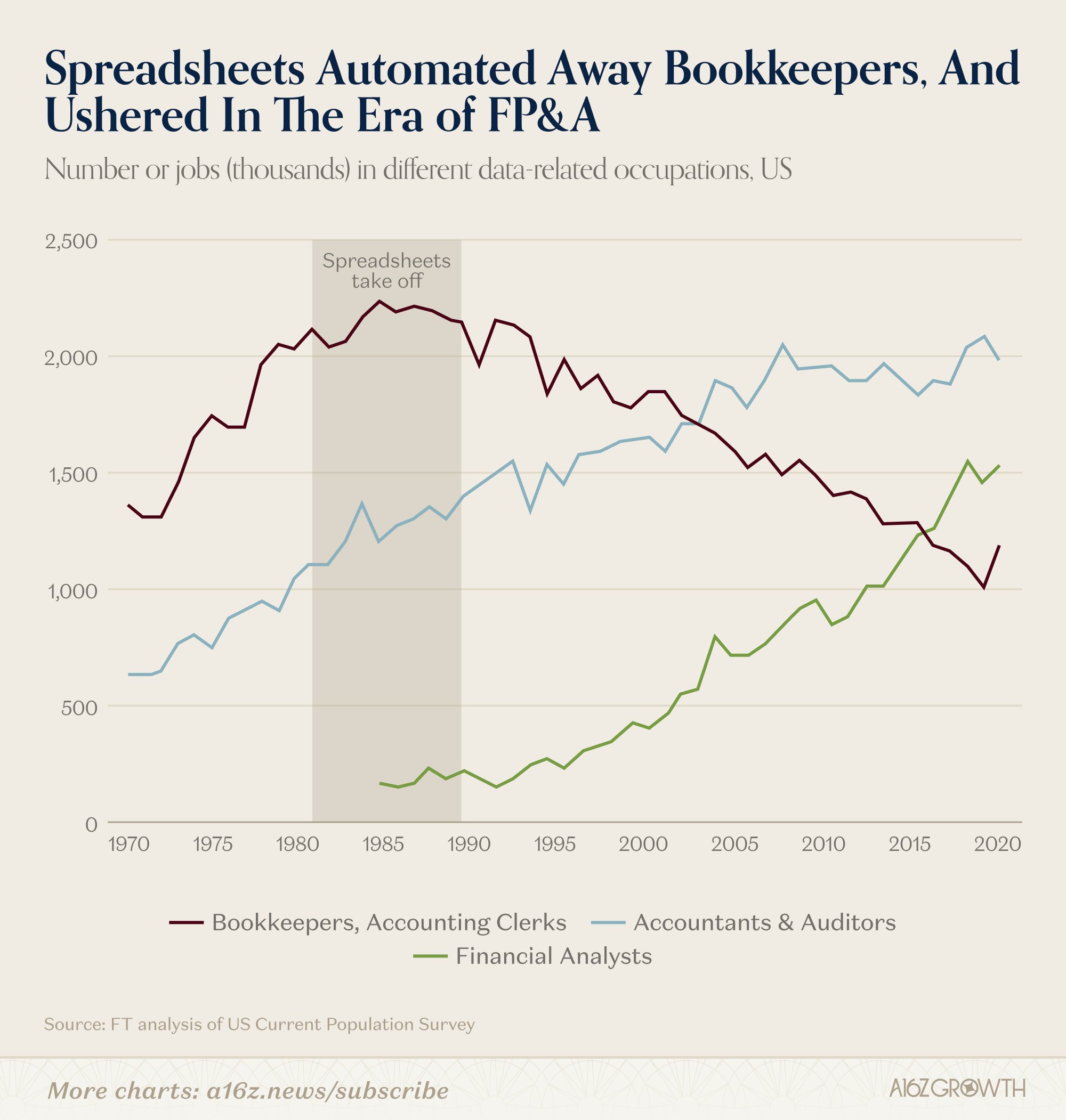
We lost ~1M “bookkeepers” and gained ~1.5M “financial analysts.”
It’s of course not always the case that task-substitution leads to job-growth in some adjacent part of the economy. Sometimes, the productivity surplus materializes as net-new job-growth in an entirely unrelated industry.
But what if AI means that some people will become fantastically wealthy, leaving the rest behind?
Well, at a minimum, those fantastically wealthy people will need to spend their money somewhere, creating whole new service industries from scratch, just like they did before:
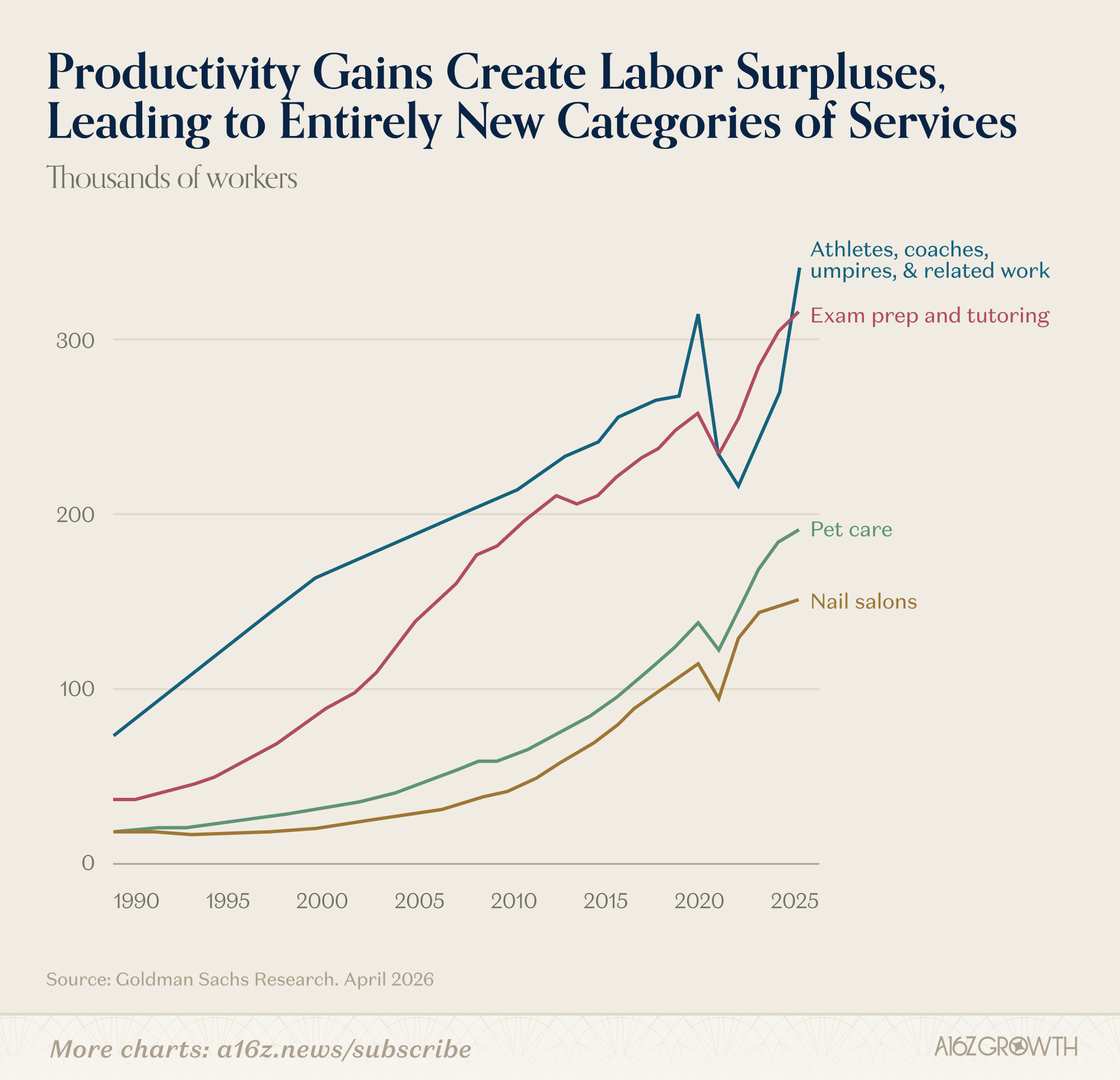
Massive productivity gains and subsequent wealth-creation led to entirely new lines of work that may never have come to fruition without rising incomes and worker availability (even though they were technologically possible, well before the 90s). However one feels about service industries that cater to the wealthy, the net result left everyone better off, as more demand led to a massive ramp in median wages (leading to more “wealthy” people).
Ernie Tedeschi, Stripe’s in-house economist, offers a fascinating “all-in-one” example of a job disrupted, transformed, and remade with technology: travel agents.
Did technology reduce demand for travel agents? Yes, absolutely:
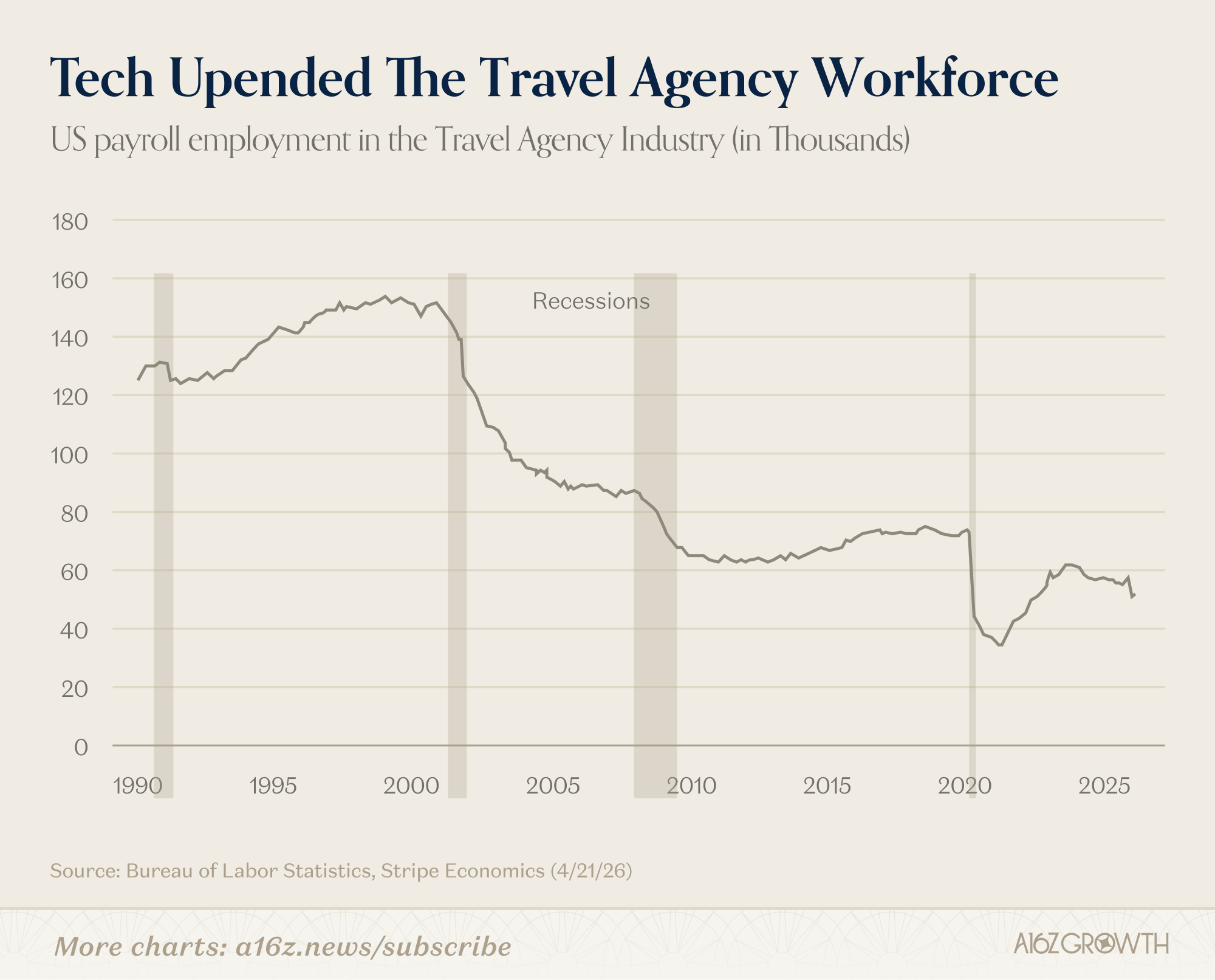
Travel agency payrolls are today about half of what they were at the turn of the century, almost certainly because of technology.
So, does that mean technology was a job-killer? No, again, because travel agents didn’t just end up permanently unemployed. They found work elsewhere in the economy, which overall has about the same employment:population ratio now, as it did in 2000 (when adjusted for aging).
Meanwhile, for the travel agents who did remain in the now tech-enabled industry, increased productivity meant higher wages than before:
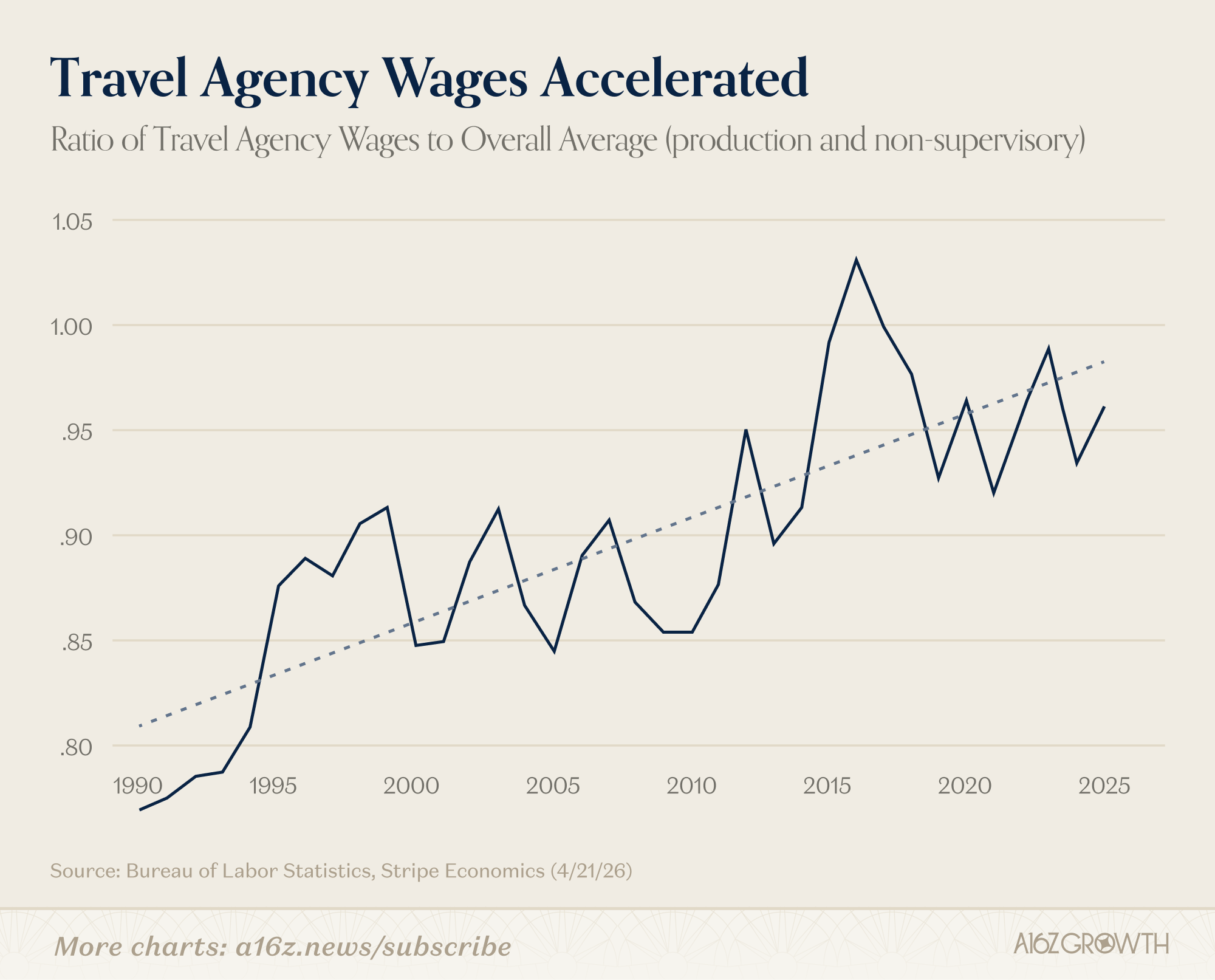
“Average weekly earnings at travel agencies were 87% of overall average weekly earnings back in the heyday of 2000. By 2025, the ratio had reached 99%, meaning travel agency wages had outpaced the rest of the private sector over that span.”
So, even then, while it’s true that tech devastated travel agent employment, in the aggregate, working-age people are just as employed as they were before, and the remaining travel agents are doing better than ever.
That last point is very important, and reflects yet another way that doomers are only telling one small part of the story.
For some jobs, AI is an existential threat. True. But for others, AI is a force-multiplier—which will make those jobs that much more valuable. For every job at-risk of AI-Substitution, there are other jobs that stand to benefit:
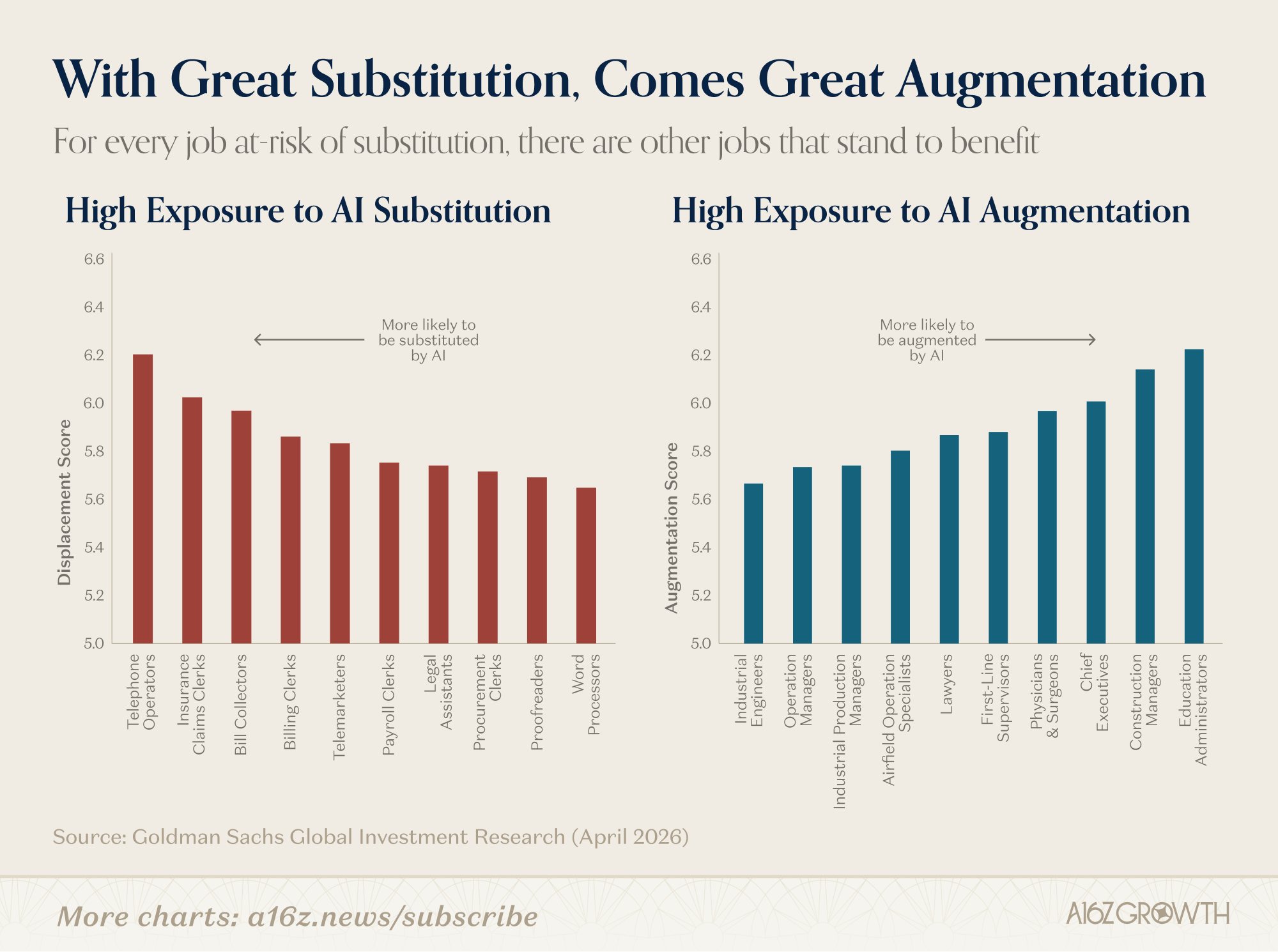
Goldman’s estimated “AI Substitution” effects are more than balanced-out by the effects of “AI Augmentation.”
Management teams also appear to be much more focused on augmentation than substitution, for what it’s worth:
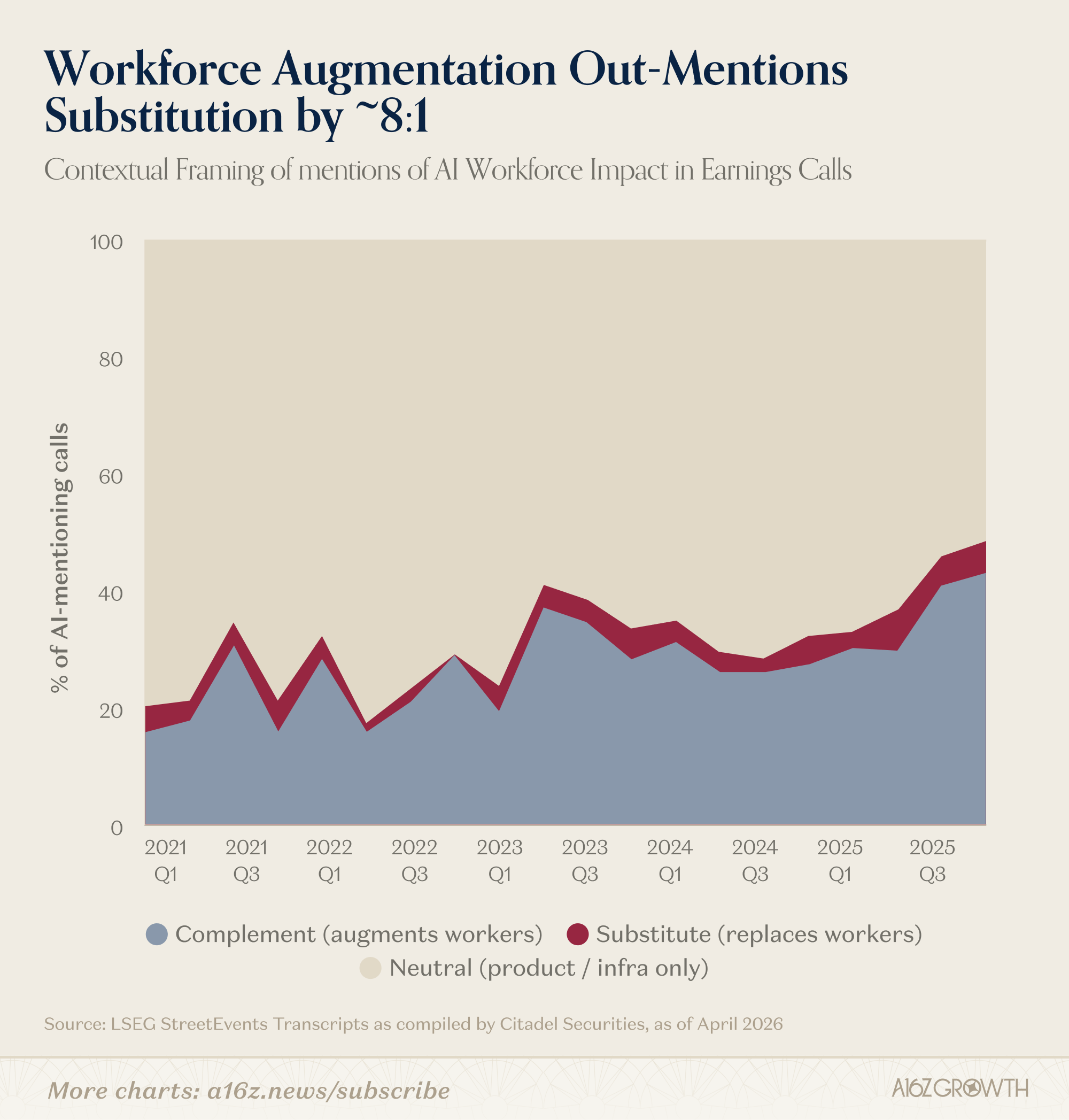
As of now, AI-as-augmentation out-mentions AI-as-substitution on earnings calls by ~8:1.

While Goldman doesn’t even include them on their “augmentation” list, software engineers are probably the perfect example of an AI Augmented role.
AI is a force-multiplier for coding. Not only are git pushes skyrocketing (as are new apps and new business formation), but it appears as though demand for SWE is inflecting upwards:
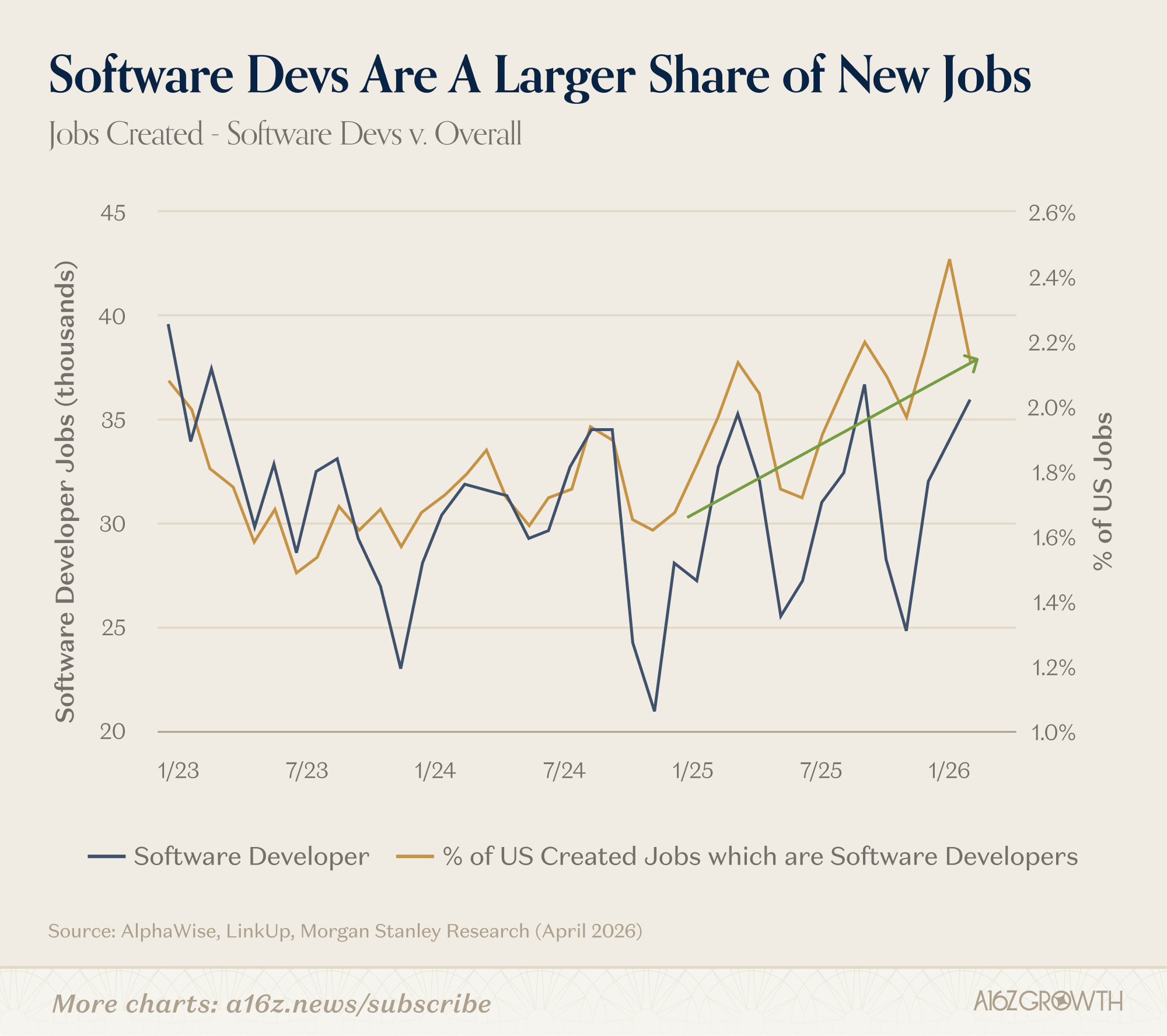
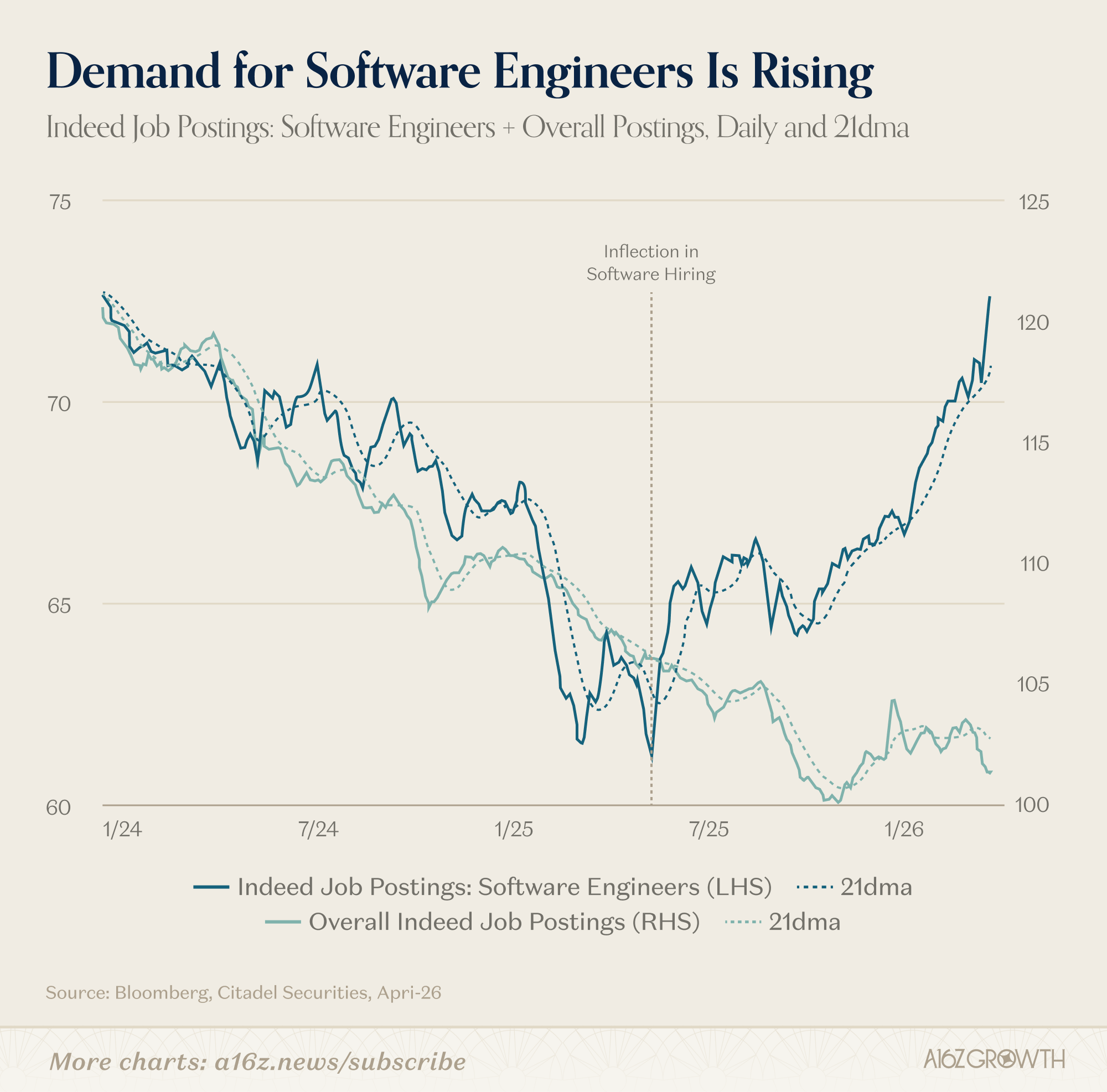
Software Development jobs (both by count, and a percent of the overall job market) have been increasing since the beginning of 2025.
Is that because of AI? Truthfully, it’s probably too soon to tell, but AI most definitely augments the work of software engineering, not to mention that AI is top-of-mind for every executive at every company.
With everyone trying to figure out how to incorporate AI into their businesses, it stands to reason that there would be substantial hiring efforts underway to make that happen, making certain employees more valuable, not less:
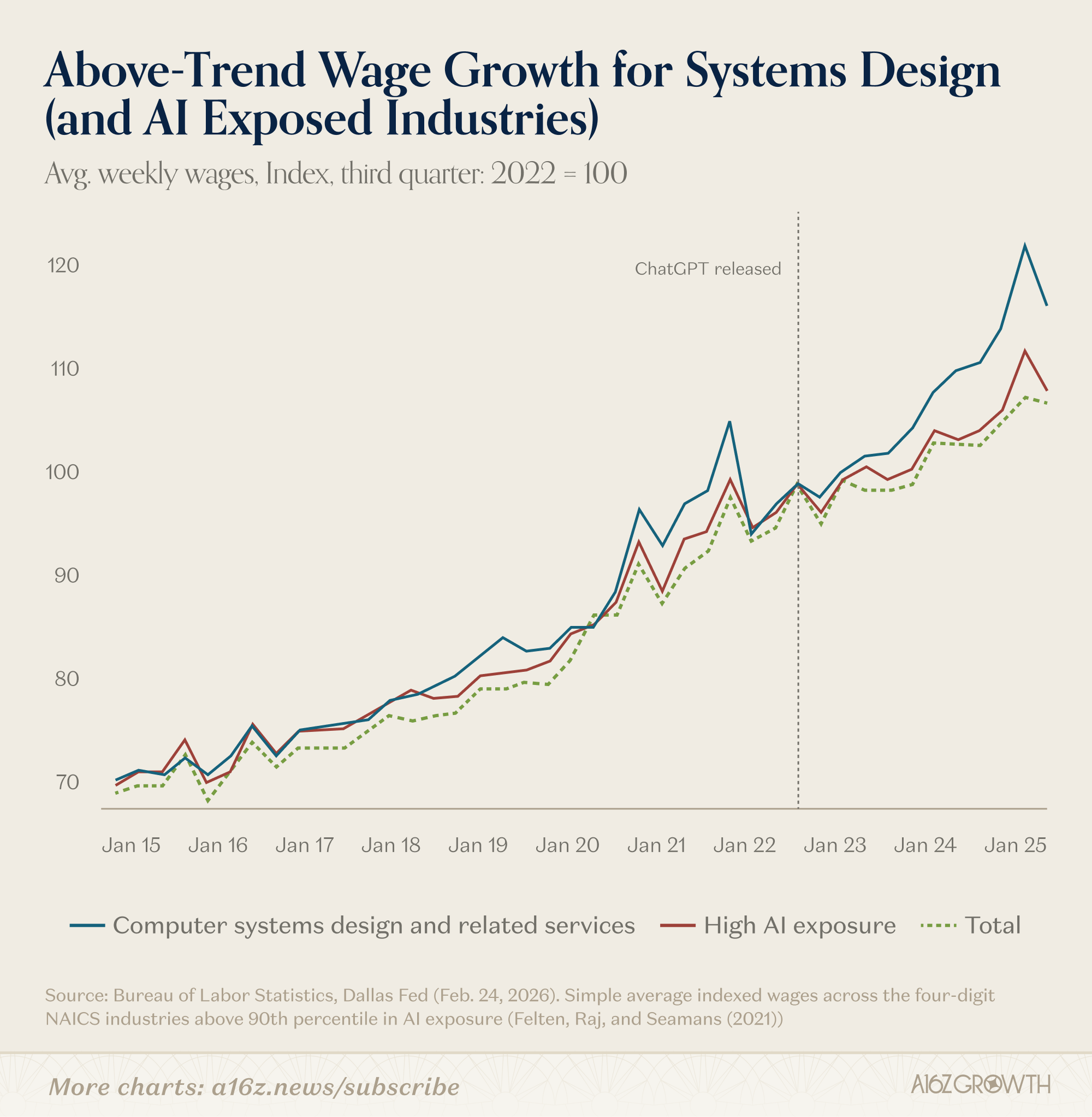
AI-exposure seems to be driving above-trend wage-growth (which is especially true for systems design).
Those gains may be somewhat narrow for now, but it’s still so, so early. As expertise widens, so too will the opportunities. In all events, it’s not the data that the doomers want you to see.
Meanwhile, according to Lenny Rachitsky (of Lenny’s Newsletter, one of the great tech-insider communities), open PM jobs continue to climb (off their rate-driven collapse) and are now more plentiful than they’ve been since 2022:
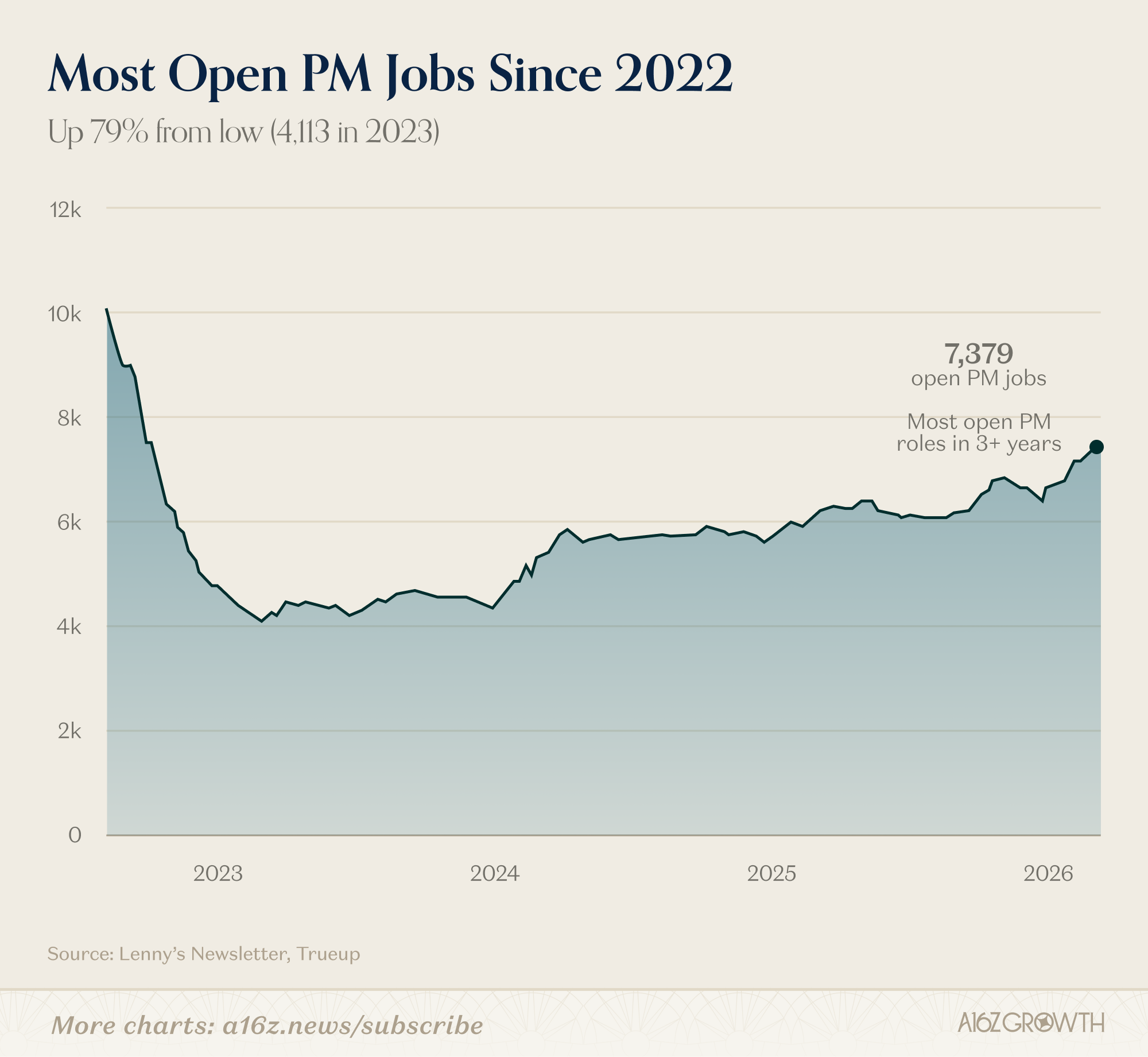
Hiring growth in both software engineers and product managers is a concise example of why the “lump of labor” fallacy is wrong. If AI substituted thinking 1:1, then you might plausibly expect, “PMs need fewer engineers,” or you could argue “engineers need fewer PMs,” but that isn’t what we see. We see demand for both continuing to rebound, because what matters is people are getting more work done.
That’s why the doomer failure is primarily a failure of imagination. They focus on the tasks that get automated away, and ignore a new frontier of demand that will create jobs we haven’t even conceived of yet:
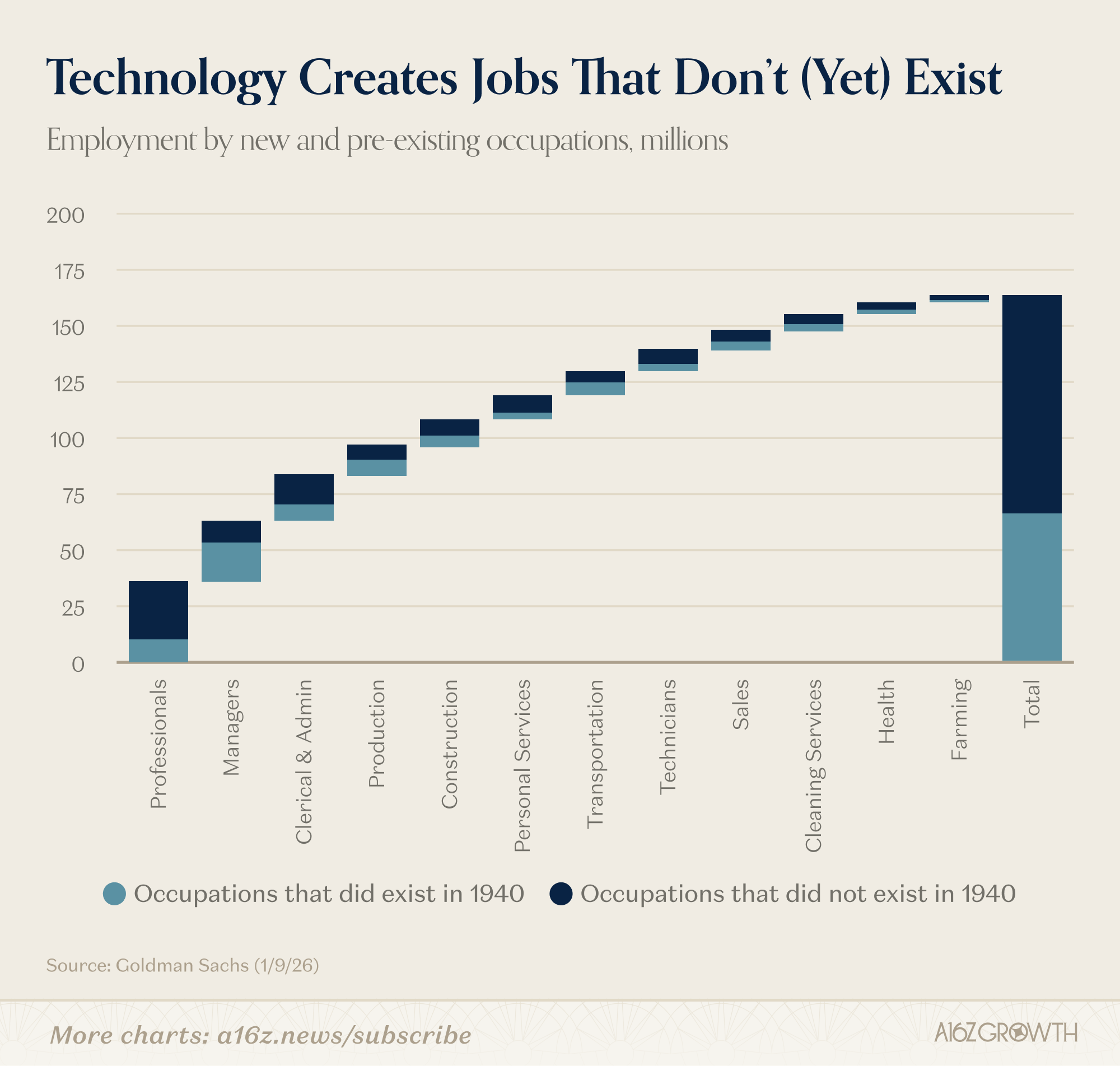
The majority of new jobs created since 1940 didn’t even exist in 1940. And in 2000, it was pretty easy to imagine all the travel agents that would be out of a job, but it was probably much harder to imagine an entire middle-market tech services industry built around “cloud migration,” since, of course, the cloud was more than a decade away.
Up until this point, we’ve been focused mostly on theory and precedent because both theory and precedent favor the bulls:

It’s true. With every productivity unlock, we get an increase in demand and/or a reallocation of the surplus to somewhere else in the economy. That means more jobs, including a whole bunch that will get a lot more valuable, and still more that we’ve never even heard of yet. If somehow this time it’s going to be different, the doomers have to make a much stronger case than frantic handwaving.
That “job substitution” is not a civilization-killer (but the opposite really) makes sense. Humanity, by its nature, does not get complacent. We finish one job and look for another.
But, theory and precedent aside, what does the actual data show, with respect to AI and employment? With the caveat that it’s early (for better or for worse), the weight of the data does not support the doomer claim. If anything, the data shows “no change, one way or another,” but there is also emerging data that points in the other direction: AI is more job-maker than job-taker.
First, let’s start with some academic research—this is not an exhaustive literature review, but just a sampling of recent papers:
AI, productivity, and the workforce: evidence from corporate executives (NBER Working Paper 34984): “Taken together, these results suggest that while AI adoption has not yet led to meaningful changes in total employment, it is already beginning to reshape the allocation of tasks and occupations within firms. In particular, routine clerical and administrative activities appear more exposed to substitution, while analytical, technical, and managerial tasks are more often described as being complemented by AI.”
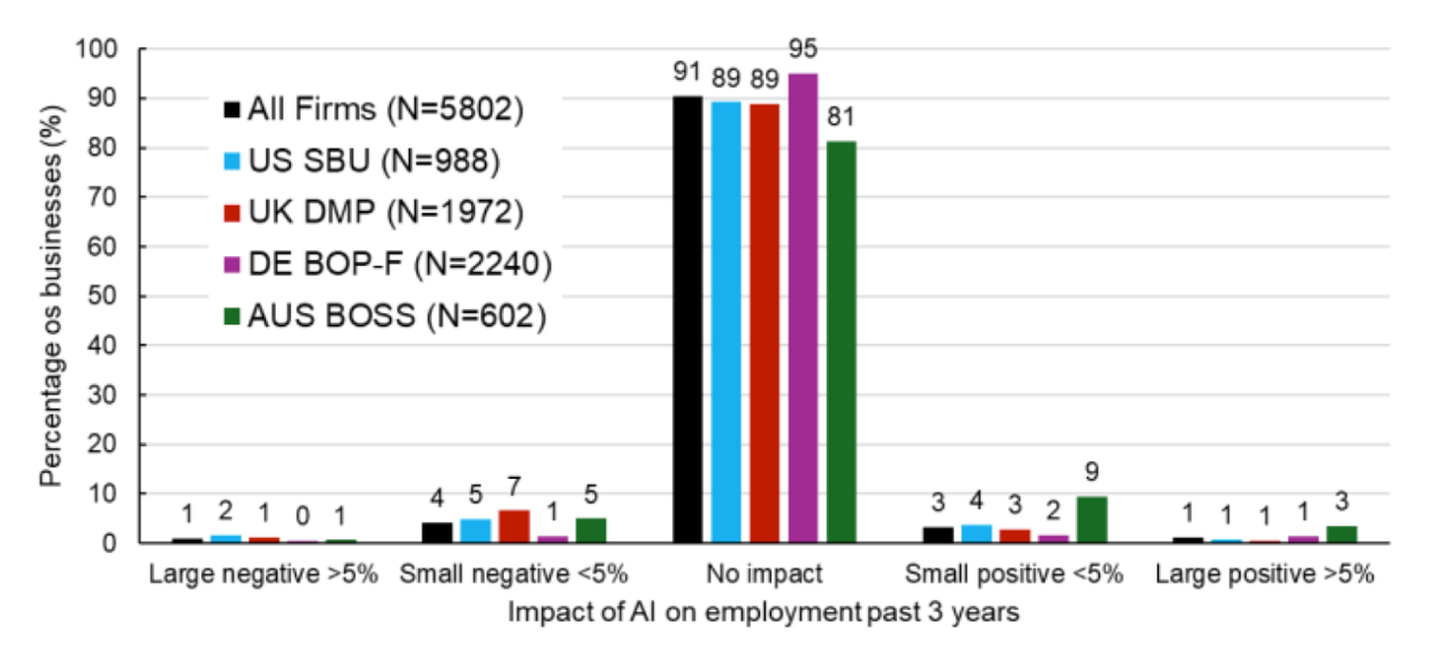
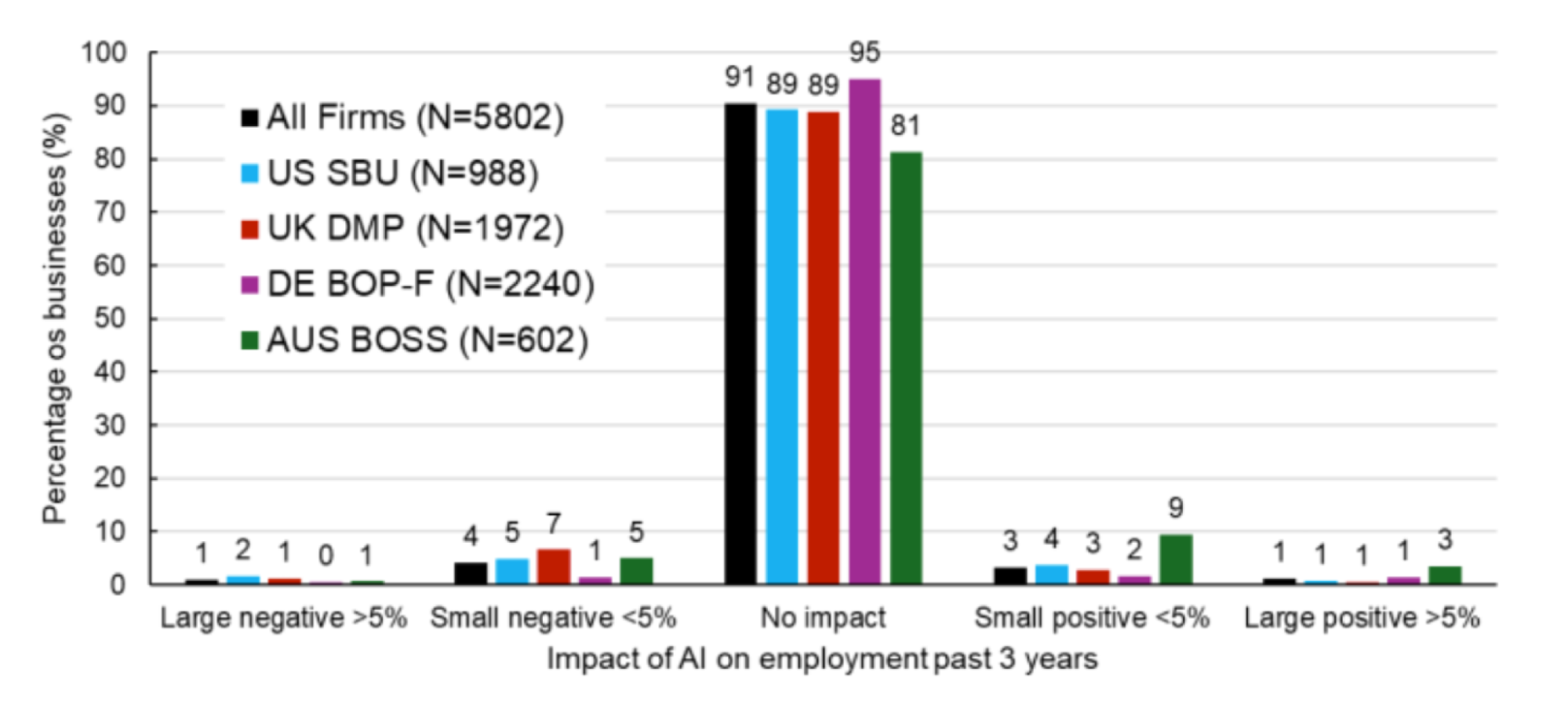
Firm Data on AI (Fed Reserve Bank of Atlanta Working Paper 2026-3): “Across the four surveys, more than 90% of firms on average estimate no impact over the last three years.”3
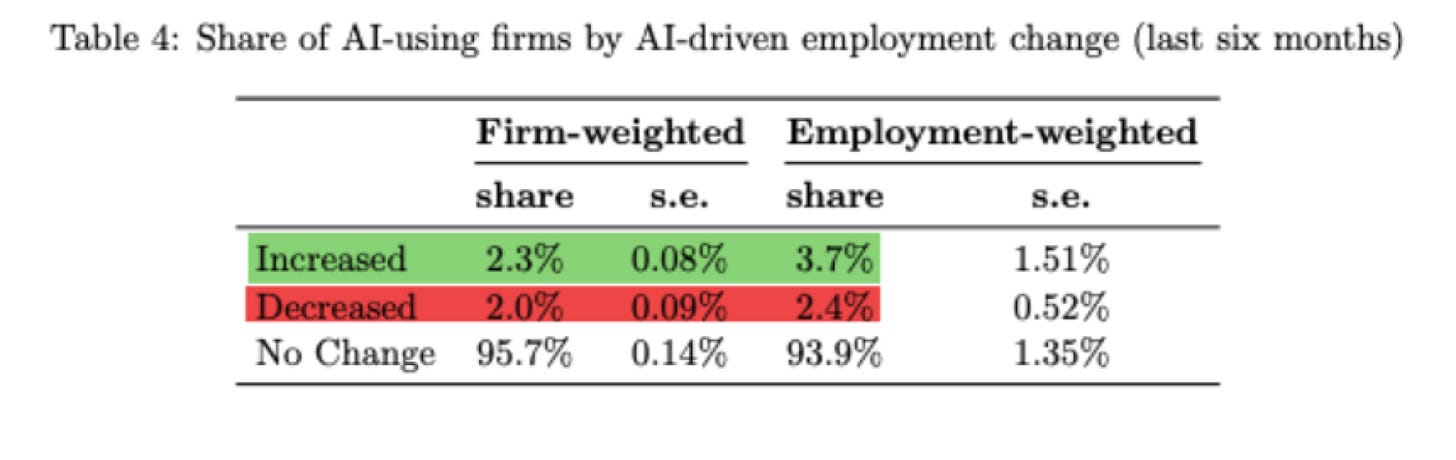
Microstructure of AI Diffusion: Evidence from firms, business functions, and worker tasks (Census Center for Economic Studies, Working Paper CES 26-25): “AI-driven employment change instances remain modest, with only about 5% of AI-using firms reporting any headcount impact—distributed nearly equally between increases (2.3% firm-weighted and 3.7% employment-weighted) and decreases (2.0% firm-weighted and 2.4% employment-weighted).”
Tracking the Impact of AI on the Labor Market (Yale Budget Lab, April 16, 2026). “While anxiety over the effects of AI on today’s labor market is widespread, our data suggests it remains largely speculative. The picture of AI’s impact on the labor market that emerges from our data is one that largely reflects stability, not major disruption at an economy-wide level.”
You get the idea. The recurring refrain from the most recent research is “no change on net, but some evidence of reallocation between jobs and tasks.” In one case, the net-effects of AI implementation on hiring were positive.
There is one notable exception to the “no change” story. Researchers at Stanford, the Dallas Fed, and Census all found (to varying degrees) that entry-level roles with high “AI exposure” are increasingly difficult to find. Before anyone concludes that “AI is killing entry-level jobs,” however, it bears mentioning that these researchers also variously found an increase in entry-level roles where AI is augmentative (and an increase where AI has no impact at all).
But, even if we stipulate for a moment that AI is “killing” certain entry-level roles (as opposed to the effects of broader cyclical hiring trends, as well as “aging in place”), in the bigger scheme of things, the data is showing pretty clearly that the aggregate effects of AI on employment are basically null.4
This is probably the most succinct view of the scoreboard with respect to AI’s impact on employment:
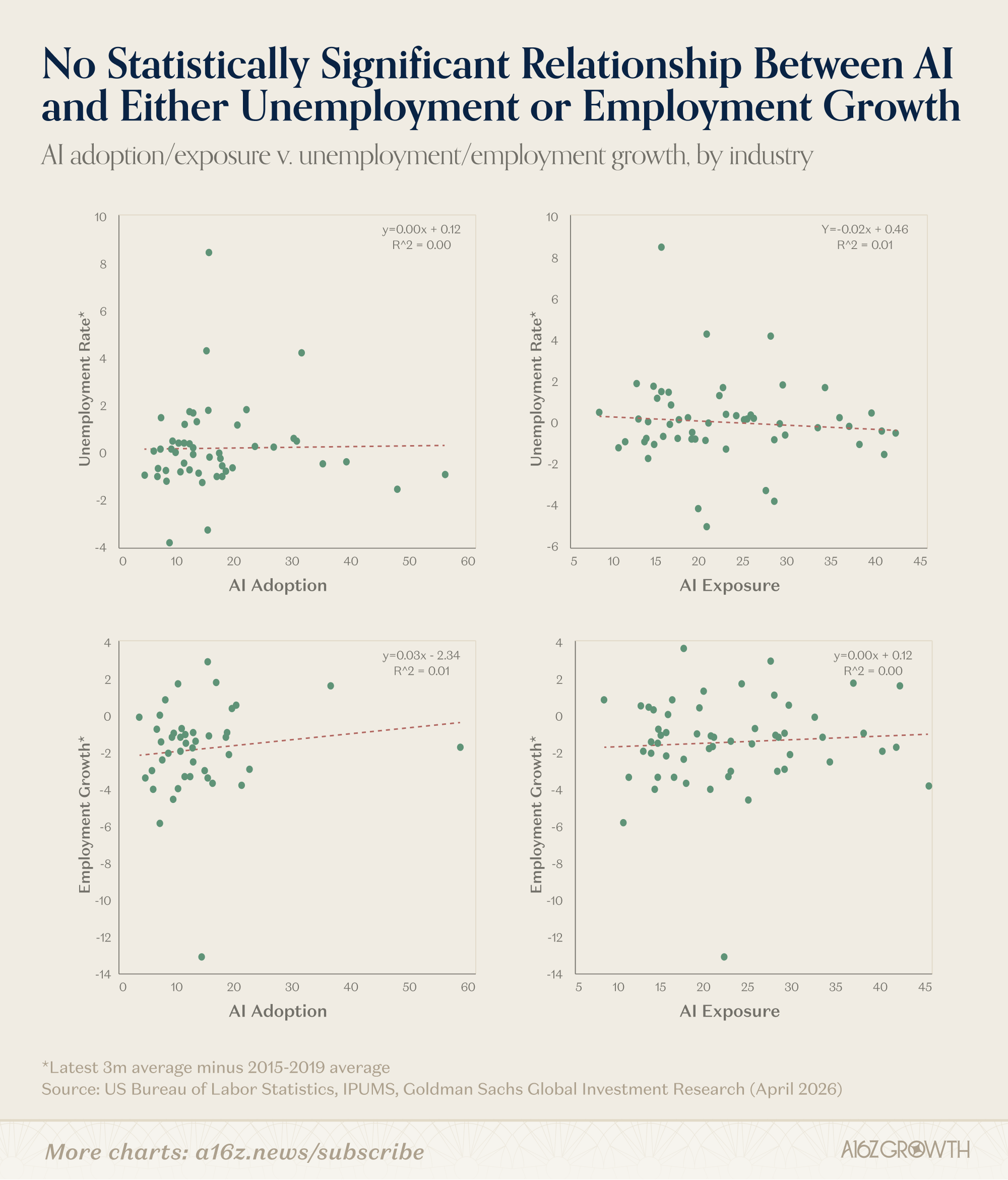
“Still no statistically significant relationship between AI and unemployment or employment growth.”
There is, perhaps, some pull towards AI Augmented roles, and some push from AI-substitute roles:
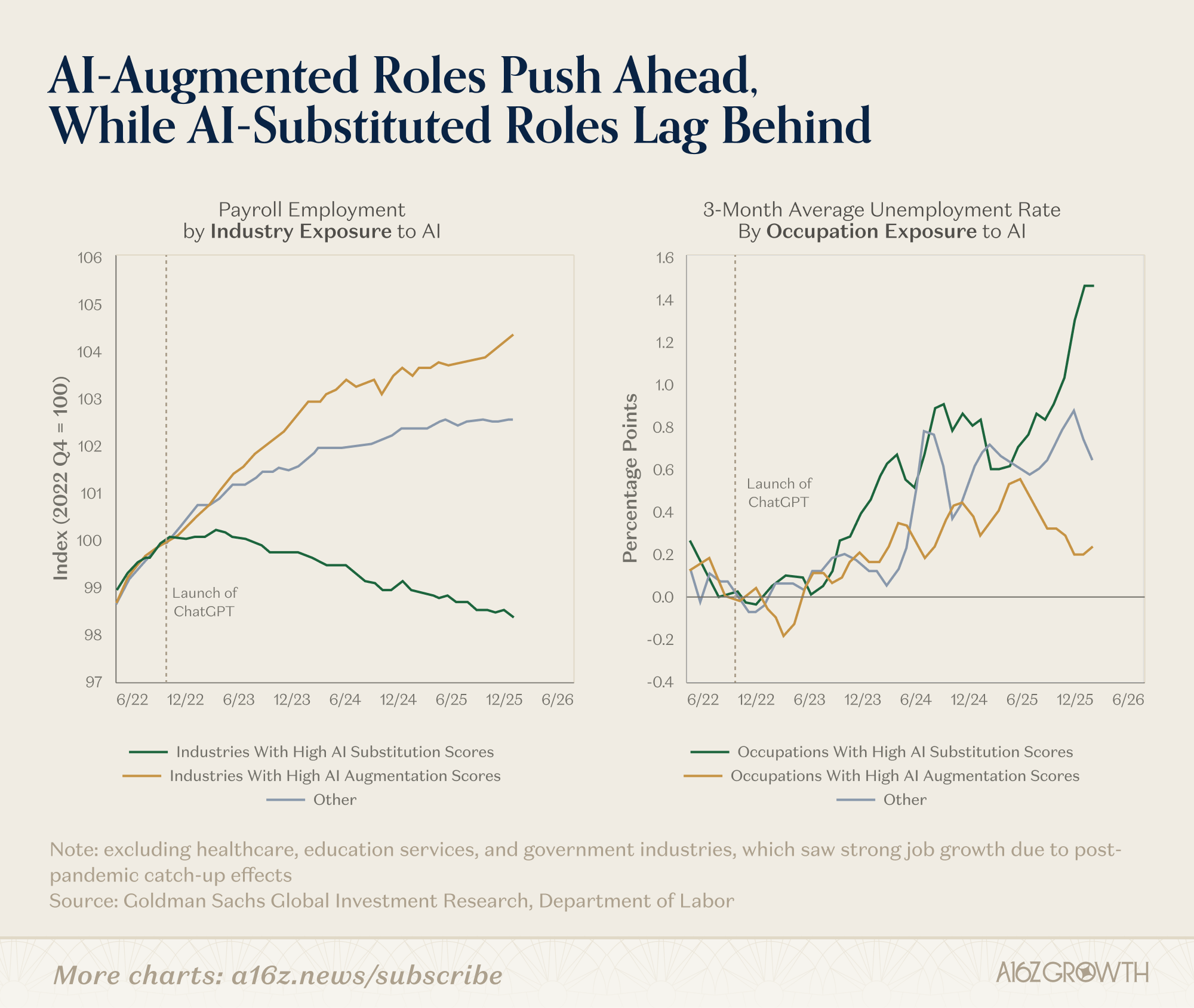
Hiring growth appears stronger (and unemployment weaker) for “AI Augmented” Industries, while the opposite is true for industries at higher risk for “AI substitution.”
In other words, the aggregate picture is neutral, but not unchanged: some job-destruction, and some job-creation, some jobs deprecated, others now with a premium.5 At this rate, job-postings for devs will exceed the pre-pandemic level in less than two years. AI may have already single-handedly saved the SF Office market, as well.
That’s where we started: AI will definitely kill and/or compress some roles (and businesses), but it’s a mistake to think that’s the end of the story. Reorientation (and eventually growth) of the labor market—as opposed to widespread unemployment—is exactly what we should expect from a transformational technology. It’s happened before, and it will almost certainly happen again (and it looks like it’s already underway).
It sounds trite, but it’s true: this isn’t the end of knowledge work—if anything, it’s the beginning.
Automation strips out the repetitive layer and pulls human work up the stack. The reason why is simple: humans want to expand! When one layer of scarcity falls, people move up to the next one. When food gets cheaper, we spend more on housing, health, education, travel, entertainment, convenience, pets, safety, beauty, and longevity.
The same thing happens in labor markets. New work keeps appearing because human ambition does not stop, and conquering old frontiers reveals new frontiers to conquer.
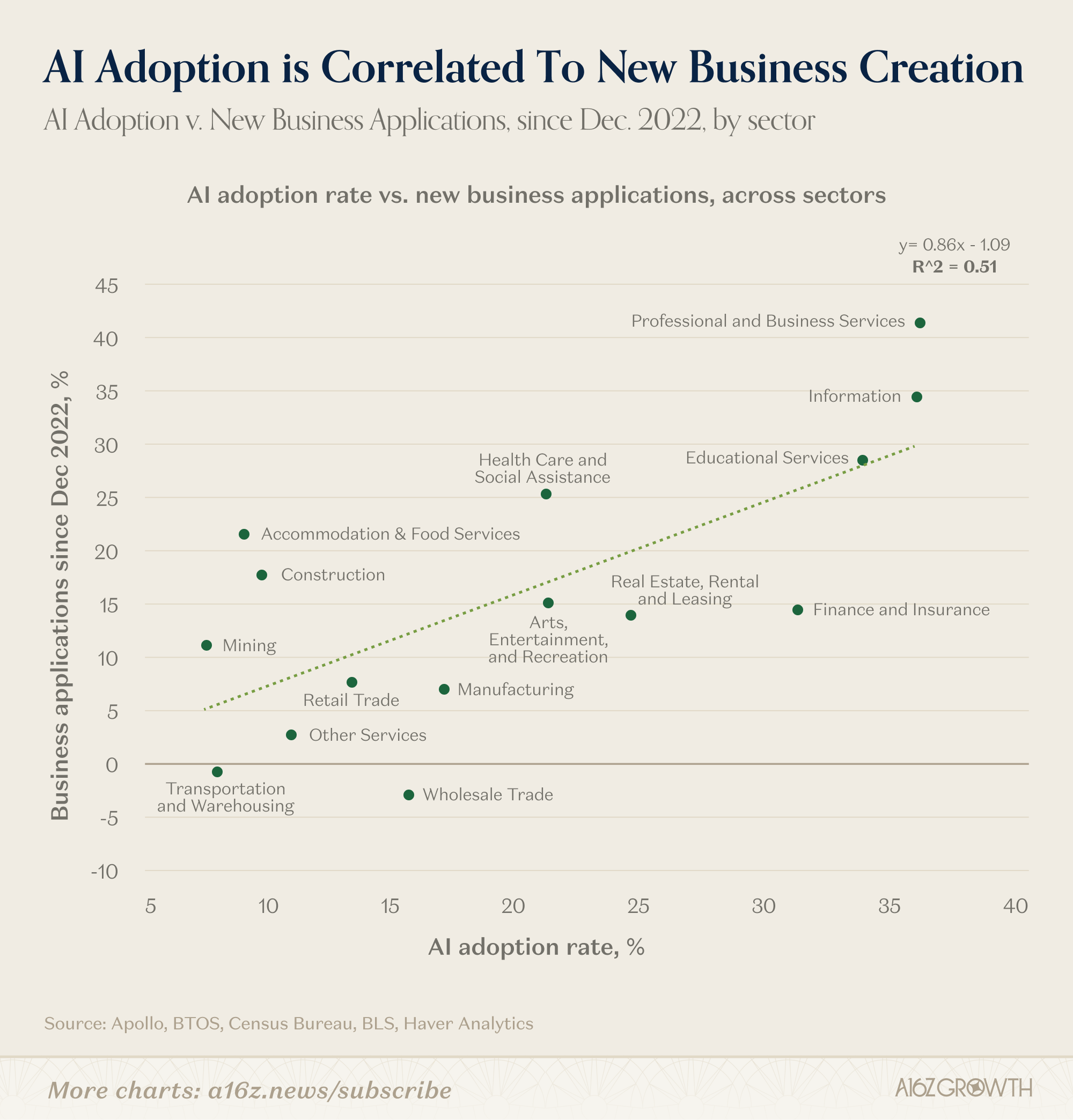
New business formation is already exploding, with a pretty decent correlation to AI adoption:
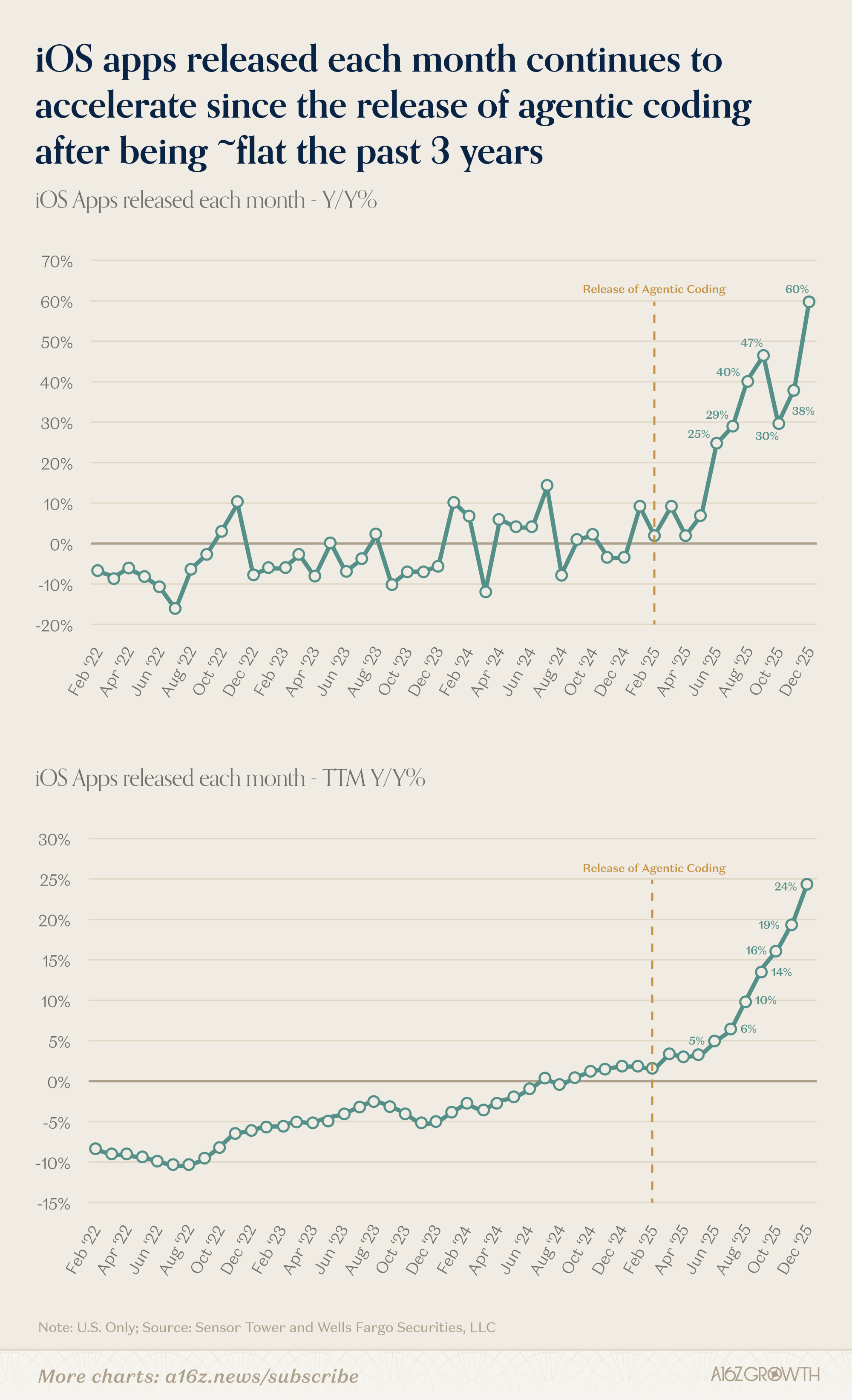
New apps are hitting the app store at a 60% YOY clip:
There should be no reason to think of the modern economy as some kind of museum of yesterday’s roles. Instead, it’s a creative allocation machine, enabling new jobs, new work, new goals, and new inventions, all the time.
Much of robotics has been considered science fiction, because the computational demands in a dynamic environment were too high. But AI is bringing an entirely new robotics industry into scope:
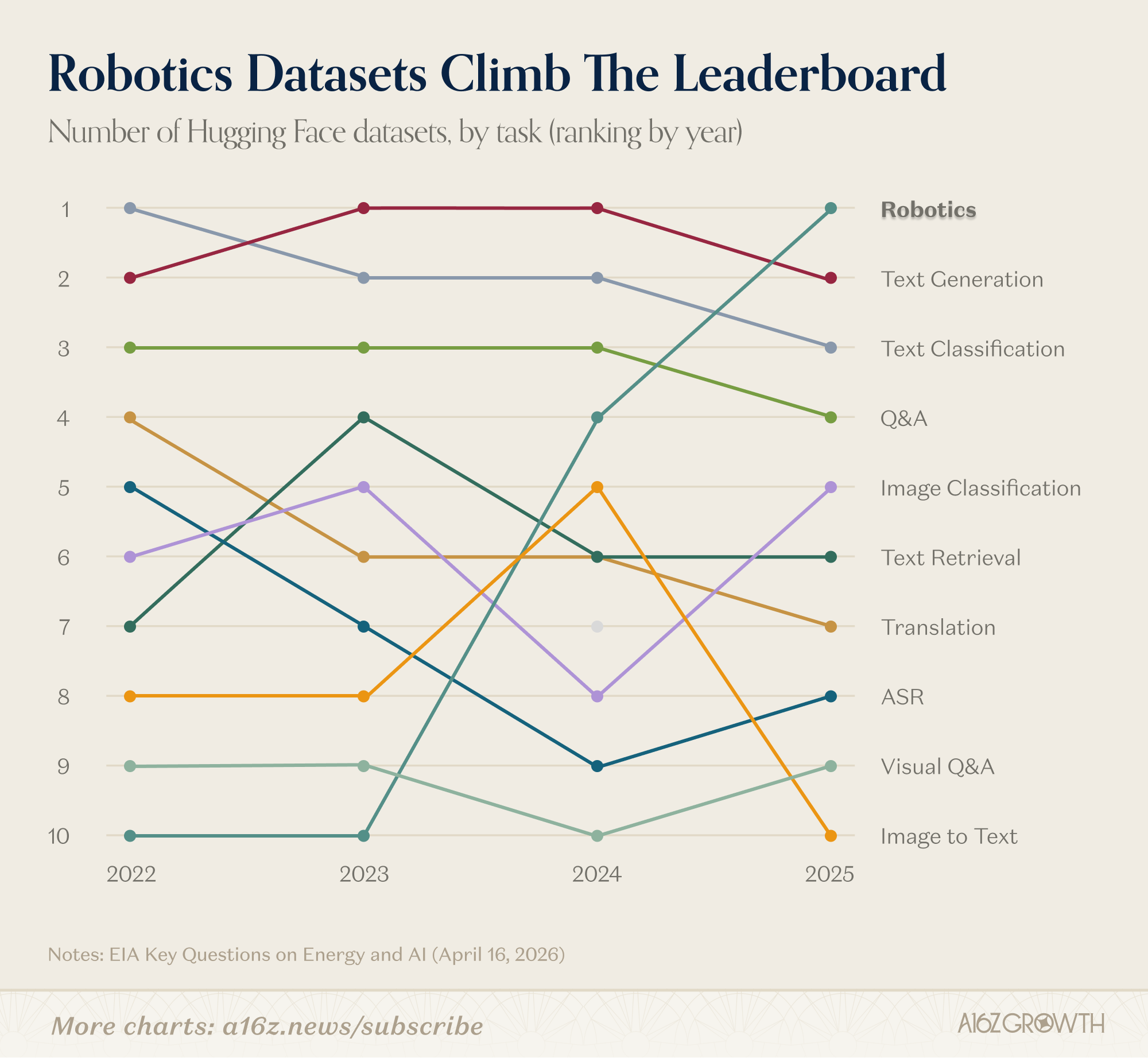
Robotics data sets have exploded, going from tenth to first, in just two years.
There’s a universe of robotics jobs no one has ever needed, until AI unlocks that need.
To repeat, none of this means every role survives intact. The BLS expects customer service representatives and medical transcriptionists to decline, and perhaps that decline is already underway:
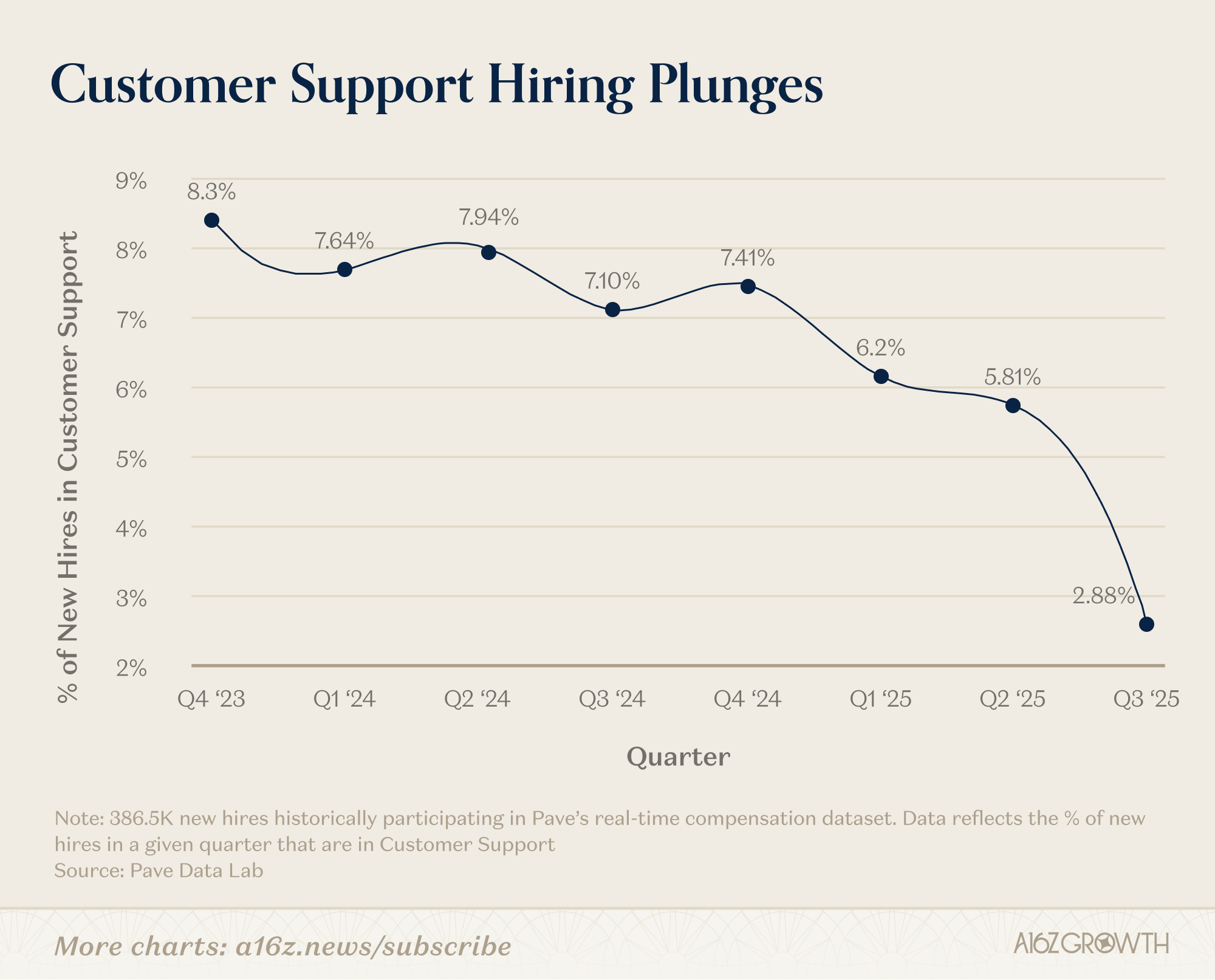
Some jobs will disappear, others will shrink. There will be adjustments and painful transitions, and it may take some time for productivity gains to wind their way through the economy (in fits and starts). We should be sympathetic to those changes and pour effort into making them as smooth as possible, including, among other things, with active job retraining (an initiative that a16z is proud to support).
Productivity is supposed to eliminate drudgery, and that is what it will do this time around too. But, the AI job apocalypse story only works if you assume human wants and ideas suddenly freeze at the exact moment intelligence gets cheap. That is absurd. I, for one, reject the Wall-E meme, and I don’t think I’m alone:

The macro story is not a jobless future, where we retire fat and complacent to our Netflix-scooters.
The future is cheaper intelligence, bigger markets, new firms, new industries, and higher-order human work. There is no fixed amount of work, let alone a fixed amount of cognition, and there never was. AI is not the end of work. It is the beginning of abundant intelligence.
LFG!

This newsletter is provided for informational purposes only, and should not be relied upon as legal, business, investment, or tax advice. Furthermore, this content is not investment advice, nor is it intended for use by any investors or prospective investors in any a16z funds. This newsletter may link to other websites or contain other information obtained from third-party sources - a16z has not independently verified nor makes any representations about the current or enduring accuracy of such information. If this content includes third-party advertisements, a16z has not reviewed such advertisements and does not endorse any advertising content or related companies contained therein. Any investments or portfolio companies mentioned, referred to, or described are not representative of all investments in vehicles managed by a16z; visit https://a16z.com/investment-list/ for a full list of investments. Other important information can be found at a16z.com/disclosures. You’re receiving this newsletter since you opted in earlier; if you would like to opt out of future newsletters you may unsubscribe immediately.
There are exceptions, of course. For some things, the outer limits of demand are constrained, and more productivity lowers costs, but doesn’t lead to more output. There are only so many smartphones that a single person can own, for example. We rapidly went from no cars, to 1 car, to 2 . . . but 3 cars for a given household is probably overkill. In this case, the doomer assumption has to be that we’ve reached the outer limit of “cognition demand,” and given the frontiers yet to conquer, in say, robotics, space, biotech, and even basic policy research, the assumption is just absurd to the point of insulting.
Although, to be fair, expectations for employment impact are still largely null, but skew more to the downside.
More recently, entry-level casualties appear to be recovering. Unemployment for young SWE has reverted to trend (implying that laid off workers found jobs elsewhere), and while non-college job-finding has gotten worse, college job-finding has gotten better (which is the opposite of what one would expect, if AI was automating away entry-level knowledge work).
It’s actually not the case that the aggregate employment picture is neutral—the effects on “AI exposure” and “AI Adoption,” are basically neutral—but AI has likely been a net-jobmaker, thus far. None of Goldman’s (or the other cited research) accounts for all the hard-hat jobs that AI Capex has created:
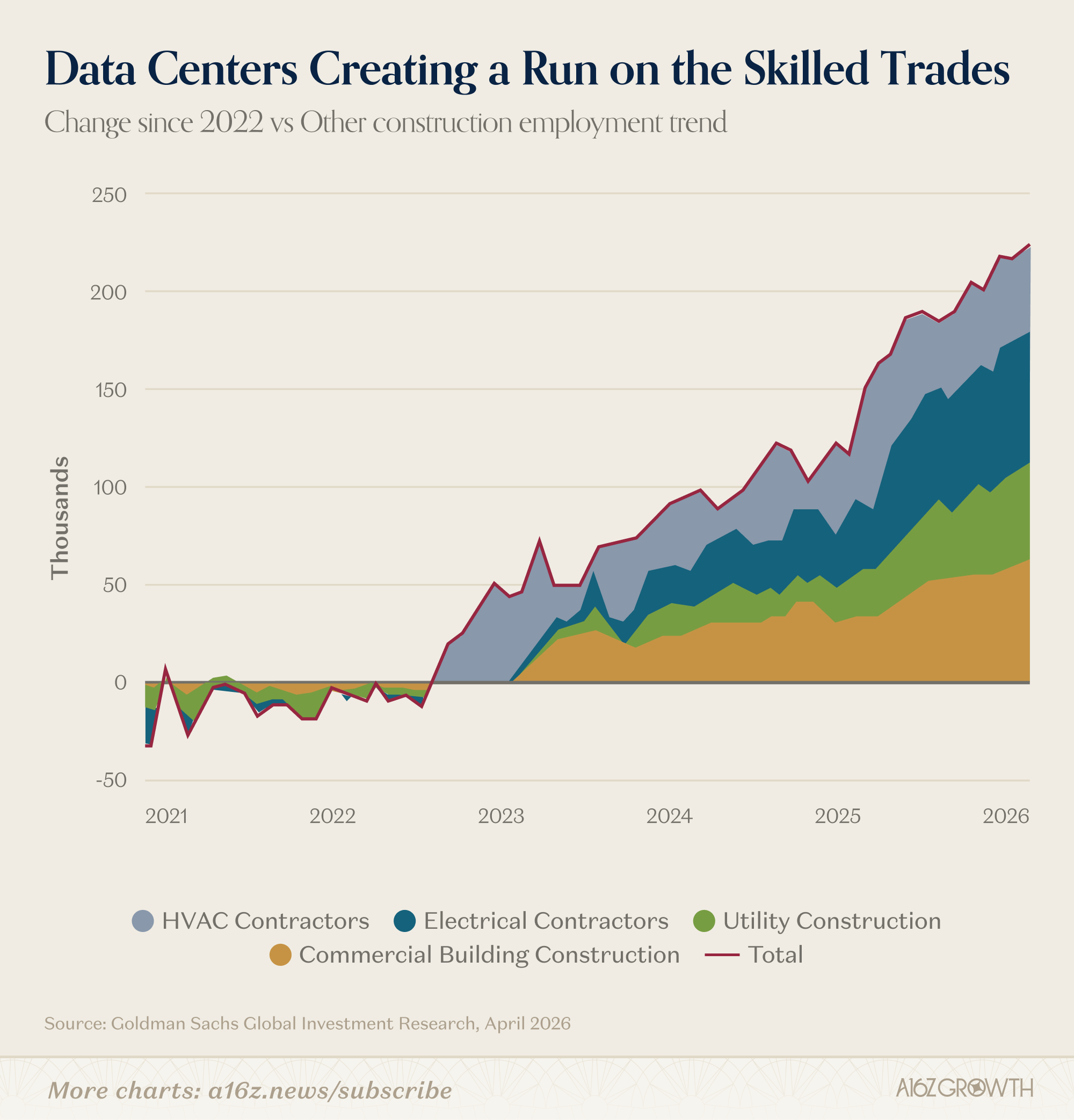
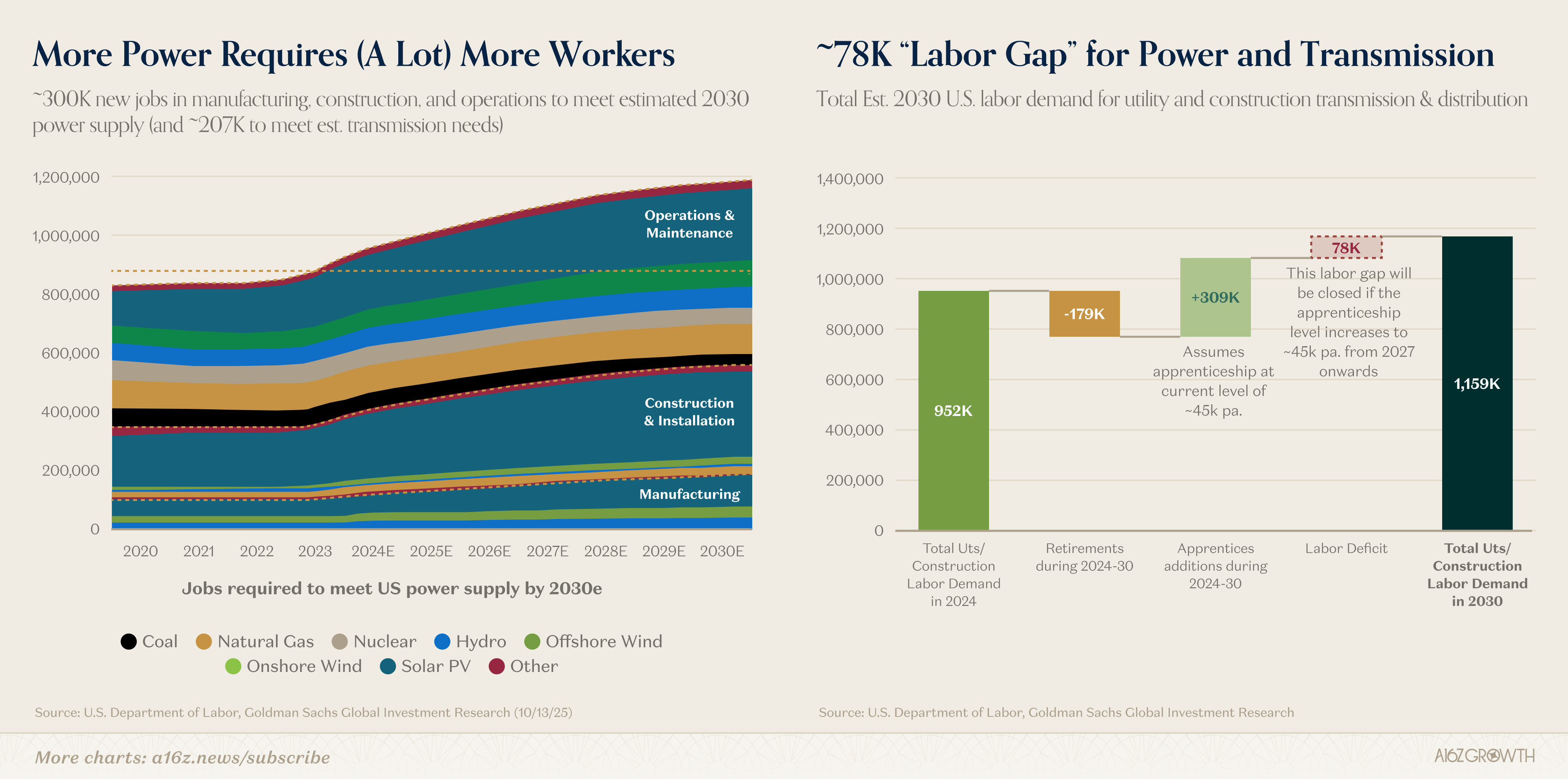
Data center construction (and the electrification of everything) have created a massive run on the skilled-trades that’s expected to persist at least through the end of the decade.
Putting aside the longer-term effects of AI on the labor market, the sheer magnitude of AI Capex makes AI a jobmaker, for now. There’s a good argument that AI Capex is the cycle now, and outside of healthcare, it’s the only jobmaker in town.