惯性聚合 高效追踪和阅读你感兴趣的博客、新闻、科技资讯
阅读原文 在惯性聚合中打开

推荐订阅源

cs.AI updates on arXiv.org
V
Visual Studio Blog
The GitHub Blog
The GitHub Blog
Apple Machine Learning Research
J
Java Code Geeks
T
Tailwind CSS Blog
大猫的无限游戏
大猫的无限游戏
Jina AI
Jina AI
OSCHINA 社区最新新闻
OSCHINA 社区最新新闻
Hugging Face - Blog
Hugging Face - Blog
WordPress大学
WordPress大学
宝玉的分享
宝玉的分享
freeCodeCamp Programming Tutorials: Python, JavaScript, Git & More
罗磊的独立博客
人人都是产品经理
人人都是产品经理
H
Heimdal Security Blog
Last Week in AI
Last Week in AI
博客园 - 【当耐特】
Cyberwarzone
Cyberwarzone
Google DeepMind News
雷峰网
雷峰网
Hacker News: Ask HN
Hacker News: Ask HN
Webroot Blog
Webroot Blog
Microsoft Azure Blog
MyScale Blog
MyScale Blog
A
About on SuperTechFans
V2EX - 技术
V2EX - 技术
小众软件
小众软件
博客园 - Franky
博客园 - 司徒正美
P
Privacy International News Feed
爱范儿
爱范儿
U
Unit 42
博客园 - 叶小钗
The Hacker News
The Hacker News
C
Check Point Blog
奇客Solidot–传递最新科技情报
奇客Solidot–传递最新科技情报
Simon Willison's Weblog
N
News and Events Feed by Topic
D
Docker
T
Threatpost
MongoDB | Blog
MongoDB | Blog
让小产品的独立变现更简单 - ezindie.com
H
Help Net Security
L
LINUX DO - 最新话题
Security Latest
Security Latest
T
The Exploit Database - CXSecurity.com
S
SegmentFault 最新的问题
A
Arctic Wolf
Spread Privacy
Spread Privacy

Hacker News - Newest: "AI"

AI can't read an investor deck AI as an attorney? Student uses ChatGPT, Gemini to sue UW over alleged racial discrimination Hacking MCP Servers in AI Systems – The Rug Pull: Tool Changes After Approval GitHub - MeepCastana/KubeezCut: Free Web based video editor GitHub - GenAI-Gurus/awesome-eu-ai-act: Curated tools, official sources, OSS, templates, and guides for EU AI Act compliance. Can AI judge journalism? A Thiel-backed startup says yes, even if it risks chilling whistleblowers Coming soon: 10 Things That Matter in AI Right Now DARPA built an AI to fact-check enemy weapons claims What explains heterogeneity in AI adoption? When AI Meets Muscle: Context-Aware Electrical Stimulation Promises a New Way to Guide Human Movements - Department of Computer Science AI Changed How We Build. It Did Not Change What Matters. Linux rules on using AI-generated code - Copilot is OK, but humans must take 'full responsibility for the… Meta spins up AI version of Mark Zuckerberg to engage with employees Code Mode: Let Your AI Write Programs, Not Just Call Tools | TanStack Blog GitHub - Delavalom/graft: Go framework for building AI agents. Type-safe tools, multi-provider (OpenAI, Anthropic, Gemini, Bedrock), zero vendor SDKs. India's TCS tops estimates, says new AI models did not dent services demand Gen Z's fading AI hype Strong feeling: we are in a folded AI reality GitHub - machinarii/total-recall-catalog: A reference catalog of latest knowledge retrieval, memory & RAG systems GitHub - mensfeld/code-on-incus: Give each AI agent its own isolated machine with root, Docker, and systemd. Active defense detects and stops threats automatically.. Quantization, LoRA, and the 8% Problem: Benchmarking Local LLMs for Production AI Iran war: We spoke to the man making Lego-style AI videos that experts say are powerful propaganda Powell, Bessent discussed Anthropic's Mythos AI cyber threat with major U.S. banks GitHub - immartian/bellamem: Persistent belief-graph memory for AI agents. Retrieves decisive context by importance — not recency, not RAG, not /compact. recursive-mode: The Repo-Native Operating System for AI Engineering After the attack on Sam Altman's home, will AI CEO's go on the offensive? The biggest advance in AI since the LLM Opus 4.6 vs GPT 5.4 One Prompt Unity World Generation Test “AI polls” are fake polls Client Challenge Can AI be a 'child of God'? Inside Anthropic's meeting with Christian leaders How to Switch AI Chatbots and Why You Might Want To GitHub - MattMessinger1/agentic_refund_guardrail: Safe refund policy layer for AI agents — Python + TypeScript. Same behavior, shared tests. Adam/papers/emergent_values_whitepaper.md at master · strangeadvancedmarketing/Adam Ask HN: How do you stop playing 20 questions with your AI coding tools How far can automation and AI support psychotherapy? - @theU GitHub - stagas/rtdiff: realtime git diff gui and AI-assisted commits A Mac Studio for Local AI — 6 Months Later A History of the Early Years of AI at the University of Edinburgh Why AI Coding Tools Still Feel Stuck on Localhost MSN AI Datacenters Are Becoming Strategic Targets twitter.com Penn Researchers Use AI to Surface Unreported GLP-1 Side Effects in Reddit Posts Show HN: MoodSense AI (ML and FastAPI and Gradio, Deployed on Hugging Face) Moodsense Ai - a Hugging Face Space by aman179102 AI models are terrible at betting on soccer—especially xAI Grok GitHub - xialeistudio/echoic GitHub - HimashaHerath/github-dev-wrapped: AI-powered weekly GitHub activity reports deployed to GitHub Pages GitHub - alejandrobalderas/claude-code-from-source: Architecture, patterns & internals of Anthropic's AI coding agent — reverse-engineered from source maps AI and Tech brief: Ireland ascendant GitHub - Titovilal/context0: Context0 - Never Surrender Training for a Marathon with an AI Coach: What Worked and What Didn't Cyber Pulse: Agentic Intel - Apps on Google Play I Built an AI PR Reviewer That Catches Bugs by Not Looking for Bugs Gen Z workers are so fearful AI will take their job they’re intentionally sabotaging their company’s AI rollout | Fortune How AI Is Reimagining the Game of Golf–For Both Players and Courses GitHub - nattergabriel/reseed: A CLI tool for managing and distributing agent skills across projects Is SVG the final frontier? My AI workflow evolved from prompts to a near-autonomous workflow MLSharp Help - 3DGS Viewer & Generator I put my cognitive field based AI's runtime on GitHub Is Numble the first AI-proof game? A3: Kubernetes for autonomous AI agent fleets | Emergent Principles Deepali Vyas ("The Elite Recruiter") GitHub - msmarkgu/RelayFreeLLM: A restful API designed to route user prompts to various AI model providers. Unionized ProPublica staff are on strike over AI, layoffs, and wages Unleashing the Advantage of Quantum AI We're heading for an AI-fueled 'dementia crisis,' brain scientist warns The AI-Assisted Breach of Mexico's Government Infrastructure [pdf] GitHub - stef41/lmscan: 🔍 Detect AI-generated text and fingerprint which LLM wrote it. Open-source GPTZero alternative. Zero dependencies, works offline. MSN GitHub - visionscaper/collabmem: Enabling long-term collaboration with Agentic AI - building up episodic and world model memory over time with in-context awareness We gave an AI a 3 year retail lease in SF and asked it to make a profit | Andon Labs AI Code is Hollowing Out Open Source, and Maintainers are Looking the Other Way What leaked "SteamGPT" files could mean for the PC gaming platform's use of AI AI is the boss at this retail store. What could go wrong? GitHub - Wuzu11517/agentic-proxy: Local proxy meant to help reduce With Drones, Geophysics and ArtificiaI Intelligence, Researchers Prepare to Do Battle Against Land Mines A Single Operator, Two AI Platforms, Nine Government Agencies: The Full Technical Report 在 Steam 上购买 FriedrichAI: Offline AI 立省 10% GitHub - inevolin/resume-cli: Hit Claude usage limits? Resume any AI coding session elsewhere. Switch tools at zero friction. GitHub - atripati/ark: AI Runtime Kernel — a context operating system for AI agents. Eliminates tool bloat, loads only what’s needed, and gives LLMs their reasoning space back. How to Build a Secure AI PR Reviewer with Claude, GitHub Actions, and JavaScript This Startup Wants You to Pay Up to Talk With AI Versions of Human Experts Intel Arc Pro B70 Brings 32GB VRAM to Local AI for $949 WordPress 7.0: The Good, the AI, and the Still Missing AI on the couch: Anthropic gives Claude 20 hours of psychiatry IatroBench: Pre-Registered Evidence of Iatrogenic Harm from AI Safety Measures AI Agents Know About Supabase. They Don't Always Use It Right. The history and future of AI at Google, with Sundar Pichai Inside an AI‑enabled device code phishing campaign How Meta Used AI to Map Tribal Knowledge in Large-Scale Data Pipelines AI for Systems: Using LLMs to Optimize Database Query Execution Forecasting the Economic Effects of AI Introducing Tinker: Play with AI, bring your ideas to life AI sheds light on an ancient gaming mystery People really hate AI but not as much as Iran—or Democrats | Fortune What is an AI Product Engineer? Phoebe Gates wants her $185 million AI startup to succeed with 'no ties to my privilege or my last name': 'I have a chip on my shoulder' | Fortune
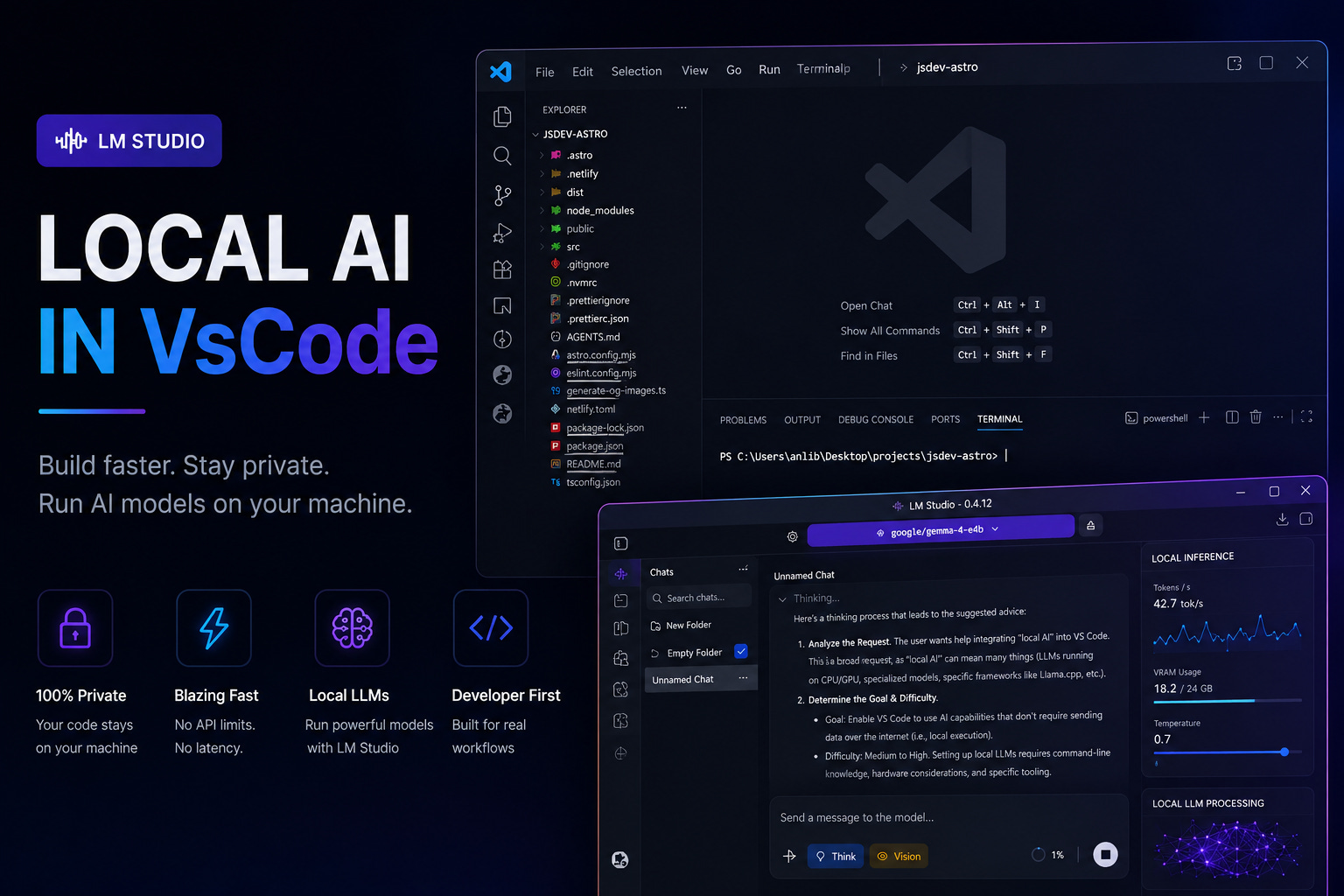
Building a Fully Local AI Workspace Inside VS Code
javatuts · 2026-05-13 · via Hacker News - Newest: "AI"

AI-assisted development is rapidly shifting from cloud-only workflows to local-first environments.

Instead of relying entirely on external services, developers can now run powerful language models directly on their own machines and integrate them into their editor, terminal, and everyday workflow.

This approach offers several advantages:

  • private local inference

  • offline development

  • zero API costs

  • customizable tooling

  • faster experimentation

  • complete environment control

In this guide, we will build a fully local AI development setup using:

Cloud-based coding assistants are convenient, but they also introduce limitations that become more noticeable over time.

Common problems include:

  • subscription pricing

  • privacy concerns

  • internet dependency

  • API rate limits

  • slow responses during peak usage

  • lack of control over models and infrastructure

Local AI environments solve many of these issues.

Instead of sending requests to external servers, everything runs directly on the developer’s machine. That means projects remain private, inference works offline, and the environment becomes fully customizable.

Of course, there is a tradeoff.

Local language models require significantly more hardware resources than traditional developer tools.

Running local models is heavily dependent on system performance.

A weak machine may technically load a model, but the actual experience can become frustrating very quickly. Response generation slows down, inference becomes inconsistent, and larger projects become difficult to work with.

Mid-range systems usually provide a much more comfortable experience, especially for small and medium-sized projects.

The most important hardware components are:

  • GPU memory

  • RAM

  • SSD speed

  • CPU performance

Operating system optimization also plays a surprisingly large role. Different Windows builds can noticeably affect model performance and inference speed.

Most JavaScript developers already have:

  • Visual Studio Code

  • Node.js

  • npm

  • terminal tooling

installed and configured.

Because of that, there is no reason to spend half the article installing VS Code and Node.js from scratch.

Instead, it makes more sense to jump directly into the interesting part: building a fully local AI workflow with LM Studio.

The next step is installing LM Studio.

Download:

LM Studio

LM Studio acts as the foundation of the entire local AI workflow.

It provides:

  • local model downloads

  • GPU acceleration

  • model management

  • chat interfaces

  • OpenAI-compatible APIs

  • inference servers

During installation, it is usually better to:

  • skip automatic model downloads

  • disable auto-start services

  • configure a custom models directory

Large models can consume hundreds of gigabytes over time, so storing them on a secondary drive is often the better option.

Example:

D:\models 

After installing LM Studio, the next step is downloading a model.

At the moment, LM Studio itself recommends the:

google/gemma-4-e4b

model by default.

And honestly, for most developers, this is currently a pretty solid starting point.

Gemma 4 E4B is part of Google DeepMind’s newer Gemma 4 family and is designed specifically for efficient local inference on consumer hardware. The model supports:

  • reasoning

  • coding tasks

  • tool calling

  • multimodal workflows

  • long context windows

while remaining relatively lightweight compared to larger models.

This is exactly why LM Studio currently pushes it as the default recommendation.

For laptops and mid-range desktop machines, E4B is usually much easier to run than massive 26B or 31B models while still delivering surprisingly good coding performance.

That said, the local AI ecosystem changes ridiculously fast.

A model that is considered “the best default” today may be outdated in a few months. New open-source models appear constantly, and performance improvements happen almost weekly.

Because of that, developers should absolutely spend time researching newer models later instead of treating the default LM Studio recommendation as permanent.

Right now, though, Gemma 4 E4B is a very reasonable place to start.

Systems with limited RAM may run into memory allocation issues when loading larger models.

Windows virtual memory can help stabilize the environment.

Open:

System Properties → Performance → Advanced

Then configure virtual memory as:

System managed size

for all drives.

After applying the changes, Windows will usually require a restart.

This simple adjustment can significantly improve stability on weaker systems.
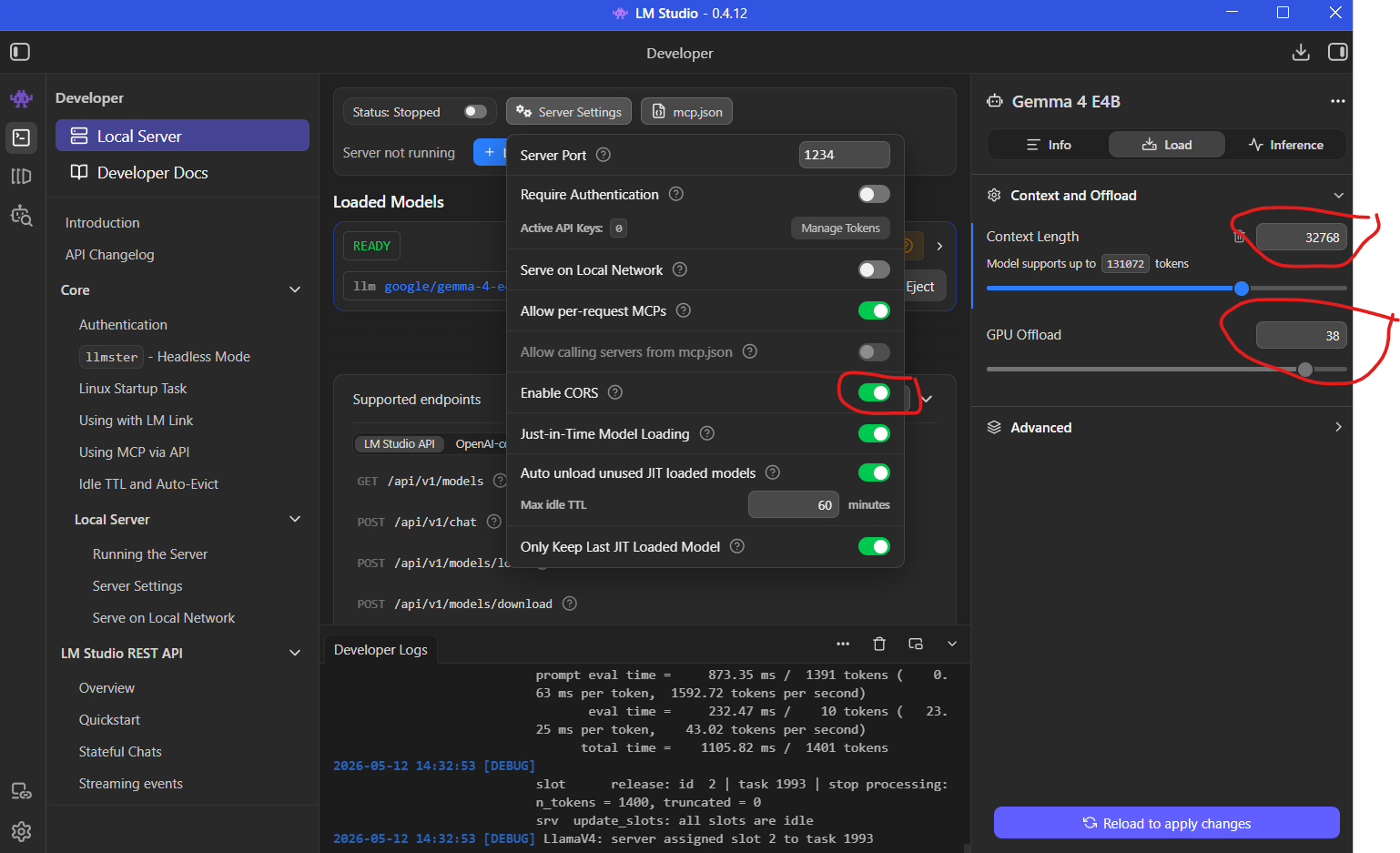
One setting that many developers overlook is context length.

Modern coding workflows benefit heavily from large context windows because AI models need to understand multiple files simultaneously.

A common configuration is:

32768

tokens.

Larger context windows help models:

  • preserve conversation history

  • analyze larger codebases

  • understand project structure

  • generate more coherent edits

For AI-assisted development, context size often matters just as much as model size.

Before connecting the model to external tools, it is a good idea to verify that everything works correctly inside LM Studio itself.

A simple prompt is enough:

What are tokens in language models?

If the model responds normally, the inference pipeline is working correctly.

At this stage, developers can also estimate generation speed and determine whether the hardware configuration feels comfortable enough for daily work.
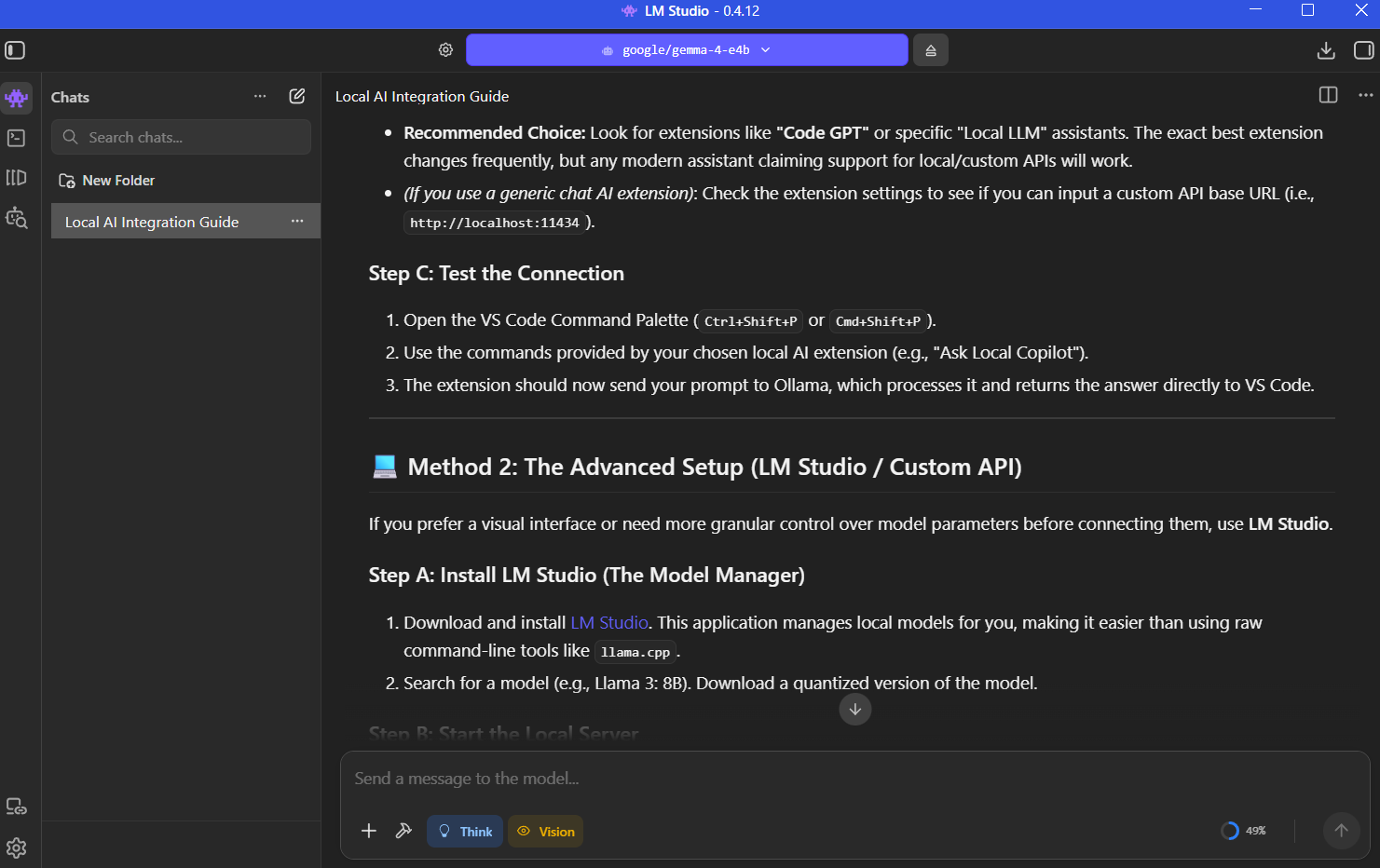
One of LM Studio’s most useful features is its OpenAI-compatible API server.

Inside the Developer section:

  1. Load the model

  2. Verify context settings

  3. Enable CORS

  4. Start the local server

Once enabled, external applications can communicate with the local model exactly like they would with a cloud AI provider.

This transforms the machine into a fully local AI backend.

Now it is time to integrate AI directly into the editor.

Inside VS Code Extensions, search for:

Cline

Install the extension and grant workspace trust permissions.

Unlike traditional autocomplete plugins, Cline behaves more like an autonomous development agent.

It can:

  • execute terminal commands

  • create files

  • refactor projects

  • install dependencies

  • update configuration files

  • explain errors

This makes the workflow feel very different from traditional autocomplete systems.

Inside Cline settings:

Choose:

OpenAI Compatible

Then configure the local endpoint:

http://127.0.0.1:1234/v1

The /v1 suffix is important because LM Studio exposes an OpenAI-style REST API.

The API key field can contain any placeholder value since everything runs locally.

Finally, copy the model identifier directly from LM Studio and paste it into the model configuration field.
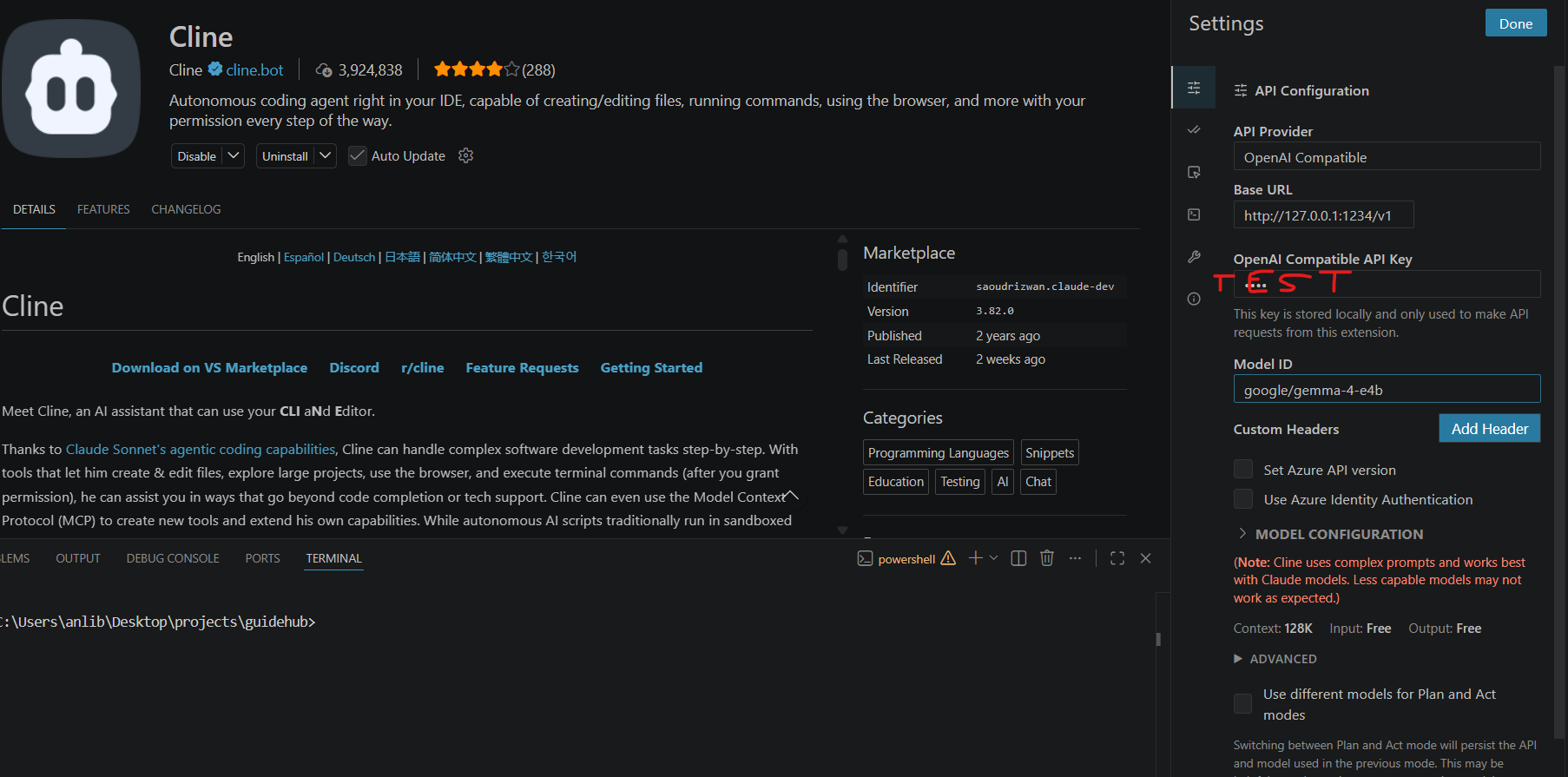
Once connected, VS Code gains direct access to locally running AI models.

AI coding agents work differently from traditional assistants.

Instead of only suggesting snippets, they can actively interact with the project itself.

For example, an agent can:

  • initialize projects

  • install dependencies

  • generate files

  • modify configuration

  • launch development servers

  • refactor existing code

The most interesting part is transparency.

Every command, file change, and generated edit remains visible to the developer.

This makes it much easier to supervise the workflow and intervene when necessary.

Even powerful models make mistakes.

Incorrect assumptions, outdated configurations, and broken project structures still happen regularly.

Sometimes the AI fixes its own mistakes automatically. Other times, manual intervention becomes necessary.

This is why modern AI workflows work best when developers treat the model as a collaborator rather than a replacement.

The quality of results depends heavily on:

  • prompt quality

  • project constraints

  • developer supervision

  • iterative refinement

Developers who expect perfect output from a single prompt usually end up disappointed.

One of the biggest differences between mediocre AI workflows and excellent ones is instruction quality.

Specific prompts dramatically improve reliability.

For example, instead of writing:

Migrate styles to Tailwind

it is much better to write:

Migrate all styles to Tailwind CSS v4
and remove old CSS files.

Version numbers matter.

Explicit constraints matter.

Clear expectations matter.

The more structured the prompt becomes, the more predictable the output becomes.

AI coding tools are especially effective for:

  • scaffolding

  • repetitive refactoring

  • style migrations

  • configuration generation

  • boilerplate creation

  • documentation

  • debugging assistance

These systems are not replacing software engineers.

They are reducing friction.

For solo developers and small teams, this can dramatically accelerate everyday development work.

Local AI development has evolved from an experimental niche into a genuinely practical workflow.

With tools like:

  • LM Studio

  • Cline

  • Visual Studio Code

developers can build fully private AI-powered workspaces directly on their own machines.

The ecosystem is still evolving rapidly, and local models still lag behind the most advanced cloud systems in some areas. But the gap is shrinking much faster than many people expected.

For developers willing to experiment, local AI already offers a surprisingly capable and highly flexible development experience.