
惯性聚合 高效追踪和阅读你感兴趣的博客、新闻、科技资讯
阅读原文 在惯性聚合中打开

推荐订阅源

F
Full Disclosure
奇客Solidot–传递最新科技情报
奇客Solidot–传递最新科技情报
Last Week in AI
Last Week in AI
The GitHub Blog
The GitHub Blog
WordPress大学
WordPress大学
博客园 - 三生石上(FineUI控件)
D
Docker
K
Kaspersky official blog
Latest news
Latest news
P
Privacy International News Feed
雷峰网
雷峰网
S
Security Affairs
博客园 - 司徒正美
博客园 - Franky
C
CERT Recently Published Vulnerability Notes
Cisco Talos Blog
Cisco Talos Blog
AWS News Blog
AWS News Blog
C
Check Point Blog
T
Tailwind CSS Blog
T
Tenable Blog
Cyber Security Advisories - MS-ISAC
T
Threat Research - Cisco Blogs
The Last Watchdog
The Last Watchdog
Google Online Security Blog
L
Lohrmann on Cybersecurity
Exploit-DB.com RSS Feed
B
Blog
The Hacker News
The Hacker News
V
V2EX
L
LINUX DO - 最新话题
云风的 BLOG
云风的 BLOG
Engineering at Meta
Engineering at Meta
GbyAI
GbyAI
W
WeLiveSecurity
Know Your Adversary
Know Your Adversary
P
Proofpoint News Feed
cs.AI updates on arXiv.org
Microsoft Security Blog
S
Securelist
V2EX - 技术
V2EX - 技术
博客园 - 叶小钗
The Cloudflare Blog
小众软件
小众软件
Recent Announcements
Microsoft Azure Blog
L
LangChain Blog
酷 壳 – CoolShell
酷 壳 – CoolShell
Hacker News: Ask HN
Hacker News: Ask HN
cs.CV updates on arXiv.org
The Register - Security

Hacker News - Newest: "AI"

AI can't read an investor deck AI as an attorney? Student uses ChatGPT, Gemini to sue UW over alleged racial discrimination Hacking MCP Servers in AI Systems – The Rug Pull: Tool Changes After Approval GitHub - MeepCastana/KubeezCut: Free Web based video editor GitHub - GenAI-Gurus/awesome-eu-ai-act: Curated tools, official sources, OSS, templates, and guides for EU AI Act compliance. Can AI judge journalism? A Thiel-backed startup says yes, even if it risks chilling whistleblowers Coming soon: 10 Things That Matter in AI Right Now DARPA built an AI to fact-check enemy weapons claims What explains heterogeneity in AI adoption? When AI Meets Muscle: Context-Aware Electrical Stimulation Promises a New Way to Guide Human Movements - Department of Computer Science AI Changed How We Build. It Did Not Change What Matters. Linux rules on using AI-generated code - Copilot is OK, but humans must take 'full responsibility for the… Meta spins up AI version of Mark Zuckerberg to engage with employees Code Mode: Let Your AI Write Programs, Not Just Call Tools | TanStack Blog GitHub - Delavalom/graft: Go framework for building AI agents. Type-safe tools, multi-provider (OpenAI, Anthropic, Gemini, Bedrock), zero vendor SDKs. India's TCS tops estimates, says new AI models did not dent services demand Gen Z's fading AI hype Strong feeling: we are in a folded AI reality GitHub - machinarii/total-recall-catalog: A reference catalog of latest knowledge retrieval, memory & RAG systems GitHub - mensfeld/code-on-incus: Give each AI agent its own isolated machine with root, Docker, and systemd. Active defense detects and stops threats automatically.. Quantization, LoRA, and the 8% Problem: Benchmarking Local LLMs for Production AI Iran war: We spoke to the man making Lego-style AI videos that experts say are powerful propaganda Powell, Bessent discussed Anthropic's Mythos AI cyber threat with major U.S. banks GitHub - immartian/bellamem: Persistent belief-graph memory for AI agents. Retrieves decisive context by importance — not recency, not RAG, not /compact. recursive-mode: The Repo-Native Operating System for AI Engineering After the attack on Sam Altman's home, will AI CEO's go on the offensive? The biggest advance in AI since the LLM Opus 4.6 vs GPT 5.4 One Prompt Unity World Generation Test “AI polls” are fake polls Client Challenge Can AI be a 'child of God'? Inside Anthropic's meeting with Christian leaders How to Switch AI Chatbots and Why You Might Want To GitHub - MattMessinger1/agentic_refund_guardrail: Safe refund policy layer for AI agents — Python + TypeScript. Same behavior, shared tests. Adam/papers/emergent_values_whitepaper.md at master · strangeadvancedmarketing/Adam Ask HN: How do you stop playing 20 questions with your AI coding tools How far can automation and AI support psychotherapy? - @theU GitHub - stagas/rtdiff: realtime git diff gui and AI-assisted commits A Mac Studio for Local AI — 6 Months Later A History of the Early Years of AI at the University of Edinburgh Why AI Coding Tools Still Feel Stuck on Localhost MSN AI Datacenters Are Becoming Strategic Targets twitter.com Penn Researchers Use AI to Surface Unreported GLP-1 Side Effects in Reddit Posts Show HN: MoodSense AI (ML and FastAPI and Gradio, Deployed on Hugging Face) Moodsense Ai - a Hugging Face Space by aman179102 AI models are terrible at betting on soccer—especially xAI Grok GitHub - xialeistudio/echoic GitHub - HimashaHerath/github-dev-wrapped: AI-powered weekly GitHub activity reports deployed to GitHub Pages GitHub - alejandrobalderas/claude-code-from-source: Architecture, patterns & internals of Anthropic's AI coding agent — reverse-engineered from source maps AI and Tech brief: Ireland ascendant GitHub - Titovilal/context0: Context0 - Never Surrender Training for a Marathon with an AI Coach: What Worked and What Didn't Cyber Pulse: Agentic Intel - Apps on Google Play I Built an AI PR Reviewer That Catches Bugs by Not Looking for Bugs Gen Z workers are so fearful AI will take their job they’re intentionally sabotaging their company’s AI rollout | Fortune How AI Is Reimagining the Game of Golf–For Both Players and Courses GitHub - nattergabriel/reseed: A CLI tool for managing and distributing agent skills across projects Is SVG the final frontier? My AI workflow evolved from prompts to a near-autonomous workflow MLSharp Help - 3DGS Viewer & Generator I put my cognitive field based AI's runtime on GitHub Is Numble the first AI-proof game? A3: Kubernetes for autonomous AI agent fleets | Emergent Principles Deepali Vyas ("The Elite Recruiter") GitHub - msmarkgu/RelayFreeLLM: A restful API designed to route user prompts to various AI model providers. Unionized ProPublica staff are on strike over AI, layoffs, and wages Unleashing the Advantage of Quantum AI We're heading for an AI-fueled 'dementia crisis,' brain scientist warns The AI-Assisted Breach of Mexico's Government Infrastructure [pdf] GitHub - stef41/lmscan: 🔍 Detect AI-generated text and fingerprint which LLM wrote it. Open-source GPTZero alternative. Zero dependencies, works offline. MSN GitHub - visionscaper/collabmem: Enabling long-term collaboration with Agentic AI - building up episodic and world model memory over time with in-context awareness We gave an AI a 3 year retail lease in SF and asked it to make a profit | Andon Labs AI Code is Hollowing Out Open Source, and Maintainers are Looking the Other Way What leaked "SteamGPT" files could mean for the PC gaming platform's use of AI AI is the boss at this retail store. What could go wrong? GitHub - Wuzu11517/agentic-proxy: Local proxy meant to help reduce With Drones, Geophysics and ArtificiaI Intelligence, Researchers Prepare to Do Battle Against Land Mines A Single Operator, Two AI Platforms, Nine Government Agencies: The Full Technical Report 在 Steam 上购买 FriedrichAI: Offline AI 立省 10% GitHub - inevolin/resume-cli: Hit Claude usage limits? Resume any AI coding session elsewhere. Switch tools at zero friction. GitHub - atripati/ark: AI Runtime Kernel — a context operating system for AI agents. Eliminates tool bloat, loads only what’s needed, and gives LLMs their reasoning space back. How to Build a Secure AI PR Reviewer with Claude, GitHub Actions, and JavaScript This Startup Wants You to Pay Up to Talk With AI Versions of Human Experts Intel Arc Pro B70 Brings 32GB VRAM to Local AI for $949 WordPress 7.0: The Good, the AI, and the Still Missing AI on the couch: Anthropic gives Claude 20 hours of psychiatry IatroBench: Pre-Registered Evidence of Iatrogenic Harm from AI Safety Measures AI Agents Know About Supabase. They Don't Always Use It Right. The history and future of AI at Google, with Sundar Pichai Inside an AI‑enabled device code phishing campaign How Meta Used AI to Map Tribal Knowledge in Large-Scale Data Pipelines AI for Systems: Using LLMs to Optimize Database Query Execution Forecasting the Economic Effects of AI Introducing Tinker: Play with AI, bring your ideas to life AI sheds light on an ancient gaming mystery People really hate AI but not as much as Iran—or Democrats | Fortune What is an AI Product Engineer? Phoebe Gates wants her $185 million AI startup to succeed with 'no ties to my privilege or my last name': 'I have a chip on my shoulder' | Fortune
Conway’s Law Teaches a Grim Lesson About AI in Product Development
flail · 2026-05-13 · via Hacker News - Newest: "AI"

When I first stumbled upon Conway’s Law, it was anything but intuitive to me.

Organizations which design systems are constrained to produce designs which are copies of the communication structures of these organizations.
Melvin E. Conway

Why would an organizational structure of a company have anything to do with software architecture? After all, there are whole bodies of knowledge covering high- and low-level concepts of software development. Aren’t these things properly planned and executed?

I mean, sure, in the details, there will always be a mess. However, in a grand scheme of things, the high-level design should be far more controllable than the law suggests.

In retrospect, Conway’s Law is one of those things that, once you’ve seen it, you can’t unsee it.

Conway’s Law and Spotify Model

Whenever Conway’s Law emerges in a discussion, my favorite example is Spotify. I’m a user since the beta. I know several people who worked there in leadership positions. Most of all, Spotify, at some point, was very vocal about their organizational approach, the so-called Spotify Model. It’s like I have enough data to connect the dots.

As popular as it was at the time, if you look at the Spotify Model, it’s hard not to see it as a glorified matrix organization. Yes, there’s more autonomy across the board, but the communication paths? They all scream “Matrix!”

What should we expect from their product design if Conway’s Law is true? My best guess is a set of features interconnected in non-obvious ways, with a common issue of lack of alignment, and a lot of local optimizations. And that’s precisely what we get.

Spotify UX

While Spotify’s codebase is not open, its UX is quite telling. By now, it’s a clutterball of misaligned ideas fighting for your attention.

spotify home screen
Playlist sidebar, announcements, recently played, made for me, music video, related music videos, now playing… Welcome to the Spotify home screen.

From a user perspective, it’s fascinating, although not in a good way, how I struggle to find the same options that I use regularly (like, multiple times a week, for years). Managing playlists? Oh, boy. Search? Every other time, it’s in the wrong context. Inconsistencies between mobile and web? Don’t get me started.

But maybe it’s just grumpy me. Fine. I’ve just literally googled “who loves spotify ux?” and among the top results are:

Doesn’t sound like a love wave, really. It’s either one: Google reads my mind, or the UX is problematic.

All that comes from a product praised (and copied) for some product innovations, such as Discovery Weekly or Spotify Wrapped. Most definitely, not everything is wrong here. It’s just a matrix of somewhat misaligned ideas, good and bad. That isn’t really a recipe for customer delight.

lighsaber seek bars spotify

By the way, did you know that Spotify has a custom seek bar for Star Wars songs that looks like a lightsaber? And you can change the looks of the specific lightsabers, no less. There could hardly be a better illustration of “a matrix of somewhat misaligned ideas, good and bad.”

Communication, Alignment, Autonomy

If you consider Conway’s Law, it’s hard not to see how Spotify UX is a precise map for the Spotify Model. Wherever communication between teams (squads, guilds, chapters, or whatever the hell they call them) was messy and faced multiple conflicting goals, so did the interconnections between features.

To make things harder, Spotify sprinkled high autonomy over their feature teams. So the matrix organization made alignment a challenge, yet decision-making was pushed down the hierarchy nonetheless.

A high-autonomy-limited-alignment setup is not a recipe for effective work. And I say that from experience. At Lunar, we walked that path. The lesson? As much as I’m a huge fan of distributed autonomy, I’d always consider alignment first.

In the late 2010s, Spotify had a few dozen relatively independent feature teams responsible for specific parts of the product. Small wonder that the “mobile playlist” team had different ideas from the “web playlist” team. Communication paths that might have fixed that were watered down by an overly complex organizational model.

By now, the engineering headcount is already in the thousands, and the team count is thus in the hundreds. Just imagine the product mess that the Spotify Model would create. No wonder they largely abandoned it.

OK, but what does it have to do with AI?

AI Product Management

Product people are encouraged almost as strongly as developers to use AI extensively. It comes as a mixed blessing. Early intensive prototyping is a viable path, and it opens up whole new avenues for validating product desirability.

LLMs make it just so easy to create extensive specifications. We can attach all the existing product descriptions as context, let AI do its own research, analyze the codebase, and more. It will produce a nice, detailed description, and the engineers will nail it.

Except we misinterpret the ease of creation for the value of the output.

A sidenote: It’s the same aspiration we had when we tried to model systems with UML diagrams, and it didn’t work either. It’s not about the tools. It’s about the iterative exploratory nature of designing software.

Still, AI can create the same illusion we followed many times before—that we can specify software upfront in detail from the outset. The output looks good. Better than ever, even. And we get it effortlessly. It’s the AI model that does the heavy lifting.

It takes some time to realize that product development doesn’t work like this. It never has. And it has nothing to do with the tools we use to create specs.

AI Kills Communication

In the past, product specifications were brief. Save maybe for some Business Analysts, no one fancied writing long forms describing all the feature details. We relied on just enough context and communication between engineers and product people.

However, now, generating detailed specifications with AI is easy and cheap. Initially, we might even verify whether the output is correct. Eventually, we’ll give up. One, often they’d be good enough. Two, LLMs are great at creating outputs that sound sensible. Three, honestly, read a 4-pager with a feature description and tell me you understood everything.

At some point, and sooner rather than later, a product manager will stop carefully verifying AI output. Soon, the developers will follow. That is, given they read the extensive specs at all in the first place. It quickly evolves into the “you give me the specs, I’ll get them built, no questions asked” kind of scenario.
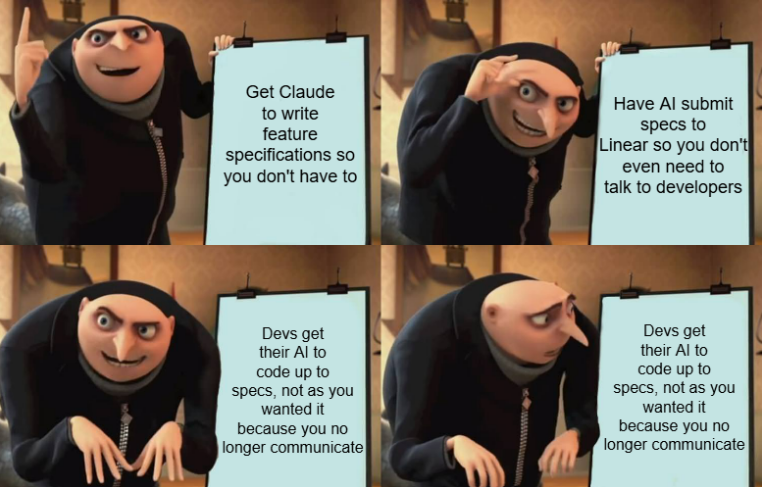
dev building up to ai specs meme

The key part here is: “no questions asked.” It’s like going all the way back to the 90s, way before Agile happened. We build up to the specs, whether it makes sense or not. The only difference is that we deal with the development so much faster. Does it matter, though, when we build the wrong thing?

Conway’s Law Meets AI Product Management

The most important change happened in between the lines, though. A one-sentence-long feature description was, by definition, full of holes and required the team to discuss. A detailed specification creates the illusion that a feature has been thought through from all angles.

The former invites communication. The latter discourages it.

As we close down communication paths, Conway’s Law kicks in. We’re bound to design architectures that copy organizational communication structures.

Less peer-to-peer communication and less collaborative exploration mean a more fragmented and less coherent architecture. As each individual is treated more and more as an isolated island, so will be the code that individual develops.

The effect will affect both a technical level (think code architecture) and a product level (think UX). Give such a way of working a couple of years, and we’ll start praising Spotify for its exceptional product design in comparison.  

AI Is on a Collision Course with Conway’s Law

Dev: The last feature is on staging.
PM [checks the feature out]: It doesn’t work as specified! Here’s what should be different.
Dev [checks the code, checks the specs, 2 hours have passed]: Well, actually, it works as specified. Here are the specific parts that prove my point.
PM: Oh, my Claude must have hallucinated that part.

That’s an actual conversation that I heard that inspired this article. When I consider the impact of AI on communication, the paths connecting product and engineering are most affected. Yet, similar effects emerge across the board.

  • A single developer may produce more code with AI tools, so they are more independent and, even under time pressure, they don’t need to collaborate with other engineers as often. We reduce the need for communication.
  • Coding agents running independently step on each other’s toes way more carelessly, creating merge conflicts and triggering rework (the worst kind of rework, actually). Operators of said agents are thus better off when they isolate their active work areas. Which means less coordination and less communication.
  • The asynchronous nature of working with AI agents incentivizes the “throw over the fence” hand-offs. My agent’s output may be ready when I’m already off, but let that not stop you from doing whatever you need to do with it. Again, less human-to-human communication.
  • The sheer amount of documentation we can generate on different levels automates away collaborative activities (or parts of them). Code review? Let an agent handle that. Even less communication, perchance?

If Conway’s Law holds, we may be up for a rude awakening. As an industry, we are hyped about all sorts of “my agent talks to your agent” scenarios. It’s easy to see the upside—automating away the mundane, tedious, and routine. It’s hard to see the long-term cost of deteriorating communication paths.

So, we either learn to navigate the new realities of collaboration better, or we accept that the products we use will increasingly be crap. Which one will it be?


These posts are not generated. 웃 https://okhuman.com/nf1GGg

Thank you for reading. I appreciate if you sign-up for getting new articles to your email.

I also publish on Pre-Pre-Seed substack, where I focus more narrowly on anything related to early-stage product development.