A close observer of OpenAI from its inception in 2019, journalist Karen Hao says the company's original nonprofit, mission-driven purpose suited its needs at the time.
In its earliest stages, OpenAI could not hope to outgun the much larger Google with big salaries to attract the talent it needed to get an edge in the race to develop artificial intelligence.
"But they could say, do you want to work for a faceless corporation or do you want to work for a mission-driven nonprofit that's trying to benefit all of humanity?"
It worked, and OpenAI surged to become a near trillion-dollar company, leading a handful of huge companies in the race to develop the most advanced artificial intelligence technology.
"Once they overcame that talent bottleneck, they needed to just play a money game, and build ever larger supercomputers that are very, very expensive in order to brute force their way to more advancement," Hao says.
A growing body of evidence suggests people in New Zealand and around the world are concerned about the impact of artificial intelligence.
A global study by accounting firm KPMG with the University of Melbourne last year found 81% of New Zealanders think regulation is required. Nine out of 10 wanted laws and action to combat AI-generated misinformation and only a quarter felt current safeguards were sufficient to make AI use safe for New Zealanders.
In the US, research by Pew published earlier this month found AI use growing fast and people finding it generally useful. At the same time, more people in that survey felt AI would be negative than positive for society over the next 20 years, and 63 per cent said it was developing too fast.
Hao says it's "really important" to say that "generally, trying to replicate humans is a fundamentally anti-human goal".
"This is one of the things that I think we should be deeply questioning about the way that Silicon Valley ultimately is trying to pursue AI development, is they have explicitly said in many of these definitions that they are trying to make humans redundant. That's not the point of technology development, and it's never been the point of technology development. Technology is meant to serve people, not serve people up to technology."
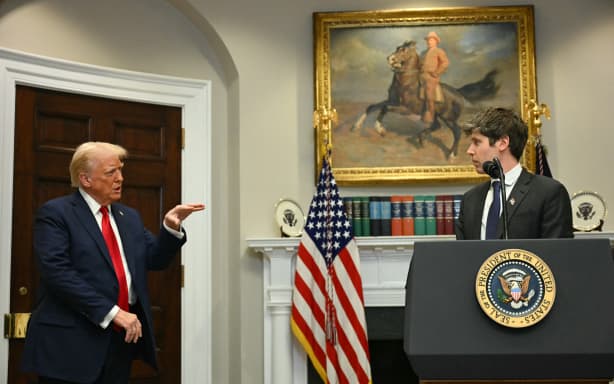
OpenAI's Sam Altman at the White House in January last year
AFP / Jim Watson
Hao's book Empire of AI, which was published last year, outlines the strategy OpenAI's chief executive Sam Altman used to navigate lawmakers eager to crackdown on the tech sector.
"Sam Altman goes up in front of Congress, and he says you should regulate us. He ... recognises that it would play well with the Biden administration to humble himself in front of Congress, and say you should regulate us," Hao says.
But instead of suggesting regulation of "concrete problems" with the industry, he put the focus on "a totally fictitious problem".
"He says you should regulate us on issues that include the potential extrication of our AI models out of data centres ... you should regulate us on the potential of our AI systems to go rogue and for us to lose control of these AI models. This is a very science fiction scenario," Hao says.
"What Altman didn't mention in that particular hearing was copyright infringement, data privacy issues, labour exploitation, environmental fallout, public health crisis - all of the other real-world concrete problems that are happening right now, the harms of their industries."
According to Hao, there are striking parallels between "the empires of AI" and the historical waves of colonialism.
In both cases, resources are claimed, value is quickly accrued from many by a few, information is controlled and it is all framed as a 'civilizing mission'.
However, the "AI hype" that initially prevailed has been replaced by large numbers concerned that AI is not on the right path.
"And so we have seen all of these different movements break out around the world to push back against the way that this technology is being developed, to push back against Silicon Valley's ideologies," she says.
Alongside a group of journalists and researchers, Hao has developed an 'AI Resist List', documenting specific instances of pushback around the world.
"Their actions are in fact holding the AI industry accountable, and it is slowing down and changing the way that the AI industry actually develops its technology."
此内容由惯性聚合(RSS阅读器)自动聚合整理,仅供阅读参考。 原文来自 — 版权归原作者所有。