A lot of people are trying to figure out recursively self-improving companies [SICs] right now.
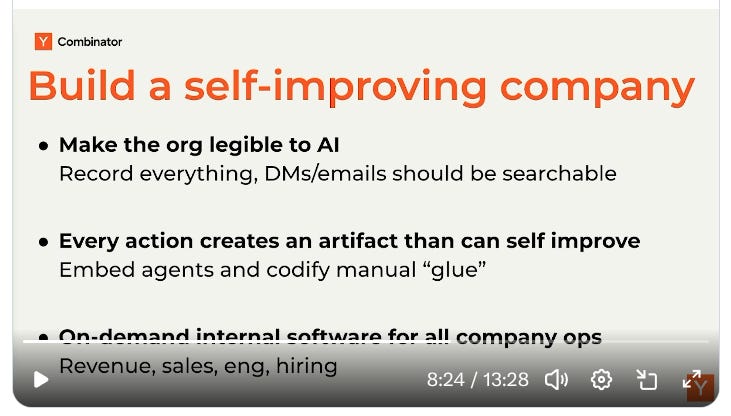
The tweet embeds a video in which Blomfield presents this slide:
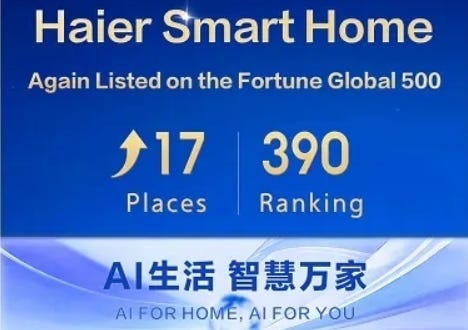
From a July 2025 press release by Chinese multinational Haier (note the tagline at the bottom):
From a September 2023 article on the website of Harvard Business Review:
[T]he defining design elements of a winning new organizational model are coming into focus: RenDanHeYi . . . which was introduced by Haier.
. . . Over the past eight years, we have been conducting a research study into the barriers within organizations to internal innovation and the emergence of new organizational models that address these barriers.
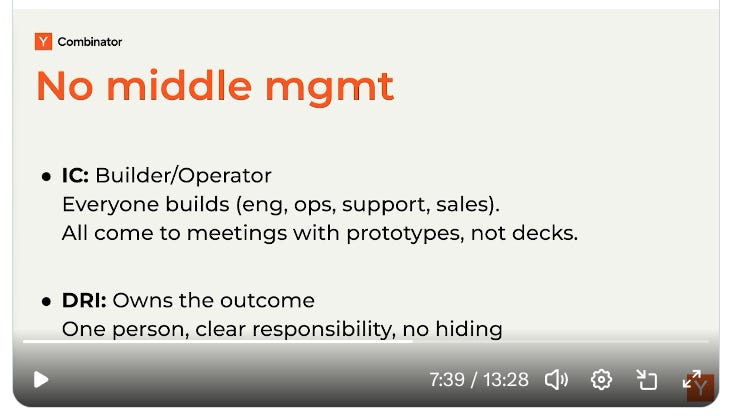
From said video:
Earlier in the video, Blomfield cites Block co-founder Jack Dorsey as an influence on his/YC’s thinking about SICs; from Dorsey’s March 31, 2026 article titled “From Hierarchy to Intelligence” (Dorsey had a co-author):
We are not the first to try to move beyond traditional hierarchy. Haier’s rendanheyi [sic] model, [etc.] . . . are real attempts at the same problem. What they [e.g., Haier] lacked was a technology capable of actually performing the coordination functions that hierarchy exists to provide.
Over the past decade, Haier has been on a quest to build a company with “zero distance” between employees and customers. To that end, it divided its seventy-two-thousand person organization into four thousand microenterprises [MEs], with just two levels separating frontline employees from the CEO. More a network than a hierarchy, Haier offers an astonishing yet practical model for achieving entrepreneurship at scale.
From said September 2023 article on the website of Harvard Business Review:
Elements of the New Organizational Model
. . . 3. “Manage” MEs with decentralized marketplace structures [my emphasis] rather than centralized authority . . .
More about Haier is below. All told, Dorsey’s omissions/distortions might be in service of a variant of a “partial hangout”: e.g., he wanted to signal to (prospective) investors that he knows to implement a variant of agentic RenDanHeYi (VAR), but he didn’t want to animate (prospective) competitors; from an April 2, 2026 article on BusinessInsider.com:
The maximum distance between Dorsey and a Block employee, he said, was now five layers.
Within the year, Dorsey is aiming to narrow that distance to “two to three” layers, he said. [Block has ~6K employees.]
From said article co-authored by Dorsey:
Most companies using AI today are giving everyone a copilot, which makes the existing structure work slightly better without changing it. We’re after something different: a company built as an intelligence (or mini-AGI).
. . . For this to work, a company needs two things: a kind of “world model” of its own operations, and a customer signal rich enough to make that model useful.
. . . [T]he capability of the system is only as good as the quality of the customer signal feeding it. And money is the most honest signal in the world.
People lie on surveys. They ignore ads. They abandon carts. But when they spend, save, send, borrow, or repay, that’s the truth. Every transaction is a fact about someone’s life. Block sees both sides of millions of these transactions every day, the buyer through Cash App and the seller through Square, plus the operational data from running the merchant’s business. That gives the customer world model something rare: a per-customer, per-merchant understanding of financial reality built from honest signal that compounds. The richer the signal, the better the model. The better the model, the more transactions. The more transactions, the richer the signal [my emphasis].
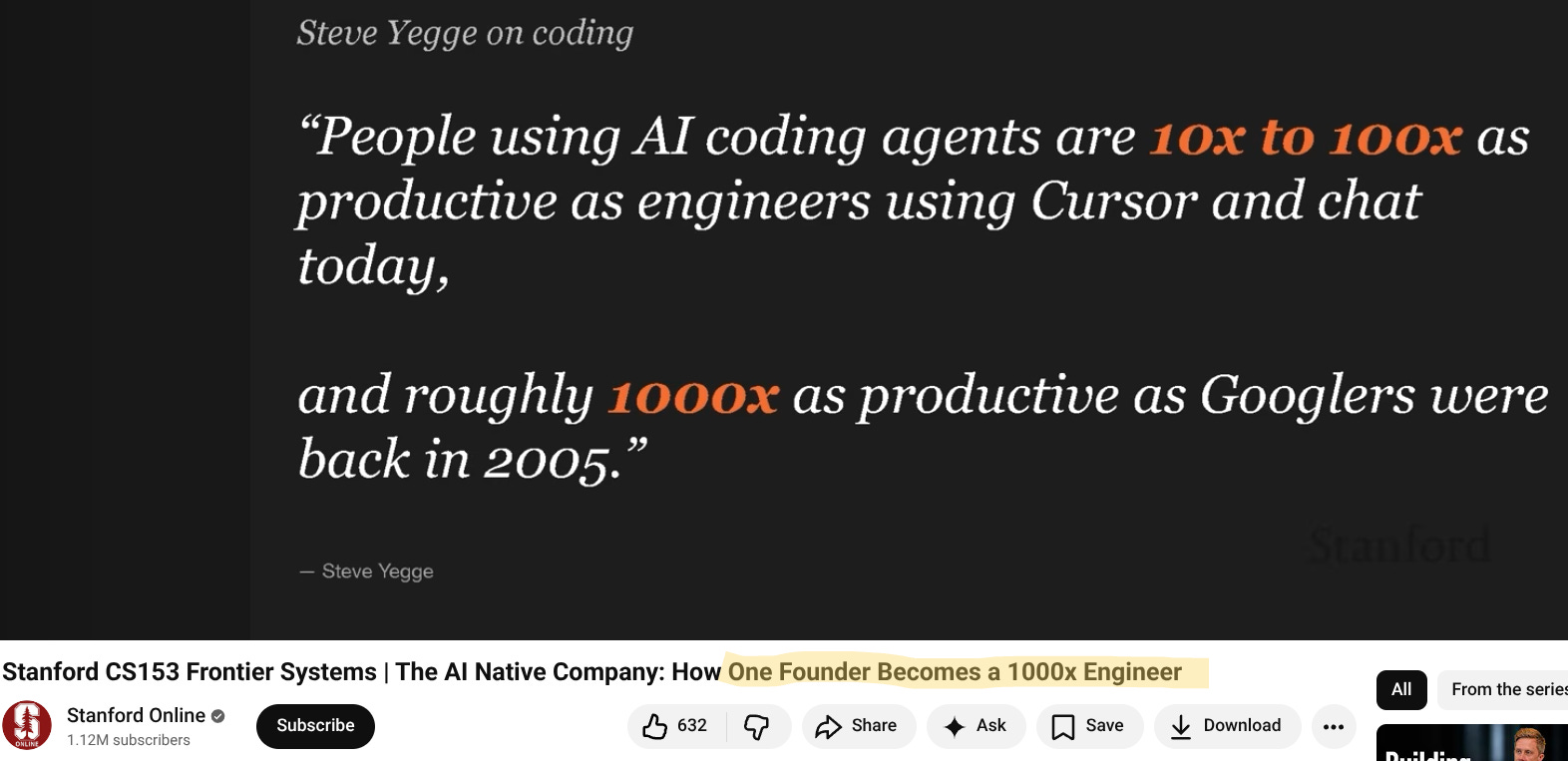
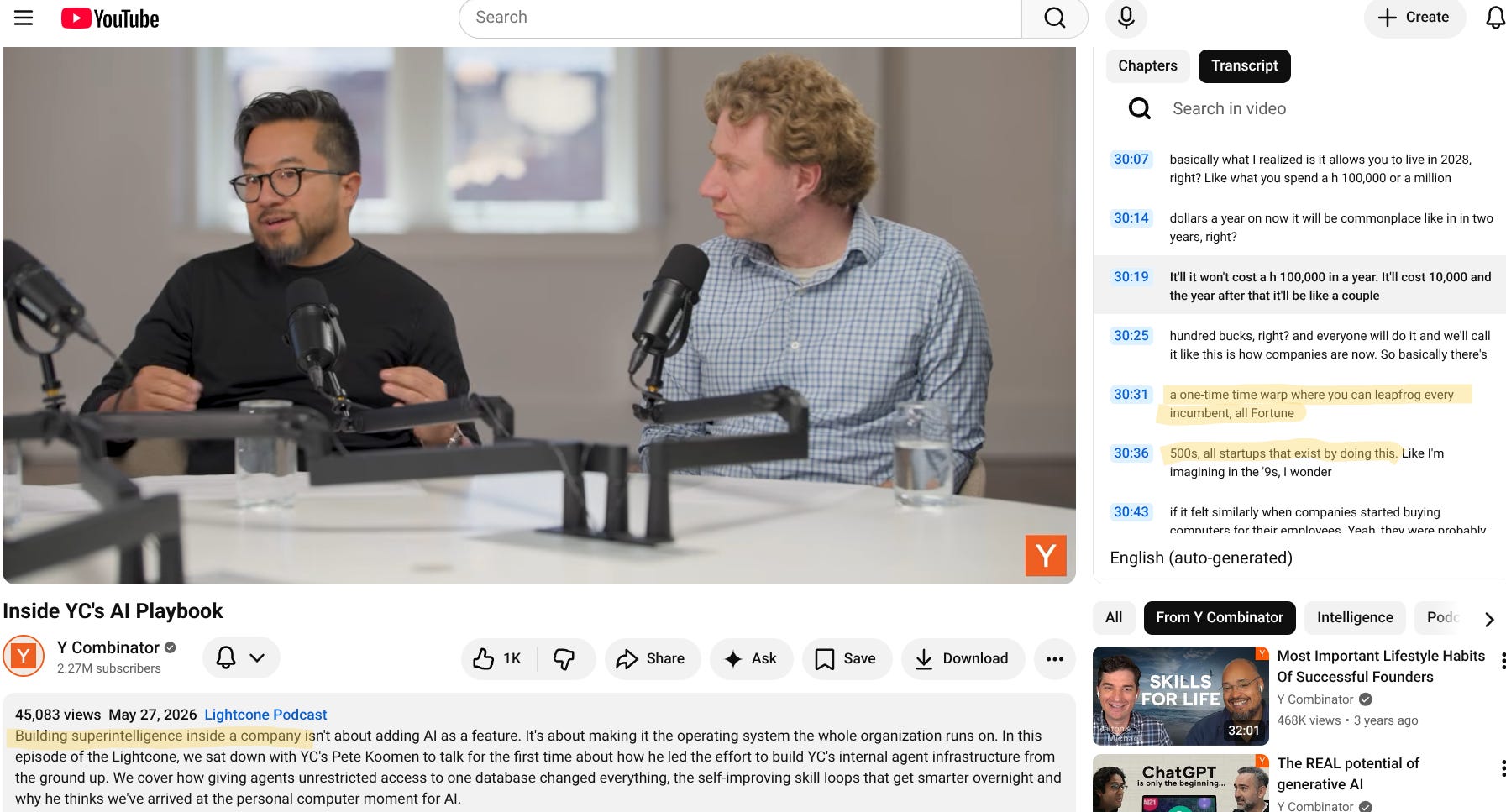
Key reason that companies of many sizes (e.g., “growth stage” startups) should implement VAR: to grow via proliferating agentic MEs; from the YouTube page of a video posted by Stanford University on May 21, 2026 (my highlight):
From the February 2026 paper titled “Intelligent AI Delegation,” co-authored by researchers at Google DeepMind:
“To achieve more ambitious goals, AI agents need to be able to meaningfully decompose problems into manageable sub-components, and safely delegate their completion . . .”
“Scalable Market Coordination. Task delegation needs to be efficiently scalable . . .”
“Markets provide useful coordination mechanisms for task delegation, but require Trust and Reputation . . . to function effectively.”
“The proposed framework is applicable to both human and AI delegators and delegatees . . .”
From a June 2026 paper co-authored by researchers at Google DeepMind et al.:
“[A]gents could form coherent ‘Group Agents’—such as fully automated corporations . . . Such multi-agent systems may be designed and orchestrated deliberately but may also emerge from market dynamics of AI services and tools . . .
. . . Much like human financial markets, these systems could leverage mechanisms such as price signals to coordinate vast numbers of . . . agents . . .”
“[A]gents may engage within broader, complex adaptive systems, such as ‘Virtual Agent Economies’, where individual decisions driven by local incentives aggregate into higher-order intelligence . . .
. . . [C]ollective intelligence of coordinated AI systems may scale as a function of agent population size and interaction density . . . Capability improvements might emerge linearly or superlinearly from the size, complexity and speed of organised collaboration, giving rise to ‘Multi-Agent Scaling Laws’.”
More reasons that companies of many sizes should implement VAR (details follow):
1) Agentic AI (AAI) shrinks teams of humans and flattens hierarchy.
2) Again, Haier excels at supporting/monetizing thousands of small teams while minimizing hierarchy.
3) This excelling is in no way disrupted by AAI.
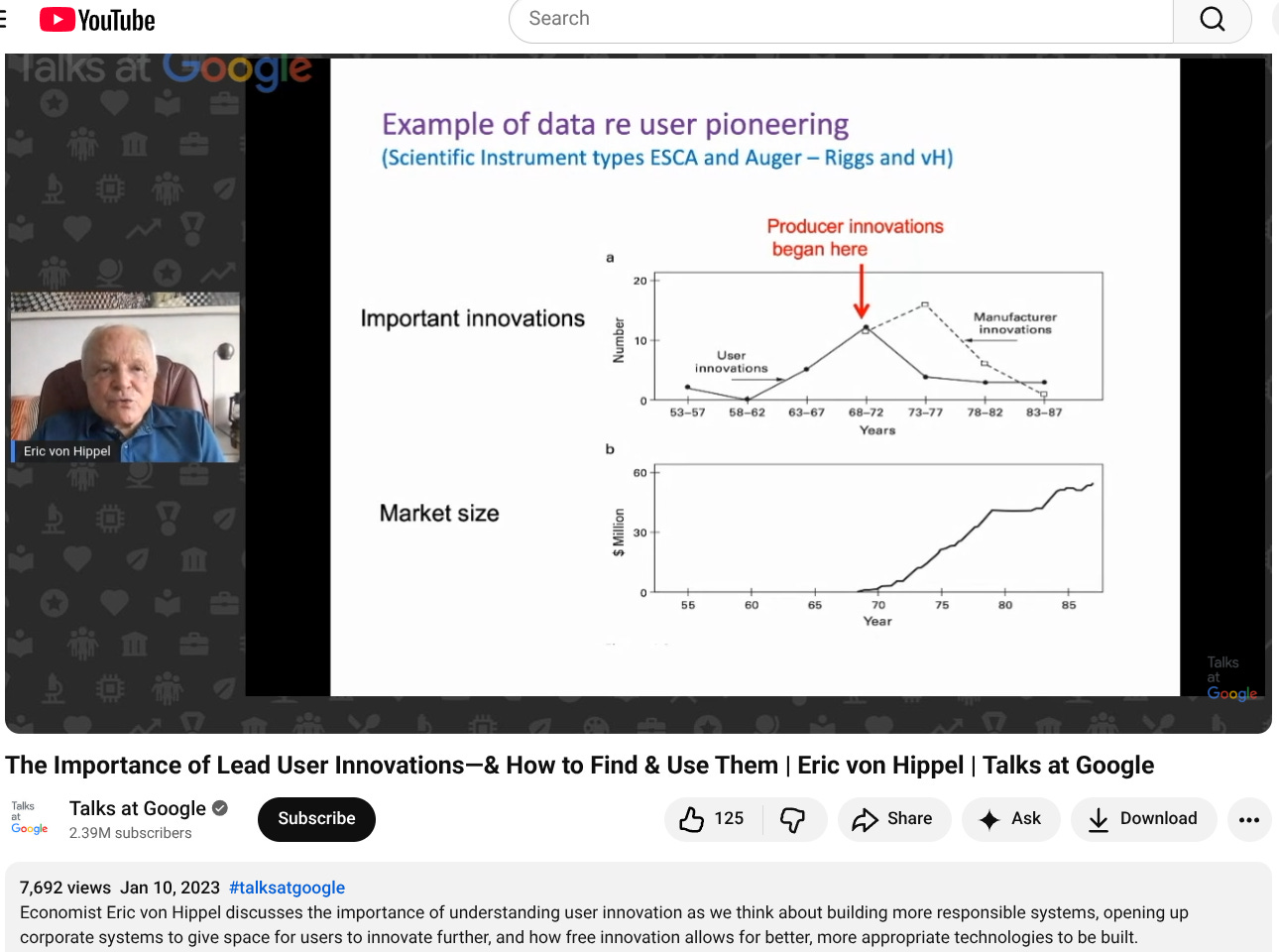
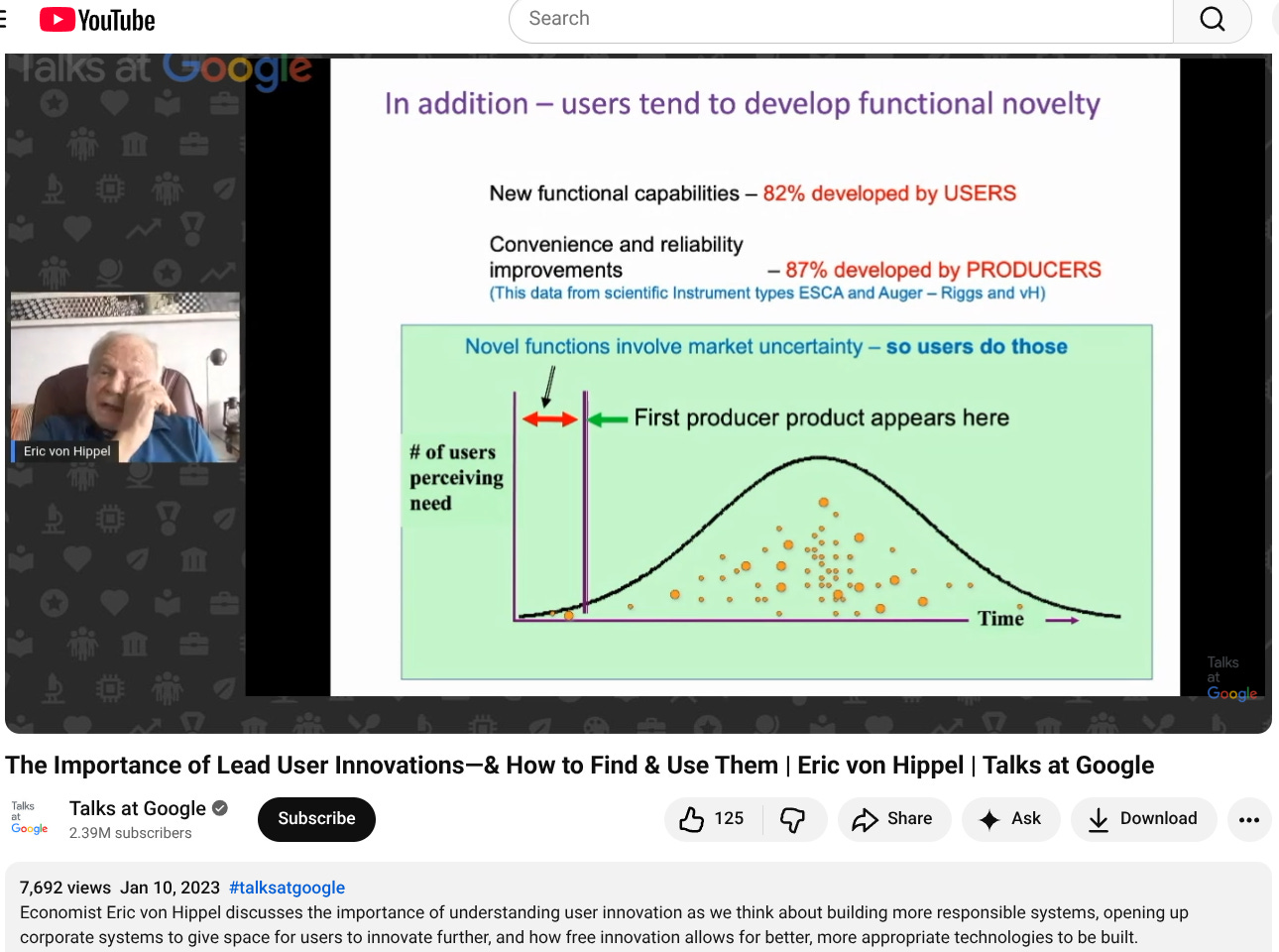
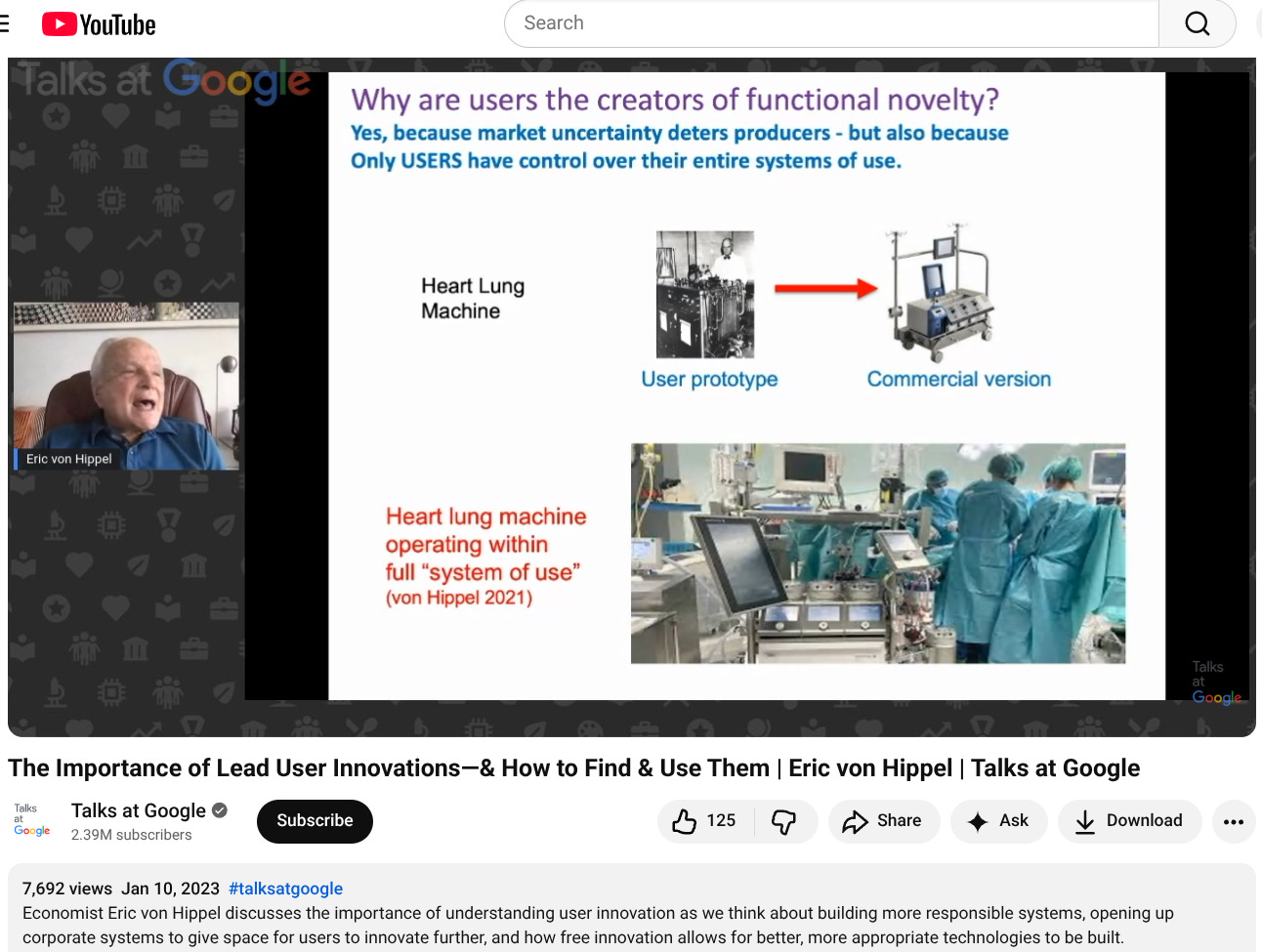
4) Haier excels at learning from “lead users” (LUs), en route to co-producing LU-innovations (LUIs).
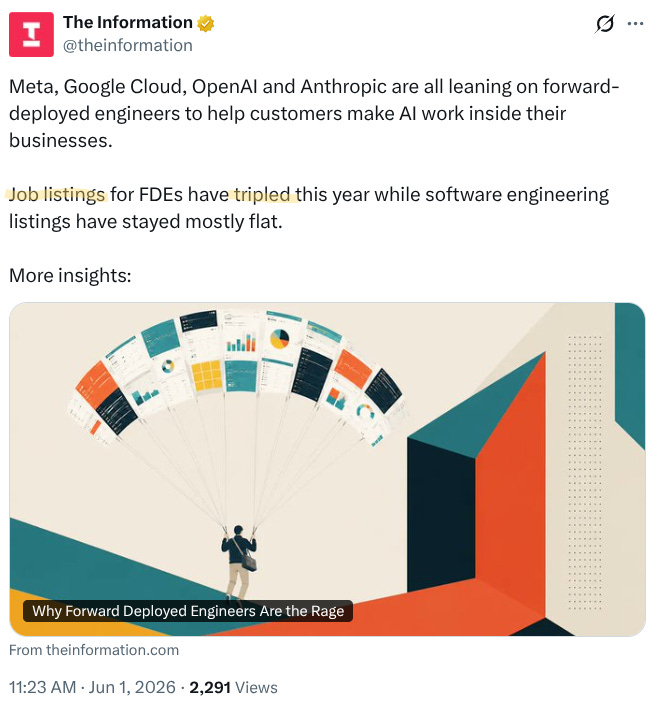
5) Innovative uses of AAI will continue to be LUIs (keywords: forward-deployed engineers).
6) From Humanocracy:
Every market-facing ME [at Haier] is expected to work hard to become an “ecosystem” business. The first step is mass customization [of products]. . . . The next step is to turn customers into users by offering services [i.e., product complements] that yield a recurring revenue stream. . . . The ultimate goal is to build a platform that connects users with third-party service providers.
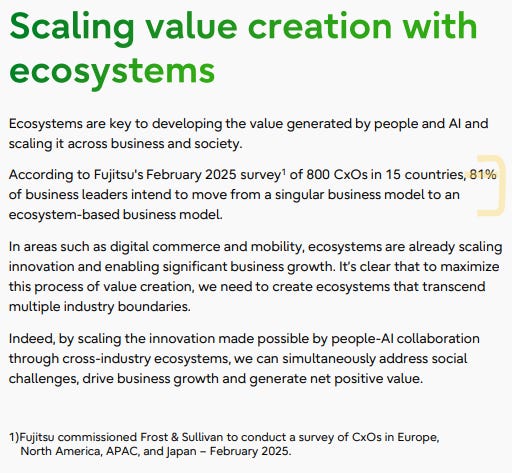
7) From a 2025 white paper (pdf) by Fujitsu, a Japanese IT(-consulting) firm (my highlights):
. . . Milgrom and Roberts started out by noting that manufacturing was “undergoing a revolution.” One paradigm of production was getting swapped out for another.
. . . The question that Milgrom and Roberts wanted to answer was simple: why did all of these changes come as a package?
. . . The explanation that Milgrom and Roberts offered was that the practices were complementary.
. . . So the correct way to think about organizational practices, Milgrom and Roberts suggested, was as bundles. A complete bundle of practices was worth more than the sum of its parts; and each part was worth less in isolation than as part of a bundle.
For dynamic social landscapes, the take-home message . . . is clear: . . . copy those who succeed and act quickly, so you don’t fall behind the other copiers.
[T]he bottom line is simply this: The RenDanHeYi model could in certain aspects be viewed as very disruptive, specifically for companies in Western countries.
Re: AAI shrinks teams of humans and flattens hierarchy
From the April 23, 2026 article in The Wall Street Journal titled “Behind Meta’s Huge Layoffs Is a Relentless Shift Toward AI”:
[Subtitle:] As company envisions smaller teams and supersmart agents, some employees wonder how they fit in
. . . Zuckerberg and his lieutenants have repeatedly emphasized the way AI lets small teams do the work of large ones, while moving faster.
From the March 28, 2026 article in The New York Times titled “Smaller Is Better in Silicon Valley’s ‘Tiny Team’ Moment”:
[Subtitle:] As artificial intelligence takes on more and more tasks, tech executives are embracing teams as small as two: one person plus A.I.
Title of an April 16, 2026 article on BusinessInsider.com:
Snap’s layoffs highlight growing work trend: AI-powered tiny teams
Block, the company behind Square, Cash App and Afterpay, is cutting its staff by 40%. The reason: “intelligence tools,” according to a letter to shareholders by co-founder Jack Dorsey.
the intelligence tools we’re creating and using, paired withsmaller and flatter teams [my emphasis], are enabling a new way of working which fundamentally changes what it means to build and run a company. and that’s accelerating rapidly.
From a March 17, 2026 article on FastCompany.com (my emphases):
It’s being called the Great Flattening: a global wave of layoffs triggered by the adoption of AI that is primarily hitting middle management. Amazon is currently leading this managerial reset, aggressively streamlining its corporate structure to reduce bureaucracy and speed decision-making. And although the tech sector remains the epicenter, projections suggest that by the end of 2026, up to 20% of firms will use AI to significantly reduce middle management ranks.
The catalyst is the rise of agentic AI . . .
More re: Haier excels at supporting/monetizing small teams while minimizing hierarchy (part 1 of 2)
From Humanocracy:
In the move to RenDanHeYi, twelve thousand mid-level managers were redeployed or dismissed.
Zhang Ruimin [then Haier’s CEO]: Currently we have 4,000 microenterprises [MEs], which coalesce with one another to form ecosystem microcommunities—or EMCs.
From Leadership for a Digital World: The Transformation of GE Appliances:
[M]embers of EMCs need to be aligned when facing users and their needs, as together they can create more value for users than they could by operating alone. Alignment between actors is done by using EMC contracts, in which each party commits to certain responsibilities and outcomes. The EMC contract is a further developed version of a smart contract, with blockchain technology used to calculate if goals were achieved and how much value each player created and delivered.
From said article in The McKinsey Quarterly:
Zhang Ruimin: Among our 300 self-organizing EMCs, we have more than 100 start-ups, four of which are already publicly traded companies.
From Leadership for a Digital World:
The ecosystem microcommunities (EMCs) consist of MEs from Haier, as well as third parties not owned by Haier.
Re: RenDanHeYi is in no way disrupted by AAI
From Leadership for a Digital World:
Haier’s incubator and accelerator platform could be viewed as a “global factory” of new businesses and is a vehicle for Haier’s self-transformation and growth . . .
From Humanocracy:
[The] combination of bonuses, dividends and profit-sharing gives employees the opportunity to multiply their base pay many times over. With so much at stake, it’s hardly surprising that ME team members have little tolerance for incompetent leaders. If an ME fails to hit its baseline targets for three months in a row, a leadership election is automatically triggered. If the ME is meeting its baseline targets but failing to reach its VAM targets, a two-thirds vote of ME members can oust the existing leader.
New leaders are chosen competitively. Typically, three or four candidates [who are members of the ME] will present their plans . . .
Poorly performing leaders are also vulnerable to a hostile takeover. Anyone at Haier who believes they could better manage a struggling ME can make a pitch to the team. Since performance data for all MEs is transparent across the company, it’s easy to spot takeover opportunities. If an interloper’s plan is convincing, a leadership change will ensue. In principle, this is no different from what happens when an underperforming company gets taken over by a rival or a private equity firm, but unlike Haier, most companies don’t have an internal market for control.
Re: LU(I)s
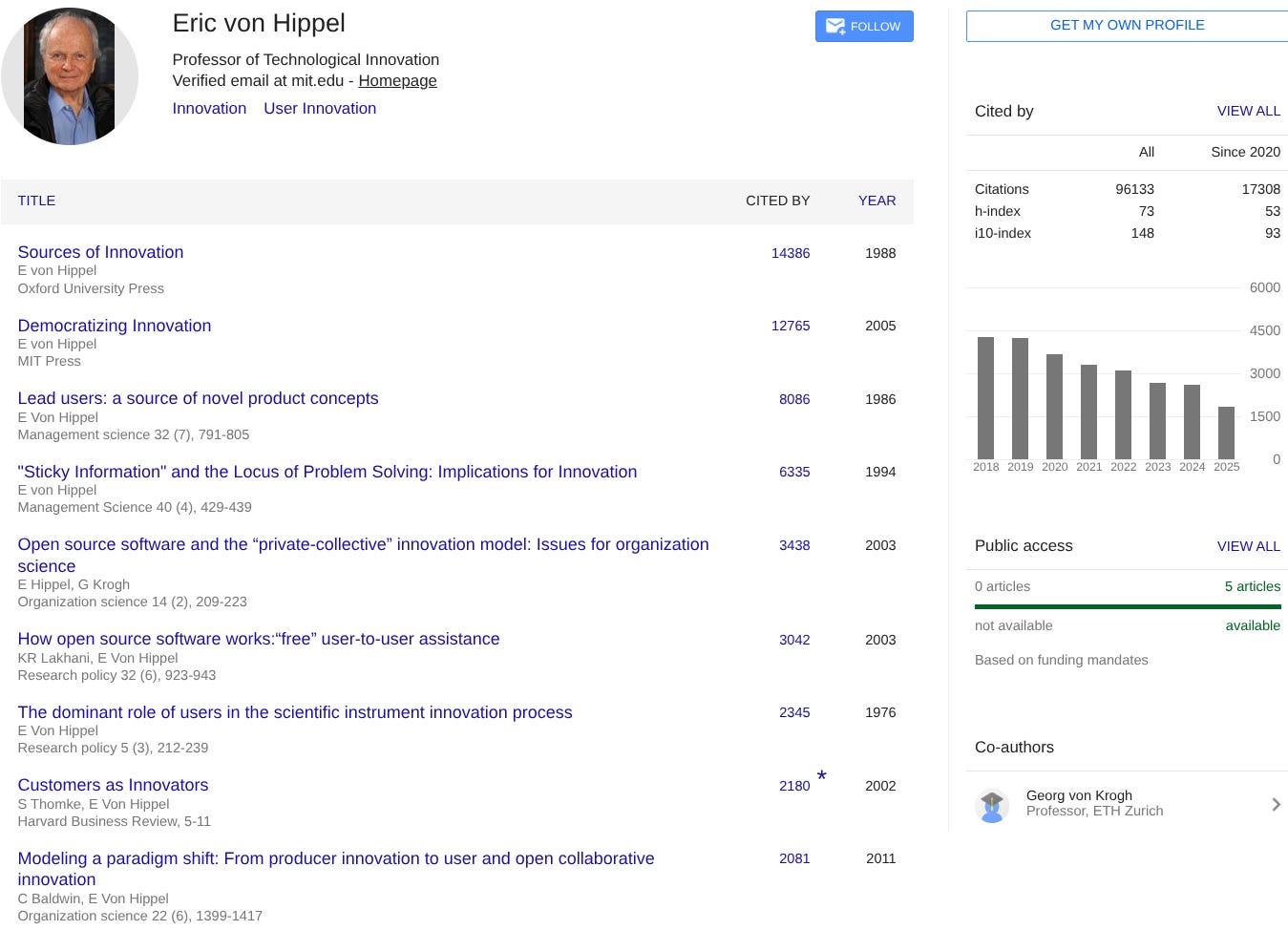
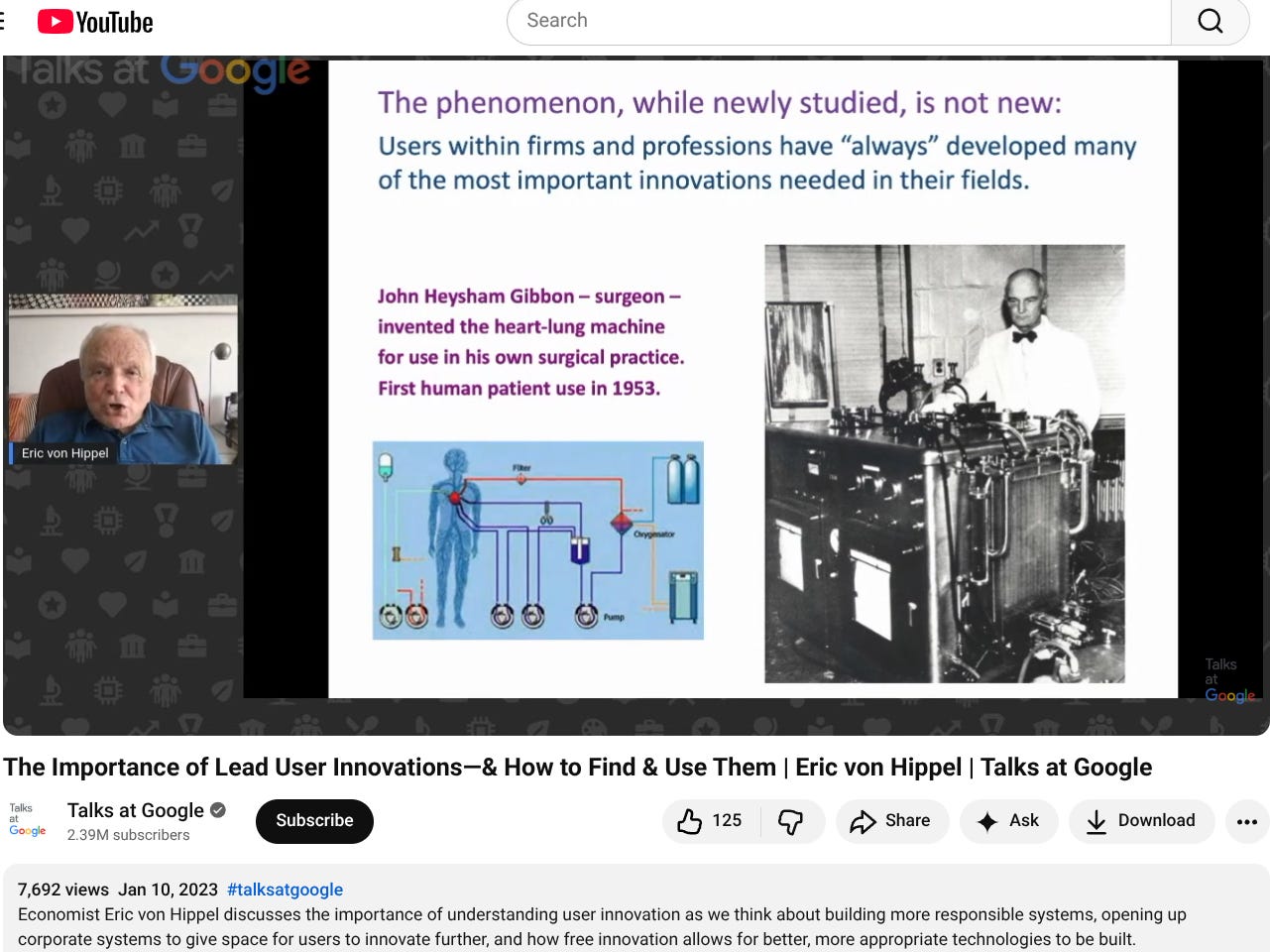
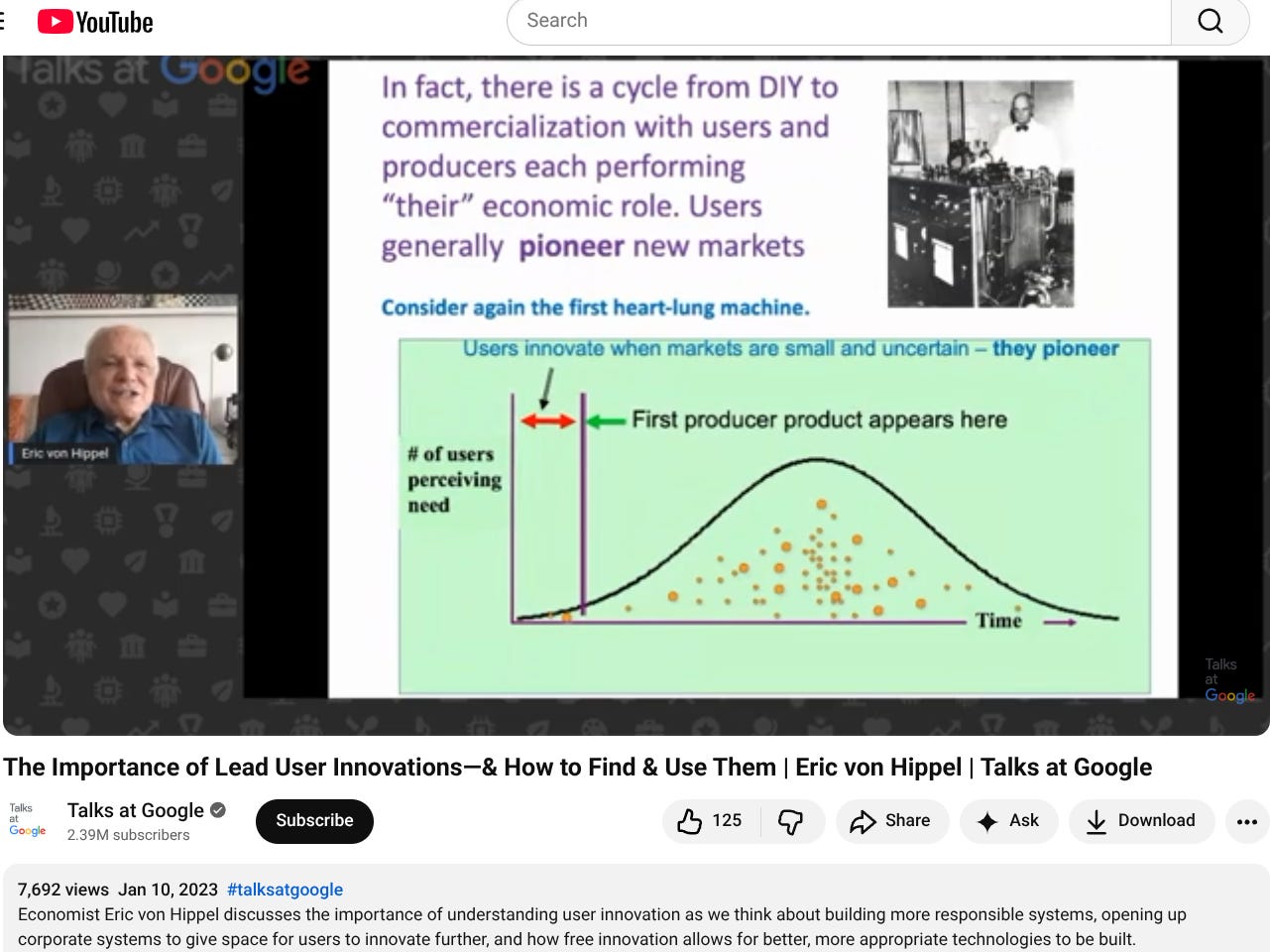
From 2005 book Democratizing Innovation, by MIT “Professor of Technological Innovation” Eric von Hippel:
[A] growing body of empirical work shows that users are the first to develop many and perhaps most new industrial and consumer products. Further, the contribution of users is growing steadily larger as a result of continuing advances in computer and communications capabilities.
. . . Empirical studies show that many users—from 10 percent to nearly 40 percent—engage in developing or modifying products. . . .
. . . Studies of innovating users (both individuals and firms) show them to have the characteristics of “lead users” [my emphasis]. That is, they are ahead of the majority of users in their populations with respect to an important market trend, and they expect to gain relatively high benefits from a solution to the needs they have encountered there.
From von Hippel’s page on Google Scholar (during 2025):
[I]t is remarkable to observe the journey of the user within Haier’s context. Traditionally viewed as an external entity in conventional business models, merely receivers of managerial decisions, the users are brought into immediate proximity or even inside the company by Haier’s approach. Indeed, recently they have been elevated to the status of co-creators, involved in designing business solutions tailored to their specific needs.
From Humanocracy:
Haier tracks the transformation of every ME with a “win-win value-added” statement that captures detailed metrics such as the extent of user involvement in product development, the degree to which Haier’s products offer unique customer value . . .
Re: innovative uses of AAI will continue to be LUIs
From Y Combinator CEO Garry Tan’s April 11, 2026 article titled “Thin Harness, Fat Skills”:
Fat skills . . . encode judgment, process, and domain knowledge. This is where 90% of the value lives.
From the November 2, 2025 article in The Financial Times titled “The new hot job in AI: forward-deployed engineers” (my emphases):
Nic Prettejohn, head of AI in the UK at Palantir, the data intelligence group, called the approach “product discovery from the inside.”
. . . OpenAI’s Fournier said: “We learn what customers in different industries really need, we experiment and innovate together . . .
Subtitle of a June 4, 2025 article on the website of VC firm Andreessen Horowitz:
Why the Forward Deployed Engineer Is the Hottest Job in Startups
More re: “Haier excels at supporting/monetizing small teams while minimizing hierarchy” (part 2 of 2)
From Humanocracy:
“Haier conducts monthly road shows across China where would-be entrepreneurs [who are Haier employees] can pitch their ideas . . .”
“Some of Haier’s new ventures remain inside Haier while others are spun out. At last count, more than 160 had received Series A funding from outside investors.”
From Leadership for a Digital World:
Haier’s incubator and accelerator platform . . . has created its own ecosystem of venture capitalists, other large industrial firms, universities, and more, and can also offer training of entrepreneurs.
Because of being a well-oiled “factory” for new businesses, Haier consciously funnels the startups from seed funding to unicorns to public listing.
More re: “the RenDanHeYi model could in certain aspects be viewed as very disruptive”
The original/canonical models of disruptive innovation were developed by Clayton Christensen (d. 2020), during his tenure as a Harvard Business School professor.
“When companies have the same capabilities and motivation, they care about the battle and have the necessary skills to fight it. Skills in execution make the difference here . . .
The more interesting scenarios occur when there are asymmetries—important differences of motivation or skills. Asymmetries of motivation occur when one firm wants to do something that another firm specifically does not want to do. Asymmetries of skills occur when one firm’s strength is another firm’s weakness.
. . . [I]ncumbents tend to respond to potential disruptive incursions in one of three ways: they either cede a market, attempt growth-driven co-option, or attempt defensive co-option.”
“Our theories suggest co-option efforts will be fruitless when success requires different skills or motivation.”
RenDanHeYi shifts the main job of upper management (UM) from allocating resources to attracting resources (e.g., investors, external specialists); from Humanocracy:
Haier often requires a startup team to obtain venture funding before contributing internal resources.
More precisely, RenDanHeYi selects for UMs who can attract resources and earn profits in the process; from said September 2023 article on the website of Harvard Business Review:
[Haier’s] organizational philosophy and system is composed of several innovative characteristics, including . . . turning support functions into profit centers . . . rather than cost centers . . .
Re: VAR UMs attracting resources and earning profits in the process
Keywords: equity crowdfunding, startup comedy (SC); details below, after the next three sections.
More re: disrupting via VAR
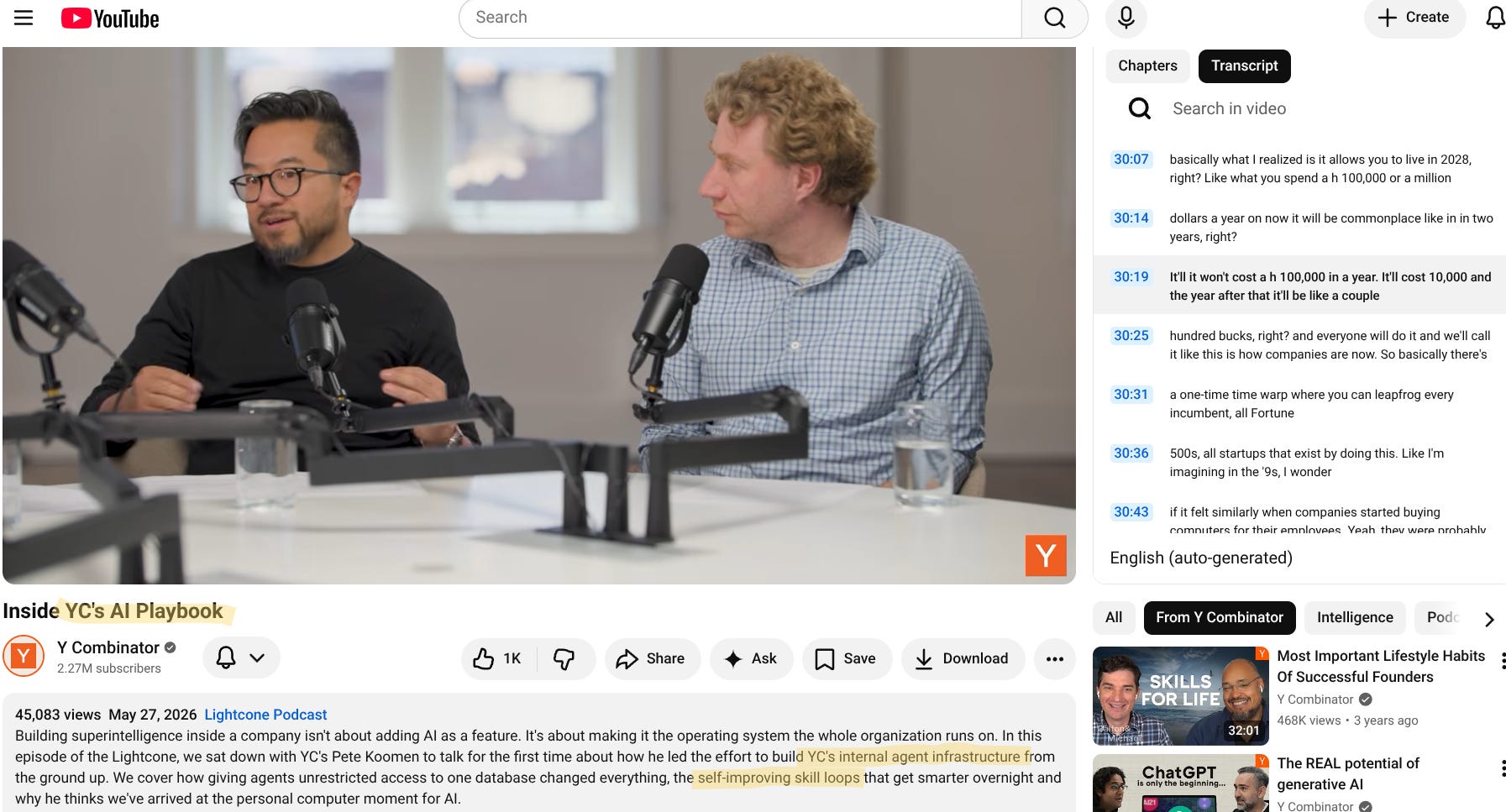
From the YouTube page of a video posted by YC on May 27, 2026 (my highlights):
Re:topVARs attracting resources and earning profits in the process
Each TV’s “bundle of practices” might include a YC variant that excels at SC-production; from said YouTube page (my highlights):
A16Z New Media is one year old! And we’ve had several portfolio companies (and other venture firms) ask us how our team works, how we built it, and how they might build their own. Here is what we share with them:
If you’re ever pitching a16z, at some point we turn it around and do “the Bear Hug”, as our competitors call it: we pitch you on all of the resources and power and networks the firm will put behind you . . .
“New Media” has become one of those critical things we advertise in the Reverse Pitch, as a way a16z helps you build your brand, reach key people, and win the battle for attention.
. . . What do we actually do? It won’t capture everything, but at first estimate you can think of a16z New Media is “go-direct as a service” for startups. We have four primary motions:
In-house creative (Video, design, editorial, from legends of the craft)
Owned channels (Our X account, Substack, podcast feeds, and more)
Full service from a dedicated team, from pitch to launch and beyond
A big network of people, with a bit of structure, software and AI to help leverage it
Implications of the above
1) YC and a16z are well positioned to catalyze an SC boom.
2) Failing to do so might pose an existential risk to both (e.g., pose with unprecedented speed).
Comedy $ via AI industry; 1.0 $ via my Microsoft-/Amazon-/VC-praised* AI-preneurship & my comedy-preneurship, partnership inquiry**
* Links to the praise are in the topmost section of frankruscica.substack.com/p/mv-details (hereafter URL); the other sections provide details about my work that are previewed below.
** See the fifth section below (title begins Re: “1.0 $ via my . . .”); keywords re: possible chronology: articles co-written, resultant equity-crowdfunding, Last Week Tonight variant catalyzes comedy boom.
Re: “comedy $ via AI industry” (part 1 of 2)
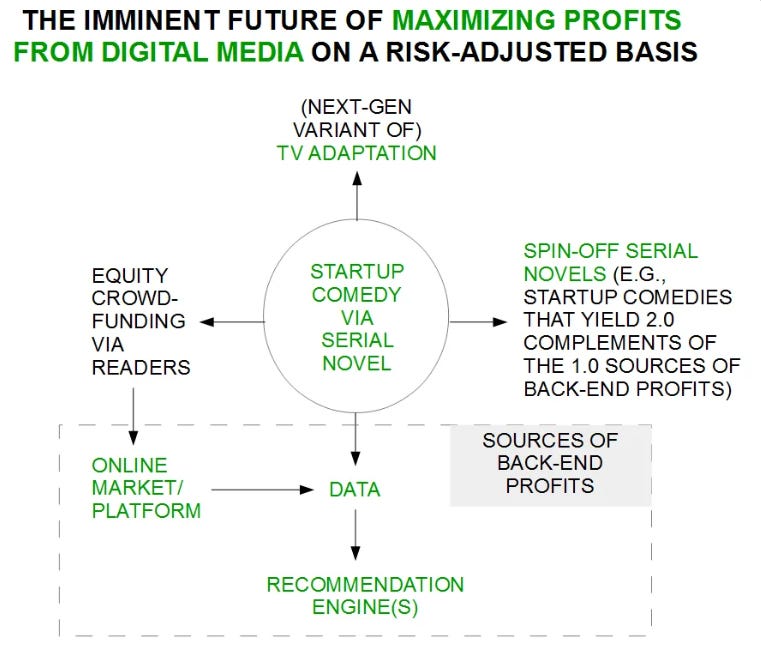
Startup comedies (SCs) will help/HELP product-development-groups raise equity-crowdfunding (ECF), en route to each group spinning-off from its parent company (i.e., each becoming a startup that the parent retains part-ownership of); implication: SCs will be produced by companies that want to attract TOP talent. Of course, AI companies WANT . . . —hence nine-figure salaries, bidding wars, etc.
Gimlet, your friendly neighborhood podcasting company that narrates its own emergence [on its podcast titled Startup] . . .
[A]ccording to the Startup episode that dropped last Thursday, Graham Holdings invested $5 million into the $6 million round [raised by Gimlet], with the remainder split between some existing investors upping their commitment and a crowdfunded pool [via Startup listeners] that was mediated through Quire, the equity-crowdfunding platform [my emphasis] . . .
“To those trapped by bureaucratic dogma, it seems inconceivable that a large company could behave like a swarm of startups. That’s because they’ve never been inside [Chinese multinational] Haier, the world’s largest appliance maker [#390 on the Global Fortune 500 in 2025, up from #407 in ‘24].
. . . Haier conducts monthly road shows across China where would-be entrepreneurs [who are Haier employees] can pitch their ideas . . .
. . . Haier often requires a startup team to obtain venture funding before contributing internal resources.”
“Some of Haier’s new ventures remain inside Haier while others are spun out. At last count, more than 160 had received Series A funding from outside investors.”
Forerunners of ‘AI companies producing SCs’
From an April 2, 2026 article in The Wall Street Journal:
OpenAI is getting into the business of daily news.
Title of an April 2, 2026 article on FT.com (site of The Financial Times):
OpenAI acquires popular tech talk show [TBPN] for ‘low hundreds of millions’
From said April 2, 2026 article in The Wall Street Journal:
While TBPN’s audience remains modest, averaging around 70,000 viewers per episode across various online platforms, the show has become popular among Silicon Valley power players . . .
. . . The 11-person company, which launched in October 2024 and began livestreaming for three hours each weekday in March 2025, says it is profitable and that it generated around $5 million in revenue from advertising last year. TBPN was on track to make more than $30 million in revenue in 2026, according to the company.
From the YouTube page of an April 6, 2026 video produced by technology-news provider The Information:
[From the May 27, 2026 article in The New York Times titled “Go Ask Alice Why Tech-Startups Are Spending Big on Hype Videos”:
“[Subtitle:] A Mad Hatter and a giant rabbit sit around a table discussing an A.I. start-up. This is normal behavior around the Bay Area these days.
. . . Having a good story is just as important as having good technology, young tech entrepreneurs are being told by the people pouring money into their start-ups.
. . . A common feature of these videos, Ms. Amos said, is that founders are often a main character or make a cameo.
. . . More companies are also hiring Nen Creative to do documentary-style videos about the start-up . . .”
“Tech companies and venture capital firms are investing in new media ventures and ‘storytellers,’ . . .”]
Re: “comedy $ via AI industry” (part 2 of 2)
From the May 3, 2026 article in The New York Times titled “How A.I. Is Transforming China’s Entertainment Industry”:
Until recently, making a hit microdrama — the soapy, short-form, made-for-mobile shows that have become wildly popular in China — meant hiring actors, renting sets and spending weeks filming and editing.
Now, some Chinese companies are churning them out for $30 a minute, with no cameras, no crew and no human performers.
That’s thanks to artificial intelligence.
From the May 1, 2026 article in The Hollywood Reporter titled “The AI Revolution Hollywood Feared Is Already Happening — in India”:
80-minute AI feature Mann Pisahach was completed for . . . roughly $360. [Director Rahi] Barve shot two actors on his iPhone, then used AI to generate their costumes, production design and the entire world around them.
From the April 24, 2026 article on CNBC.com titled “How a new Amazon-backed Hollywood production startup deploys AI for speed and cost-cutting”:
The first project using this new workflow is . . . set to debut this spring. The three-episode series, shot in a single week on the virtual soundstage, shows the actors in 40 locations, by putting footage from around the world into the screens in the production facility.
From said May 1, 2026 article in The Hollywood Reporter:
Yash Raj Films’ action sequel War 2, released in late 2025, became a landmark demonstration of AI use in the sector: filmed in Hindi, the movie was released across multiple languages using NeuralGarage’s “VisualDub” tool, which subtly adjusts actors’ lips and facial expressions so that Hrithik Roshan’s Hindi dialogue appears to be spoken naturally in Telugu.
. . . India’s film industry has always been defined by its linguistic geography — separate star systems, separate audiences, separate power bases, each sustained by the natural barrier of language. Pan-India releases were already a growing trend before AI; now, with the technology capable of producing day-and-date multilingual releases that are virtually seamless, that trend could become the default. . . . [I]f AI dubbing can unify India’s fragmented linguistic marketplace, the technology will likely do the same for international entertainment, accelerating a future already coming into focus on Netflix, where language is no longer a barrier to seamless content consumption anywhere. No more subtitles or overdubs, just digitally altered face movements with synthetic speech in the international actor’s own voice — and content from everywhere effectively competing on the same linguistic plane.
From a 2024 paper by researchers at Google DeepMind:
To cite Winters [106], “Humor’s frame-shifting prerequisite reveals its difficulty for a machine to acquire . . . This substantial dependency on insight into human thought (e.g., memory recall, linguistic abilities for semantic integration, and world knowledge inferences) often made researchers conclude that humor is an AI- complete problem”[; from Winters: “This category denotes problems that are no less difficult than solving ‘general intelligence’ or ‘strong AI.’”] . . . Winters [106] continues: “genuine humor appreciation requires machines to have human-level intelligence, since it needs functionally equivalent cognitive abilities, sensory inputs, anticipation-generators and world views” . . .
Until artificial general intelligence (AGI) or close to it, then, AI will yield SC-production budgets that prioritize spending on comedy talent (e.g., as AI improves, resultant savings will be used to bid up the price of comedy talent).
Keys to this spending being as large as possible: 1) SCs launch online as serial novels*, 2) AI generates translations and serial audiobooks, 3) SC-consumers can opt to receive installments via email, podcast feed, etc.
* From the April 25, 2026 article in The New Yorker titled “Inside the World-Conquering Rise of the Micro-Drama” (my emphases):
In China, web fiction is an enormous industry in itself, and [serial] stories are ranked and modified, on various platforms, based on reader feedback. The best are adapted, through a similar calibration, into films, video games, and micro-dramas; by the time they reach American viewers, they’ve survived a Darwinian gantlet.
Of course, web novels can incorporate other multimedia elements while centering on prose.
Re: “1.0 $ via my . . .” (part 1 of 2)
The D-ai-ly $how (i.e., an AI-focused variant of The Daily Show) is waiting to happen, not least because:
the premise of my 1.0 SC can double as an ideal comedy lens through which TD$ covers AI (the premise is previewed in the section after next)
TD$ would be an ideal complement to SCs (e.g., TD$ could often have guests who’d show funny clips of their then-new(ly-adapted) SC)
Possible stepping-stones to TD$:
Toward The D-ai-ly $how launches as a weekly series (i.e., as a variant of Last Week Tonightwith John Oliver)
TTD$ catalyzes production of several/many 1.0 SCs
efforts to launch TTD$ are catalyzed by a series of articles that we co-author
Re: said premise predates my thinking re: (T)TD$ (part 1 of 2)
My planned company (MPC) will implement my Amazon-/VC-praised design that:
fixes the fatal flaw of 2003 “sensation” BlogShares.com
will yield a next-generation variant of LinkedIn (NGLI; i.e., the most popular implementation will equate to NGLI)
Millions of girls have consumed Alloy Entertainment’s products, but the company’s name does not appear on the spine of its books. Rather, it packages about thirty novels a year for publishers . . . In order to do all this, Alloy has developed a process with an industrial level of efficiency.
In many cases, editors at Alloy . . . craft proposals for publishers and create plotlines and characters before handing them over to a writer (or a string of writers).
. . . Ms. von Ziegesar, who created the concept, plots and characters for the “Gossip Girl” books while an editor at Alloy, went on to write the first eight books of the series. She said that while at Alloy she crafted carefully plotted packages for other series and recruited writers who were told to follow her directions closely.
Re: the premise
Details: URL; excerpt:
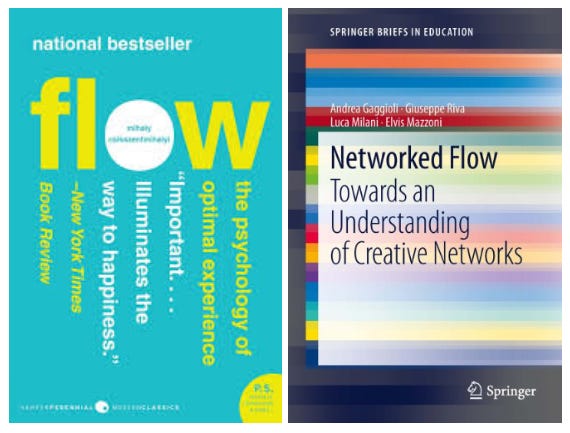
Flow is the neurochemical state that enables/accompanies top performance/problem-solving; often, flow via collaboration—“group flow”—sparks flowmantic attraction.
Many/MANY flowmances will be sparked (partly) via [MPC’s LinkedIn variant] . . .
— Preview of the case that MANY flowmances will be sparked (more details are in other sections below) —
Title of a 2020 article on ScientificAmerican.com:
Do We Live in a Simulation? Chances Are About 50–50
From the 2022 article on Wired.com titled “Of Course We’re Living in a Simulation”:
[T]his past January, the Australian technophilosopher David Chalmers published a book called Reality+: Virtual Worlds and the Problems of Philosophy, the central argument of which is, yes indeed: We live in a simulation. Or, more accurately, we can’t know, statistically speaking, that we don’t live in a simulation—philosophers being particularly prone to the plausible deniability of a double negative. Chalmers isn’t some rando, either. He’s probably the closest thing to a rock star the field of philosophy has . . .
. . . [H]is new book, despite its terrible title, is far and away the most credible articulation of simulation theory to date, 500 pages of immaculately worked-through philosophical positions and propositions . . .
Let’s say that a sim sign is a feature that raises the probability that a creature is a sim. . . .
The economist and futurist Robin Hanson has suggested that interestingness is a sim sign. Designers interested in entertainment or in historical simulation will more often create and sustain interesting . . . sims . . .
So we might live in a historical simulation that’s (partly) a simcom.
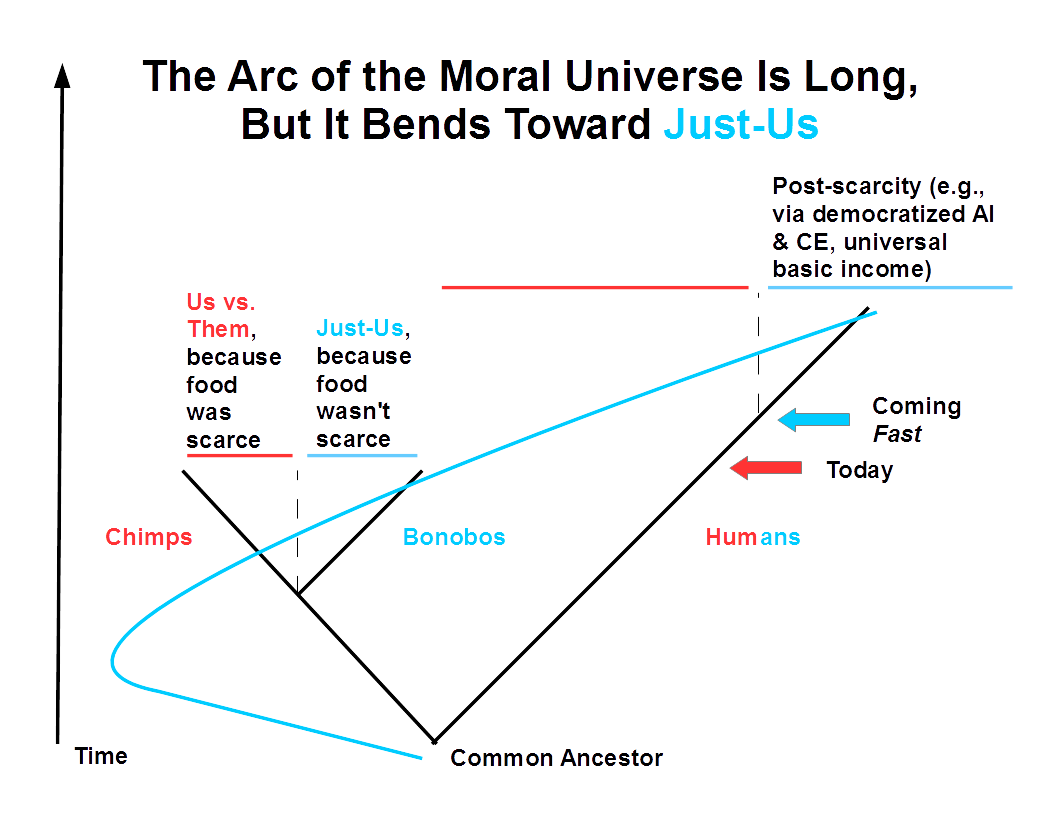
Plausible/likely focus of the simcom: humankind’s ongoing transition from our variant of Chimp Society to a human variant of Bonobo Society*.
Plausible/likely indicator that the transition is gathering momentum: flowmances INCREASE via OSG [The Opportunity Services Group; i.e., MPC].
Pygmy chimpanzees (to avoid confusion, scientists usually call them bonobos; journalists often call them hippie chimps) and regular chimpanzees (usually just called chimpanzees, without any qualifying adjective) have almost identical DNA, having diverged from their shared ancestor just 1.3 million years ago . . . Even more surprisingly, the two kinds of apes are genetically equidistant from humans. If chimpanzee wars suggest that humans might be natural-born killers, bonobo orgies suggest we could equally well be natural-born lovers.
. . . Something happened 7 or 8 million years ago to set chimpanzees and humans on the road toward violence; then, around 1.3 million years ago, something else happened to push bonobos away from using violence against their own kind . . .
I will offer an analysis of the largest-ever survey of Americans’ sexual fantasies . . .
89 percent [of respondents] reported fantasizing about threesomes, 74 percent about orgies, and 61 percent about gangbangs . . . [T]he majority of women reported having each of these sex fantasies . . .
More than three-quarters of the men and women I surveyed hope to eventually act on their favorite sexual fantasies.
Altman is wary of discussing it with journalists, but friends including Thiel say he is sympathetic to the notion, common in Silicon Valley, that AGI has already been invented and we are living in a simulation that it created.
. . . [Altman:] “I think it’s very interesting how much the Silicon Valley religion of the simulation . . .”
[W]e crossed the country for a trip to the Googleplex. We were there to talk flow states with engineers . . .
[W]e . . . attend[ed] the opening of their new multimillion-dollar mindfulness center . . . Google had realized that when it comes to the highly competitive tech marketplace, helping engineers get into the zone and stay there longer was an essential . . .
We’ve been collaborating with some of the top experience designers, biohackers, and performance specialists to help develop the Flow Dojo . . . a learning lab dedicated to mapping the core building blocks of optimum performance.
In the fall of 2015 we had the opportunity to bring a prototype of the Dojo to Google’s Silicon Valley headquarters and engage in a joint-learning project. For six weeks, a handpicked team of engineers, developers, and managers committed to a flow training program, and then capped that off with two weeks in a beta version of the training center.
A ten-year study done by McKinsey found top executives reported being up to five times more productive when in flow. Creativity and cooperation are so amplified by the state that [a] Greylock Partners venture capitalist . . . called “flow state percentage”—defined as the amount of time employees spend in flow—the “most important management metric for building great innovation teams.”
“In researching this book, we spent a lot of time talking to experts across a dozen fields: AI, biotech, genetics, robotics, neuroscience, psychology, and more. . . .
The opinion these people shared was about who would thrive in the twenty-first century[:] . . . Creative leaders who know how to drop into flow and collaborate, with each other—and with AI—will own the future.”
“Over the past decade, neuroscientists . . . [identified] the neural mechanisms behind the skills that make group flow possible . . . This work began in the field of coordination dynamics, which explores how brains align in time, and continued as neurobiologists deciphered the chemistry of social bonding, from oxytocin’s role in trust to dopamine’s role in love. Social neuroscientists then learned to map and measure synchrony, entrainment and inter-brain coherence. All of this culminated in a landmark 2021 study in which [a] Caltech neuroscientist . . . used hyper-scanning EEG to show that team flow has a unique brain signature: increased beta-gamma activity in the left middle temporal cortex that directly correlates to a significant increase in inter-brain synchrony, heightened information processing, and improved team performance.
As a result of all this work, AI tools are now being designed to target group flow’s triggers . . .”
“Consciousness-raising means using neuroscience to unlock expansive altered states once reserved for mystics: deep flow, collective ecstasy, even the oneness with everything that comes from enlightenment. These states are the very technologies that the brain uses to foster and enhance cooperation. They spark compassion, expanding empathy and dissolving the boundaries between us. When technologically enabled—for greater precision and control—they form the cognitive infrastructure for large-scale collaboration [e.g., that yields a human variant of Bonobo Society] . . .”
— More re: flow, group flow and flowmantic attraction —
Flow may be the biggest neurochemical cocktail of all. The state appears to blend all six of the brain’s major pleasure chemicals and may be one of the few times you get all six at once.
. . . What we can say for sure: all of these neurochemicals help explain why flow tends to show up when the impossible becomes possible. The reason? It’s because of how these neurochemicals impact all three sides of the high-performance triangle: motivation, learning and creativity.
On the motivation side, all six of these chemicals are reward drugs, making flow one of the most rewarding experiences we can have. This is why researchers call the state “the source code of intrinsic motivation” and why McKinsey discovered that productivity is amplified 500 percent in flow—that’s the power of addictive, pleasure chemistry.
From The Rise of Superman:
[T]here are extraordinarily powerful social bonding neurochemicals at the heart of both flow and group flow: dopamine and norepinephrine, that underpin romantic love . . .
. . . [During Apple’s early years, Steve Jobs mandated that] employees share [hotel] rooms when they were at conventions and other professional meetings . . . to limit bed-hopping . . .
. . . From the 2017 article in Wired titled “The Ins and Outs of Silicon Valley’s New Sexual Revolution”:
In Silicon Valley, love’s many splendors often take the form of, well, many lovers.
. . . Some workplaces (coughGooglecough) have quasi-official poly clubs . . .
[S]ex parties happen so often among the high-end, premier VC and founder crowd that this isn’t a scandal or even really a secret, I’ve been told; it’s a lifestyle choice. This isn’t Prohibition or the McCarthy era, people remind me; it’s Silicon Valley in the twenty-first century. No one has been forced to attend, and they’re not hiding anything, not even if they’re married or in a committed relationship. They’re just being discreet in the real world. Many guests are invited as couples—husbands and wives, boyfriends and girlfriends—because open relationships are the new normal.
. . . I doubt history has ever seen a cohort of women more adventurous or less restrained in exploring sexual boundaries.
— Re: “Plausible/likely indicator that the transition is gathering momentum: flowmances INCREASE via OSG” (part 2 of 2) —
Bonobo Society is female-FRIENDLY.
OSG will be female-FRIENDLY*, not least because women are ~60% of recent college graduates in many countries (e.g., the U.S.)[**].
* . . . [More details are below, in the section titled More re: OSG will be female-FRIENDLY.
** OSG 3.0 will focus on providing/owning the most popular online-market for customized-education and AI (e.g., AI-powered CE for people, CE-for-AI); details at URL.
From the July 7, 2024 article in The New York Times titled “Romance Bookstores Are Booming, Dishing ‘All the Hot Stuff You Can Imagine’”:
[W]omen make up the majority [~80%] of the readers who have sent romance sales soaring — from 18 million print copies sold in 2020 to more than 39 million in 2023, according to Circana BookScan.
“The overwhelming popularity of chick lit . . . can be traced to the social reality of its readership with regard to work . . . In its greater integration of the professional sphere into the romance plot, chick lit offers . . . attempts at synthesis of work and love . . .”
“One of chick lit’s contributions as a genre is the production of what we might call a sexual theory of late capitalism . . .”
“Chick lit heroines’ preoccupation with money . . . is normative with recent real-life social science findings: researchers . . . have found that the worst fear for single women . . . is having no money.”
In the spring and summer of 2012, Random House was printing one million copies of the Fifty Shades trilogy every week. Now with more than 150 million sold copies, Fifty Shades of Grey is the bestselling book in the history of Random House.]
— End of excerpt from URL —
Re: said premise predates my thinking re: (T)TD$ (part 2 of 2)
The 1.0 version of the premise—designed to motivate use of OSG’s LinkedIn variant, of course—was conceived before the legalization of ECF in 2012 provided the impetus for developing the 2.0 premise. Keywords re: 3.0’s impetus: simulation, Silicon Valley religion.
Comedy-opener of my 1.0 SC
“Twenty-four states,” I said, “have legalized recreational marijuana. A lot of partying happens away from home. Smoking weed gives people the munchies. Many popular night-spots don’t serve food. So there’s greenfield opportunity at the intersection of weed storage, mobile storage and food storage. In particular, the opportunity for OSG to patent my design of clothing-pockets that close via Ziploc.”
Seolhyun’s eyes widened for an instant. Then her lips formed a thin smile.
“I see you’re worried about developing laugh lines,” I said. “Put your mind at ease! Cosmetic surgery is advancing so rapidly that it will soon be easy to change—nay, overhaul!—the appearance of every part of a person’s face.”
Then I tried to appear struck by a flash of insight.
“Which means,” I said, “that soon millions of Caucasian women will find it impossible to get a date! Unless . . .”
I picked up the handset of my desk phone, then appeared to dial an extension.
“It has come to my attention,” I said into the handset, “that OSG can profit obscenely by purchasing the rights to develop and market the only DNA test that enables a woman to prove she’s notLorena Bobbitt!”
Seolhyun laughed.
I restored the handset to its cradle, then used my laptop. A new presentation-slide appeared on the wall-mounted screen:
“When it comes to saving a bad line, [Johnny Carson] is the master”—to quote a tribute paid in my presence by George Burns. . . . One sometimes detects a vindictive glint in Carson’s eye when a number of gags sink without risible trace, but [Tonight Show writer Pat] McCormick assures me that this is all part of the act . . .
— End of the opener —
More re: the making of the opener
In 1985:
I learned that I can reliably generate comic insights (e.g., I can write jokes, I can twist a comedy-plot)*
From a 1998 email sent to me by the then Manager of the Learning Sciences and Technology Group at Microsoft Research:
Frank, you are a good man. Have you thought about joining this team? Your only alternative, of course, is venture capital. But their usual models require getting rid of the “originator” within the first eighteen months. With Netscape it took a little longer, but you get the idea.
From a 2004 email sent to me by the CEO of a defunct then-startup funded by Amazon:
Frank, I just spent about an hour surfing around your website with a bit of amazement. I run a little company . . . We are a team of folks who worked together at Amazon.com developing that company’s personalization and recommendations team and systems. We spent about 1.5 years thinking about what we wanted to build next. We thought a lot about online education tools. We thought a lot about classified ads and job networks.We thought a lot about reputation systems. We thought a bit about personalized advertising systems. We thought a lot about blogging and social networking systems. . . . I guess I’m mostly just fascinated that we’ve been working a very similar vein to the one you describe, without having a solid name for it (we call it “the age of the amateur” or “networks of shared experiences” instead of [AI-powered**] CLLCS [i.e., customized lifelong-learning-and-career-services], but believe me, we are talking about the same patterns and markets, if not in exactly the same way). Thanks for sharing what you have — it’s fascinating stuff.
In 2006 my focus shifted to developing craft/artfulness in my chosen medium/form/genres (i.e., shifted to preparing to launch/run said Alloy variant).
** Symbolic AI was a focus of the startup that I co-founded in 1995, and that earned $1.13M during my three-year tenure; some AI-details are in a 2000 paper co-authored by my co-founder Joseph Gartner, M.D.
Machine learning was a focus of mine from 2000 through 2005 (esp. support vector machines via statistical learning theory—the leading edge of ML before deep learning).
More re: said premise “can double as an ideal comedy lens through which (T)TD$ covers AI”
From Humanocracy:
Haier has long adhered to the adage that most of the world’s smartest people work somewhere else. With that in mind, the company launched the Haier Open Partnership Ecosystem (HOPE) in 2014. The platform connects the company’s internal entrepreneurs with skills and resources from across the world and plays an essential role in helping Haier develop and pursue new opportunities.
The HOPE platform encompasses more than four hundred thousand “solvers”—individual experts and partner institutions that cover more than a thousand technical domains. The HOPE database includes profiles of each solver, their areas of expertise, research interests, and published works.
. . . All told, my work toward OSG equates to work toward a next-gen/agentic variant of Haier’s RenDanHeYi that might yield the world’s leading wealth-creation ecosystem; re: “might”:
CE will be to the AI economy what oil has been to the industrial economy
my focus since 2006 has been making OSG’s business model disruptive to both groups of prospective competitors
from URL:
In keeping with said comic premise, OSG will grow by enabling prosperity/quality-of-life to be shared as broadly as possible. In particular:
OSG will leverage its OMs, PEO and IFFPHC to $upport/facilitate “garage biotech,” esp. diagnostics initially.
OSG will be able to attract growth capital on more favorable terms by facilitating garage-biotech re: extending human longevity (e.g., capital for producing AI-models).
To increase profits from all of its businesses, OSG will:
race to provide a loan program for CE consumers (i.e., loans that will be variants of today’s “private” student loans)
Variant of ‘American investors profiting by $upporting the shift from U.S.-AI’s 1.0 business-model to its 2.0 BM’: selling Yahoo stock in 2000, using the proceeds to buy Google stock in 2004; from 2015 book Marissa Mayer and the Fight to Save Yahoo!:
This was an instance of Yahoo, then [June 2000] the Internet’s most impressive and valuable company, big-timing a little start-up called Google.
It wasn’t the first time Yahoo dismissed Google.
Back in 1997, when Google was still a Stanford thesis project called BackRub, its creator, Larry Page, wanted to sell it for a million dollars so he could finish his PhD and become a professor. Page met with [Yahoo’s co-founders] Jerry Yang and Dave Filo. Everyone got along, but Yahoo passed.
. . . By 2000, Yahoo had four thousand employees and only six of them working on search. This drove a man named Udi Manber nuts. As the head of Yahoo’s search group, he wanted to hire a bunch more people and build an algorithmic search product for Yahoo. But management told him no.
From Humanocracy:
As one of the company’s [i.e., Haier’s] venture capital partners explained, “Microenterprises are like a reconnaissance unit—they scan the battlefield and identify the most promising opportunities. It’s like a giant search function.”]
. . . ECF* . . . to launch TTD$ . . .
* e.g., from: 1) adherents of said ‘Silicon Valley religion** of the simulation,’ . . .
** From the September 2025 article in The Hollywood Reporter titled “Angel Studios Goes Public: Will Investors Buy Into the Entertainment Business’ Faith-Friendly [my emphasis] Outsider?”:
“[I]n 2021, the company shifted focus to producing and distributing original content through equity crowdfunding.”
“Among the company’s digital marketing and crowdfunding innovations is, as [CEO Neal] Harmaon noted, its Angel Guild program . . .”
[Haramaon:] “[W]e have almost 70,000 investors to provide the liquidity [i.e., provide ECF for each of the studio’s film/TV projects] . . .”
— End of excerpt from frankruscica.substack.com/p/cmb-inquiry —
More re: OSG will be female-FRIENDLY
Note: The below is an early draft of this multi-part section; improvements coming ASAP.
Possible keywords: ex(xx)oskeletons, partly via cybernetic complements; both sets of offerings improved continuously via OSG’s VAR.
— Re: exoskeletons —
From a May 2023 article re: the “Military Exoskeleton Market”:
Soldiers use exoskeletons or exo-suits over their regular uniforms to increase their strength. The equipment includes high-powered special technologies as well as artificial intelligence to improve a soldier’s capabilities.
With the help of a robotic exoskeleton, Reynolds Community College student Khalil Watson was able to walk across the stage at his graduation. In 2016, Watson was shot in the neck, resulting in a spinal cord injury leaving him paralyzed from the neck down.
From the April 2026 article in IEEE Spectrum titled “What Exoskeletons Learned From One Relentless User”:
For Woo, the real question about the self-balancing Wandercraft [exoskelton] was: Could he cook with it? In the VA hospital’s home mockup, he tried it out in the kitchen, stepping sideways to retrieve items from cabinets and squatting to grab something from the fridge’s lower shelf. For the first time in years, he could work at a counter without leaning on crutches. “The self-standing exoskeleton changes everything,” he says. He imagines a user placing a Thanksgiving turkey on a tray attached to the suit and walking it into the dining room.
Back in the showroom, Woo finishes the demo and brings the suit to a seated position before transferring back to his wheelchair. After so many years of testing prototypes, he’s now realistic about the technology’s timeline. A truly all-day exoskeleton—the kind you live in, the kind that replaces a wheelchair—may be a decade or more away.
— Re: eXXXos —
(Eventual) possibilities include “soft” eXXXos that:
restrict the amount of force that a wearer can generate (e.g., a man wearing the eXXXo is made much weaker than his female sex-partner)*
are programmable (e.g., partly via sensors and AI), so a woman can largely pre-choreograph (group-)sex she has with her male partner(s)**
[A]n increasing number of scientists believe that humans should be regarded as a domesticated version of an earlier human ancestor. . . . [H]ow did we get that way? Who could have domesticated us?
Bonobos suggest a solution. . . . Bonobos must have self-domesticated.
[B]onobos have sex to diffuse potential tension—when they come upon a cache of food, for example, or a new bonobo troop, having sex is a way to bond and take the stress level down. Parish pointed out that this was happening as we observed them being fed. Once the food was flung down to them, at least one pair of bonobos began to “consort” immediately. Only then did they get down to the business of eating.
** From Untrue:
Meredith Small reports being in a room of three hundred or so primatologists and journalists for a screening of some early footage of bonobos in 1991, before much was known about them. Moments after the film began, the room fell utterly silent as the assembled took in the spectacle of these primates having sex more times and in more positions and combinations than most humans in any culture could even imagine.
From The Goodness Paradox:
With regard to the idea that Homo sapiens self-domesticated, . . . there is no reason to regard our domestication as complete. . . . [H]umans could in theory become as hard to rile as lop-eared rabbits at a petting farm, which remain gentle even when stroked repeatedly by dozens of eager children.
— Forerunners of possible complements of eXXXos —
From a February 8, 2025 article in The Wall Street Journal:
Soho House started its life in London in 1995 as a private members club for the artsy elite. Eight years later, it brought its exclusive formula of gathering designers, musicians and writers in perfectly worn velvet club chairs to New York. Then after a 2021 public offering [my emphasis], it opened up in 11 other cities around the world.
From the March 18, 2026 article in The Wall Street Journal titled “Private Club to the Stars Tests Its Appeal by Pursuing New Investors”:
[A]n early test of investor appetite for the booming private club scene.
The Chicago club [the first] opened on February 29, 1960 . . . Within the first year, more than fifty thousand men had paid . . . to become lifetime keyholders [i.e., members].
. . . [W]ith over 132,000 visitors in the last three months of 1961, it was the busiest nightclub in the world.
These rebel forces were heavily backed by Hugh Hefner, whose Playboy magazine and nightclub circuit [my emphasis] made him a major comedy power broker of the time. Playboy’s panels and interviews showcased all the rising, new, socially relevant wits . . .
“If the vision of Neom’s designers is eventually realized . . . public spaces will transform and reconfigure themselves based on use patterns and community needs . . . This reconfiguration will be achieved with modular design elements and smart infrastructure [e.g., privacy levels in clubs can be adjusted via a grid of robot/retractable walls].”
“Neom is . . . the most ambitious attempt yet to bring the principles of cybernetic urbanism to life . . .
. . . With a projected population of nine million citizens and an estimated cost of $500 billion . . .”
“With . . . trusted, edge AI devices, the personalized, data-driven experiences we imagine existing within Neom could in fact foster greater social connection . . .”
— Re: possible use-cases for OSG’s cybernetic variants of said forerunner-clubs —
I imagine: 1) the clubs would feature nightly lineups of live comedy, 2) often/typically, each act would: a) be produced by an ME/EMC of OSG(’s partner-ecosystems), b) showcase the ME’s/EMC’s work, c) make a case that the work strengthens said simcom-case, d) feature 2+ performers, e) be workshopped at the club, partly via audience response/feedback, en route to videos (esp. for OSG’s LinkedIn variant), an SC, etc.
One reason providing said feedback might be popular: each member of a prospective flowmance could, over the course of an evening together, signal credibly that (s)he’d be an artful partner across a range of flowmantic possibilities.
I imagine that: 1) the clubs would be popular with people who’d want to perform in acts of said kind (i.e., who’d want to network), 2) some/many of these aspirants would: a) have followings on social media because they create adult content (AC)*, b) believe that being cast in an act might lead to an AC-earnings windfall**, c) want to signal credibly that their followings will persist; possible implication: 1.0 use-case for eXXXos via AC-ers enabling each member of a prospective flowmance to signal credibly that (s)he wouldn’t force the other member(s) to make uncomfortable choices about other (prospective) flowmances (e.g., (s)he wouldn’t insist on monogamy)***.
* From a 2015 article on CNBC.com titled “Porn stars’ best business advice: Diversify”:
Today’s big stars aren’t just performers. They’re also directors, sex educators and lecturers. They oversee huge social media empires [my emphasis] on Twitter, Instagram and their own websites. And they license their names to adult novelty companies in return for a portion of the sales of their branded sex toys.
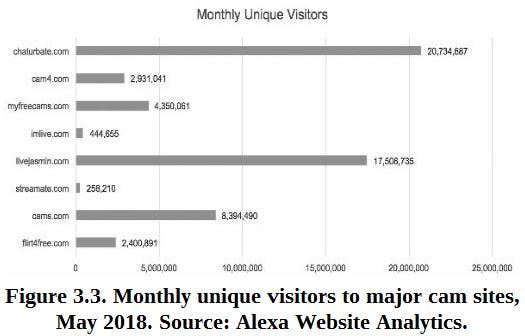
“[E]xtremely high wages occurred but disproportionately went to full-time cam models who have worked in the industry for long periods of time and who labored incredibly hard to build popular brands [my emphasis].”
** From Camming (my emphases):
“[O]f all the models in the sample who have earned $10,000 in any month camming, there was not one who had been camming for less than a year. Alicia once earned $54,000 in one month and averages $11,000 a month; she has been camming for seven years. Quinn, who one month earned $50,000 and averages $5,000 a month, has cammed for five years. Tanya once earned $25,000 in a month and usually makes $10,000 a month; she has worked as a cam model for over eight years.”
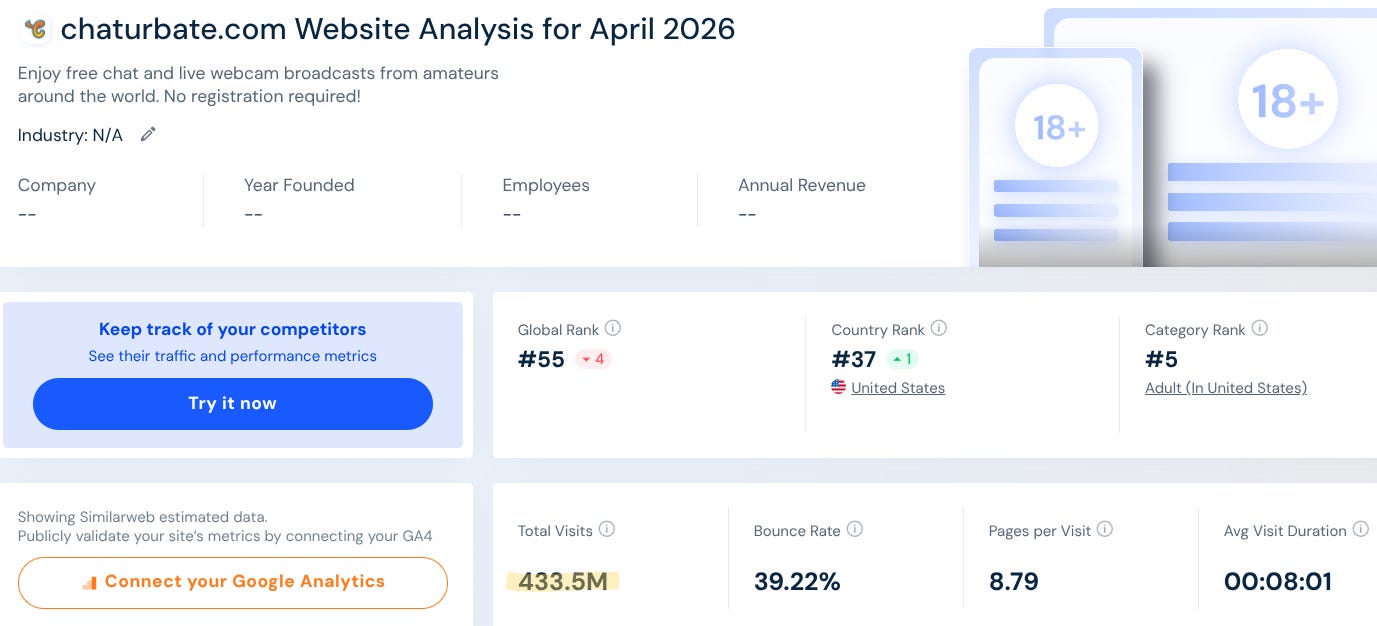
Related to the outlier months: 1) camming can still be lucrative (details below), 2) camming-adjacent businesses can be lucrative (see the next three excerpts).
From an August 2025 article on the site of Variety magazine:
Porn-friendly creator platform OnlyFans is still making money hand over fist . . .
In fiscal 2024, the company reported $7.22 billion in gross revenue, an increase of 9%, representing fan payments to creators on the platform.
Part of the title of a December 2024 article on the website of People magazine:
At the beginning of the [video] clip, Rain [said OF model] was seen scrolling through the OnlyFans statistics page from her phone, displaying that her most recent 30 day earnings is a staggering $1.29 million.
. . . Rain went on to click to display her earnings for all time, which showed a gross earning of $101,206,272.78.
*** From the 2012 article on PsychologyToday.com titled “Porn Stars and Evolutionary Psychology”:
What seems very clear from these studies is that both male and female performers have unusually high sex drives and a willingness to have sexual relations with a large number of partners.
The sensitive accelerator plus not-so-sensitive brakes combination describes between 2 and 6 percent of women . . . [If you’re one of these women:] Because the brain mechanism responsible for noticing sexually relevant stimuli [i.e., the accelerator] is very sensitive, you’re highly motivated to pursue sex, and . . . the brain mechanism responsible for stopping you . . . is only minimally functional . . .
Don Symons found that more than half of women’s fantasies reflect the desire to be sexually irresistible. Women frequently fantasize about being a stripper, harem girl, or Las Vegas showgirl and “delighting many men.”
[There’s a] fundamental difference between how we behave in “hot” states (those of . . . sexual excitation and the like [e.g., the prospect of financial windfall]) and “cold” states of rational calm. . . .
Data from tests in which volunteers are asked how they would behave in various “heat of the moment” situations . . . have consistently shown that different states of arousal can alter answers by astonishing margins. “These kinds of states have the ability to change us so profoundly that we’re more different from ourselves in different states than we are from another person,” [George] Loewenstein says.
From the chapter in 2009 book Predictably Irrationaltitled “The Influence of Arousal: Why Hot Is Much Hotter Than We Realize”:
In 2001, while I was visiting Berkeley for the year, my friend, academic hero, and longtime collaborator George Loewenstein and I invited a few bright students to help us understand the degree to which rational, intelligent people can predict how their attitudes will change when they are in an impassioned state.
— More re: OSG’s cybernetic clubs being flowmance-FRIENDLY could be expected to expedite the female-FRIENDLY (ongoing?) transition from today’s human variant of Chimp World to a human variant of Bonobo World —
Re: “ongoing?”
From a paper in the August 2017 issue of Journal of Sex & Marital Therapy (my emphases):
Although academic and popular interest in consensual nonmonogamy (CNM) is increasing, little is known about the prevalence of CNM. Using two separate U.S. Census based quota samples of single adults in the United States (Study 1: n = 3,905; Study 2: n = 4,813), the present studies show that more than one in five (21.9% in Study 1; 21.2% in Study 2) participants report engaging in CNM at some point in their lifetime. This proportion remained constant across age, education level, income, religion, region, political affiliation, and race, but varied with gender and sexual orientation. Specifically, men (compared to women) and people who identify as gay, lesbian, or bisexual (compared to those who identify as heterosexual) were more likely to report previous engagement in CNM.
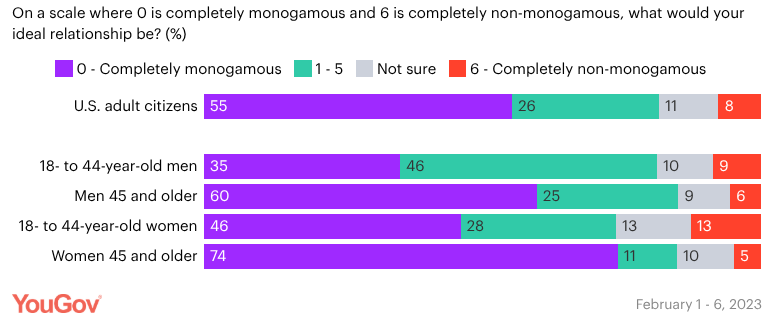
A January poll of more than 1,300 US adults finds that about one-third (32%) of US adults say that their ideal relationship is non-monogamous to some degree.
Millennials (43%) are particularly likely to say their ideal relationship is non-monogamous . . .
From a 2023 article on YouGov.com that reports on a poll of 1000 U.S. adults:
[R]ecent science and women’s voices left me with pointed lessons:
That women’s desire—its inherent range and innate power—is an underestimated and constrained force, even in our times . . .
[T]his force is not, for the most part, sparked or sustained by emotional intimacy and safety . . .
[O]ne of our most comforting assumptions, . . . that female eros is much better made for monogamy than the male libido, is scarcely more than a fairy tale.
What’s author is a contributing writer for TheNew York Times Magazine and the author of six books of nonfiction.
The most patient and thorough research about the hook-up culture shows that over the long run, women benefit greatly from living in a world where they can have sexual adventure without commitment . . . and where they can enter into temporary relationships that don’t derail their careers.
To put it crudely, now feminist progress is largely dependent on hook-up culture. To a surprising degree, it is women—not men—who are perpetuating the culture . . .
Terri Fisher, a psychologist at Ohio State University . . . asked two hundred female and male undergraduates to complete a questionnaire dealing with masturbation and the use of porn. The subjects were split into groups and wrote their answers under three different conditions: either they were instructed to hand the finished questionnaire to a fellow college student, who waited just beyond an open door and was able to watch the subjects work; or they were given explicit assurances that their answers would be kept anonymous; or they were hooked up to a fake polygraph machine, with bogus electrodes taped to their hands, forearms, and necks.
The male replies were about the same under each of the three conditions, but for the females the circumstances were crucial. Many of the women in the first group—the ones who could well have worried that another student would see their answers—said they’d never masturbated, never checked out anything X-rated. The women who were told they would have strict confidentiality answered yes a lot more. And the women who thought they were wired to a lie detector replied almost identically to the men.
. . . When Fisher employed the same three conditions and asked women how many sexual partners they’d had, subjects in the first group gave answers 70 percent lower than women wearing the phony electrodes. Diligently, she ran this part of the experiment a second time, with three hundred new participants. The women who thought they were being polygraphed not only reported more partners than the rest of the female subjects, they also . . . gave numbers a good deal higher than the men.
From Chick Lit and Postfeminism:
“The high number of sexual partners the chick lit protagonist experiences . . .”
“Though an offshoot of popular romance, chick lit transforms it significantly, virtually jettisoning the figure of the heterosexual [male] hero . . .
Men are not really valued as individuals as much as means to a lifestyle . . .
Even texts that end with marital happiness present a predominantly depressing take on marriage.”
From Untrue: Why Nearly Everything We Believe About Women, Lust, and Infidelity Is Wrong and How the New Science Can Set Us Free:
[A] 2017 study shows that among women aged twenty-five to twenty-nine, group sex and threesome experience equaled that of men the same age, and women were nearly twice as likely to have gone to a dungeon, BDSM, swingers’, or sex party.
— Note —
I’m optimistic that eXXXos will expedite advances of the associated technologies, and that these advances will lead to many pro-social uses (e.g., helping soldiers and police officers prevent escalations/resumptions of conflict); reasons for my optimism: 1) the long history of technologies gaining early-adopters via sex-related uses, 2) we might be living in a simcom with said focus, 3) from Playboy and the Making of the Good Life in Modern America:
“Playboy tied the pursuit of pleasure to national purpose.”
“Changes in sexual morality were also linked to developments in the consumer society. Policymakers and captains of industry after World War II upheld economic growth as the fount of national well-being. . . . The widespread adoption of an ethical framework that sanctioned pleasure-seeking . . . helped sustain the nation’s consumer society.”
“Writing in Harper’s magazine in 1967, journalist David Halberstam reflected on the years he spent as a foreign correspondent in [communist] Poland, until his unflattering reports about the government caused him to be expelled from the country. Before leaving Poland, Halberstam recounted, he wanted to show his appreciation to a Polish intellectual who had remained a loyal friend during the skirmishes with state officials that resulted in his expulsion. To his surprise, Halberstam’s Polish friend requested a subscription to Playboy, ‘the most important magazine there is.’ When the American journalist suggested that there were other magazines more suitable for the caliber of this man’s intellect, his friend reportedly told him:
But you don’t understand how important Playboy is. . . . It is for us the greatest American export in the world. For us it is the good life.”
More re: comedy and AI (e.g., possibilities via my work)
— From a write-up of mine circa 2020, soon after Andrew Yang catalyzed a lot of discourse about universal basic income —
Martin Luther King Jr.: “The arc of the moral universe is long, but it bends toward justice.”
From a June 22, 2026 article by a Stanford University professor:
TEACHING THE NEW LOOP. The future of the university is preparing every student to design and build the private evals and workflows that allow them to combine their expertise with AI in ways that accrue value to them, not just to the frontier models.
I’ve been experimenting with how to do this
@StanfordGSB in my new class, “Free Systems.” Here’s what I learned teaching it for the first time this year:
(1) Human expertise is a pre-req to building private evals. In my class, students were able to use Claude Code + OpenRouter to design their own personal evals . . . but first, they had to know what they wanted to evaluate! That’s where their own experience, values, and expertise came in. We’re going to have to double down on non-AI teaching to get students to this place, where they can bring all of that to the AI classroom.
(2) Students need a ramp with tangible exercises. Throwing a student straight into the deepend with coding agents and evals doesn’t work for many of them. Instead, we started with more structured tasks and pre-built environments before gradually removing the training wheels. This helped bring everyone along.
(3) In-person collaboration and tutoring will be a big part of these classes. Students learned a lot more by working through the projects in the same room, hearing from one another as they went, and benefitting from TAs getting them unstuck the moment anything went awry.
** Startup Camedy? Re: adult entertainers who “cam” could be early-adopters/LUs of PAI (e.g., EAs via raising ECF):
Lacey is a cam model. She performs one-woman sex shows . . .
Lacey’s regulars know many intimate details about her. But they may not realize that she runs a serious business. When she’s not on camera, she tracks metrics and promotes herself on social media, checks in with clients. She can’t see the men she performs for, but she watches their habits closely.
. . . Outside Lacey’s office, at a desk beside the brown couches in her living room, Mr. Lewis was tracking the users in Lacey’s chat room, sending Lacey notes through a private channel when big tippers arrived.
Mr. Lewis is known to the regulars as Lolli’s Helper, his screen name. Lacey hired him last October. She was working five or six days a week on camera, often more than one session. She was also writing for her two blogs, running a membership site and posting to Twitter. She met Mr. Lewis at a local association of people involved with bondage and sadomasochism.
Lacey offered him 5 percent of her revenue to help her expand the business. He built a database of the screen name of every one of the 1,594 people who tipped Lacey since October and how much they tipped. Another database logs Lacey’s shows, the theme and how much money each generated.
This gave Lacey metrics. One of her best shows, in which she applied oil while in her backyard, brought in 48,795 tokens (about $2,439 to Lacey); the “maids and room service,” a more typical show, brought $534.85. She has Mr. Lewis look at what other models are doing, explore new trends, try to measure what works and doesn’t. She goes to pornography industry conventions. She offers promotions and prizes on Twitter and offers business counsel to other models in cam forums.
From Camming: Money, Power, and Pleasure in the Sex Work Industry:
There’s a price of admission, and almost nobody is paying it: you have to be willing to spend on tokens.
Peter Steinberger built OpenClaw, my favorite harness. He has said he’s willing to spend on the order of a million dollars a year in tokens to do it. Most people hear that and flinch, but they shouldn’t because that’s the gold: you can live in 2028 if you can [do] this, and it will be years before people catch up.
. . . You can live in 2028 but in 2026, and that is worth the trade in paying more now since, those same toke[n]s that cost $100K today will be $10K next year and $1K the year after that, and maybe $100 by end of 2028. If you could tell any founder in the history of the world that you could invest 6 figures in capital into living 2 to 3 years in the future and hold that advantage for years, 100 out of 100 founders worth their salt would take that deal.
— Implication of the previous section —
PAI might be advanced via OSG creating a startup camedy titled TokenmaXXXing.
The Second Empire of Napoleon III marked the emergence of the high-class prostitute as a noticeable and much-discussed public figure, whose career could lead to immense wealth . . .
What sealed the alliance of the figure of the prostitute with . . . commercially successful literature was Eugene Sue’s Les Mysteres de Paris, perhaps the most widely read novel of the nineteenth century, which was published serially . . . from June 9, 1842 to October 15, 1843.
— Possible subtitle of TokenmaXXXing —
The Making of Girl Groups
— Re: “Making” —
OSG’s TokenmaXXXing would double as a flowmantic comedy (e.g., the serial’s lead flowmance would derive from co-creating GG).
— Possibilities re: GG —
serial fiction
set initially in 1959, at and around the Brill Building in New York City:
[A] remarkable group of songwriters . . . in the late 1950s and early ‘60s . . . pioneered a distaff doo-wop, the girl-group sound of the Shirelles, the Crystals, the Ronettes, and the Shangri-Las.
— More possibilities re: TokenmaXXXing —
Othercharacters would include the staff of writers, story consultants et al. who co-produce GG (along with said co-creators).
Guest-stars would often/typically be adult entertainers who: 1) want to raise ECF, 2) are cast in GG (i.e., cast in fictional roles).
— More possibilities re: GG, given the need to showcase guest-stars in TokenmaXXXing —
Originated as a serial novel; by the start of TokenmaXXXing has been adapted for video (i.e., video excerpts of GG would be interspersed within the prose of TokenmaXXXing).
This book is . . . about the social and cultural transformations of the 1960s and ’70s.
. . . Developed in 1957 and licensed by the Food and Drug Administration in 1960, the birth control pill—which quickly became known simply as “the pill”—gave women a greater sense of sexual freedom than any contraceptive device that had come before.
In particular, music from/around the Brill Building might be part of said transition.
Re: “from”
From Always Magic in the Air:
Expressing the optimism . . . of the early civil rights movement, it [i.e., music from the Brill Building] amalgamated black, white and Latino sounds before multiculturalism became a concept . . . and integrated audiences before America desegregated its schools.
[In the early ‘60s] young women were increasingly visible on the rock, pop and R&B scenes, and the girl-group combination of teen energy and imaginative arrangements brought those scenes closer together. In 1957, recordings by women singers had accounted for only four of the hits on Billboard’s year-end top 100 list . . . By 1960, Brenda Lee, Connie Francis and the Shirelles had helped bring that number up to thirteen, and in 1962 and 1963 almost a quarter of the top 100 sellers were by women, including lots of young R&B singers and girl groups . . .
[T]he Fifties’ teenage culture marked the territory for the far larger youth upheaval . . . Rock and roll and its dances were the opening wedge.
From Always Magic in the Air:
[T]he Palladium Ballroom [for dancing], four blocks north of the Brill Building . . .
From Rock ‘n’ Roll: A Very Short Introduction:
[F]emale teens on the cusp of the 1960s were not just mooning over cute boys; they were pioneering a new approach to dancing that would transform popular music and culture around the world.
Re: “from/around”
From Always Magic in the Air:
“[T]he syncretic nature of Latin music—‘neither black nor white, African nor European,’ in the words of one scholar, ‘but negriblanca’—modeled and mediated popular music’s integration of black and white music. “The Palladium was the laboratory,” another historian of Latin music observed. ‘The catalyst that brought [together] Afro-Americans, Irish, Italians, Jews. God, they danced the mambo. And because of the mambo, race relations started to improve in that era . . .
‘The Palladium opened the door,’ music historian Joe Conzo concurred, ‘and then suddenly there was no racism.’ Ernie Ensley, an African American who frequented the Palladium, confirmed that his fellow dancers ‘came from Brooklyn, the white guys and girls, and they could dance. . . . I used to go to those dance halls out in Brooklyn and be the only black guy there. But I always had someone to dance with. I never had any problem or discrimination. It was a dancing crowd.’”
“Shuman described himself as ‘a mambonik’ who ‘wrote rock n’ roll but lived, ate, drank and breathed Latino.’ He ingested it chiefly at the Palladium Ballroom . . . Wednesday was Anglo night, when Killer Joe Piro taught celebrities like Kim Novak and Marlon Brando to mambo. ‘Stars of stage and screen danced and drank with cleaning ladies, seamstresses . . . ,’ Shuman wrote . . .”
From Rock ‘n’ Roll: A Very Short Introduction:
“Killer Joe Piro, a popular dance maven explained: ‘The girl is free to do what she wants to. She couldn’t let herself go before the Twist [enormously popular from 1960-62] . . .’”
“The Twist was doubly transformative: it encouraged white dancers who were not used to working their hips to move their bodies in new ways, and it was a solo dance . . . Soon women, in particular, were taking to the floor by themselves or with female friends, shaking their tailfeathers in the Jerk and the Frug, waving their arms in the Swim and the Fly, prancing and stomping in the Pony and the Mashed Potato and shimmying like exotic dancers in the Afrian-styled Watusi. Some of the moves looked silly, but they heralded a new era.”
— Re: the lead flowmance of TokenmaXXXing could be expected to co-create GG —
“Using a computer model that can read, recognize and sift through thousands of features in thousands of books, we discovered that there are fascinating patterns inherent to the books that are most likely to succeed . . .”
“[Fifty Shades of Grey author E.L.] James writes emotional turns with such a regularity of beat that the reader feels the thrum of her words in their bodies like the effect of club music. Only twenty-five other best-selling novels share James’s rhythm, and only one other novel we could find has mastered the same measured beat. That other novel happens to be the other highest-selling book for adults of the past thirty years. It is the only novel in our research corpus that not only enjoyed the same massive and controversial response right from publication, but also (to date) outsold Fifty Shades of Grey. That novel is Dan Brown’s The Da Vinci Code.”
— Re: TokenmaXXXing could spin-off from OSG’s 1.0 SC —
From my 2015 business-plan:
— Re: recommendation engines —
A possible spin-off from OSG’s 1.0 SC or from TokenmaXXXing: Sexcerpts and the City, which would: 1) showcase AC-ers et al. benefiting from a particular recommendation engine, 2) help the engine’s developers raise ECF.
Re: “AC-ers . . . benefiting” (part 1 of 2)
From The Bestseller Code:
“[Y]ears of research in authorship attribution and stylometrics have suggested that each of us has a fairly unique and individual linguistic fingerprint or style.”
“In early July of 2013 a U.S. professor received a random phone call from across the Atlantic. The stranger on the end of the line asked him to help solve a mystery. The professor was asked to bring his special expertise in hidden patterns to correct history. Within a week he would be in the spotlight, all over the international news. The story sounds just like something Dan Brown would make up and then sell about a hundred million copies. But in this instance, the professor was not Robert Langdon but Patrick Juola, his domain was not symbology but stylometrics, and his case study was not the Catholic Church but J. K. Rowling. Juola, a professor of computer science and an expert on computational authorship attribution, was asked by a Sunday Times news reporter to investigate a new novel. That novel was The Cuckoo’s Calling by Robert Galbraith, a debut author who had ostensibly drawn on his years as a member of the Royal Military Police to write a detective story. But the reporter had been tipped off. The anonymous hint was that Galbraith didn’t really exist and that the real author was in fact the Harry Potter creator. Was it true? Juola worked on the case. Within thirty minutes, his computer gave him sufficient evidence to support the tip-off.
. . . Even when Rowling tried, very consciously, to write like “Robert Galbraith” and not like J. K. Rowling, there were habits and patterns to her prose that she could not successfully suppress.”
From a May 2026 paper in the Journal of American College Health:
[Start of title:] Undergraduate students sugar dating in the US . . .
. . . Prevalence of sugar dating was 5.2%.
From Wikipedia:
In July 2015, an unknown person or group calling itself “The Impact Team” announced that they had stolen user data of Ashley Madison, a commercial website billed as enabling extramarital affairs.
. . . In the days following the breach, extortionists began targeting people whose details were included in the leak . . . One company started offering a “search engine” where people could type email addresses of colleagues or their spouse into the website, and if the email address was on the database leak, then the company would send them letters threatening that their details were to be exposed unless they paid money to the company.
. . . On 24 August 2015, Toronto police announced that two unconfirmed suicides had been linked to the data breach, in addition to “reports of hate crimes connected to the hack”.[39][40] Unconfirmed reports say a man in the U.S. died by suicide.[28] At least one suicide, which was previously linked to Ashley Madison, has since been reported as being due to “stress entirely related to issues at work that had no connection to the data leak”.[41] The same day, a pastor and professor at the New Orleans Baptist Theological Seminary killed himself citing the leak that had occurred six days before.
From a June 14, 2026 article on the website of The Economist magazine:
On June 11th Mark Warner, the vice-chair of the Senate Intelligence Committee, said that General Joshua Rudd, who leads the National Security Agency and the Pentagon’s Cyber Command, had told him that [Anthropic’s AI model] Mythos “broke into almost all of our classified systems, not in weeks, but in hours” [my emphasis].
Re: “et al. benefiting”
From the 2022 article in The New York Times titled “How TikTok Became a Best Seller Machine”:
[Subtitle:] #BookTok, where enthusiastic readers share reading recommendations, has gone from being a novelty to becoming an anchor in the publishing industry and a dominant driver of fiction sales.
Re: “AC-ers . . . benefiting” (part 2 of 2)
I suspect that AC-ers will profit from synergies* between the recommendation engine and AC-ers’ PAI.
* Possible keywords re: PAI traces: include calls to the engine; include downstream results of the calls (esp. decisions by (prospective) customers); leveraged to improve (e.g., post-train) the engine.
In the late 1990s—during the dot-com boom—I conceived a simcom (my descriptor back then) that would’ve been: 1) viewed online, 2) a bit interactive as a means of providing “virtual internships.” In particular, my simcom-design (SD) was informed by: 1) work on training simulations done by a longtime chairman of the computer science department at Yale University, 2) the then popularity of the comic strip Dilbert.
SD is (much) more viable today, given: 1) ubiquitous broadband; 2) AI for production; 3) the larger simcom-case (LSC); 4) the overlap between SD and NBC’s The Apprentice c. 2004 (SD features concurrent storylines, each of which maps to a role on an organization chart); 5) the June 8, 2026 article on Axios.com titled “Trump the dealmaker wants a slice of the AI boom” reports: “The U.S. government now owns shares of chipmakers, miners and quantum computing companies, often taking a stake in exchange for federal money . . .”; 6) apprenticeship.gov/AI-in-registered-apprenticeships; 7) an implementation of SD could center on President Trump presiding over the creation of many AI apprenticeships that help the president and OSG combat the threat to the AI industry et many al. that: a) was a focus of my work from 2016 through 2025, b) has taken shape via ongoing research-advances (esp. in molecular genetics, neuroscience and AI) intersecting with “Autocracy, Inc.”, c) might strengthen LSC.
Re: indicators that my threat-analyses (current version: 3.5) have been at least partly correct
During 2016 through early 2025 I submitted (~)four times to relevant agencies of the U.S. government (USG); plausible result: I’ve been on the radar of Autocracy, Inc. for years:
From a 2023 email that I sent:
Since I emailed . . . there have been indicators that, via my tenure since 2016 as an/the-world’s-most accidental threat-analyst, I’m continuing to experience a variant of the interference previewed below.
From the April 3, 2023 article in The New Yorker titled “The Smear Factory: When private investigators fight autocrats’ battles” (my emphases):
In the summer of 2017, Hazim Nada, a thirty-four-year-old American living in Como, Italy, received an automated text message from his mobile-phone carrier: How was our customer service? Puzzled, he called a friend at the company. Someone impersonating Nada had obtained copies of his call history. Afew weeks later, his account manager at Credit Suisse alerted him that an impostor who sounded nothing like Nada—he has a slightly nasal, almost childlike voice—had phoned and asked for banking details.
. . . In the fall of 2017 there was another deceptive call. A man pretending to represent Citibank contacted Nada’s company . . .
. . . [T]he growing number of private firms—often staffed by former Western intelligence agents—makes it easy for governments or oligarchs to order an espionage or misinformation operation à la carte.
From a March 28, 2023 article in The Washington Post (my emphases):
Bruce Klingner, a longtime Northeast Asia specialist, once received a message from a verified email address of Korea analyst Aidan Foster-Carter that seemed innocuous: Would Klingner review a paper by nuclear policy expert Jamie Kwong? Klingner agreed, and began exchanging emails with “Kwong” about her paper. Then came an email with a fishy link, which he forwarded to his IT team. It was malware, and the entire exchange was a trap; neither Foster-Carter nor Kwong had contacted Klingner. Like many Korea watchers, Klingner, a senior research fellow at the Heritage Foundation, can rattle off more than a half-dozen such phishing attempts impersonating researchers, government officials and journalists.
Successfully deployed, Pegasus essentially owns a mobile phone; it can break down defenses built into a cell phone, including encryption, and gain something close to free rein on the device, without ever tipping off the owner to its presence. That includes all text and voice communications to and from the phone . . .
All told, kleptocrats bleep with people like me systematically*, so it’d be predictable if you received some misinformation after our initial exchange.
Best,
. . . * From the Foreign Policy Centre’s November 2020 reportUnsafe for Scrutiny: Examining the pressures faced by journalists uncovering financial crime and corruption around the world (63 investigative journalists from 41 countries participated in the survey; my highlights):
More re: USG-ers who I reached might’ve concluded that the lead in confronting the threat should be taken by the group who has the most to gain: the AI industry
“[Kazakhstan’s] kleptocracy had gone after a man[*] . . . Any spook, lawyer, lobbyist or PR could see there was a fortune to be made from that. And fortunes had been made. Half a billion dollars had gone out [to bleep with one guy] . . .”
“[F]or the kleptocrat, ruling by licensing theft rather than seeking consent, money can achieve most of what needs to be done. For everything else, there is violence.”
In many instances, however, it seemed that an expert or expert group, a Cassandra, had accurately predicted what would happen. They were often ignored . . .
. . . Warnings that have this potential to steal resources from less threatening projects tend to encounter institutional reluctance to tackle the issue [my emphasis].
Before Apalachin, before, say, 12:40 p.m. on November 14, 1957, there was no mob. No organized crime at all in America. Citizens believed this because the country’s head copper [i.e., FBI director Hoover] told it to them again and again, obsessively, as he did almost everything, like a bulldog, the breed Hoover famously resembled. The director repeated the line so often that it became a sort of reality.
. . . Which meant the mob threat went largely unchallenged in any focused, plenary way. The criminal conspiracy comprised mainly of Sicilian Mafia immigrants grew into a national cartel totally unhampered by the FBI. “Hoover’s not a problem,” one mob boss was caught saying on a phone wiretap. The brutal campaigns of extortion and violence, the beatings, the murders, the organized crime tax that all citizens paid whether they knew it or not, the corrupting influence of the mob, all proceeded unchecked by the nation’s premier federal law enforcement bureau.
Recalled United States district attorney for New York Robert M. Morgenthau: “For pretty much close to twenty-five years, organized crime had a free run. I mean from the end of Prohibition down to 1960. And I think it kind of had woven into at least part of the fabric of society.”
* From Kleptopia:
[Said man] Ablyazov was the owner of BTA Bank, one of Kazakhstan’s biggest.
. . . [Ablyazov] alone stood up to the president, denouncing the promotion of Nazarbayev’s relatives and the creeping establishment of what he called a “clan-ocracy.” When he refused to continue in the cabinet, Nazarbayev demanded to see him. “You don’t respect your president,” he ranted, “you don’t respect me as a person, you’re not loyal to me.” He calmed down and asked again: “Come back and work for me.” Again Ablyazov refused. “Well, in that case, you’re going to have to give me a chunk.” They would be partners. The president would take half of BTA Bank. It would be a guarantee against disloyalty. Ablyazov stood firm: no. He knew change was coming. He wanted it, and found that others did too. Together, these reformers founded a political party, Democratic Choice of Kazakhstan.
Nazarbayev, their enlightened ruler, crushed it.
. . . The [2008 financial] crisis had presented Nazarbayev and his court with the pretext they needed to seize BTA from Ablyazov and make it look like a rescue rather than robbery.
Re: the threat that I analyzed might strengthen LSC
“[T]he second most difficult scene to write is the Central Plot’s Inciting Incident. We rewrite this scene more than any other. So here are some questions to ask that should help bring it to mind.
What is the worst possible thing [my emphasis] that could happen to my protagonist? How could that turn out to be the best possible thing [my emphasis] that could happen to him?”
“Writers and the stories they tell can be usefully divided into three grand categories, according to the emotional charge of their Controlling Idea.
. . . Idealistic Controlling Ideas
‘Up-ending’ stories expressing the optimism, hopes, and dreams of mankind, a positively charged vision of the human spirit; life as we wish it to be.”
In particular, LSC might be strengthened because: 1) LSC might make more people willing to confront the threat; from Story (my emphases):
Comedy contains myriad subgenres as well, each with its own conventions, but one overriding convention unites this mega-genre and distinguishes it from drama: Nobody gets hurt. In Comedy, the audience must feel that no matter how characters bounce off walls, no matter how they scream and writhe under the whips of life, it doesn’t really hurt.
2) confronting the threat partly via OSG’s VAR might yield a positive-feedback dynamic: OSG’s progress strengthens people’s belief in LSC, which leads more people to confront the threat, which yields more OSG progress; 3) an ideal way to prime/predispose President Trump to catalyze said feedback dynamic might include the portentou$ne$$ of recursively self-improving companies, 4) it’d figure if the writers of the simcom we live in are REALLY good. :-)
[S]cript guru Robert McKee, whose popular guide to screenwriting, “Story: Substance, Structure, Style, and the Principles of Screenwriting,” was published more than twenty-five years ago . . .
. . . When I lived in Los Angeles, it wasn’t unusual to be in a cafe, surrounded by aspiring screenwriters with laptops running Final Draft, who were obsessing aloud over Inciting Incidents, Turning Points, and Major Dramatic Questions. In “Story,” McKee bestows these concepts . . .
— Forerunner of VAR UMs adding enormous value via comedy —
At the height of his career Mr. [Louis B.] Mayer was the czar of Hollywood movie producers. . . . [F]or seven consecutive years, with an income in the million-dollar bracket, he was the highest paid executive in the United States [i.e., highest across all industries, maybe from 1937-43].
In the late 1930s when the Hollywood studio era was at its zenith, F. Scott Fitzgerald noted that “people in the East pretend to be interested in how pictures are made,” but their real fascination was with “the pretensions, the extravagances, and vulgarities” of Hollywood. “Tell them that pictures have a private grammar like politics or automobile production,” he said, “and watch the blank look come into their faces.” That observation is from The Last Tycoon, Fitzgerald’s fictionalized homage to Thalberg . . . Thalberg was one Easterner who not only learned the grammar of pictures, but also found out how it could be rearticulated systematically and on a massive scale. Thalberg was not the most powerful man at Loew’s/MGM, nor was he the most artistic individual at the studio. But he occupied a critical position in the system — poised, in effect, between New York and L.A., between capitalization and production, between conception and execution. He developed a system that kept these forces in equilibrium, and he carved out his own role as studio production chief in the process. It was a role that Thalberg virtually created and defined, and by the late 1920s it was the single most important role in the Hollywood studio system.
Re: presentation-errors above (i.e., errors that a copy editor would fix)
Every time I turn in the “final” copy of a book [Kawasaki (co-)authored nine books before APE], I believe that it’s perfect. In APE’s case, upward of seventy-five people reviewed the manuscript, and [co-author] Shawn [Welch] and I read it until we were sick of it. Take a wild guess at how many errors our copy editor found. The answer is 1,500. [APE is 410 pages.]