
인셔셔RSS 관심 있는 블로그, 뉴스, 기술 정보를 효율적으로 추적하고 읽으세요
원문 읽기 InertiaRSS에서 열기

추천 피드

云风的 BLOG
云风的 BLOG
M
MIT News - Artificial intelligence
博客园 - Franky
J
Java Code Geeks
V
Visual Studio Blog
G
Google Developers Blog
罗磊的独立博客
MongoDB | Blog
MongoDB | Blog
奇客Solidot–传递最新科技情报
奇客Solidot–传递最新科技情报
Recent Announcements
Last Week in AI
Last Week in AI
Cyber Security Advisories - MS-ISAC
Stack Overflow Blog
Stack Overflow Blog
博客园 - 司徒正美
The GitHub Blog
The GitHub Blog
腾讯CDC
阮一峰的网络日志
阮一峰的网络日志
V
V2EX
博客园 - 【当耐特】
IT之家
IT之家
I
InfoQ
U
Unit 42
C
Check Point Blog
Martin Fowler
Martin Fowler

Hacker News - Newest: "AI"

AI can't read an investor deck AI as an attorney? Student uses ChatGPT, Gemini to sue UW over alleged racial discrimination Hacking MCP Servers in AI Systems – The Rug Pull: Tool Changes After Approval GitHub - MeepCastana/KubeezCut: Free Web based video editor Can AI judge journalism? A Thiel-backed startup says yes, even if it risks chilling whistleblowers Coming soon: 10 Things That Matter in AI Right Now DARPA built an AI to fact-check enemy weapons claims What explains heterogeneity in AI adoption? When AI Meets Muscle: Context-Aware Electrical Stimulation Promises a New Way to Guide Human Movements - Department of Computer Science AI Changed How We Build. It Did Not Change What Matters. Linux rules on using AI-generated code - Copilot is OK, but humans must take 'full responsibility for the… Meta spins up AI version of Mark Zuckerberg to engage with employees Code Mode: Let Your AI Write Programs, Not Just Call Tools | TanStack Blog GitHub - Delavalom/graft: Go framework for building AI agents. Type-safe tools, multi-provider (OpenAI, Anthropic, Gemini, Bedrock), zero vendor SDKs. India's TCS tops estimates, says new AI models did not dent services demand Gen Z's fading AI hype Strong feeling: we are in a folded AI reality GitHub - machinarii/total-recall-catalog: A reference catalog of latest knowledge retrieval, memory & RAG systems GitHub - mensfeld/code-on-incus: Give each AI agent its own isolated machine with root, Docker, and systemd. Active defense detects and stops threats automatically.. Quantization, LoRA, and the 8% Problem: Benchmarking Local LLMs for Production AI Iran war: We spoke to the man making Lego-style AI videos that experts say are powerful propaganda Powell, Bessent discussed Anthropic's Mythos AI cyber threat with major U.S. banks GitHub - immartian/bellamem: Persistent belief-graph memory for AI agents. Retrieves decisive context by importance — not recency, not RAG, not /compact. recursive-mode: The Repo-Native Operating System for AI Engineering After the attack on Sam Altman's home, will AI CEO's go on the offensive? The biggest advance in AI since the LLM Opus 4.6 vs GPT 5.4 One Prompt Unity World Generation Test “AI polls” are fake polls Client Challenge Can AI be a 'child of God'? Inside Anthropic's meeting with Christian leaders
Why Good Engineers Become Worse With AI
sneruz · 2026-05-24 · via Hacker News - Newest: "AI"

The 10x engineer is regressing towards the mean.

Francis Galton named this effect in 1886 [1], when he noticed that exceptionally tall parents had children closer to average. LLMs are regression machines by construction. The decoding step samples the most-probable continuation of your prompt. That's the mean of the training distribution, conditioned on what you typed.
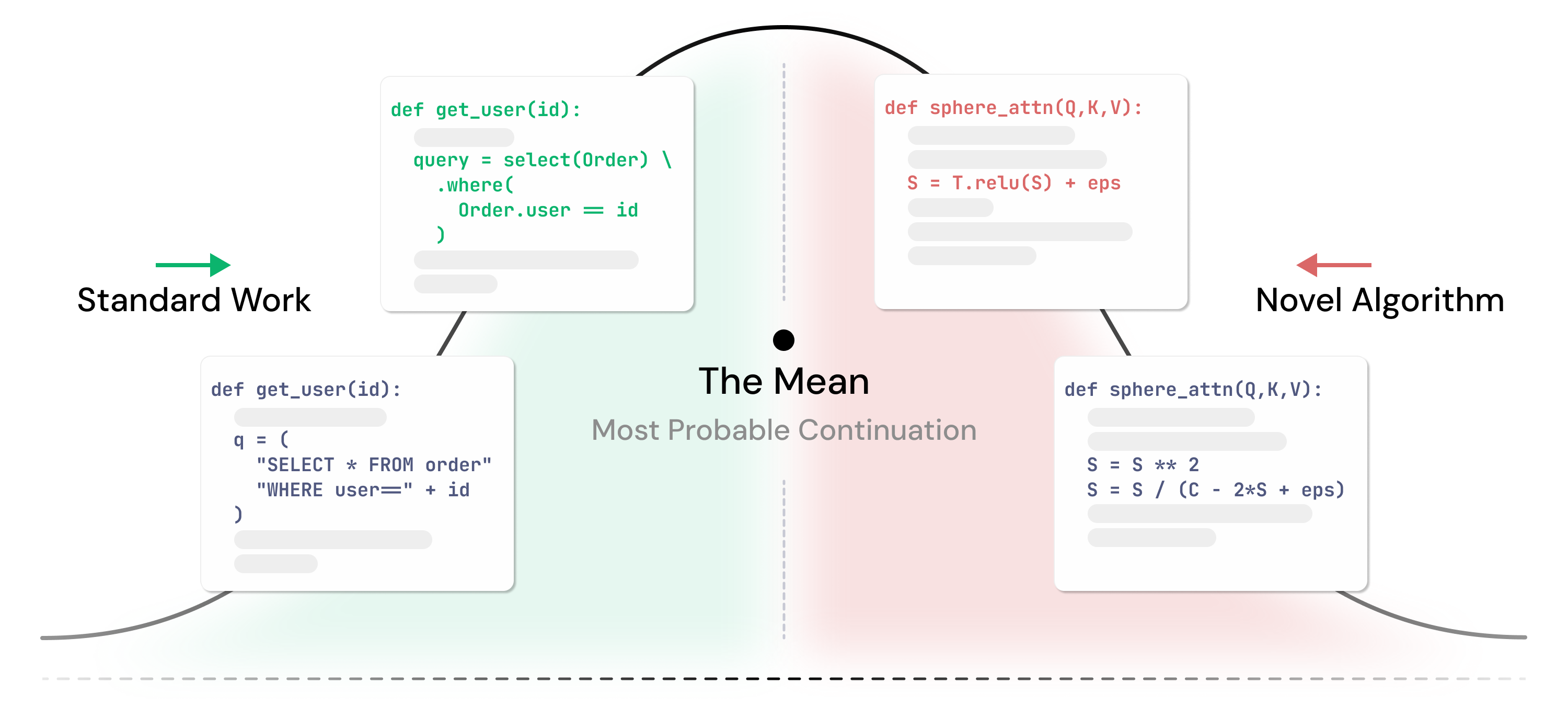
Four code samples arranged around a regression curve, converging on a center.
Regression to the mean. Standard patterns get lifted up to it; novel algorithms get dragged down to it. Same mechanism, opposite outcomes.

The effect is asymmetric. On common work, the 10x engineer becomes 100x. On novel work, the same engineer gets dragged to the mean and ships code that looks right and isn't. The model doesn't know which one you are.

What the Failure Looks Like

A docstring describes behavior. You can only specify what you already know.

I used a paper from ICML 2026 [2] whose contribution is one attention kernel formula. I stripped the implementation and sent DeepSeek V4 Pro the signature and docstring, then captured the logprobs on the completion.

import torch
import torch.nn.functional as F

def spherical_attention(Q, K, V):
    """
    Attention with spherical-constrained Q, K and positive scoring kernel.

    Queries and keys are normalized to the unit sphere. A positive kernel
    function maps the cosine similarity between query and key directions
    to an attention score. Scores are normalized per query and used to
    weight V.

    Args:
        Q, K, V: (batch, heads, seq, head_dim) tensors.

    Returns:
        Attention output of shape (batch, heads, seq, head_dim).
    """
    Q = F.normalize(Q, dim=-1)
    K = F.normalize(K, dim=-1)
    S = torch.einsum('bhqd,bhkd->bhqk', Q, K)
    C = 2.0 + 1e-6
    S = S**2 / (C - 2*S)                      # Yat-kernel
    A = S / S.sum(dim=-1, keepdim=True)
    O = torch.einsum('bhqk,bhkd->bhqd', A, V)
    return O
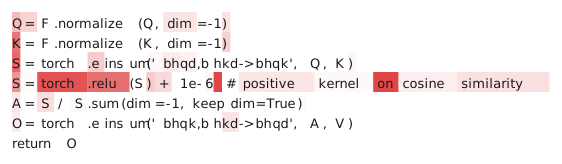
Model completion with per-token uncertainty heatmap. The kernel line torch.relu(S) + 1e-6 is highlighted red.
The model's completion. Deeper red indicates lower confidence.

Seven identical lines. One different: where the paper writes S**2 / (C - 2*S) (the Yat-kernel, the paper's contribution), the model wrote torch.relu(S) + 1e-6. The model was sampling from the common positive functions: ReLU, softplus, exp. The Yat-kernel wasn't in the candidate set.

The model gets it right when given the formula. Know the formula and you don't need the model. Structurally correct code with the wrong formula on the load-bearing line.

Where It Doesn't Fail

In May 2026, OpenAI's reasoning model disproved the Erdős unit distance conjecture [4], a combinatorics problem open since 1946. DeepMind's AlphaProof Nexus solved nine of the 353 open Erdős problems the same week [5].

Both used the same structure: the model generates candidate constructions; Lean, a formal proof checker, verifies each one. A proof compiles or it doesn't. What looks like AI solving novel mathematics is search over a space with a ground-truth oracle.

The kernel experiment has no oracle. The model generated one completion, nothing verified it, and the most probable token was ReLU. The logprobs show uncertainty on that line; the model knew it was in the tail. But uncertainty with no verifier downstream collapses into the modal token.

What's Permanent

You might expect this to fix itself: publish the paper, the next model trains on it, the gap closes. Some of it does. But the frontier always sits past the cutoff, and the highest-value work never publishes at all. HFT pricing logic, FAANG infrastructure, bank risk systems stay behind corporate firewalls [6]. There's always a tail, and the best engineers work in it.

Rarity is the diagnostic. Standard application code sits near the center of the distribution, and the model lifts it. Rare patterns sit in the tail, where models underlearn them [3] and produce something same-shape and confidently wrong.

Engineers who stay sharp know which lines carry the contribution. The model doesn't know. If you've been delegating the judgment of which lines matter, you're the one regressing.

References

  1. Wikipedia. Regression toward the mean | Discovery. Wikipedia.
  2. Luna, Bouhsine, and Choromanski. SLAY: Geometry-Aware Spherical Linearized Attention with Yat-Kernel. arXiv:2602.04915, 2026. ICML 2026.
  3. Kandpal et al. Large Language Models Struggle to Learn Long-Tail Knowledge. arXiv:2211.08411, 2023. ICML 2023.
  4. OpenAI. Remarks on the Disproof of the Unit Distance Conjecture. arXiv:2605.20695, 2026.
  5. Google DeepMind. AlphaProof Nexus. arXiv:2605.22763, 2026.
  6. Ahmed et al. Studying LLM Performance on Closed- and Open-source Data. arXiv:2402.15100, 2024.