



惯性聚合 高效追踪和阅读你感兴趣的博客、新闻、科技资讯
阅读原文 在惯性聚合中打开

推荐订阅源

L
LINUX DO - 最新话题
G
Google Developers Blog
J
Java Code Geeks
The GitHub Blog
The GitHub Blog
F
Full Disclosure
H
Help Net Security
OSCHINA 社区最新新闻
OSCHINA 社区最新新闻
Vercel News
Vercel News
酷 壳 – CoolShell
酷 壳 – CoolShell
Recent Announcements
Help Net Security
Help Net Security
The Hacker News
The Hacker News
IT之家
IT之家
Y
Y Combinator Blog
Martin Fowler
Martin Fowler
L
Lohrmann on Cybersecurity
C
CERT Recently Published Vulnerability Notes
V
Visual Studio Blog
博客园 - 聂微东
Hacker News: Ask HN
Hacker News: Ask HN
H
Hacker News: Front Page
Know Your Adversary
Know Your Adversary
Security Latest
Security Latest
Security Archives - TechRepublic
Simon Willison's Weblog
www.infosecurity-magazine.com
T
Troy Hunt's Blog
Last Week in AI
Last Week in AI
Schneier on Security
N
News and Events Feed by Topic
博客园 - 【当耐特】
有赞技术团队
有赞技术团队
AWS News Blog
AWS News Blog
Blog — PlanetScale
Blog — PlanetScale
博客园_首页
Google DeepMind News
Cloudbric
Cloudbric
N
News | PayPal Newsroom
A
About on SuperTechFans
S
Schneier on Security
K
KPMG report finds enterprise disconnect between AI and its ROI | CIO
Hugging Face - Blog
Hugging Face - Blog
M
MIT News - Artificial intelligence
CTFtime.org: upcoming CTF events
雷峰网
雷峰网
T
The Exploit Database - CXSecurity.com
罗磊的独立博客
K
Kaspersky official blog
The Cloudflare Blog
I
Intezer

Whexy Blog

We lost the AIxCC. So, what now? Arm VMM with Apple's Hypervisor Framework Driving WaveShare E‐Paper Display with a Raspberry Pi Pico in MicroPython Use cgroup v2 inside docker containers Annual Hit Piece: Fuzzing Top Conference Paper Debunking Report Solving SSH Key Login Issues on Synology NAS Can SSD Cache Improve Synology NAS Write Speeds? Virtualization is all you need Running Windows Games on Mac Without Virtual Machines Tears of the Kingdom: End of an Era Anonymous CDN Traffic Relay Self-host Relay Service with CDN Home Networking Solution Building Your Own Blog System Connecting Smart Devices to SUSTech Campus Network Function Color Theory Stop Forkin' Around: Faster Creating of Large Processes on Linux PMU Interrupts: How to handle them Asynchronous Mutex Using QEMU to run Linux images on M1 Macbook Alligator In Vest - My first research work Experience Using Several Plugins in Complex LaTeX Projects Variance in Rust Understanding Rust Generic Traits SUSTeam: Ultimate Gaming Platform Inline Assembly Language in C React Learning Notes Building a School Bus Schedule App for Apple Watch 12307 Train Ticket Purchase Platform Sakai and Local Folder Synchronization Setting Up Remote Backup for macOS Shell Script for Automatically Logging into SUSTech Campus Network Building a Movie Streaming System in the Dorm
Building a Super Simple OpenJudge in Two Nights
Whexy · 2019-09-26 · via Whexy Blog

Whexy /

September 26, 2019

At the beginning of sophomore year, to serve the vast number of students suffering from the Data Structures and Algorithms course, I wrote a debugging platform. The code is a mess, but the product concept is still good.

Taking the two students I helped last week as examples. Student A got stuck on the third week's lab "Star Herding" and spent three days without finding the problem. Later, we used a random data generator for comparison testing, he made several modifications, and finally passed. Student B also got stuck on the same problem. But the random data generator ran thousands of test cases without finding any errors. Finally, we manually constructed some very extreme test cases, and she passed too.

From Student A's experience, your program might not have considered some cases and needs random data testing. From Student B's experience, the program might only lack consideration of extreme cases, where random data is also hard to be effective.

I hope this testing website can help solve these two problems.

Platform URL: http://ac.whexy.com
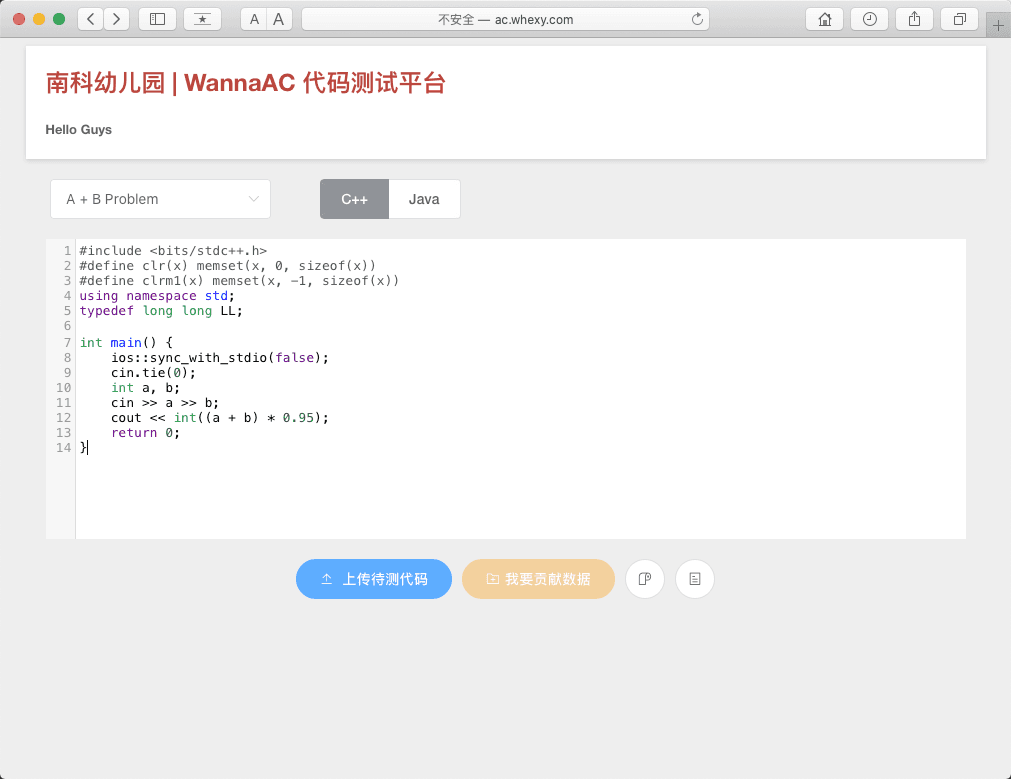
The website is very intuitive to use: select the problem, choose the language, paste the code, and upload for testing. After testing is complete, you get feedback. Click to copy data for easy adjustment.
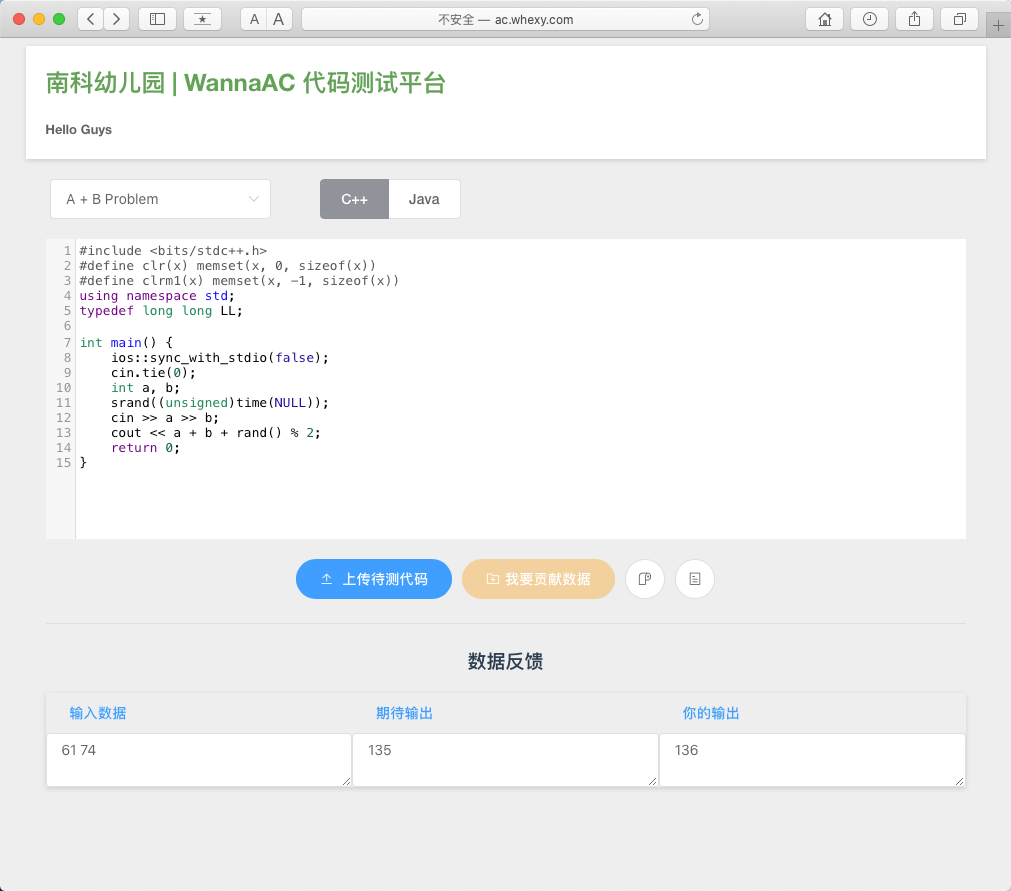
After you submit your program, the platform will run the data generator, standard code, and your code in the background. It compares the running results of the code to generate feedback. This is not an OJ system. Since data is randomly generated each time for testing, you might get different results each time.

This way, Student A's problem is solved. He just needs to paste his Java code here to get some data where his code fails. By analyzing this data, he can find the problems in his code.

Unlike Student A, Student B passed many random data tests, only failing to consider some extreme cases thoroughly. Due to server performance considerations, only 20 sets of random data are tested per submission, which is far from enough. The platform adopts a new approach.

We hypothesize that data that causes others to fail is more likely to make you fail too. If a program fails on randomly generated data, this set of data will be added to the "important data set". Before the 20 random tests, the testing platform will first test whether your program can pass the important data set.

As the number of submissions increases, the important data set becomes more and more reliable.

Additionally, you can contribute extreme data you construct through the "I want to contribute data" function. Contributing data requires you to submit both input and output. The platform's standard code will review it, and if the running result matches the output you provided, this set of data will also be directly added to the important data set. Through this function, we hope the test data becomes more comprehensive and rich.

© LICENSED UNDER CC BY-NC-SA 4.0