





Listen to this post:
It’s the nature of business that the eulogy for a chief executive doesn’t happen when they die, but when they retire, or, in the case of Apple CEO Tim Cook, announce that they will step up to the role of Executive Chairman on September 1. The one morbid exception is when a CEO dies on the job — or quits because they are dying — and the truth of the matter is that that is where any honest recounting of Cook’s incredibly successful tenure as Apple CEO, particularly from a financial perspective, has to begin.
The numbers, to be clear, are extraordinary. Cook became CEO of Apple on August 24, 2011, and in the intervening 15 years revenue has increased 303%, profit 354%, and the value of Apple has gone from $297 billion to $4 trillion, a staggering 1,251% increase.
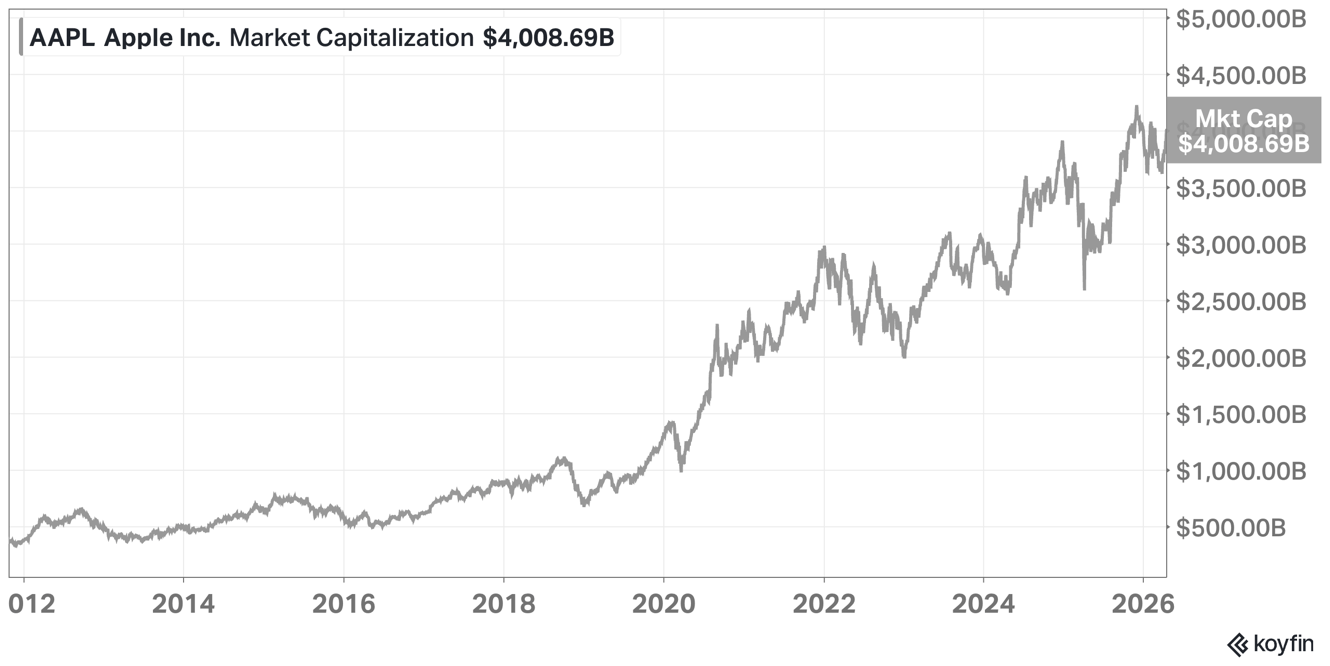
The reason for Cook’s accession in 2011 became clear a mere six weeks later, when Steve Jobs passed away from cancer on October 5, 2011. Jobs’ death isn’t the reason Cook was chosen — Cook had already served as interim CEO while Jobs underwent treatment in 2009 — but I think the timing played a major role in making Cook arguably the greatest non-founder CEO of all time.
Peter Thiel introduced the concept of Zero To One thusly:
When we think about the future, we hope for a future of progress. That progress can take one of two forms. Horizontal or extensive progress means copying things that work — going from 1 to n. Horizontal progress is easy to imagine because we already know what it looks like. Vertical or intensive progress means doing new things — going from 0 to 1. Vertical progress is harder to imagine because it requires doing something nobody else has ever done. If you take one typewriter and build 100, you have made horizontal progress. If you have a typewriter and build a word processor, you have made vertical progress.
Steve Jobs made 0 to 1 products, as he reminded the audience in the introduction to his most famous keynote:
Every once in a while, a revolutionary product comes along that changes everything. First of all, one’s very fortunate if one gets to work on one of these in your career. Apple’s been very fortunate: it’s been able to introduce a few of these into the world.
In 1984, we introduced the Macintosh. It didn’t just change Apple, it changed the whole computer industry. In 2001, we introduced the first iPod. It didn’t just change the way we all listen to music, it changed the entire music industry.
Well, today we’re introducing three revolutionary products of this class. The first one: a widescreen iPod with touch controls. The second: a revolutionary mobile phone. And the third is a breakthrough Internet communications device. Three things…are you getting it? These are not three separate devices. This is one device, and we are calling it iPhone.
Steve Jobs would, three years later, also introduce the iPad, which makes four distinct product categories if you’re counting. Perhaps the most important 0 to 1 product Jobs created, however, was Apple itself, which raises the question: what makes Apple Apple?
“What Makes Apple Apple” isn’t a new question; it was the central question of Apple University, the internal training program the company launched in 2008. Apple University was hailed on the outside as a Steve Jobs creation, but while I’m sure he green lit the concept, it was clear to me as an intern on the Apple University team in 2010, that the program’s driving force was Tim Cook.
The core of the program, at least when I was there, was what became known as The Cook Doctrine:
We believe that we’re on the face of the Earth to make great products, and that’s not changing.
We’re constantly focusing on innovating.
We believe in the simple, not the complex.
We believe that we need to own and control the primary technologies behind the products we make, and participate only in markets where we can make a significant contribution.
We believe in saying no to thousands of projects so that we can really focus on the few that are truly important and meaningful to us.
We believe in deep collaboration and cross-pollination of our groups, which allow us to innovate in a way that others cannot.
And frankly, we don’t settle for anything less than excellence in every group in the company, and we have the self-honesty to admit when we’re wrong and the courage to change.
And I think, regardless of who is in what job, those values are so embedded in this company that Apple will do extremely well.
Cook explained this on Apple’s January 2009 earnings call, during Jobs’ first leave of absence, in response to a question about how Apple would fare without its founder. It’s a brilliant statement, but it is — as the last paragraph makes clear — ultimately about maintaining, nurturing, and growing what Jobs built.
That is why I started this Article by highlighting the timing of Cook’s ascent to the CEO role. The challenge for CEOs following iconic founders is that the person who took the company from 0 to 1 usually sticks around for 2, 3, 4, etc.; by the time they step down the only way forward is often down. Jobs, however, by virtue of leaving the world too soon, left Apple only a few years after its most important 0 to 1 product ever, meaning it was Cook who was in charge of growing and expanding Apple’s most revolutionary device yet.
Cook, to be clear, managed this brilliantly. Under his watch the iPhone not only got better every year, but expanded its market to every carrier in basically every country, and expanded the line from one model in two colors to five models in a plethora of colors sold at the scale of hundreds of millions of units a year.
Cook was, without question, an operational genius. Moreover, this was clearly the case even before he scaled the iPhone to unimaginable scale. When Cook joined Apple in 1998 the company’s operations — centered on Apple’s own factories and warehouses — were a massive drag on the company; Cook methodically shut them down and shifted Apple’s manufacturing base to China, creating a just-in-time supply chain that year-after-year coordinated a worldwide network of suppliers to deliver Apple’s ever-expanding product line to customers’ doorsteps and a fleet of beautiful and brand-expanding stores. There was not, under Cook’s leadership, a single significant product issue or recall.
Cook also oversaw the introduction of major new products, most notably AirPods and Apple Watch; the “Wearables, Home, and Accessories” category delivered $35.4 billion in revenue last year, which would rank 128 on the Fortune 500. Still, both products are derivative of the iPhone; Cook’s signature 0 to 1 product, the Apple Vision Pro, is more of a 0.5.
Cook’s more momentous contribution to Apple’s top line was the elevation of Services. The Google search deal actually originated in 2002 with an agreement to make Google the default search service for Safari on the Mac, and was extended to the iPhone in 2007; Google’s motivation was to ensure that Apple never competed for their core business, and Cook was happy to take an ever increasing amount of pure profit.
The App Store also predated Cook; Steve Jobs said during the App Store’s introduction that “we keep 30 [percent] to pay for running the App Store”, and called it “the best deal going to distribute applications to mobile platforms”. It’s important to note that, in 2008, this was true! The App Store really was a great deal.
Three years later, in a July 28, 2011 email — less than a month before Cook officially became CEO — Phil Schiller wondered if Apple should lower its take once they were making $1 billion a year in profit from the App Store. John Gruber, writing on Daring Fireball in 2021, wondered what might have been had Cook followed Schiller’s advice:
In my imagination, a world where Apple had used Phil Schiller’s memo above as a game plan for the App Store over the last decade is a better place for everyone today: developers for sure, but also users, and, yes, Apple itself. I’ve often said that Apple’s priorities are consistent: Apple’s own needs first, users’ second, developers’ third. Apple, for obvious reasons, does not like to talk about the Apple-first part of those priorities, but Cook made explicit during his testimony during the Epic trial that when user and developer needs conflict, Apple sides with users. (Hence App Tracking Transparency, for example.)
These priorities are as they should be. I’m not complaining about their order. But putting developer needs third doesn’t mean they should be neglected or overlooked. A large base of developers who are experts on developing and designing for Apple’s proprietary platforms is an incredible asset. Making those developers happy — happy enough to keep them wanting to work and focus on Apple’s platforms — is good for Apple itself.
I want to agree with Gruber — I was criticizing Apple’s App Store policies within weeks of starting Stratechery, years before it became a major issue — but from a shareholder perspective, i.e. Cook’s ultimate bosses, it’s hard to argue with Apple’s uncompromising approach. Last year Apple Services generated 26% of Apple’s revenue and 41% of the company’s profit; more importantly, Services continues to grow year-over-year, even as iPhone growth has slowed from the go-go years.
Another way to frame the Services question is to say that Gruber is concerned about the long-term importance of something that is somewhat ineffable — developer willingness and desire to support Apple’s platforms — which is, at least in Gruber’s mind, essential for Apple’s long-term health. Cook, in this critique, prioritized Apple’s financial results and shareholder returns over what was best for Apple in the long run.
This isn’t the only part of Apple’s business where this critique has validity. Cook’s greatest triumph was, as I noted above, completely overhauling and subsequently scaling Apple’s operations, which first and foremost meant developing a heavy dependence on China. This dependence was not inevitable: Patrick McGee explained in Apple In China, which I consider one of the all-time great books about the tech industry, how Apple made China into the manufacturing behemoth it became. McGee added in a Stratechery Interview:
Let me just refer back to something that you wrote I think a few months ago when you called the last 20, 25 years, like the golden age for companies like Apple and Silicon Valley focused on software and Chinese taking care of the hardware manufacturing. That is a perfect partnership, and if we were living in a simulation and it ended tomorrow, you’d give props for Apple to taking advantage of the situation better than anybody else.
The problem is we’re probably not living in the simulation and things go on, and I’ve got this rather disquieting conclusion where, look, Apple’s still really good probably, they’re not as good as they once were under Jony Ive, but they’re still good at industrial design and product design, but they don’t do any operations in our own country. That’s all dependent on China. You’ve called this in fact the biggest violation of the Tim Cook doctrine to own and control your destiny, but the Chinese aren’t just doing the operations anymore, they also have industrial design, product design, manufacturing design.
It really is ironic: Tim Cook built what is arguably Apple’s most important technology — its ability to build the world’s best personal computer products at astronomical scale — and did so in a way that leaves Apple more vulnerable than anyone to the deteriorating relationship between the United States and China. China was certainly good for the bottom line, but was it good for Apple’s long-run sustainability?
This same critique — of favoring a financially optimal strategy over long-term sustainability — may also one day be levied on the biggest question Cook leaves his successor: what impact will AI have on Apple? Apple has, to date, avoided spending hundreds of billions of dollars on the AI buildout, and there is one potential future where the company profits from AI by selling the devices everyone uses to access commoditized models; there is another future where AI becomes the means by which Apple’s 50 Years of Integration is finally disrupted by companies that actually invested in the technology of the future.
If Tim Cook’s timing was fortunate in terms of when in Apple’s lifecycle he took the reins, then I would call his timing in terms of when in Apple’s lifecycle he is stepping down as being prudent, both for his legacy and for Apple’s future.
Apple is, in terms of its traditional business model, in a better place than it has ever been. The iPhone line is fantastic, and selling at a record pace; the Mac, meanwhile, is poised to massively expand its market share as Apple Silicon — another Jobs initiative, appropriately invested in and nurtured by Cook — makes the Mac the computer of choice for both the high end (thanks to Apple Silicon’s performance and unified memory architecture) and the low end (the iPhone chip-based MacBook Neo significantly expands Apple’s addressable market). Meanwhile, the Services business continues to grow. Cook is stepping down after Apple’s best-ever quarter, a milestone that very much captures his tenure, for better and for worse.
At the same time, the AI question looms — and it suggests that Something Is Rotten in the State of Cupertino. The new Siri still hasn’t launched, and when it does, it will be with Google’s technology at the core. That was, as I wrote in an Update, a momentous decision for Apple’s future:
Apple’s plans are a bit like the alcoholic who admits that they have a drinking problem, but promises to limit their intake to social occasions. Namely, how exactly does Apple plan on replacing Gemini with its own models when (1) Google has more talent, (2) Google spends far more on infrastructure, and (3) Gemini will be continually increasing from the current level, where it is far ahead of Apple’s efforts? Moreover, there is now a new factor working against Apple: if this white-labeling effort works, then the bar for “good enough” will be much higher than it is currently. Will Apple, after all of the trouble they are going through to fix Siri, actually be willing to tear out a model that works so that they can once again roll their own solution, particularly when that solution hasn’t faced the market pressure of actually working, while Gemini has?
In short, I think Apple has made a good decision here for short term reasons, but I don’t think it’s a short-term decision: I strongly suspect that Apple, whether it has admitted it to itself or not, has just committed itself to depending on 3rd-parties for AI for the long run.
As I noted above and in that Update, this decision may work out; if it doesn’t, however, the sting will be felt long after Cook is gone. To that end, I certainly hope that John Ternus, the new CEO, was heavily involved in the decision; truthfully, he should have made it.
To that end, it’s right that Cook is stepping down now. Jobs might have been responsible for taking Apple from 0 to 1, but it was Cook that took Apple from 1 to $436 billion in revenue and $118 billion in profit last year. It’s a testament to his capabilities and execution that Apple didn’t suffer any sort of post-founder hangover; only time will tell if, along the way, Cook created the conditions for a crash out, by virtue of he himself forgetting The Cook Doctrine and what makes Apple Apple.
此内容由惯性聚合(RSS阅读器)自动聚合整理,仅供阅读参考。 原文来自 — 版权归原作者所有。