





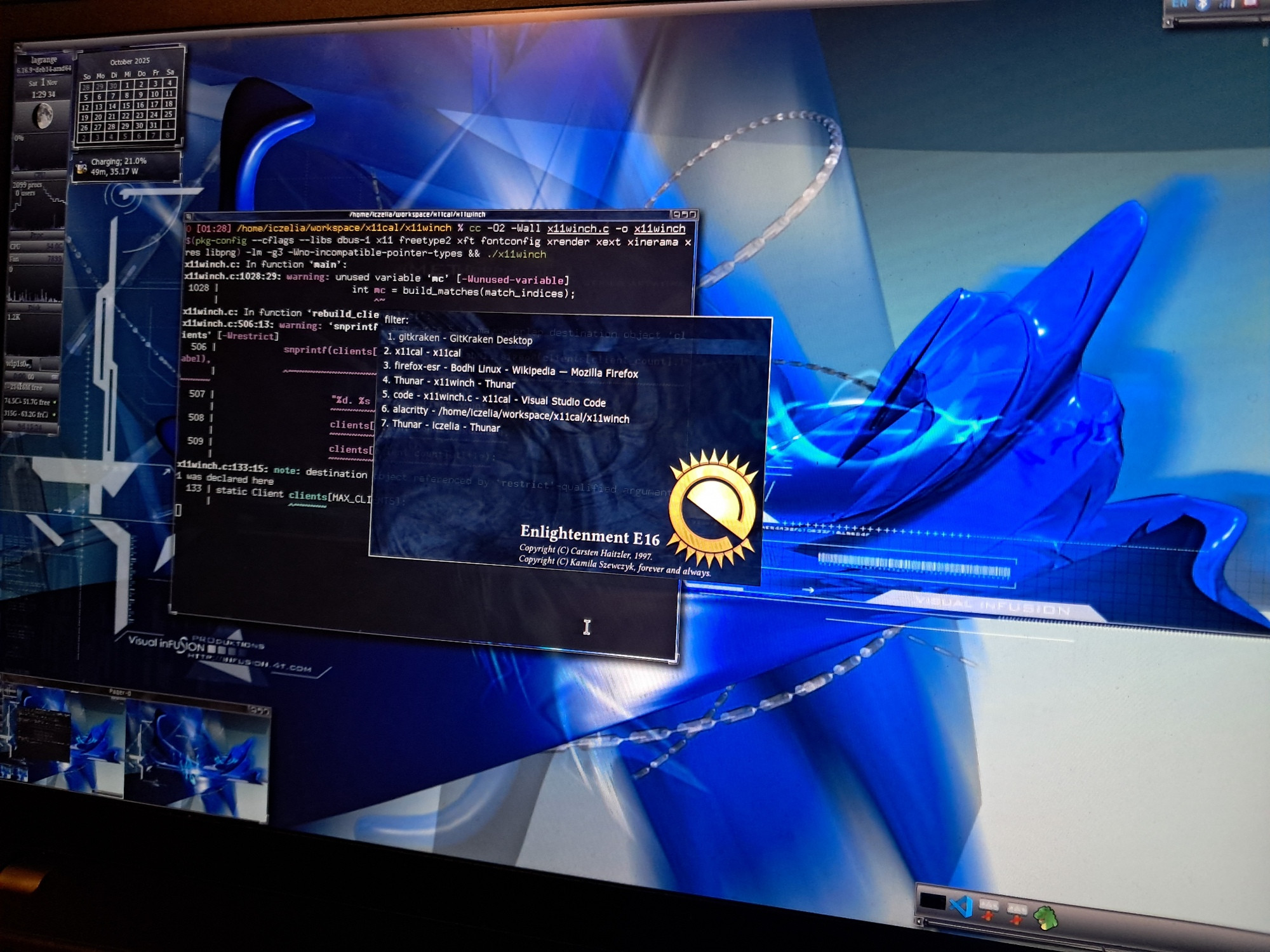
The editor in chief of this blog was born in 2004. She uses the 1997 window manager, Enlightenment E16, daily. In this article, I describe the process of fixing a show-stopping, rare bug that dates back to 2006 in the codebase. Surprisingly, the issue has roots in a faulty implementation of Newton's algorithm.
Some may find it weird, but I actually greatly enjoy using Enlightenment E16 as my window manager. It's themable, hackable, lightweight (24MB peak RSS!), amenable to heavy keyboard users like myself, and most importantly - it looks goregous:
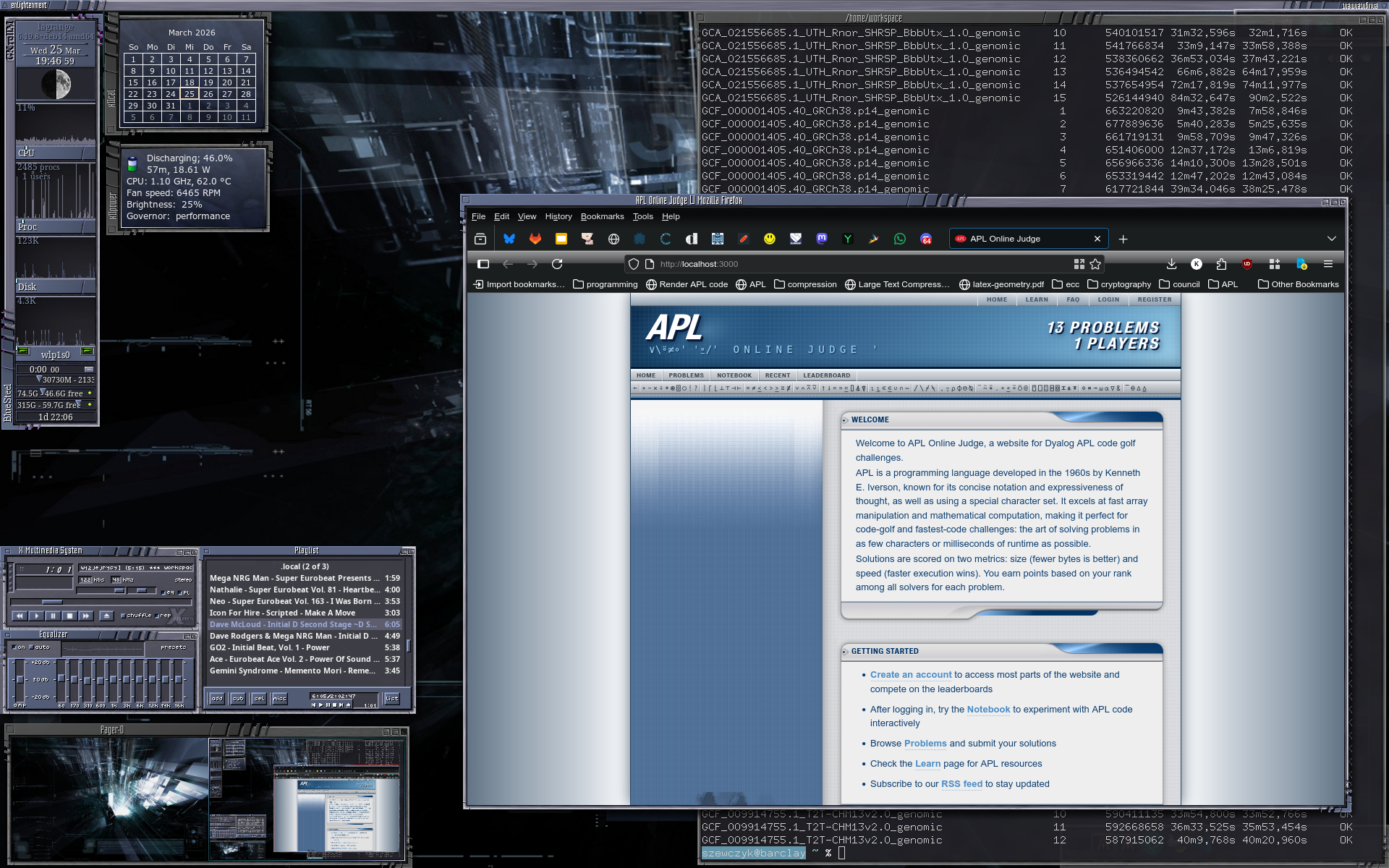
E16 first came to be in 1997, thanks to Carsten Haitzler, and it has been in development ever since. Most have moved to E17 and other newer versions; a community of hardcore enthusiasts still uses E16, and I am one of them. The codebase is quite old, and it has accumulated a lot of technical debt over the years.
Bugs always come out of the woodworks in a time scramble and this one likely sensed a prime opportunity: I was doing a lot of last-minute work on a couple of slides for a course that I will be teaching. I had a couple of PDFs with lecture slides and an exercise sheet typeset in LaTeX. At some point, I opened one of them in Atril, and the entire desktop froze.
I killed the X11 session from a TTY. Sadly, the hang was deterministic: every time I opened that specific PDF.
Attaching gdb to the live process showed every sample parked in imlib2's font cache, under the same e16 caller:
#0  __strcmp_evex ()
#1  __imlib_hash_find (hash=0x55bc9c111420, key="\001\001\001\001\001")     object.c:172
#2  __imlib_font_cache_glyph_get (fn=..., index=0)                          font_draw.c:30
#3  __imlib_font_get_next_glyph (... utf8="Kickoff.pdf — Introduction...")  font_main.c:218
#4  __imlib_font_query_advance (...)                                        font_query.c:89
#5  imlib_get_text_advance (...)                                            api_text.c:231
#6  Efont_extents (...)                                                     text_ift.c:87
#7  _ift_TextSize (...)                                                     text_ift.c:156
#8  TextstateTextFitMB (ts=..., textwidth_limit=291)                        text.c:350
#9  TextstateTextFit (...)                                                  text.c:559
#10 TextstateTextDraw (... text="Kickoff.pdf — Introduction...")            text.c:638
#11 ITApply (...)                                                           iclass.c:930
#12 ITApply (...)                                                           iclass.c:884
#13 _BorderWinpartITclassApply (ewin=..., i=2, force=1)                     borders.c:179
#14 EwinBorderUpdateInfo (ewin=...)                                         borders.c:300
#15 EwinChangesProcess (...)                                                ewins.c:2141
#16 EwinEventPropertyNotify (ewin=..., ev=...)                              ewins.c:1438
...
#21 main (...)                                                              main.c:320
Re-attaching repeatedly showed the program was not deadlocked. __imlib_font_cache_glyph_get was being called with different glyph indices (0, 20, 73, 81, 82, 87, 88, ...) each time. So the inner font-measurement was making progress; the loop was somewhere outside it.
After some fudging, I found out that Frame 8 (TextstateTextFitMB at text.c:350) was the constant. That's a ts->ops->TextSize(ts, new_line, 0, pw, &hh, &ascent); call inside the middle-ellipsis truncation loop that tries to fit a string into textwidth_limit = 291 pixels by nuking characters out of the middle - used when rendering the title of the PDF, that happened to also be the title of the window, too long for the decoration to contain.
Dumping the frame's locals across many samples revealed a clean two-state oscillation:
nuke_count = 8   nc2 = 36   wc_len = 81   len_n = 76
nuke_count = 11  nc2 = 35   wc_len = 81   len_n = 73
nuke_count = 8   nc2 = 36   wc_len = 81   len_n = 76
...
I always saw two trial truncations, forever, same text each time.
We start at the lowest common denominator - there is likely a logic bug here.
static void
TextstateTextFitMB(TextState *ts, char **ptext, int *pw, int textwidth_limit)
{
    char           *text = *ptext;
    int             width, hh, ascent, cw;
    char           *new_line;
    int             nuke_count, nc2;
    int             len, len_mb;
    wchar_t        *wc_line = NULL;
    int             wc_len, len_n;

    if (EwcOpen(ts->need_utf8 || Mode.locale.utf8_int))
        return;

    len = strlen(text);
    wc_len = EwcStrToWcs(text, len, NULL, 0);
    if (wc_len <= 1)
        goto done;

    wc_line = EMALLOC(wchar_t, wc_len + 1);
    if (!wc_line)
        goto done;

    if (EwcStrToWcs(text, len, wc_line, wc_len) <= 0)
        goto done;

    new_line = EMALLOC(char, len + 10);
    if (!new_line)
        goto done;

    width = *pw;
    nuke_count = ((width - textwidth_limit) * wc_len) / width;
    if (nuke_count < 2)
        nuke_count = 2;

    for (;;)
    {
        if (nuke_count >= wc_len - 1)
        {
            len_mb = EwcWcsToStr(wc_line, 1, new_line, MB_CUR_MAX);
            if (len_mb < 0)
                len_mb = 1;

            strcpy(new_line + len_mb, "...");
            break;
        }

        nc2 = (wc_len - nuke_count) / 2;

        len_mb = EwcWcsToStr(wc_line, nc2, new_line, len + 10);
        memcpy(new_line + len_mb, "...", 3);
        len_mb += 3;
        len_mb += EwcWcsToStr(wc_line + nc2 + nuke_count,
                              wc_len - nc2 - nuke_count,
                              new_line + len_mb, len + 10 - len_mb);
        new_line[len_mb] = '\0';
        len_n = wc_len - nuke_count + 3;

        ts->ops->TextSize(ts, new_line, 0, pw, &hh, &ascent);

        width = *pw;
        nc2 = textwidth_limit - width;
        cw = width / len_n;

        if (nc2 >= 0 && nc2 < 3 * cw)
            break;
        if (nc2 > 0)
            nuke_count -= (nc2 <= 2 * cw) ? 1 : (nc2 + cw / 2) / cw;
        else
            nuke_count += (-nc2 <= 2 * cw) ? 1 : (-nc2 + cw / 2) / cw;
    }

    Efree(text);
    *ptext = new_line;
  done:
    Efree(wc_line);
    EwcClose();
}
The loop is of paticular interest to us. Abridged:
for (;;)
{
    if (nuke_count >= wc_len - 1) { /* degenerate: single char + "..." */ break; }

    nc2 = (wc_len - nuke_count) / 2;
    /* build new_line = first nc2 wchars + "..." + tail wchars */
    len_n = wc_len - nuke_count + 3;

    ts->ops->TextSize(ts, new_line, 0, pw, &hh, &ascent);
    width = *pw;
    nc2 = textwidth_limit - width;
    cw = width / len_n;

    if (nc2 >= 0 && nc2 < 3 * cw)
        break;                                    /* fit, within 3 chars */

    if (nc2 > 0)                                  /* room to spare */
        nuke_count -= (nc2 <= 2 * cw) ? 1 : (nc2 + cw / 2) / cw;
    else                                          /* too wide */
        nuke_count += (-nc2 <= 2 * cw) ? 1 : (-nc2 + cw / 2) / cw;
}
This is a Newton-style search that estimates how many more/fewer wchars to nuke based on how far off width is from textwidth_limit, using cw = width / len_n as the derivative (average pixels per char). Seeing clever and crafty solutions like this is delightful. But to anyone who has ever implemented Newton's method, this code screams something obvious: "Where is your iteration limit?!". Newton's method can fail to converge, and it can also overshoot and diverge - all depending on the starting point, the nature of the function, and the quality of the derivative estimate. In this case, the method was oscillating between two points forever.
To make matters worse, the exit tolerance ( ) is tight - accept only
 nc2 between [0, 3*cw). This also explains why ordinary short titles never tripped it - on shorter strings or with wider cw, the <= 2*cw branch kicks in and the step becomes 1, which converges.
I have made three defensive changes, applied symmetrically to both the multi-byte and ASCII loops:
nc2 >= 0 we just accept it; otherwise bump nuke_count by 1 and retry. This guarantees termination in bounded time and picks the first fitting trial once the Newton step has been shown to oscillate.nuke_count at 1 inside the loop, so a negative correction can never produce the degenerate tail-overlaps-head string.cw at 1, so a pathological zero-width measurement cannot turn the step formulas into a divide-by-zero.--- a/src/text.c
+++ b/src/text.c
@@ -255,7 +255,7 @@ TextstateTextFit1(TextState *ts, char **ptext, int *pw, int textwidth_limit)
if (nuke_count < 2)
nuke_count = 2;
- for (;;)
+ for (int iter = 0;; iter++)
{
if (nuke_count >= len - 1)
{
@@ -263,6 +263,8 @@ TextstateTextFit1(TextState *ts, char **ptext, int *pw, int textwidth_limit)
memcpy(new_line + 1, "...", 4);
break;
}
+ if (nuke_count < 1)
+ nuke_count = 1;
nc2 = (len - nuke_count) / 2;
@@ -276,9 +278,18 @@ TextstateTextFit1(TextState *ts, char **ptext, int *pw, int textwidth_limit)
width = *pw;
nc2 = textwidth_limit - width;
cw = width / len_n;
+ if (cw < 1)
+ cw = 1;
if (nc2 >= 0 && nc2 < 3 * cw)
break;
+ if (iter >= 32)
+ {
+ if (nc2 >= 0)
+ break;
+ nuke_count++;
+ continue;
+ }
if (nc2 > 0)
nuke_count -= (nc2 <= 2 * cw) ? 1 : (nc2 + cw / 2) / cw;
else
@@ -335,7 +346,7 @@ TextstateTextFitMB(TextState *ts, char **ptext, int *pw, int textwidth_limit)
if (nuke_count < 2)
nuke_count = 2;
- for (;;)
+ for (int iter = 0;; iter++)
{
if (nuke_count >= wc_len - 1)
{
@@ -346,6 +357,8 @@ TextstateTextFitMB(TextState *ts, char **ptext, int *pw, int textwidth_limit)
strcpy(new_line + len_mb, "...");
break;
}
+ if (nuke_count < 1)
+ nuke_count = 1;
nc2 = (wc_len - nuke_count) / 2;
@@ -362,9 +375,18 @@ TextstateTextFitMB(TextState *ts, char **ptext, int *pw, int textwidth_limit)
width = *pw;
nc2 = textwidth_limit - width;
cw = width / len_n;
+ if (cw < 1)
+ cw = 1;
if (nc2 >= 0 && nc2 < 3 * cw)
break;
+ if (iter >= 32)
+ {
+ if (nc2 >= 0)
+ break;
+ nuke_count++;
+ continue;
+ }
if (nc2 > 0)
nuke_count -= (nc2 <= 2 * cw) ? 1 : (nc2 + cw / 2) / cw;
elseAny window whose WM_NAME is long enough that the middle-ellipsis search falls into the overshoot regime reproduces this. The one in the wild:
Kickoff.pdf — Introduction to Information Theory Session 1: kickoff & first topic(81 wide chars including the em-dash, a ~291px border title slot, font roughly 3px/char average.)
Newer is not necessarily better. Fresh software carries brand new bugs for you and the maintainers to enjoy, now empowered by the barrier to contribute being much lower thanks to Large Language Models. But sometimes stable maintainers do absurdly dumb things too:
On the 3rd of April 2026, I remarked that fgetxattr(54321, NULL, NULL, 0); apparently crashes yesterday's 6.6.y lts kernel. A call that should just return -1 and set errno to EINVAL because the path is invalid, but a stable maintainer patched it out wholesale.
Then, the awful commit was reverted, on the 8th of April. No CVE has been assigned despite an obvious Denial-Of-Service attack vector being introduced.
If this is what happens by mistake on a daily basis[1], what happens when the supply chain is compromised and a malicious actor intentionally introduces a bug? The mind boggles. Back when the XZ backdoor was introduced, I was scrolling through news on my Debian Sid laptop with some code compiling in the background. I learned of a backdoor in XZ Utils, potentially introduced by a state actor in version v5.6.0. Thinking back to the fact that I do, indeed, run a bleeding edge distro and update often, I immediately ran apt list --upgradable | grep xz-utils. Sure enough, the stains on my laptop from the coffee I spat out through the nose[2] were pretty tough to deal with.
On the other hand, the amount of bugs in private checkouts of crusty old software maintained by competent developers will monotonically decrease. If I need a feature, I will implement it. If there is a problem, I only have myself to blame. There is no supply chain to compromise, and if a determined, targetted state actor wants sudo privileges on my machine - they will find a way to get it anyway. Oh, also, eI probably wasn't going to use whatever features that my XFWM updates (the WM I used to use before!) were going to bring.
此内容由惯性聚合(RSS阅读器)自动聚合整理,仅供阅读参考。 原文来自 — 版权归原作者所有。