




惯性聚合 高效追踪和阅读你感兴趣的博客、新闻、科技资讯
阅读原文 在惯性聚合中打开

推荐订阅源

Forbes - Security
Forbes - Security
OSCHINA 社区最新新闻
OSCHINA 社区最新新闻
P
Palo Alto Networks Blog
Martin Fowler
Martin Fowler
T
Threatpost
D
Docker
S
Schneier on Security
M
MIT News - Artificial intelligence
G
Google Developers Blog
L
LINUX DO - 热门话题
J
Java Code Geeks
月光博客
月光博客
博客园 - 三生石上(FineUI控件)
IT之家
IT之家
博客园 - Franky
C
Cyber Attacks, Cyber Crime and Cyber Security
K
Kaspersky official blog
Google DeepMind News
N
News and Events Feed by Topic
V
Vulnerabilities – Threatpost
CTFtime.org: upcoming CTF events
人人都是产品经理
人人都是产品经理
Spread Privacy
Spread Privacy
T
Tailwind CSS Blog
爱范儿
爱范儿
阮一峰的网络日志
阮一峰的网络日志
U
Unit 42
C
CERT Recently Published Vulnerability Notes
The GitHub Blog
The GitHub Blog
Simon Willison's Weblog
NISL@THU
NISL@THU
MongoDB | Blog
MongoDB | Blog
Application and Cybersecurity Blog
H
Heimdal Security Blog
Recorded Future
Recorded Future
云风的 BLOG
云风的 BLOG
SecWiki News
SecWiki News
P
Privacy International News Feed
P
Proofpoint News Feed
O
OpenAI News
B
Blog
腾讯CDC
F
Full Disclosure
Apple Machine Learning Research
T
Tor Project blog
H
Hacker News: Front Page
Project Zero
Project Zero
Hugging Face - Blog
Hugging Face - Blog
C
Cisco Blogs
S
Security Affairs

Hacker News: Best

madhadron - The seven programming ur-languages GitHub - smol-machines/smolvm: Tool to build & run portable, lightweight, self-contained virtual machines. I Measured Claude 4.7's New Tokenizer. Here's What It Costs You. Introducing Claude Design by Anthropic Labs It Is Time to Ban the Sale of Precise Geolocation The creative software industry has declared war on Adobe Isaac Asimov: The Last Question Newly unsealed records reveal Amazon’s price-fixing tactics, California attorney general claims Clojure - Documentary Android CLI and skills: Build Android apps 3x faster using any agent Qwen3.6-35B-A3B on my laptop drew me a better pelican than Claude Opus 4.7 Codex for almost everything Introducing Claude Opus 4.7 Qwen Studio The Future of Everything is Lies, I Guess: Where Do We Go From Here? Virginia Bans Sale of Geolocation Data YouTube now lets you turn off Shorts Burgers | マクドナルド公式 ChatGPT for Excel Ask HN: Who is using OpenClaw? Live Nation illegally monopolized ticketing market, jury finds Google Broke Its Promise to Me. Now ICE Has My Data. Open Source Isn't Dead. The Future of Everything is Lies, I Guess: New Jobs Unexpected €54k billing spike in 13 hours: Firebase browser key without API restrictions used for Gemini requests IPv6 – Google Your Backpack Got Worse On Purpose Good sleep, good learning, good life Fixing a 20-year-old bug in Enlightenment E16. Does Gas Town 'steal' usage from users' LLM credits & paid services to improve itself? Tell HN: Fiverr left customer files public and searchable Cybersecurity Looks Like Proof of Work Now Getting the Flock out Release OpenSSL 4.0.0 · openssl/openssl Internet será irrespirable los días de fútbol y otros deportes. Telefónica extiende los bloqueos a Champions, tenis y golf. Automate work with routines - Claude Code Docs The Future of Everything is Lies, I Guess: Work Thousands of rare concert recordings are landing on the Internet Archive — listen now What is jj and why should I care? Backblaze has quietly stopped backing up your data Cal.com Goes Closed Source: Why AI Security Is Forcing Our Decision | Cal.com - Scheduling Software for Online Bookings Codex Hacked a Samsung TV The Future of Everything is Lies, I Guess: Safety GitHub - sterlingcrispin/nothing-ever-happens: Polymarket bot that buys "No" on all non-sports markets. For entertainment only, mostly a meme. Make tmux Pretty and Usable - Ham Vocke Microsoft isn't removing Copilot from Windows 11, it's just renaming it Servo is now available on crates.io - Servo aims to empower developers with a lightweight, high-performance alternative for embedding web technologies in applications. We May Be Living Through the Most Consequential Hundred Days in Cyber History, and Almost Nobody Has Noticed All elementary functions from a single binary operator 奈拜提耶市 Seven countries now generate 100% of their electricity from renewable energy Pro Max 5x Quota Exhausted in 1.5 Hours Despite Moderate Usage Tell HN: docker pull fails in spain due to football cloudflare block Bring Back Idiomatic Design @adlrocha - How the "AI Loser" may end up winning Apple update turns Czech mate for locked-out iPhone user Cache TTL silently regressed from 1h to 5m around early March 2026, causing quota and cost inflation The peril of laziness lost AI Will Be Met With Violence, and Nothing Good Will Come of It Center for Responsible, Decentralized Intelligence at Berkeley The disturbing white paper Red Hat is trying to erase from the internet – OSnews The Future of Everything is Lies, I Guess: Annoyances 447 Terabytes per Square Centimetre at Zero Retention Energy: Non-Volatile Memory at the Atomic Scale on Fluorographane Show HN: Pardonned.com – A searchable database of US Pardons 20 Years on AWS and Never Not My Job Artemis II crew splashes down near San Diego after historic moon mission Molotov Cocktail Is Hurled at Home of Sam Altman, OpenAI’s CEO France to ditch Windows for Linux to reduce reliance on US tech On filing the corners off my MacBooks Installing every* Firefox extension Chimpanzees in Uganda locked in vicious 'civil war', say researchers linux/Documentation/process/coding-assistants.rst at master · torvalds/linux GitHub - callumlocke/json-formatter: Makes JSON easy to read. A compelling title that is cryptic enough to get you to take action on it GitHub - Keychron/Keychron-Keyboards-Hardware-Design: Industrial design files for Keychron keyboards and mice. 100+ models with CAD assets in STEP, DXF, DWG, and PDF. Source-available, with commercial use allowed for original compatible accessories within the license terms. [ANNOUNCE] WireGuardNT v0.11 and WireGuard for Windows v0.6 Released 1D-Chess Helium Is Hard to Replace FBI used iPhone notification data to retrieve deleted Signal messages Microsoft suspends dev accounts for high-profile open source projects Why you can’t trust Privacy & Security Serenity Forge (@serenityforge.com) A new trick brings stability to quantum operations OpenAI Backs Bill That Would Limit Liability for AI-Enabled Mass Deaths or Financial Disasters Netflix Prices Went Up Again – I Bought a DVD Player Instead DOJ Wants to Scrap Watergate-Era Rule That Makes Presidential Records Public EFF is Leaving X How NASA built Artemis II’s fault-tolerant computer Meta removes ads for social media addiction litigation How Pizza Tycoon simulated traffic on a 25 MHz CPU Claude mixes up who said what, and that's not OK Reallocating $100/Month Claude Code spend to Zed and OpenRouter Help Keep Thunderbird Alive! Why Are Flock Employees Watching Our Children? The Pentagon Threatened Pope Leo XIV’s Ambassador With the Avignon Papacy Fragments: April 2 Native Instant Space Switching on MacOS Bitcoin miners are losing $19,000 on every BTC produced as difficulty drops 7.8% God sleeps in the minerals Apple Silicon and Virtual Machines: Beating the 2 VM Limit
www.space.com
https://www.space.com/author/tereza-pultarova · 2026-06-20 · via Hacker News: Best
Artist's illustration of a U.S. GPS satellite in orbit around Earth.
Artist's illustration of a U.S. GPS satellite, an increasingly frequent target for jamming, in orbit around Earth. (Image credit: Lockheed Martin and U.S. Space Force)

An experimental satellite has mapped the scale of GPS jamming across Europe and the Middle East from space for the first time.

The data surprised the team behind the project and indicated that satellites orbiting far from Earth aren't the only ones that experience degradation of their positioning, navigation and timing (PNT) signals, which could affect their performance and the safety of their operations.

The new measurements were made by Pulsar-0, the first satellite of the novel Pulsar navigation constellation developed by California-based Xona Space Systems. The experimental satellite orbits 310 miles (500 kilometers) above Earth, testing Xona's technology before the company begins deploying its navigation constellation of 300 spacecraft in low Earth orbit (LEO) later this year.

The purpose of the Pulsar constellation is to provide a more resilient PNT service compared to the United State's GPS network and other global navigation satellite systems (GNSS), such as Europe's Galileo or China's Beidou. The PNT signals distributed by GNSS satellites underpin many systems that our civilization relies on in everyday life, including the operation of power grids, finance operations and oil drilling.

But because GNSS satellites orbit quite far from Earth — at altitudes abve 12,000 miles (19,000 km) — the signal that ground-based receivers detect is weak and can be easily jammed.

GNSS jamming (the overpowering of GNSS signals with noise) and spoofing (which involves overriding the original signals with false ones carrying incorrect coordinates), have become almost a global emergency over the past five years.

For example, Russian jammers have been disrupting GNSS signals along Russia's western borders, officially to protect the country from Ukrainian drone attacks. Every month, this interference affects tens of thousands of flights that cruise over the region. The warring parties in the Middle East, too, use jamming and spoofing to deflect drone attacks and hide the positions of illegal ships at sea.
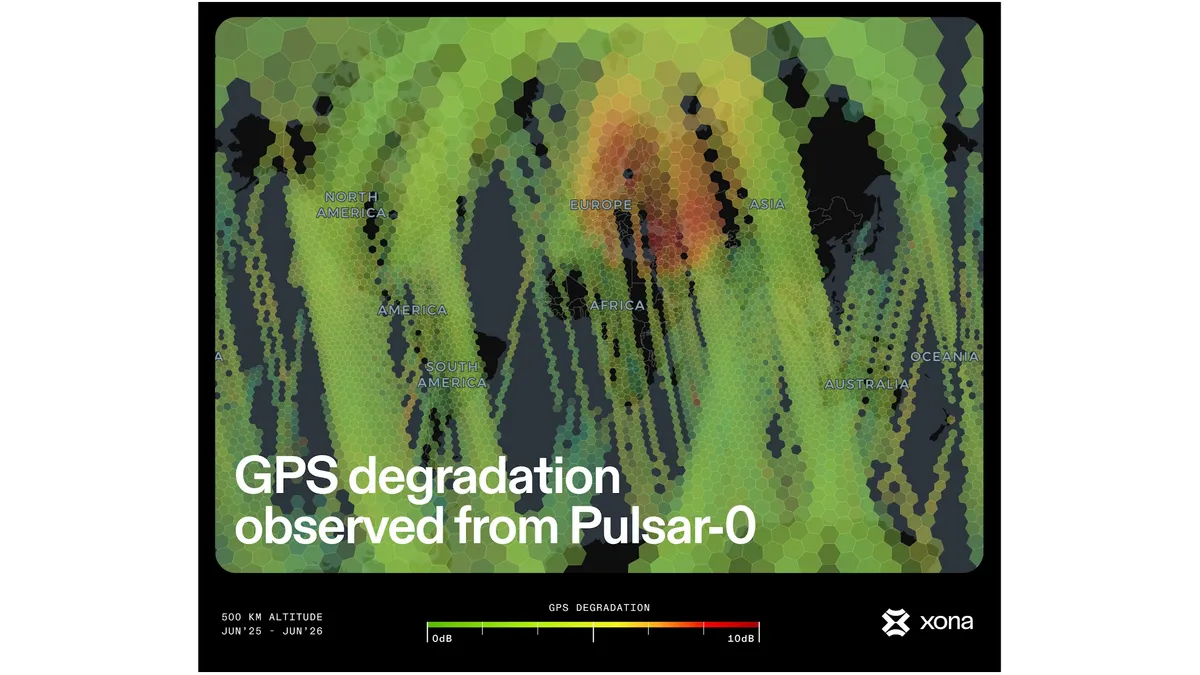
Pulsar-0 navigation satellite has mapped areas of GNSS jamming on Earth with unprecedented accuracy.

Xona's Pulsar-0 navigation satellite has mapped areas of GNSS jamming on Earth with unprecedented accuracy. (Image credit: Xona)

Xona's satellites will use a similar signal, but one that's 100 times stronger, to offer greater resiliency against such deliberate interference. But the Pulsar-0 spacecraft also carries a GPS receiver to make sure the two systems will be able to work together. When the Xona team first turned on that receiver a few months after Pulsar-0's launch last year, they were shocked by the scale of signal degradation the receiver was reporting above Europe and parts of the Middle East.

"When we fly over North America, for example, we see a beautiful signal all the time," Kaz Gunning, Xona's co-founder, told Space.com. "But as soon as we started doing any operations above Europe, we noticed that there was really something going on there. We thought we were going to see some jamming, but it's quite a bit more than we expected."

In the hardest-hit areas, the strength of the GPS signals at the satellite's altitude dropped from the regular 40 decibels to as little as 10 decibels.

Gunning says that, due to the altitude of the Pulsar-0 satellite, the map may not truthfully reflect where jamming is worst for users on the ground. The data, however, revealed that satellites in heavily used LEO suffer from some degree of GPS signal disruption all the way from France in the west to the borders of Pakistan in the east.

The measurements mean that satellites in LEO are not out of the reach of ground-based jammers, and that the PNT signals those satellites need to time-sync their operations and determine their position in space can't always be relied upon.

"You lose the GPS capability as soon as you pass over these regions," said Gunning. "That may be a problem for imaging satellites that are trying to position themselves to take images of a certain region. You can't do altitude determination, you can't do the positioning without the GPS signal. You can't even accurately point at your telecommand antenna on the ground. That's generally going to disrupt satellite operations."

Satellite constellations such as SpaceX Starlink also rely on GPS to avoid collisions with other spacecraft.
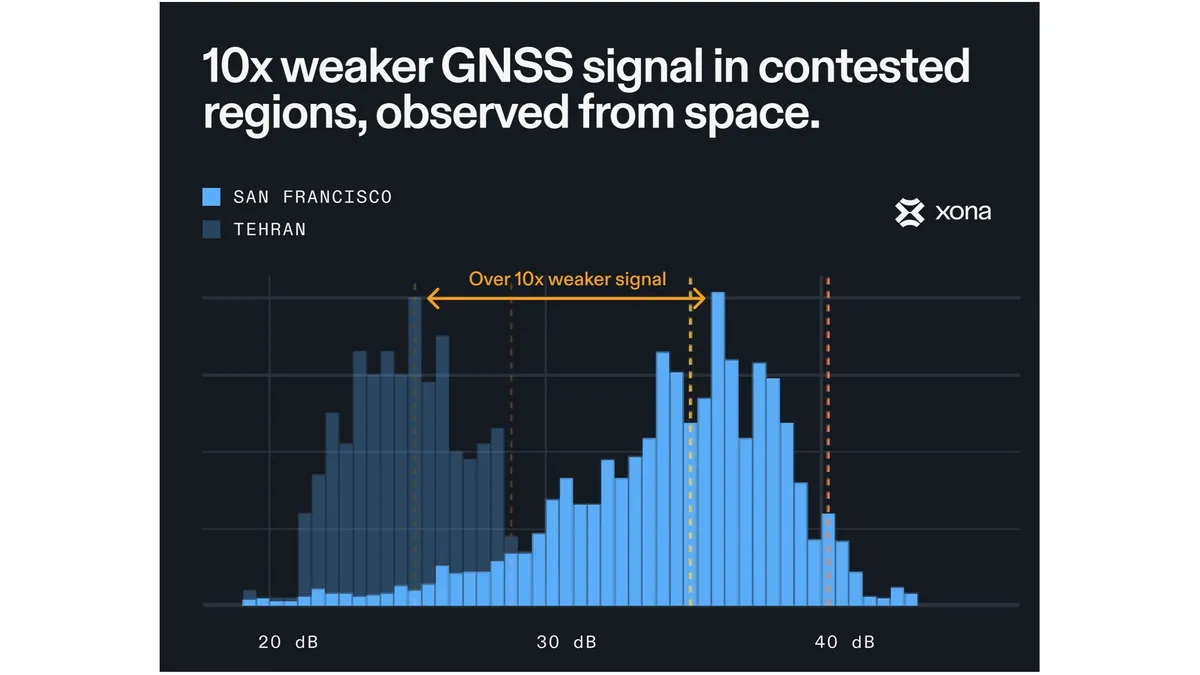
Pulsar-0 navigation satellite has mapped areas of GNSS jamming on Earth with unprecedented accuracy.

Pulsar-0 has found that GNSS signals are tampered with more extensively over regions in conflict. (Image credit: Xona)

It's not just deliberate jamming and spoofing that can wreak havoc with the precious PNT signal. Severe solar storms, too, can cause serious disruptions. The Gannon superstorm in May 2024, for example, distorted the GNSS signal so much that precision farming machinery in parts of the U.S. couldn't operate for days. Technologists are therefore racing to find backup solutions to transmit the PNT signal to everyone who needs it whenever GNSS is down.

Xona hopes that the Pulsar constellation, once up and running, will make the lives of those dependent on GNSS much easier.

Gunning says that, with the superior strength of the PNT signal transmitted by the company's planned LEO constellation, existing jammers would only be able to affect about 5% of the area they can currently disrupt.

"The effect of the jamming is going to be reduced to a smaller radius," Gunning said. "The degradation area will go down, and the full lock-out radius will also go down."

Xona plans to launch a batch of six satellites in October and begin ramping up production shortly thereafter. The company raised $170 million in a "Series C" funding round this March and hopes to begin delivering basic service in early 2027.

"We expect early customers in timekeeping to begin utilizing Pulsar at the end of this year with intermittent coverage," Max Eunice, Xona's head of communications, told Space.com. "Pulsar's capability will increase with every subsequent launch, unlocking new advantages for new customer segments as our constellation fills out."

Tereza is a London-based science and technology journalist, aspiring fiction writer and amateur gymnast. She worked as a reporter at the Engineering and Technology magazine, freelanced for a range of publications including Live Science, Space.com, Professional Engineering, Via Satellite and Space News and served as a maternity cover science editor at the European Space Agency.