




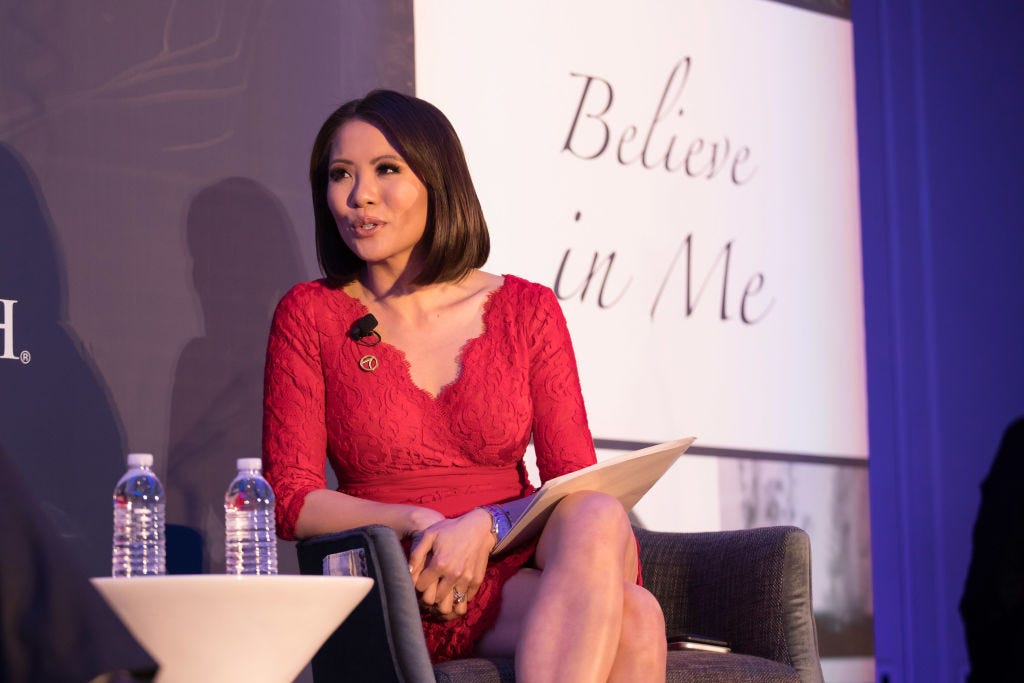
Over at X, Garry Tan, the president and CEO of the venture capital firm Y Combinator, put up a long post this week touting a new book by San Francisco TV reporter Dion Lim.
Lim’s book, called Amplified, was published by Third State Books, a company started by Tan’s wife, Stephanie Lim, to provide a voice for Asian-American authors. That’s a great idea, and much needed. I’m just not sure they should have made Lim’s book their first title.
Tan titled his post “Power Spoke to Truth. Truth Didn’t Flinch.” He portrays Lim as a heroic, crusading journalist who exposed crimes against Asian-Americans during and after the pandemic. He characterizes her as a brave truth-teller who took on progressive District Attorney Chesa Boudin, who she believed wasn’t sufficiently prosecuting those crimes.
I haven’t read Lim’s book, so I’m not in a position to comment on the bulk of Tan’s post. There were a lot of horrific, bigoted attacks on Asian-Americans at that time, along with a lot of ugly, racist rhetoric — from the White House on down.
But there was also a lot of misinformation about Boudin and his office, including false and misleading allegations that he had stopped prosecuting crimes like shoplifting, and often mistaken accusations that he freed specific people accused of brutal violence. Boudin critics also amplified incorrect or misleading crime statistics, and circulated sensationalistic essays about how San Francisco was dying or was a “failed city.”
The portion of Tan’s post that I can address is the part that pertains to me. And unfortunately, he gets a lot wrong. Here’s the excerpt:
In the summer of 2021, journalist Radley Balko emailed Dion asking who her sources were. A cardinal sin. On June 14, the Washington Post ran “The Bogus Backlash Against Progressive Prosecutors,” which accused Dion of pressuring victims’ families.
Through FOIA requests, the public later obtained 81 pages of texts between Kasie Lee, Boudin’s victim services head, and Balko. The files included a document titled “Dion Lim Misrepresentations.” The DA’s office, which should have been prosecuting the people attacking Asian Americans, was orchestrating a media hit on the journalist covering those attacks.
Dion’s two Signal sources went silent after the Post piece. “I woke up every morning with a feeling of dread,” she writes. “Oh God, what am I going to be accused of today?” Her management declined to issue a public statement of support. They took her off Boudin stories temporarily. One manager asked her to confirm a source’s account in front of them.
Veteran journalist Vic Lee told her the attack was “a badge of honor: how many journalists made elected leaders so scared they went on the offensive?”
The message from the DA’s office was clear. Stop covering these anti-Asian hate crimes, or your career is in jeopardy.
This is roughly similar to what I’ve seen in conservative outlets over the last few years. It’s wrong on the facts, and also implies that I and Boudin’s office engaged in some unethical collaboration to sabotage Lim’s career.
I wouldn’t normally comment on my communication with a source, but given that this is a persistent narrative, and that my text exchanges with Lee are already public, I’m going to explain what really happened.
In May 2021, I did get a voicemail from someone in Boudin’s office. I don’t recall specifically who that was. But I was eventually put in touch with Kasie Lee. Just to be clear, Lee and I had never previously corresponded, and we haven’t corresponded since I wrote the story, save for yesterday when, as a courtesy, she and another former Boudin staffer gave me permission to publish our text exchanges.
Why did they reach out to me? I don’t know, but if I had to guess, it was because I’d been writing about criminal justice for 15 years, I’m critical of the current system, and I had a platform at the Washington Post.
Lee and I exchanged a couple voicemails. She then texted me, and we set up a time to talk by phone. That’s when she told me that a carjacking story Lim had recently published, and which had gone viral, had gotten some basic facts wrong. Moreover, according to Lee, both the carjacking victim and a witness were upset by her story and by their experience with Lim. After that conversation, Lee texted me some documents and screenshots verifying what she had just told me.
I responded to Lee’s tip like I would any other. I interviewed the victim, who asked not to be named, and the witness, a man named Harry Mulholland. I fact-checked what I found. I then used Lim’s viral story as the hook for a broader piece about the backlash against Boudin and other progressive prosecutors.
Here are the relevant parts of the story I ultimately published at the Washington Post:
“I feel like I was played for a fool,” says Harry Mulholland. “Honestly. I felt a little violated.”
Mulholland is a genuine hero. Earlier this year, he witnessed three assailants attack and attempt to carjack a 75-year-old woman in the parking lot of a San Francisco Safeway. Mulholland intervened, punching out the back window of the car to scare off the attackers, who then fled the scene. One of them, a 16-year-old girl, was later arrested. The others have yet to be identified.
Mulholland says the “violation” came when Dion Lim, a reporter with local ABC affiliate KGO-TV, contacted him. She told him that according to “multiple high-level sources,” the office of San Francisco DA Chesa Boudin had dropped the charges against the juvenile assailant.
“I didn’t really want to comment. But the reporter called me out of the blue and then kept pushing me to say something,” he says. He finally relented, telling Lim, “I believe in restorative justice and I understand Chesa has a model but . . . his way of going about it is not working.”
Lim, who has written multiple articles critical of Boudin, also reached out to the victim’s son over text messaging. In those texts, which the victim shared with me, Lim was sharply critical of Boudin’s office, often using unusually pointed language for a journalist. Her texts also misstated other details about the attack and investigation. Like Mullholland, the victim says Lim persisted until she reluctantly provided a quote criticizing the district attorney.
Lim’s resulting article went viral, gaining more traction after right-wing agitator Andy Ngô amplified it on Twitter. The story resonated with Boudin’s critics, and with critics of the reformist prosecutor movement more generally. For them, it seemed to be a manifestation of everything wrong with “restorative justice.”
The problem is that Lim was wrong. The charges against the assailant were never dropped. Juvenile cases are sealed, so the DA’s office is barred by state law from discussing the case. But in phone interviews, both the victim and Mulholland tell me they were quickly informed by Boudin’s office that Lim’s story is inaccurate. The juvenile not only still faces charges, she has a court date this week . . .
. . . Mulholland says he was skeptical of Boudin’s policies before all of this, and he’s still skeptical now. But he says he’s also more skeptical of Boudin’s critics now, and he regrets commenting for Lim’s article. He’d also like to know how Lim got his name and number, since the police report from the incident was supposed to be sealed. “My understanding is that it could only have come from the police,” he says.
The victim herself, a British travel agent who has lived in the U.S. for more than 50 years, says she was a Boudin supporter before the attack, and she remains one now. “I’m not overly political, but the little I’ve read about him I’ve liked,” she says. “I always thought the criminal system here is un-just. I never liked the idea of locking kids up and throwing away the key.”
As for what should happen to her assailant, she says, “I was upset when the reporter told me the charges had been dropped because I had hoped the girl could be persuaded to give up the others. She wasn’t the ringleader. But other than that, I hope she gets counseling and community service. A lot of these kids have been damaged, hurt by the system. I don’t know the answer. I just hope she gets the help she needs.”
KGO eventually published a correction.
There’s some other context that’s pertinent to all of this. First, in their initial posts to social media, which also went viral, Lim and KGO included an image of the victim’s face, despite the fact that the victim did not want to be identified. Boudin’s office was furious about that, as was the victim.
Second, the San Francisco Police Department and the police union had been feuding with Boudin since the day he took office. Boudin’s staff suspected that the police department and union had been feeding what they believed to be false information and misleading narratives to friendly reporters like Lim.
To be clear, even if that’s true, I don’t begrudge Lim for following up on leads she may have received from SFPD. I get leads from government sources too, including in this case. But I don’t publish those leads or relay them to other sources without first verifying that they’re true.
Whoever told Lim that the charges against the teen girl had been dropped was wrong. Lim credulously repeated that false claim to a victim and witness, pressured them to give her a quote, and then published a story about their reaction. That story then went viral.
This put Boudin’s office in an ethical quandary. Juvenile cases are sealed. To refute Lim’s false claim that they had dropped the charges would require them to publicly comment on a juvenile case, which they couldn’t do.
But the office also had to balance that concern with another ethical obligation — to the victim and the witness. Both told the office they felt like they’d been burned. They had made public statements based on misinformation. And if SFPD had improperly leaked the story, the false claim about dropped charges, and their identities and contact information to Lim (the latter of which would also have been illegal), they wanted to know. It makes sense that she’d try to find an outlet for the victim and witness to be heard.
I ran with the story because I thought Lim’s viral narrative needed a corrective, and because it was a data point backing the allegation that SFPD was feeding misleading anti-Boudin stories to friendly journalists. As Mulholland told me, other than the DA’s office itself, there was no other way for Lim to have gotten his name.
In his X post, Tan writes that I emailed Lim “asking who her sources were.” I emailed her for comment — to get her side of the story. And because I planned to include a quote from Mulholland saying he was bothered that SFPD may have illegally given his contact information to Lim, yes, I had an obligation to ask her if that was true.
I did not expect Lim to tell me how she got Mulholland’s name, though frankly, if a confidential source intentionally lies to you or misleads you, you’re no longer ethically obligated to protect their identity.
I don’t think my story was unfair to Lim. I certainly didn’t try to end her career, as Tan suggests later in his post. The closest I came to personal criticism was writing that her texts to the victim and witness used “unusually pointed language for a journalist.” I don’t think that’s inaccurate. It’s also sentiment that both the witness and victim expressed to me. They felt like she had badgered them into giving her the quotes she wanted.
But you needn’t take my word for it. Since Lim’s texts to the victim and her son are also public, I’ve posted them below.
Just to clarify what you’re reading: The victim put her correspondence with Lim in a document and sent it to Boudin’s office, along with a few comments. After I talked to the victim, she sent the document to me as well. Lim’s texts to the victim and her son are in bold.


When I first saw Tan’s post, I was puzzled at how an open records request for my exchanges with Lee could have produced 81 pages of documents. So I pulled up my history of texts with Lee on my phone. I texted her six times between May 30 and June 7, 2021. She texted me 24 times, although even that oversells the exchange. Lee tended to break her sentences up into individual texts instead of putting everything in one message. If you were to print out the exchange, you could easily and legibly fit it onto a couple pages.
But here again, I won’t ask you to take my word for it. Because these texts are public now — and with Kasie Lee’s permission — here are screenshots of our entire exchange.


I obviously did eventually get in touch with the victim. Boudin’s critics have also claimed that his office violated the privacy of Mulholland and the victim by giving me their contact information. This is incorrect. Both reached out to Boudin’s office to say they wanted to correct the record, and both gave the office permission to provide their information to me. That isn’t just what Boudin’s office said. Mulholland and the witness also confirmed this to me.
The claim that there were 81 pages of texts between Lee and me makes it sound like we were engaged in some elaborate conspiracy that went on for months. I tried to click on Tan’s link to documents, but it brought me to a one-page document that appears to be in Portuguese. I’m guessing this is a cut-and-paste error on his part.
But I found another place where someone has posted all 81 pages. It’s here. Feel free to look them over.
As you’ll see, the vast majority of the 81 pages are emails between Lim and Boudin’s office. They don’t involve me at all. There are also multiple duplicates. My exchange with Lee makes up 13 of the 81 pages, and even that is only because the texts themselves have been blown up.
I also had a brief exchange with another of member of Boudin’s office which takes up two more pages. That exchange was with Boudin’s communications chief, Rachel Marshall, who sent me the “Dion Lim Misrepresentations” document that Tan mentions in his post. As the name suggests, that document is a list of stories in which Boudin’s office believes Lim relayed false information or slanted the truth. I didn’t rely on that document for my reporting. But in the interest of transparency, I’m posting it as well. You can read it here.
That report takes up nine pages. So in all, 24 of the 81 pages involve text exchanges between me and Boudin’s office, including the “Misrepresentations” document and the screenshots of Lim’s texts to the victim. The other 57 pages don’t have anything to do with me.
Why did the office’s response to the open records request include those 57 pages? I don’t know. I don’t have a copy of the original request. Perhaps it was broadly worded. Or perhaps the open records officer in Boudin’s office was engaging in some malicious compliance.
But the last two pages are also interesting. They consist of a letter Boudin’s office sent to Lim and her station about another incident in which a crime victim reached out to complain about Lim’s reporting. In a story about the carjacking of an elderly Asian man, Lim apparently published personal and potentially identifying information about the victim without his permission. He wanted to know how she got his name and phone number. According to the letter, Lim appears to have received the police report about the incident. Given that the perpetrator hadn’t been apprehended and the investigation was still ongoing, that report should have been sealed. The letter asked that Lim and KGO redact the victim’s personal information.
Tan concludes his post this way:
The old playbook says speak truth to power and hope someone listens. This book documents what actually happens: power speaks first, and it speaks louder, and it uses lawyers and political operatives and corporate settlement offers to make truth disappear.
But truth has the internet now. And a journalist who stands up for her community who would not be silenced.
This is a pretty distorted description of the power structure in San Francisco. Boudin is a former public defender who ran for DA because he thought the criminal justice system was unfair and destructive to marginalized people. From the day he was elected, he drew the ire of wealthy tech executives, legacy prosecutors from the previous DA’s office, real estate developers, the police department, and the police union.
He lasted two-and-a-half-years before he was removed by a $7 million recall campaign funded largely by a few large PACs whose main contributors were realtors, finance executives, venture capital firms, and tech executives (including Garry Tan). Seventy-five percent of donations to the recall campaign were for $50,000 or more.
Once can disagree with Boudin’s policies and how he ran his office. Plenty of people did. Even some criminal justice reformers have told me they thought he made some critical mistakes. But it’s quite a stretch to portray him as the face of entrenched power in San Francisco. And while I’d agree that Dion Lim tried to speak up for Asian-Americans who felt victimized during the pandemic, it’s also quite a stretch to say her reporting always spoke the truth.