


惯性聚合 高效追踪和阅读你感兴趣的博客、新闻、科技资讯
阅读原文 在惯性聚合中打开

推荐订阅源

T
Tor Project blog
博客园 - 聂微东
Microsoft Azure Blog
博客园 - 【当耐特】
G
Google Developers Blog
J
Java Code Geeks
The Cloudflare Blog
Attack and Defense Labs
宝玉的分享
宝玉的分享
Last Week in AI
Last Week in AI
Cisco Talos Blog
Cisco Talos Blog
酷 壳 – CoolShell
酷 壳 – CoolShell
I
Intezer
Jina AI
Jina AI
T
Tenable Blog
P
Palo Alto Networks Blog
Project Zero
Project Zero
D
DataBreaches.Net
Hugging Face - Blog
Hugging Face - Blog
The Hacker News
The Hacker News
F
Full Disclosure
Cloudbric
Cloudbric
量子位
H
Heimdal Security Blog
K
Kaspersky official blog
有赞技术团队
有赞技术团队
罗磊的独立博客
V
Vulnerabilities – Threatpost
cs.AI updates on arXiv.org
阮一峰的网络日志
阮一峰的网络日志
Vercel News
Vercel News
Recent Announcements
WordPress大学
WordPress大学
GbyAI
GbyAI
S
SegmentFault 最新的问题
M
MIT News - Artificial intelligence
OSCHINA 社区最新新闻
OSCHINA 社区最新新闻
I
InfoQ
Recorded Future
Recorded Future
Security Archives - TechRepublic
AI
AI
Webroot Blog
Webroot Blog
C
CXSECURITY Database RSS Feed - CXSecurity.com
爱范儿
爱范儿
freeCodeCamp Programming Tutorials: Python, JavaScript, Git & More
T
The Exploit Database - CXSecurity.com
Apple Machine Learning Research
C
Cybersecurity and Infrastructure Security Agency CISA
H
Hacker News: Front Page
Latest news
Latest news

Hacker News: Best

madhadron - The seven programming ur-languages GitHub - smol-machines/smolvm: Tool to build & run portable, lightweight, self-contained virtual machines. I Measured Claude 4.7's New Tokenizer. Here's What It Costs You. Introducing Claude Design by Anthropic Labs It Is Time to Ban the Sale of Precise Geolocation The creative software industry has declared war on Adobe Isaac Asimov: The Last Question Newly unsealed records reveal Amazon’s price-fixing tactics, California attorney general claims Clojure - Documentary Android CLI and skills: Build Android apps 3x faster using any agent Qwen3.6-35B-A3B on my laptop drew me a better pelican than Claude Opus 4.7 Codex for almost everything Introducing Claude Opus 4.7 Qwen Studio The Future of Everything is Lies, I Guess: Where Do We Go From Here? Virginia Bans Sale of Geolocation Data YouTube now lets you turn off Shorts Burgers | マクドナルド公式 ChatGPT for Excel Ask HN: Who is using OpenClaw? Live Nation illegally monopolized ticketing market, jury finds Google Broke Its Promise to Me. Now ICE Has My Data. Open Source Isn't Dead. The Future of Everything is Lies, I Guess: New Jobs Unexpected €54k billing spike in 13 hours: Firebase browser key without API restrictions used for Gemini requests IPv6 – Google Your Backpack Got Worse On Purpose Good sleep, good learning, good life Fixing a 20-year-old bug in Enlightenment E16. Does Gas Town 'steal' usage from users' LLM credits & paid services to improve itself? Tell HN: Fiverr left customer files public and searchable Cybersecurity Looks Like Proof of Work Now Getting the Flock out Release OpenSSL 4.0.0 · openssl/openssl Internet será irrespirable los días de fútbol y otros deportes. Telefónica extiende los bloqueos a Champions, tenis y golf. Automate work with routines - Claude Code Docs The Future of Everything is Lies, I Guess: Work Thousands of rare concert recordings are landing on the Internet Archive — listen now What is jj and why should I care? Backblaze has quietly stopped backing up your data Cal.com Goes Closed Source: Why AI Security Is Forcing Our Decision | Cal.com - Scheduling Software for Online Bookings Codex Hacked a Samsung TV The Future of Everything is Lies, I Guess: Safety GitHub - sterlingcrispin/nothing-ever-happens: Polymarket bot that buys "No" on all non-sports markets. For entertainment only, mostly a meme. Make tmux Pretty and Usable - Ham Vocke Microsoft isn't removing Copilot from Windows 11, it's just renaming it Servo is now available on crates.io - Servo aims to empower developers with a lightweight, high-performance alternative for embedding web technologies in applications. We May Be Living Through the Most Consequential Hundred Days in Cyber History, and Almost Nobody Has Noticed All elementary functions from a single binary operator 奈拜提耶市 Seven countries now generate 100% of their electricity from renewable energy Pro Max 5x Quota Exhausted in 1.5 Hours Despite Moderate Usage Tell HN: docker pull fails in spain due to football cloudflare block Bring Back Idiomatic Design @adlrocha - How the "AI Loser" may end up winning Apple update turns Czech mate for locked-out iPhone user Cache TTL silently regressed from 1h to 5m around early March 2026, causing quota and cost inflation The peril of laziness lost AI Will Be Met With Violence, and Nothing Good Will Come of It Center for Responsible, Decentralized Intelligence at Berkeley The disturbing white paper Red Hat is trying to erase from the internet – OSnews The Future of Everything is Lies, I Guess: Annoyances 447 Terabytes per Square Centimetre at Zero Retention Energy: Non-Volatile Memory at the Atomic Scale on Fluorographane Show HN: Pardonned.com – A searchable database of US Pardons 20 Years on AWS and Never Not My Job Artemis II crew splashes down near San Diego after historic moon mission Molotov Cocktail Is Hurled at Home of Sam Altman, OpenAI’s CEO France to ditch Windows for Linux to reduce reliance on US tech On filing the corners off my MacBooks Installing every* Firefox extension Chimpanzees in Uganda locked in vicious 'civil war', say researchers linux/Documentation/process/coding-assistants.rst at master · torvalds/linux GitHub - callumlocke/json-formatter: Makes JSON easy to read. A compelling title that is cryptic enough to get you to take action on it GitHub - Keychron/Keychron-Keyboards-Hardware-Design: Industrial design files for Keychron keyboards and mice. 100+ models with CAD assets in STEP, DXF, DWG, and PDF. Source-available, with commercial use allowed for original compatible accessories within the license terms. [ANNOUNCE] WireGuardNT v0.11 and WireGuard for Windows v0.6 Released 1D-Chess Helium Is Hard to Replace FBI used iPhone notification data to retrieve deleted Signal messages Microsoft suspends dev accounts for high-profile open source projects Why you can’t trust Privacy & Security Serenity Forge (@serenityforge.com) A new trick brings stability to quantum operations OpenAI Backs Bill That Would Limit Liability for AI-Enabled Mass Deaths or Financial Disasters Netflix Prices Went Up Again – I Bought a DVD Player Instead DOJ Wants to Scrap Watergate-Era Rule That Makes Presidential Records Public EFF is Leaving X How NASA built Artemis II’s fault-tolerant computer Meta removes ads for social media addiction litigation How Pizza Tycoon simulated traffic on a 25 MHz CPU Claude mixes up who said what, and that's not OK Reallocating $100/Month Claude Code spend to Zed and OpenRouter Help Keep Thunderbird Alive! Why Are Flock Employees Watching Our Children? The Pentagon Threatened Pope Leo XIV’s Ambassador With the Avignon Papacy Fragments: April 2 Native Instant Space Switching on MacOS Bitcoin miners are losing $19,000 on every BTC produced as difficulty drops 7.8% God sleeps in the minerals Apple Silicon and Virtual Machines: Beating the 2 VM Limit
Never Give Them Your Face
2026-06-22 · via Hacker News: Best

They want your face. It will be called safety. Verification. Age assurance. A small step to protect children. But strip the language away and the demand is plain: before you may speak, post, or read, you must first prove who you are. And the only way they've figured out how to do it is with your government ID, or with your face held up to a camera that decides whether you are old enough to be trusted. This is the deal now being written into law on three continents, and you are meant to accept it quietly. Don't.
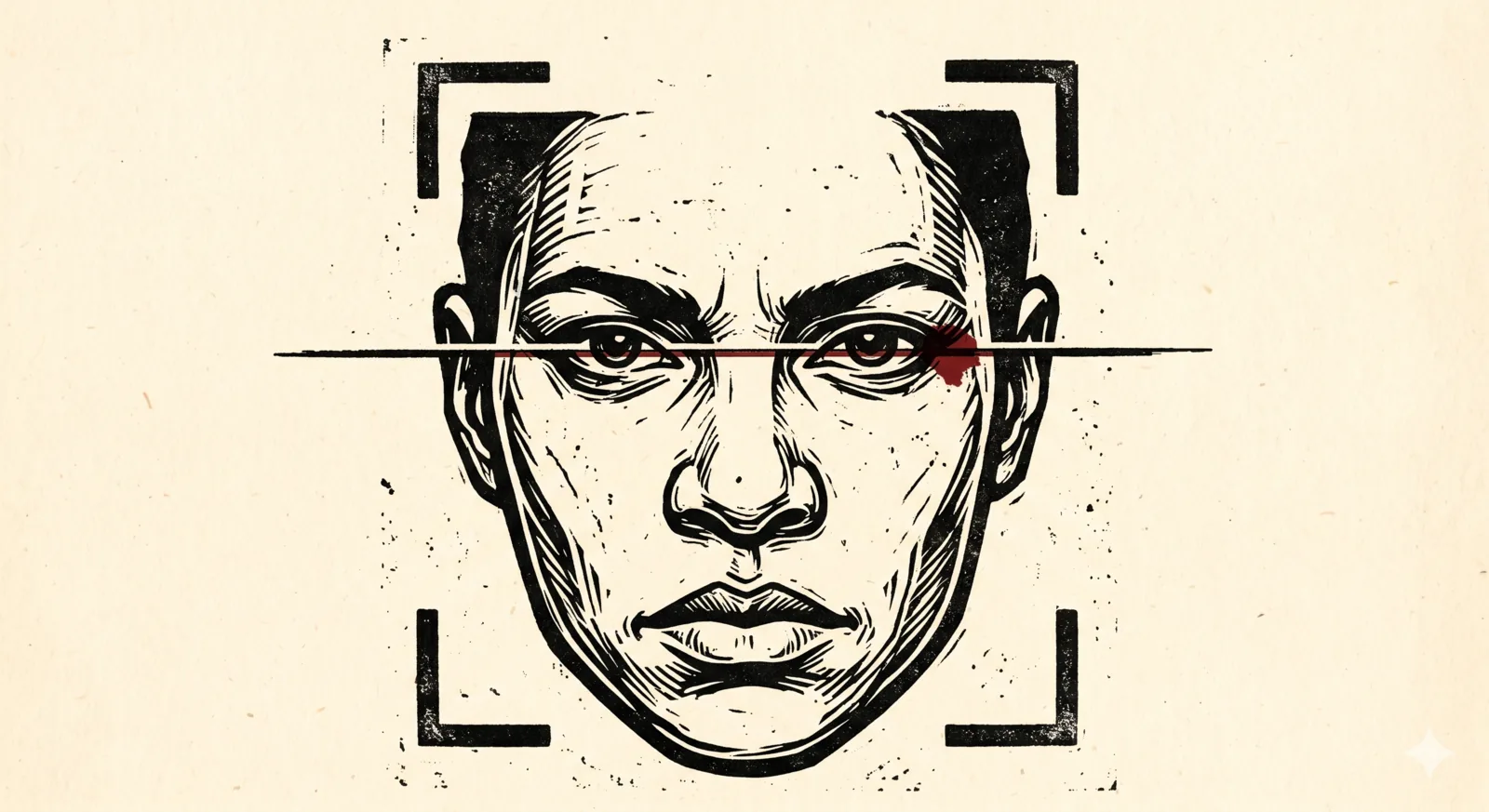
A human face overlaid with facial-recognition brackets and a red scan line.
Fig. 1 — They are not asking your age. They are mapping your face.

It's always "won't someone think of the children?!". But this affects everyone.

No one disputes that the internet can hurt kids. That grief is real, but it's being exploited. Here is the trick: to confirm that a child is not present, a service has to check everybody. Every adult passes through the checkpoint. A law written about sixteen-year-olds quietly becomes an identity requirement for the entire internet. You are not carded because you are suspected of anything. You are carded because carding has become the price of admission to life on the web.

We run background checks on people who want to buy a gun, but we do not background check everyone at all times just in case. Yet that is exactly the design here. It's a permit check at the door of every conversation, applied to all, justified by the few.

It is not age verification. It is identity verification.

Watch the words drift. This whole system was sold as age assurance, which is a yes-or-no question, are you over eighteen? But almost none of these systems are built to answer only that. They are built to know who you are: your name, your date of birth, your document number, your face. This is not age verification at all. It is forced identity tracking. Your real-world identity captured by not only Meta, Facebook, Twitter, Instagram, etc, but shared broadly with every creepy agency you already worry about "having all your data".

Name the places now demanding "age verification," and see how many will accept a plain government document that says only that you are over eighteen — and nothing else. Almost none will. Because age was never the point.

We spent a generation teaching people the first rule of the internet: never give out your real identity to strangers. We have a word, doxxing, for inflicting that exposure on someone against their will. And now the same governments and platforms are asking every citizen to do it to themselves, voluntarily, as a condition of logging in.

You can change a password. You cannot change your face.

A leaked password is an inconvenience. You reset it and move on. Your face, your driver's license, the unique geometry a scanner reduces to a number cannot be reset. A face scan is not a photograph. It is a three-dimensional map of you, a biometric template precise enough to be matched later against a surveillance camera on a street corner. When you hand over and it lives on someone else's server, often a third-party vendor you never chose, cannot name, and cannot hold to account.
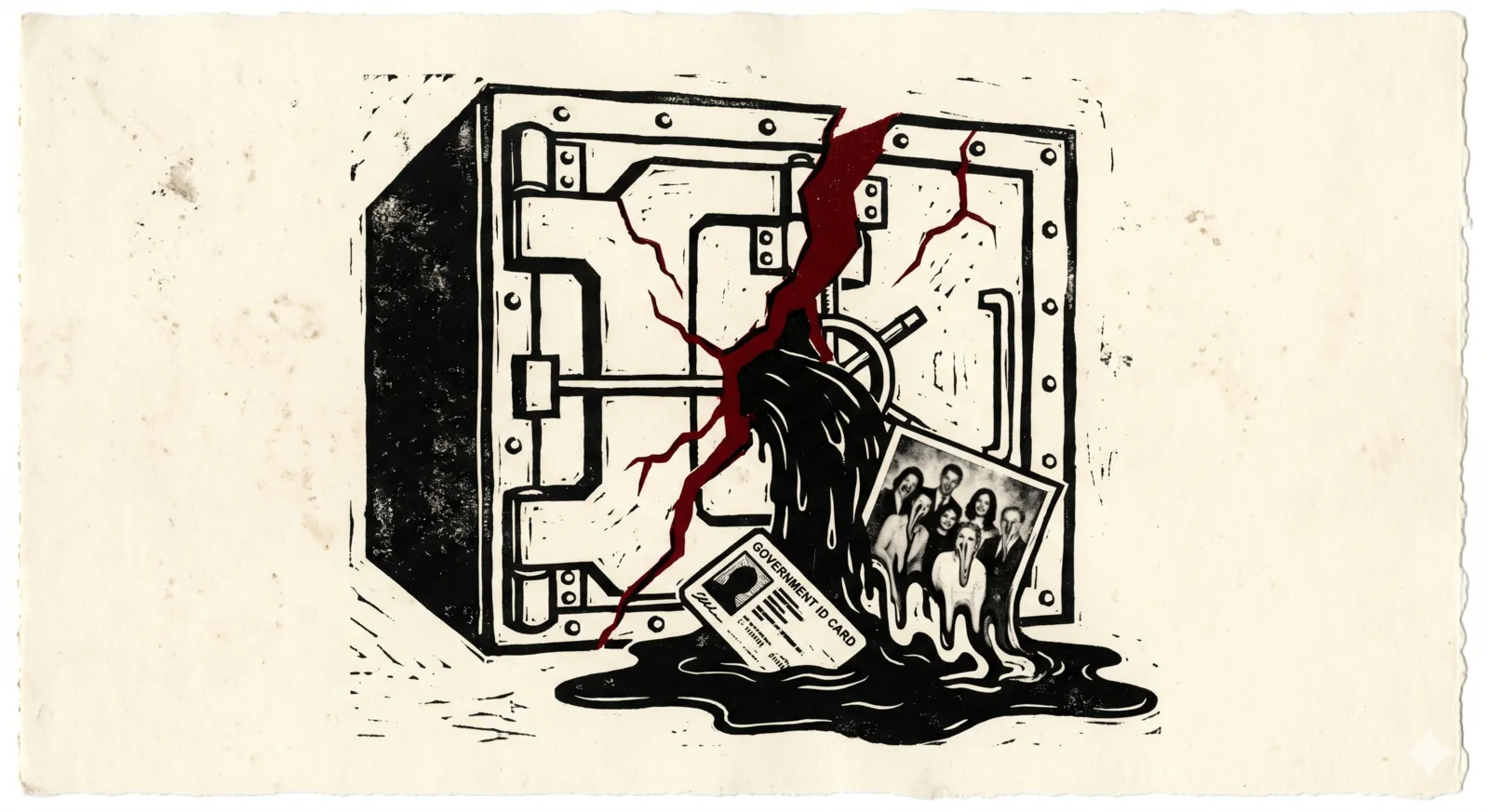
A government ID and photograph spilling from a cracked server vault.
Fig. 2 — Every verification database is a honeypot waiting to spill.

Every one of those databases is a honeypot. The verifier promises your documents are deleted the moment they are checked. They are not always deleted, and the promise is worthless the day the company is breached. Remember the last twenty years of worthles $17.99 Equifax IDentityGuard+ credits from all those data breaches? It has happened, it will happen again, except this time it's not your email, hashed password, or even your SSN. It's your face and passport that's for sale on the dark web.

It does not work — and it makes the danger worse.

Here is the insult beneath the injury: it fails at the one thing it promises. Determined teenagers route around age gates like breathing — a borrowed login, a VPN, a checkbox, a verified account bought for the price of a coffee. Within hours of one platform rolling out age brackets, pre-verified accounts for every age were for sale on eBay. Teenagers machete their way through technologies designed to "protect" or limit them in the same way that water finds the cracks in the wall. They have all the time in the world, all of the incentives, and all of the social structure and obfuscated chat channels to do it.

Worse, the architecture built to "protect" children can endanger them. Sort users into age-labeled pens and you have not only failed to stop a predator, you have created a children index, a phonebook, a way to filter directly for children. Teenagers pushed off mainstream platforms do not stop going online (see point about water above). They move to smaller, darker, unmoderated corners, away from the very oversight that was supposed to keep them safe. The children are not saved. The surveillance is the only thing that survives intact.

Safe now, ??? later

The database you are helping build for a trustworthy government does not stay in trustworthy hands. Administrations change. A registry that merely catalogs who you are today becomes, under a future government, a map of who to find. We already know that US federal agencies spy on citizens wholesale: who attended which protest, who read which forum, who belongs to which group. People are right to be afraid of what a hostile regime would do with a ready-made list. The data does not forget, and it does not take sides. It simply waits for whoever holds it next.

The whole internet starts to feel like the office: everyone too frightened to say anything but the safe thing, lest a real name attached to a real opinion cost them a real job.

A principled stance

Most people are fine with this, based on the same debunked "nothing to hide" fallacies that are always trotted out in these conversations. Surveys find overwhelming majorities want children protected online, and large majorities say they support age verification in the abstract.

This is not a popularity contest, and refusal is not a vote you are trying to win. A verification regime does not need your approval — it needs your participation. It only works if nearly everyone complies. The point of refusal is not to persuade a majority before acting; it is to deny the system the universal cooperation it requires to function at all. You do not need to win the poll. Just don't upload the photo. Never give them your face.

If Starbucks asked to scan your ID and put it in a national database to sell you a latte, would you give it to them? No, because you value your identity more than your latte. Do you not value your identity more than your ability to see some random cousin post about their repugnant political opinions or a picture of someone's dog?

I am but one

In theory, us normal internet users can stop this whole system by opt-ing out, by boycotting the process. Imagine a "National Month of Identity Choice", where no one used any platform demanding your face, no one logged on, no one saw any ads, no one bought any sponsored projects. The platforms would see massive revenue drops, and there would be intense lobbying to reverse these awful laws. We can do it.

The only word they cannot route around is no.

These systems run on compliance. They assume you will sigh, upload the photo, and move on. Their entire business model depends on it. Which is also their weakness. A verification wall that no one verifies for is a wall with no one standing at it.
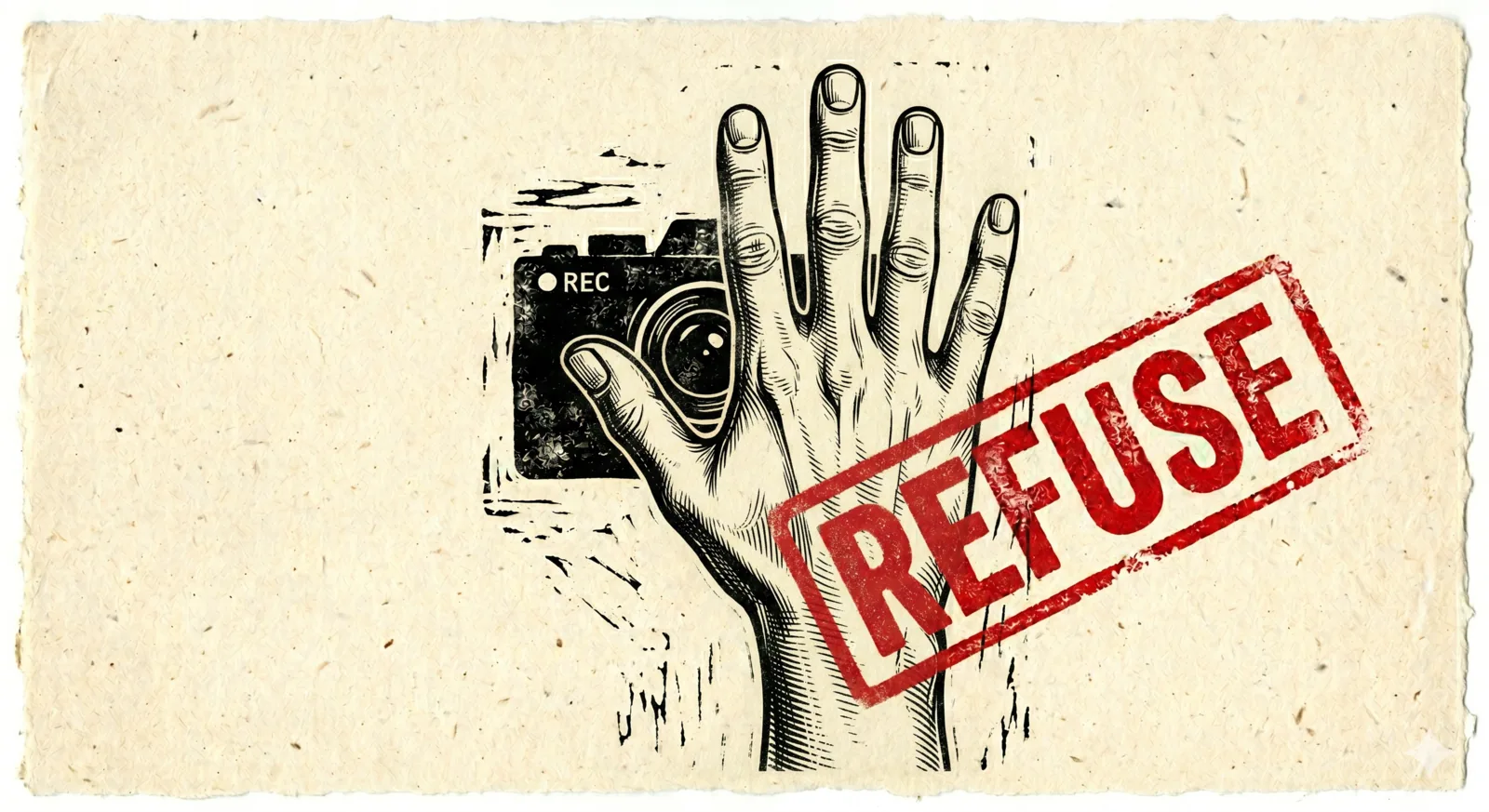
A flat raised palm covering a camera lens, with a red REFUSE stamp.
Fig. 3 — The only word they cannot route around is no.

So refuse. Refuse the scan. Refuse the upload. Close the accounts that demand it and tell them, in writing, exactly why you are leaving. The platforms need you far more than you need them. \You can live without the feed, they cannot live without the crowd. Do not comply in advance. The face on your ID is the most permanent thing you own.

Never give them your face.