






On 23 April, our pure-OCaml CCSDS protocol stack booted up in low Earth orbit! The project, codename Borealis, is running inside DPhi Space's ClusterGate-2 payload module on the host satellite, with end-to-end-encrypted command and control and post-quantum key rotation, all implemented in safe OCaml.
Why does OCaml matter here? Untrusted code running on a satellite is a huge security risk, and OCaml is an ideal safe language to run in space. In his ICFP 2022 keynote, KC Sivaramakrishnan looked back on the decade-long engineering effort that produced OCaml 5, the release that put safe and performant multi-threading into the OCaml runtime.
KC ended his talk speculating that OCaml 5.0 would go to the moon, due to its language features that would deliver C/Rust-like performance on demand while keeping the mathematical rigour of classic ML. Here at Parsimoni, we took his words a bit too literally :-)
The host satellite circles the Earth every ninety minutes or so. A few months after Virgile Robles and I hacked on this over Christmas, we (virtually) jumped around when we saw this:
2026-04-23 18:48:06  SpaceOS/Borealis (BPv7, BPSec, OTAR) by Parsimoni
2026-04-23 18:48:06  ClusterGate-2 proxy [single iteration]
2026-04-23 18:48:06  Config: scid=100, tm_vcid=0, tc_vcid=4, tm_spi=1, tc_spi=2, tm_frame_len=1115
2026-04-23 18:48:06  Session keys: EK=0x0100 AK=0x0101 active
2026-04-23 18:48:09  Telemetry health: { ... "status": "healthy" }
Borealis is a daemon. On both the ground and the satellite it speaks a normal client-server protocol (telemetry queries, commands and responses, OTAR rekey requests), the same shape as any production server. What is unusual is the wire underneath.
The protocol stack is a pure-OCaml implementation of
CCSDS, the protocol
family that links spacecraft to the ground. It covers every
layer from radio framing up through Bundle Protocol and the
security extensions on top; the binary formats are described as
ocaml-wire codecs.
On ClusterGate-2, only the upper layers of that stack are exercised. The satellite has no network connectivity from outside. The only ground link is filesystem upload and download via DPhi's API: a file written to the uplink directory is forwarded by DPhi on the next pass, and downlink works the same way. Borealis treats that filesystem as a delay-tolerant network. Every command, response, telemetry sample and image chunk is serialised into a BPv7 bundle and written to disk; DPhi forwards the file as opaque bytes.
BPSec wraps each bundle in two extension blocks: one encrypts the payload, the other authenticates it. Sequence numbers reject replays, and the pre-shared keys (rotated by OTAR, below) keep the routing path out of the trust path. The satellite operator sees only opaque bundle bytes; nothing in the routing path can read, modify, forge or substitute the contents.
This matters because we are tenants on someone else's hardware. On a hosted-payload satellite multiple tenants share a single bus, and container isolation alone would not suffice. A shared Linux kernel means kernel-level CVEs regularly break the tenant boundary, and the same primitives keep resurfacing in new forms: Dirty Frag (a universal Linux LPE published this year), Fragnesia (a close cousin in the same family), and "Copy Fail", a Linux kernel privilege escalation disclosed in late April that hit every major distribution at once. Earlier rounds (Dirty Pipe in 2022, the nf_tables use-after-free exploited for container escape in 2024) suggest there will be more. On a ground server you can run the package manager and reboot; in orbit, kernel patching is its own delivery problem with its own delay, and is sometimes not possible at all. The cryptographic envelope around each bundle is the only durable guarantee.
Beyond confidentiality and authenticity, the long-mission threat model needs key rotation. Borealis supports OTAR (Over-The-Air Rekeying) for its post-quantum signing keys (ML-DSA-65). Those keys live for the life of the satellite (ten to fifteen years), which is why NASA's Space System Protection Standard (NASA-STD-1006A) treats post-quantum command authentication as a requirement rather than a future option. OTAR lets us rotate the post-quantum keys without re-flashing the satellite. To our knowledge this will be the first public in-orbit demonstration of post-quantum OTAR; we plan to exercise the rotation on a later pass.
Borealis runs as a guest on DPhi's hosted-payload module: an Arm
SoC (four Cortex-A53 cores, 4 GB RAM) running Linux. The
flight binary is 5-10 MB, statically linked, shipped as a
FROM scratch Docker image. It polls the bus for telemetry
(angle, speed, position) and an onboard camera (a low-quality
fish-eye, good for demos only). The core of the satellite-side
loop looks like this:
let send_telemetry t ~prefix payload =
  let bundle =
    make_bundle t ~source:Eid.sat_telem
      ~destination:Eid.ground_telem ~payload
  in
  match protect_bundle t bundle with
  | Ok protected ->
      ignore (write_bundle t ~dir:(downlink_dir t.config) ~prefix protected)
  | Error _ -> log t "Failed to protect telemetry bundle"
protect_bundle applies BPSec with keys from the SDLS Security
Association, the cryptographic parameters ground and satellite
agreed on at provisioning. If any of that fails, no bundle leaves
the satellite.
The uplink path mirrors the downlink path. The satellite reads
bundles from /data/uplink/, unprotects each with BPSec, and
routes by destination at the bundle layer:
if dest = Eid.sat_cmd  then handle_command t payload
else if dest = Eid.sat_otar then handle_otar t payload
else log t "Unknown destination"
Text commands are short UTF-8 strings parsed into an ADT; the typechecker enforces exhaustive dispatch:
type cmd = Ping | Check | Capture | Halt

let dispatch t = function
  | Ping    -> send_response t ~prefix:"pong" "PONG"
  | Check   -> run_self_check t
  | Capture -> capture_and_send t
  | Halt    -> t.shutdown_requested <- true
Adding a new command means adding a constructor; the compiler then flags every place it is not yet handled.
OTAR rekey messages take the other branch. The payload is binary rather than text, encrypted under a master key that was loaded onto the satellite at integration time and lives in process memory on the module (the module has no TPM or secure element, because building a radiation-tolerant one is still an open hardware problem). The satellite decrypts the new keys, holds them in a staging slot, and activates them. The current flight loop activates on receipt; the protocol also supports a separate ground-driven activation step where the operator verifies the install before committing, and switching to that path is a flight-loop change, not new code.
The master key itself has no rotation path. It was installed on the payload before the satellite was mated to the launcher, and there is no more-trusted channel to deliver a new one once the spacecraft is in orbit. If the master key is lost, this stack is unreachable. That is the honest failure mode for a long mission with no hardware-backed key storage.
OxCaml is Jane Street's compiler branch on top of OCaml. Its mode system matters on the satellite hot path. Locality lets us mark allocations stack-bound, so they never reach the heap and never reach the GC. Uniqueness and capabilities track shared mutable state in the type system, turning data races into compile-time errors on the parallel parts of the stack.
The hot path on the hosted-payload module is CCSDS dispatch: every CFDP segment, every COP-1 frame, every camera packet flows through a Space Packet header decode and an APID-based routing step before the payload reaches the application logic. Real-time on-board dispatch with hard scheduling deadlines on every pass is exactly the workload the EU ORCHIDE Horizon Europe project was set up to address (the consortium where this on-board work first started inside Tarides, and which eventually led us to spin Parsimoni out as a dedicated space-software company).
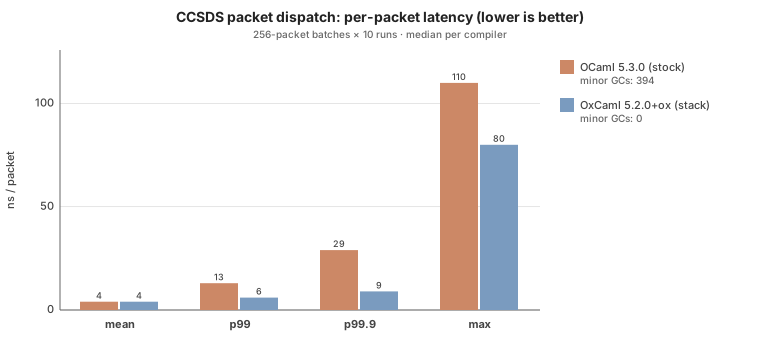
exclave_ stack_. Measured on a
laptop, not the flight module.
Switching to OxCaml with exclave_ stack_ annotations drops
p99.9 latency from 29 ns to 9 ns per packet on the dispatch
hot path, and removes GC pressure entirely (394 minor GCs to
zero over 25 million packets). Throughput is comparable; the
win is jitter, and on a hosted-payload module with hundreds of
microseconds of jitter budget, that is the whole game.
The recipe is mechanical: turn a per-iteration heap allocation
({ apid; seq_count; data_len }) into a stack-allocated one
(exclave_ stack_ { apid; seq_count; data_len }), and require
the consumer to take it @ local. The type system proves the
record cannot escape the dispatch scope; the compiler emits no
heap traffic; the GC has nothing to collect.
Setup. Apple M5 Max, macOS 25.4. Stock OCaml 5.3.0 versus
5.2.0+ox (Jane Street's OxCaml fork). Workload: 100 000 batches
of 256 CCSDS Space Packet header dispatches each (about 25.6 M
packets total), each routed through an [@inline never] handler
so the record genuinely escapes. Median of 10 runs.
Around 70% of severe CVEs in C/C++ codebases trace to memory corruption (buffer overflows, use-after-free, integer overflows), based on Microsoft's MSRC analysis (2019) and Chromium's 2020 study. Our security extensions (SDLS, BPSec, and OTAR) all handle ciphertexts and key material, which is exactly where memory bugs hurt most. The C-based incumbent in this domain, NASA CryptoLib, has had its own such bugs: for instance, a heap buffer overflow in the TC frame parser, triggered by an integer underflow on a crafted frame. An OCaml implementation removes that class of attack surface from the application logic by construction. The runtime, the kernel underneath, and the bootloader are still C and still in the TCB: memory safety helps where it helps, and is not a substitute for a trusted compute base audit.
Beyond what OCaml gives us today, the language itself keeps advancing. Jane Street maintains OxCaml, an experimental branch of OCaml. Its design goal is safe, predictable control over the performance-critical parts of a program, opt-in only where you need it, and still in OCaml: every valid OCaml program is also a valid OxCaml program. OxCaml Labs (Anil Madhavapeddy's group at Cambridge) and FP Launchpad (KC Sivaramakrishnan's lab at IIT Madras) are pushing OCaml forward; Tarides upstreams the pieces that are ready into the mainline.
I somehow focused on the moon :-) Going to orbit first meant prioritising correctness over performance, because protocol bugs in orbit are expensive to fix. The defence runs through every layer of the stack: type checking, formally verified cryptographic primitives (libcrux, fiat-crypto), interop testing, and dependency audits.
Take three of those layers as concrete examples. The wire-format codecs are generated from a typed schema, reject malformed bytes at decode time, and feed Microsoft's EverParse parser generator, which produces C validators formally verified in F*. The protocol state machines are encoded as GADTs, so the typechecker rejects invalid transitions at compile time. An interop pipeline runs against existing reference implementations, catching what the type system cannot express and surfacing defects in upstream libraries along the way.
Beyond what these layers catch, the functional core lets us ship
the same code as flight software, ground software, and test
oracle. The protect_bundle above is the same function in all
three roles. We feed recorded traffic from one role to the
others and compare outputs byte-for-byte. The OCaml code is also
the reference implementation that other implementations are
validated against. This is the nqsb-TLS
approach (Kaloper-Mersinjak, Mehnert, Madhavapeddy and Sewell,
USENIX Security 2015), and it has held up in TLS for a decade.
Nitrokey's NetHSM
runs the same OCaml TLS stack in shipping hardware security
modules today.
Borealis is no exception. It might look like we wrote a full CCSDS protocol stack from zero to in-orbit demonstration in a couple of months. That is not what happened. The core libraries come from MirageOS, and have been running in production on the ground for the last decade. A library operating system is, by definition, a large toolset where you pick the pieces you need.
The ASPLOS 2013 unikernels paper asked whether sealed, single-purpose images could improve cloud infrastructure. A decade later, the same libraries run in Docker Desktop on hundreds of millions of laptops. Now they run in space, on ClusterGate-2, doing the system-level plumbing as a Linux process rather than a unikernel, in places I did not predict when we first designed them.
Borealis is one binary in orbit. The next problem is scale: deploying and managing a fleet of specialised payload binaries across many satellites with the same one-command ease that Docker brought to Linux on the ground. The harder half is doing that safely: signed updates from the ground, isolation between payloads, and attestation of what is actually running. Getting hardware to orbit is becoming routine; the interesting problems are increasingly in the software that runs on it, a familiar shift from cloud computing, where the stack on top of the servers ended up mattering more than the servers. That is what we are building next at Parsimoni, with collaborators at Cambridge and beyond. I sketched the wider question in Is Running Untrusted Code on a Satellite a Good Idea?.
If you are building payload software, considering hosted payloads on your bus, or want to compare notes on OCaml in flight, talk to me or write to the Parsimoni team.
此内容由惯性聚合(RSS阅读器)自动聚合整理,仅供阅读参考。 原文来自 — 版权归原作者所有。