

惯性聚合 高效追踪和阅读你感兴趣的博客、新闻、科技资讯
阅读原文 在惯性聚合中打开

推荐订阅源

博客园 - 三生石上(FineUI控件)
V
Vulnerabilities – Threatpost
C
Cisco Blogs
A
Arctic Wolf
L
LINUX DO - 热门话题
P
Proofpoint News Feed
Security Latest
Security Latest
AWS News Blog
AWS News Blog
cs.AI updates on arXiv.org
Application and Cybersecurity Blog
Cisco Talos Blog
Cisco Talos Blog
L
Lohrmann on Cybersecurity
W
WeLiveSecurity
爱范儿
爱范儿
Last Week in AI
Last Week in AI
Hacker News - Newest:
Hacker News - Newest: "LLM"
S
Security Affairs
PCI Perspectives
PCI Perspectives
C
Cybersecurity and Infrastructure Security Agency CISA
Spread Privacy
Spread Privacy
IT之家
IT之家
月光博客
月光博客
云风的 BLOG
云风的 BLOG
宝玉的分享
宝玉的分享
J
Java Code Geeks
美团技术团队
酷 壳 – CoolShell
酷 壳 – CoolShell
I
Intezer
博客园_首页
博客园 - 司徒正美
奇客Solidot–传递最新科技情报
奇客Solidot–传递最新科技情报
P
Palo Alto Networks Blog
NISL@THU
NISL@THU
Recent Commits to openclaw:main
有赞技术团队
有赞技术团队
K
KPMG report finds enterprise disconnect between AI and its ROI | CIO
量子位
The Last Watchdog
The Last Watchdog
Google Online Security Blog
freeCodeCamp Programming Tutorials: Python, JavaScript, Git & More
博客园 - 聂微东
N
News and Events Feed by Topic
Webroot Blog
Webroot Blog
OSCHINA 社区最新新闻
OSCHINA 社区最新新闻
S
Security @ Cisco Blogs
罗磊的独立博客
大猫的无限游戏
大猫的无限游戏
The Cloudflare Blog
V
V2EX
Jina AI
Jina AI

Hacker News: Best

Dubai police arrest airline worker after accessing private WhatsApp group madhadron - The seven programming ur-languages GitHub - smol-machines/smolvm: Tool to build & run portable, lightweight, self-contained virtual machines. I Measured Claude 4.7's New Tokenizer. Here's What It Costs You. Introducing Claude Design by Anthropic Labs It Is Time to Ban the Sale of Precise Geolocation The creative software industry has declared war on Adobe Isaac Asimov: The Last Question Newly unsealed records reveal Amazon’s price-fixing tactics, California attorney general claims Clojure - Documentary Android CLI and skills: Build Android apps 3x faster using any agent Qwen3.6-35B-A3B on my laptop drew me a better pelican than Claude Opus 4.7 Codex for almost everything Introducing Claude Opus 4.7 Qwen Studio The Future of Everything is Lies, I Guess: Where Do We Go From Here? Virginia Bans Sale of Geolocation Data YouTube now lets you turn off Shorts Burgers | マクドナルド公式 ChatGPT for Excel Ask HN: Who is using OpenClaw? Live Nation illegally monopolized ticketing market, jury finds Google Broke Its Promise to Me. Now ICE Has My Data. Open Source Isn't Dead. The Future of Everything is Lies, I Guess: New Jobs Unexpected €54k billing spike in 13 hours: Firebase browser key without API restrictions used for Gemini requests IPv6 – Google Your Backpack Got Worse On Purpose Good sleep, good learning, good life Fixing a 20-year-old bug in Enlightenment E16. Does Gas Town 'steal' usage from users' LLM credits & paid services to improve itself? Tell HN: Fiverr left customer files public and searchable Getting the Flock out Release OpenSSL 4.0.0 · openssl/openssl Internet será irrespirable los días de fútbol y otros deportes. Telefónica extiende los bloqueos a Champions, tenis y golf. Automate work with routines - Claude Code Docs The Future of Everything is Lies, I Guess: Work Thousands of rare concert recordings are landing on the Internet Archive — listen now What is jj and why should I care? Backblaze has quietly stopped backing up your data Cal.com Goes Closed Source: Why AI Security Is Forcing Our Decision | Cal.com - Scheduling Software for Online Bookings Codex Hacked a Samsung TV The Future of Everything is Lies, I Guess: Safety GitHub - sterlingcrispin/nothing-ever-happens: Polymarket bot that buys "No" on all non-sports markets. For entertainment only, mostly a meme. Make tmux Pretty and Usable - Ham Vocke Microsoft isn't removing Copilot from Windows 11, it's just renaming it Servo is now available on crates.io - Servo aims to empower developers with a lightweight, high-performance alternative for embedding web technologies in applications. We May Be Living Through the Most Consequential Hundred Days in Cyber History, and Almost Nobody Has Noticed All elementary functions from a single binary operator 奈拜提耶市 Seven countries now generate 100% of their electricity from renewable energy Pro Max 5x Quota Exhausted in 1.5 Hours Despite Moderate Usage Tell HN: docker pull fails in spain due to football cloudflare block Bring Back Idiomatic Design @adlrocha - How the "AI Loser" may end up winning Apple update turns Czech mate for locked-out iPhone user Cache TTL silently regressed from 1h to 5m around early March 2026, causing quota and cost inflation The peril of laziness lost AI Will Be Met With Violence, and Nothing Good Will Come of It Center for Responsible, Decentralized Intelligence at Berkeley The disturbing white paper Red Hat is trying to erase from the internet – OSnews The Future of Everything is Lies, I Guess: Annoyances 447 Terabytes per Square Centimetre at Zero Retention Energy: Non-Volatile Memory at the Atomic Scale on Fluorographane Show HN: Pardonned.com – A searchable database of US Pardons 20 Years on AWS and Never Not My Job Artemis II crew splashes down near San Diego after historic moon mission Molotov Cocktail Is Hurled at Home of Sam Altman, OpenAI’s CEO France to ditch Windows for Linux to reduce reliance on US tech On filing the corners off my MacBooks Installing every* Firefox extension Chimpanzees in Uganda locked in vicious 'civil war', say researchers linux/Documentation/process/coding-assistants.rst at master · torvalds/linux GitHub - callumlocke/json-formatter: Makes JSON easy to read. A compelling title that is cryptic enough to get you to take action on it GitHub - Keychron/Keychron-Keyboards-Hardware-Design: Industrial design files for Keychron keyboards and mice. 100+ models with CAD assets in STEP, DXF, DWG, and PDF. Source-available, with commercial use allowed for original compatible accessories within the license terms. [ANNOUNCE] WireGuardNT v0.11 and WireGuard for Windows v0.6 Released 1D-Chess Helium Is Hard to Replace FBI used iPhone notification data to retrieve deleted Signal messages Microsoft suspends dev accounts for high-profile open source projects Why you can’t trust Privacy & Security Serenity Forge (@serenityforge.com) A new trick brings stability to quantum operations OpenAI Backs Bill That Would Limit Liability for AI-Enabled Mass Deaths or Financial Disasters Netflix Prices Went Up Again – I Bought a DVD Player Instead DOJ Wants to Scrap Watergate-Era Rule That Makes Presidential Records Public EFF is Leaving X How NASA built Artemis II’s fault-tolerant computer Meta removes ads for social media addiction litigation How Pizza Tycoon simulated traffic on a 25 MHz CPU Claude mixes up who said what, and that's not OK Reallocating $100/Month Claude Code spend to Zed and OpenRouter Help Keep Thunderbird Alive! Why Are Flock Employees Watching Our Children? The Pentagon Threatened Pope Leo XIV’s Ambassador With the Avignon Papacy Fragments: April 2 Native Instant Space Switching on MacOS Bitcoin miners are losing $19,000 on every BTC produced as difficulty drops 7.8% God sleeps in the minerals Apple Silicon and Virtual Machines: Beating the 2 VM Limit
Cybersecurity Looks Like Proof of Work Now
2026-04-15 · via Hacker News: Best

Is security spending more tokens than your attacker?

Last week we learned about Anthropic’s Mythos, a new LLM so “strikingly capable at computer security tasks” that Anthropic didn’t release it publicly. Instead, only critical software makers have been granted access, providing them time to harden their systems.

We quickly blew through our standard stages of processing big AI claims: shock, existential fear, hype, skepticism, criticism, and (finally) moving onto the next thing. I encouraged people to take a wait-and-see approach, as security capabilities are tailor-made for impressive demos. Finding exploits is a clearly defined, verifiable search problem. You’re not building a complex system, but poking at one that exists. A problem well suited to throwing millions of tokens at.

Yesterday, the first 3rd party analysis landed, from the AI Security Institute (AISI), largely supporting Anthropic’s claims. Mythos is really good, “a step up over previous frontier models in a landscape where cyber performance was already rapidly improving.”

The entire report is worth reading, but I want to focus on the following chart, detailing the ability of different models to successfully complete a simulated, complex corporate network attack:
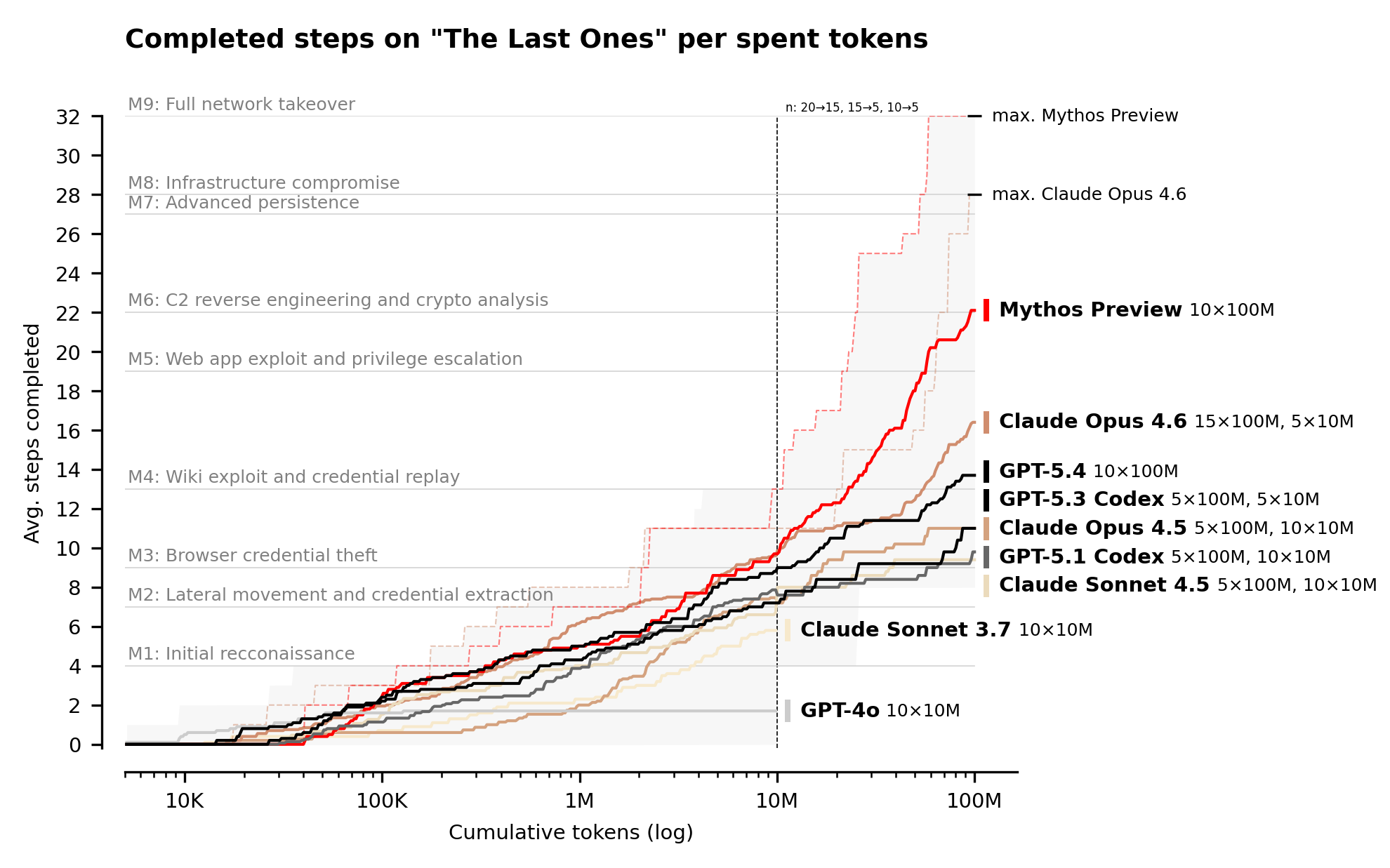
The Last Ones” is, “a 32-step corporate network attack simulation spanning initial reconnaissance through to full network takeover, which AISI estimates to require humans 20 hours to complete.” The lines are the average performance across multiple runs (10 runs for Mythos, Opus 4.6, and GPT-5.4), with the “max” lines representing the best of each batch. Mythos was the only model to complete the task, in 3 out of its 10 attempts.

This chart suggests an interesting security economy: to harden a system we need to spend more tokens discovering exploits than attackers spend exploiting them.

AISI budgeted 100M tokens for each attempt. That’s $12,500 per Mythos attempt, $125k for all ten runs. Worryingly, none of the models given a 100M budget showed signs of diminishing returns. “Models continue making progress with increased token budgets across the token budgets tested,” AISI notes.

If Mythos continues to find exploits so long as you keep throwing money at it, security is reduced to a brutally simple equation: to harden a system you need to spend more tokens discovering exploits than attackers will spend exploiting them.

You don’t get points for being clever. You win by paying more. It is a system that echoes cryptocurrency’s proof of work system, where success is tied to raw computational work. It’s a low temperature lottery: buy the tokens, maybe you find an exploit. Hopefully you keep trying longer than your attackers.

This calculus has a few immediate takeaways:

First, open source software remains critically important.

For those of you who aren’t exposed to AI maximalists, this statement feels absurd. But lately, after the LiteLLM and Axios supply chain scares, many have argued for reimplementing dependency functionality using coding agents.

Here’s Karpathy, just a few weeks ago:

Classical software engineering would have you believe that dependencies are good (we’re building pyramids from bricks), but imo this has to be re-evaluated, and it’s why I’ve been so growingly averse to them, preferring to use LLMs to “yoink” functionality when it’s simple enough and possible.

If security is purely a matter of throwing tokens at a system, Linus’s law that, “given enough eyeballs, all bugs are shallow,” expands to include tokens. If corporations that rely on OSS libraries spend to secure them with tokens, it’s likely going to be more secure than your budget allows. Certainly, this has complexities: cracking a widely used OSS package is inherently more valuable than hacking a one-off implementation, which incentivizes attackers to spend more on OSS targets.

Second, hardening will be an additional phase for agentic coders.

We’ve already been seeing developers break their process into two steps, development and code review, often using different models for each phase. As this matures, we’re seeing purpose-built tooling meeting this pattern. Anthropic launched a code review product that costs $15-20 per review.

If the above Mythos claims hold, I suspect we’ll see a three phase cycle: development, review, and hardening.

  1. Development: Implement features, iterate quickly, guided by human intuition and user feedback.
  2. Review: Document, refactor, and other gardening tasks, async, applying best practices with each PR.
  3. Hardening: Identify exploits, autonomously, until the budget runs out.

Critically, human input is the limiter for the first phase and money is the limiter for the last. This quality inherently makes them separate stages (why spend to harden before you have something?). Previously, security audits were rare, discrete, and inconsistent. Now we can apply them constantly, within an optimal (we hope!) budget.

Code remains cheap, unless it needs to be secure. Even if costs go down as inference optimizations, unless models reach the point of diminishing security returns, you still need to buy more tokens than attackers do. The cost is fixed by the market value of an exploit.