
惯性聚合 高效追踪和阅读你感兴趣的博客、新闻、科技资讯
阅读原文 在惯性聚合中打开

推荐订阅源

The Hacker News
The Hacker News
F
Full Disclosure
Cloudbric
Cloudbric
Blog — PlanetScale
Blog — PlanetScale
W
WeLiveSecurity
N
News and Events Feed by Topic
T
Troy Hunt's Blog
V2EX - 技术
V2EX - 技术
CTFtime.org: upcoming CTF events
B
Blog
GbyAI
GbyAI
C
Check Point Blog
B
Blog RSS Feed
Application and Cybersecurity Blog
Recorded Future
Recorded Future
The Last Watchdog
The Last Watchdog
N
News and Events Feed by Topic
T
The Blog of Author Tim Ferriss
O
OpenAI News
V
V2EX
人人都是产品经理
人人都是产品经理
cs.AI updates on arXiv.org
IT之家
IT之家
WordPress大学
WordPress大学
www.infosecurity-magazine.com
S
Security @ Cisco Blogs
C
Cisco Blogs
Security Latest
Security Latest
S
Security Affairs
V
Visual Studio Blog
C
Cybersecurity and Infrastructure Security Agency CISA
Hacker News - Newest:
Hacker News - Newest: "LLM"
博客园 - 司徒正美
freeCodeCamp Programming Tutorials: Python, JavaScript, Git & More
Microsoft Azure Blog
Last Week in AI
Last Week in AI
AWS News Blog
AWS News Blog
雷峰网
雷峰网
Apple Machine Learning Research
PCI Perspectives
PCI Perspectives
博客园_首页
U
Unit 42
Google DeepMind News
Hugging Face - Blog
Hugging Face - Blog
Project Zero
Project Zero
Cisco Talos Blog
Cisco Talos Blog
The Register - Security
N
Netflix TechBlog - Medium
L
LINUX DO - 热门话题
H
Hacker News: Front Page

Hacker News: Best

madhadron - The seven programming ur-languages GitHub - smol-machines/smolvm: Tool to build & run portable, lightweight, self-contained virtual machines. I Measured Claude 4.7's New Tokenizer. Here's What It Costs You. Introducing Claude Design by Anthropic Labs It Is Time to Ban the Sale of Precise Geolocation The creative software industry has declared war on Adobe Isaac Asimov: The Last Question Newly unsealed records reveal Amazon’s price-fixing tactics, California attorney general claims Clojure - Documentary Android CLI and skills: Build Android apps 3x faster using any agent Qwen3.6-35B-A3B on my laptop drew me a better pelican than Claude Opus 4.7 Codex for almost everything Introducing Claude Opus 4.7 Qwen Studio The Future of Everything is Lies, I Guess: Where Do We Go From Here? Virginia Bans Sale of Geolocation Data YouTube now lets you turn off Shorts Burgers | マクドナルド公式 ChatGPT for Excel Ask HN: Who is using OpenClaw? Live Nation illegally monopolized ticketing market, jury finds Google Broke Its Promise to Me. Now ICE Has My Data. Open Source Isn't Dead. The Future of Everything is Lies, I Guess: New Jobs Unexpected €54k billing spike in 13 hours: Firebase browser key without API restrictions used for Gemini requests IPv6 – Google Your Backpack Got Worse On Purpose Good sleep, good learning, good life Fixing a 20-year-old bug in Enlightenment E16. Does Gas Town 'steal' usage from users' LLM credits & paid services to improve itself? Tell HN: Fiverr left customer files public and searchable Cybersecurity Looks Like Proof of Work Now Getting the Flock out Release OpenSSL 4.0.0 · openssl/openssl Internet será irrespirable los días de fútbol y otros deportes. Telefónica extiende los bloqueos a Champions, tenis y golf. Automate work with routines - Claude Code Docs The Future of Everything is Lies, I Guess: Work Thousands of rare concert recordings are landing on the Internet Archive — listen now What is jj and why should I care? Backblaze has quietly stopped backing up your data Cal.com Goes Closed Source: Why AI Security Is Forcing Our Decision | Cal.com - Scheduling Software for Online Bookings Codex Hacked a Samsung TV The Future of Everything is Lies, I Guess: Safety GitHub - sterlingcrispin/nothing-ever-happens: Polymarket bot that buys "No" on all non-sports markets. For entertainment only, mostly a meme. Make tmux Pretty and Usable - Ham Vocke Microsoft isn't removing Copilot from Windows 11, it's just renaming it Servo is now available on crates.io - Servo aims to empower developers with a lightweight, high-performance alternative for embedding web technologies in applications. We May Be Living Through the Most Consequential Hundred Days in Cyber History, and Almost Nobody Has Noticed All elementary functions from a single binary operator 奈拜提耶市 Seven countries now generate 100% of their electricity from renewable energy Pro Max 5x Quota Exhausted in 1.5 Hours Despite Moderate Usage Tell HN: docker pull fails in spain due to football cloudflare block Bring Back Idiomatic Design @adlrocha - How the "AI Loser" may end up winning Apple update turns Czech mate for locked-out iPhone user Cache TTL silently regressed from 1h to 5m around early March 2026, causing quota and cost inflation The peril of laziness lost AI Will Be Met With Violence, and Nothing Good Will Come of It Center for Responsible, Decentralized Intelligence at Berkeley The disturbing white paper Red Hat is trying to erase from the internet – OSnews The Future of Everything is Lies, I Guess: Annoyances 447 Terabytes per Square Centimetre at Zero Retention Energy: Non-Volatile Memory at the Atomic Scale on Fluorographane Show HN: Pardonned.com – A searchable database of US Pardons 20 Years on AWS and Never Not My Job Artemis II crew splashes down near San Diego after historic moon mission Molotov Cocktail Is Hurled at Home of Sam Altman, OpenAI’s CEO France to ditch Windows for Linux to reduce reliance on US tech On filing the corners off my MacBooks Installing every* Firefox extension Chimpanzees in Uganda locked in vicious 'civil war', say researchers linux/Documentation/process/coding-assistants.rst at master · torvalds/linux GitHub - callumlocke/json-formatter: Makes JSON easy to read. A compelling title that is cryptic enough to get you to take action on it GitHub - Keychron/Keychron-Keyboards-Hardware-Design: Industrial design files for Keychron keyboards and mice. 100+ models with CAD assets in STEP, DXF, DWG, and PDF. Source-available, with commercial use allowed for original compatible accessories within the license terms. [ANNOUNCE] WireGuardNT v0.11 and WireGuard for Windows v0.6 Released 1D-Chess Helium Is Hard to Replace FBI used iPhone notification data to retrieve deleted Signal messages Microsoft suspends dev accounts for high-profile open source projects Why you can’t trust Privacy & Security Serenity Forge (@serenityforge.com) A new trick brings stability to quantum operations OpenAI Backs Bill That Would Limit Liability for AI-Enabled Mass Deaths or Financial Disasters Netflix Prices Went Up Again – I Bought a DVD Player Instead DOJ Wants to Scrap Watergate-Era Rule That Makes Presidential Records Public EFF is Leaving X How NASA built Artemis II’s fault-tolerant computer Meta removes ads for social media addiction litigation How Pizza Tycoon simulated traffic on a 25 MHz CPU Claude mixes up who said what, and that's not OK Reallocating $100/Month Claude Code spend to Zed and OpenRouter Help Keep Thunderbird Alive! Why Are Flock Employees Watching Our Children? The Pentagon Threatened Pope Leo XIV’s Ambassador With the Avignon Papacy Fragments: April 2 Native Instant Space Switching on MacOS Bitcoin miners are losing $19,000 on every BTC produced as difficulty drops 7.8% God sleeps in the minerals Apple Silicon and Virtual Machines: Beating the 2 VM Limit
Claude Fable is relentlessly proactive
Simon Willison · 2026-06-12 · via Hacker News: Best

11th June 2026

After two days of experience with Claude Fable 5 I think the best way to describe it is relentlessly proactive. It knows a whole lot of tricks and it will deploy pretty much any of them to get to its goal.

I’ll illustrate this with an example. I was hacking on Datasette Agent today when I noticed a glitch: a horizontal scrollbar that shouldn’t be there in the jump menu chat prompt. I snapped this screenshot:
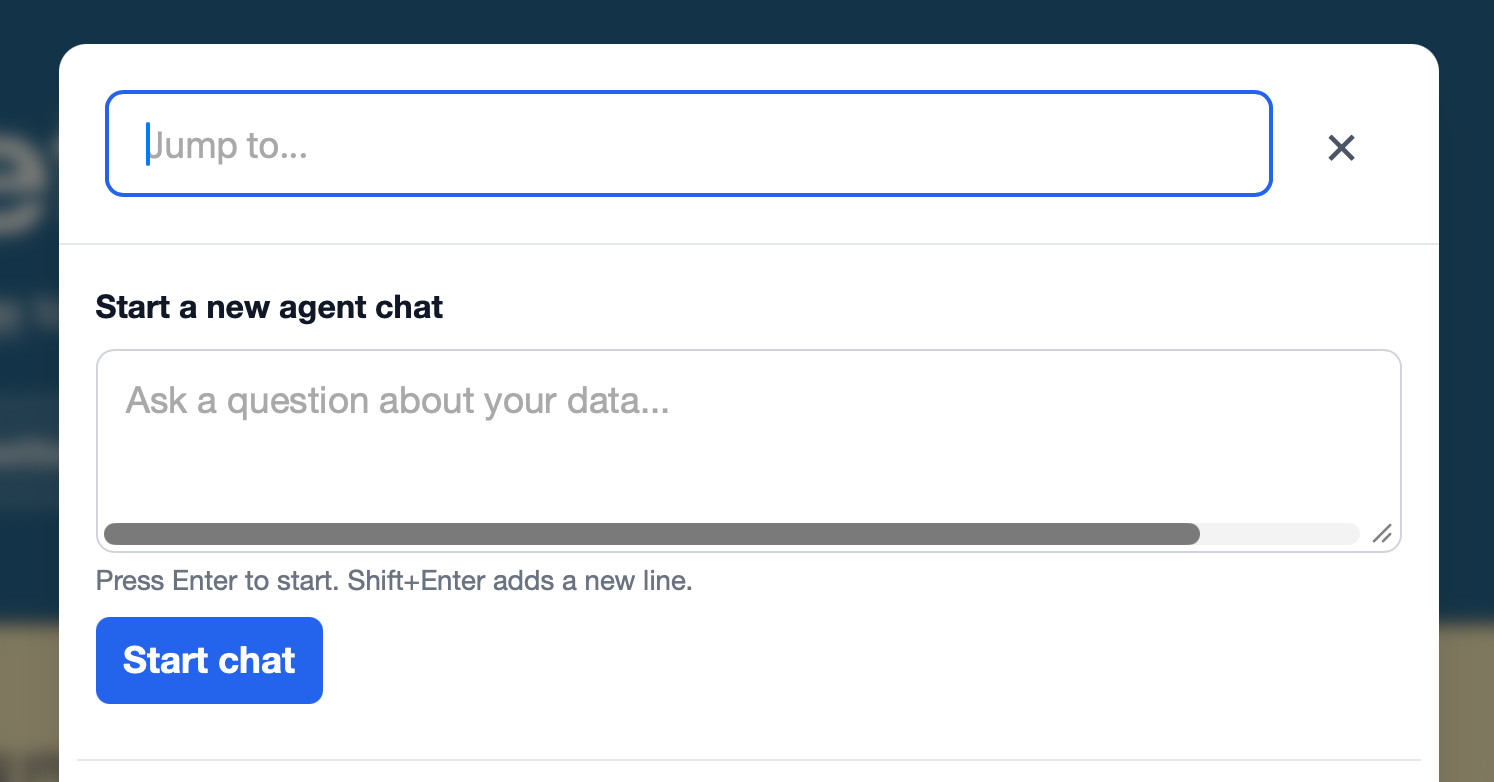
Screenshot of a modal dialog demonstrating a scrollbar bug. At the top is a focused search input with blue outline and placeholder "Jump to...", with an X close button to its right. Below, a heading reads "Start a new agent chat" above a textarea with the placeholder "Ask a question about your data..." — the bug: a thick gray horizontal scrollbar is incorrectly displayed along the bottom edge of the empty textarea, spanning nearly its full width, next to the resize handle. Below the textarea: "Press Enter to start. Shift+Enter adds a new line." followed by a blue "Start chat" button.

Then I started a fresh claude session in my datasette-agent checkout, dragged in the screenshot and told it:

Look at dependencies to help figure out why there is a horizontal scrollbar here

I had a hunch the cause was in a dependency of Datasette Agent (likely Datasette itself) and I knew Fable was good at digging into dependency code, either by inspecting installed files in its own virtual environment site-packages or by referencing a local checkout on disk. Telling it to start with dependencies felt like a good bet.

I got distracted by a domestic task and wandered away from my computer.

When I came back a few minutes later I saw my machine open a browser window in my regular Firefox and then navigate to the dialog in question. I had not told Claude Code to use any browser automation, and I was pretty sure it wasn’t possible for it to trigger mouse movements or keyboard shortcuts within a window, so how was it doing that?

I watched in fascination as it continued with its explorations, then saw it open a Safari window instead of Firefox. I also grabbed this snapshot from the Claude terminal:

Screenshot of two Bash tool calls in a dark terminal interface. First: Bash(open -a Safari /tmp/textarea-scrollbar-test.html && sleep 4 && uv run --with pyobjc-framework-Quartz python - <<'EOF' import Quartz wins = Quartz.CGWindowListCopyWindowInfo(Quartz.kCGWindowListOptionOnScreenOnly, Quartz.kCGNullWindowID) for w in wins: if (w.get('kCGWindowOwnerName') or '') == 'Safari' and 'textarea' in (w.get('kCGWindowName') or '').lower(): print(w.get('kCGWindowNumber')) EOF) with output 153551. Second: Bash(screencapture -x -o -l 153551 /tmp/safari-cases.png && echo ok) with output ok.

What was it doing there with uv run --with pyobjc-framework-Quartz?

It turns out Fable had hacked up its own pattern for taking screenshots of browser windows. It was using Python to iterate through all available windows on my machine, then filtering for Safari windows with expected strings such as "textarea" in the window name. It used that to find their window number—an integer like 153551—which it could then use with the screencapture CLI tool to grab a PNG.

OK fine, that’s a neat way of taking screenshots. But what was it taking screenshots of?

Turns out it had been writing its own scratch HTML pages to try and recreate the bug, then opening Safari and grabbing screenshots.

Here’s that /tmp/textarea-scrollbar-test.html page it created, and the screenshot it took with screencapture -x -o -l 153551 /tmp/safari-cases.png:
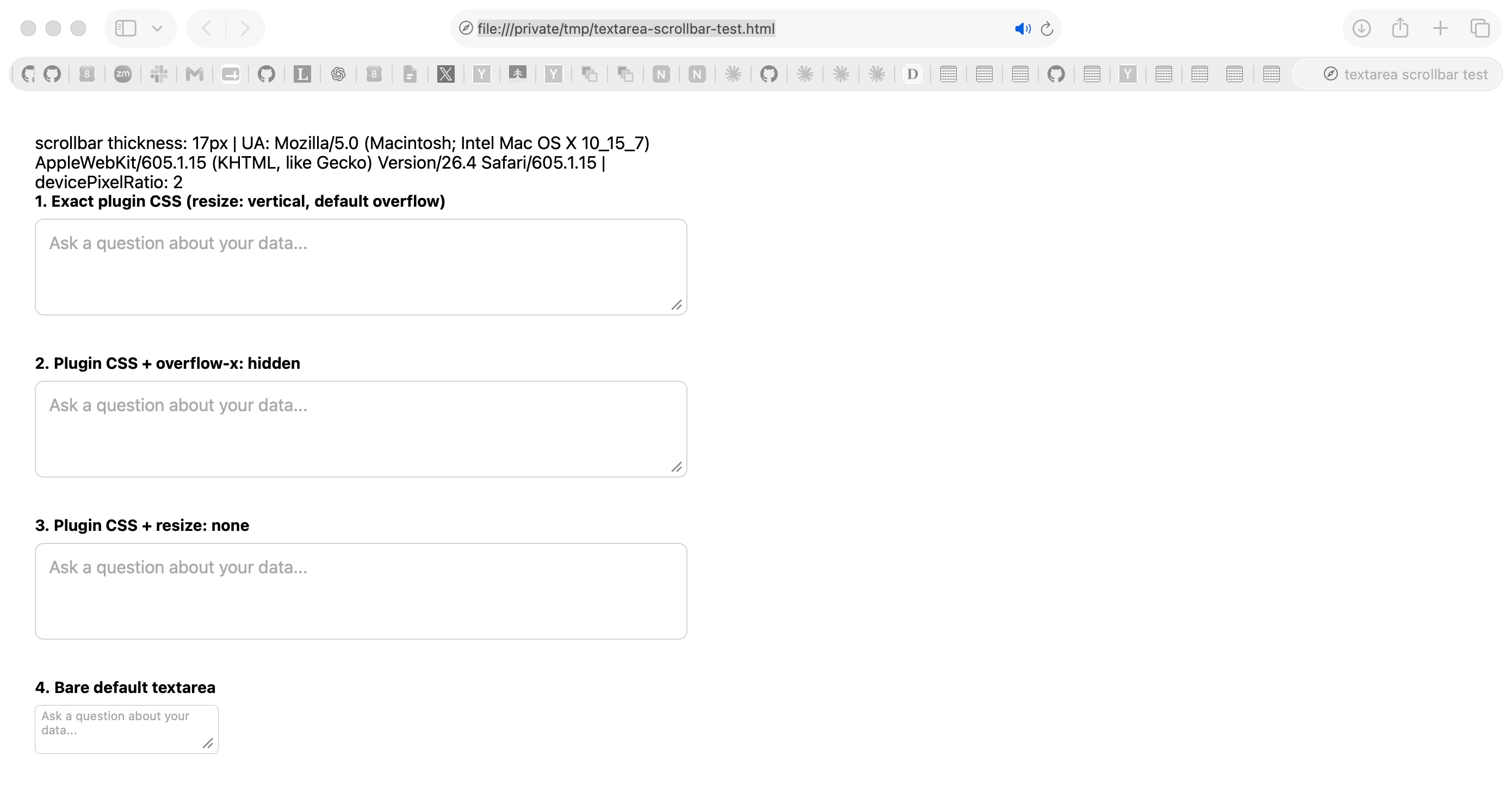
Screenshot of a Safari browser window showing a textarea scrollbar test page at file:///private/tmp/textarea-scrollbar-test.html. Page text reads: scrollbar thickness: 17px | UA: Mozilla/5.0 (Macintosh; Intel Mac OS X 10_15_7) AppleWebKit/605.1.15 (KHTML, like Gecko) Version/26.4 Safari/605.1.15 | devicePixelRatio: 2. Four numbered test cases follow, each with a textarea containing the placeholder "Ask a question about your data...": 1. Exact plugin CSS (resize: vertical, default overflow), 2. Plugin CSS + overflow-x: hidden, 3. Plugin CSS + resize: none, and 4. Bare default textarea, which is a much smaller box with the placeholder wrapping onto two lines. (I have way too many open tabs!)

OK, so I can see how it’s opening test pages and taking screenshots, but how on earth was it triggering the modal dialog that was meant to be under test? That’s only available via a click or a keyboard shortcut, and I couldn’t see a mechanism for it to run those in Safari.

I eventually figured out what it had done.

Claude was running in a folder that contained the source code for the application. It knows enough about Datasette to be able to run a local development server. It turns out it was editing Datasette’s own templates to add JavaScript that would trigger the correct keyboard shortcut as soon as the window opened, adding code like this:

<script>
window.addEventListener("load", function () {
  setTimeout(function () {
    document.dispatchEvent(new KeyboardEvent("keydown", {key: "/", bubbles: true}));
  }, 1200);
});
</script>

1.2 seconds after the window opens, this code triggers a simulated / key, which is the keyboard shortcut for opening the modal dialog.

There was one challenge left. In order to understand what was going on, Claude needed to run JavaScript on the page to take measurements for itself.

It wrote its own custom web application to capture information via CORS, then ran that as a local server and opened a page with JavaScript that would POST directly to it!

Here’s the Python web app it wrote, using the standard library http.server package:

from http.server import HTTPServer, BaseHTTPRequestHandler

class H(BaseHTTPRequestHandler):
    def do_POST(self):
        n = int(self.headers.get("Content-Length", 0))
        open("/tmp/diag.json", "w").write(self.rfile.read(n).decode())
        self.send_response(200)
        self.send_header("Access-Control-Allow-Origin", "*")
        self.end_headers()
    def do_OPTIONS(self):
        self.send_response(200)
        self.send_header("Access-Control-Allow-Origin", "*")
        self.send_header("Access-Control-Allow-Headers", "*")
        self.end_headers()
    def log_message(self, *a):  # quiet
        pass

HTTPServer(("127.0.0.1", 9999), H).serve_forever()

All this does is accept a POST request full of JSON and write that to the /tmp/diag.json file. It sends Access-Control-Allow-Origin: * headers (including from OPTIONS requests) so that code running on another domain can still communicate back to it.

Then Claude injected this code into the template that it was loading in a browser:

const host = document.querySelector("navigation-search");
const ta   = host.shadowRoot.querySelector("textarea");
const cs   = getComputedStyle(ta);
fetch("http://127.0.0.1:9999/diag", {
  method: "POST",
  body: JSON.stringify({
    dpr: window.devicePixelRatio,
    scrollWidth: ta.scrollWidth, clientWidth: ta.clientWidth,
    whiteSpace: cs.whiteSpace, width: cs.width,
  }),
});

This took measurements of the <textarea> inside the <navigation-search> Web Component and sent them to the server, which wrote them to a file on disk, which Claude could then read.

Having figured out all of these tricks Fable... hit some invisible guardrail and downgraded itself to Opus. Thankfully Opus had access to the full transcript and could continue using the tricks pioneered by Fable, and shortly afterwards found, tested and verified the fix.

I prompted Opus to:

Write a report in /tmp/automation-report.md where you note down all of the tricks you have used in this session to test against real browsers on my computer, include runnable code examples

Which produced this report, which was invaluable for piecing together the details of what had happened for this post.

I’ve shared the full terminal transcript of the Claude Code session as well.

A review of everything it did

Based on a screenshot and a one-line prompt, Claude Fable 5 + Claude Code:

  • Figured out the recipe to run the local development server (with fake environment variables needed to get it running)
  • Fired up a Playwright Chrome session
  • Turned on the visible scrollbars setting for Chrome defaults write com.google.chrome.for.testing AppleShowScrollBars Always (it turned that off again later)
  • Cycled through Firefox and WebKit in Playwright too, failing to recreate the bug
  • Worked out my default browser was Safari
  • Built a textarea-scrollbar-test.html HTML document
  • Opened that in real (not Playwright) Firefox
  • Found that osascript -e 'tell application "System Events" to tell process "firefox" to id of window 1' was blocked because “osascript is not allowed assistive access”
  • Figured out that uv run --with pyobjc-framework-Quartz python workaround, described above
  • Added JavaScript to the site templates in order to trigger the / key
  • Built its own little Python CORS web server to capture JSON data
  • Rewrote the template to capture that data and send it to the server
  • Scripted its way through the Web Component shadow DOM to the information it needed
  • Opened Safari to confirm the source of the bug
  • Modified its custom template to hack in a potential fix
  • Confirmed the hacked fix worked
  • Reported back on how to fix the problem

Like I said, relentlessly proactive!

An estimate of the cost

I’m currently on the $100/month Claude Max plan, which includes a generous allowance for Fable up until June 22nd after which Anthropic say they’ll start charging full API prices for it.

I’m using AgentsView to track my spending (see this TIL). Here’s what AgentsView says this session would have cost me if I was paying full price for it:

~ % uvx agentsview session usage be8850a7-6119-46a0-b5d6-79c7fff5ae2b
Session:       be8850a7-6119-46a0-b5d6-79c7fff5ae2b
Agent:         claude
Output:        68606
Peak ctx:      113178
Cost:          ~$12.11 (claude-fable-5, claude-opus-4-8)

If you don’t keep a close eye on it, Fable will quite happily burn $12 in tokens inventing new ways to debug your CSS.

I really need to lock this thing down

On the one hand, watching Fable go to extreme lengths to get the information that it needed to debug what was, in the end, a two-line CSS fix, was fascinating.

But on the other hand... this is a robust reminder that coding agents can do anything you can do by typing commands into a terminal—and frontier models know every trick in the book, and evidently a few that nobody has ever written down before.

If Fable had been acting on malicious instructions—a prompt injection attack hidden in code or an issue thread, or something I’d carelessly pasted into my terminal—it’s alarming to think quite how far it could go to exfiltrate data or cause other forms of mischief.

Running coding agents outside of a sandbox has always been a bad idea—it’s my top contender for a Challenger disaster incident, as described by Johann Rehberger in The Normalization of Deviance in AI.

Fable is arguably smarter and hence more suspicious of potentially malicious instructions. But that smartness is very much a two-edged sword: if it does get subverted by instructions, the amount of damage it can do given its relentless proactivity is terrifying.