





Last year around this time The New York Times Magazine ran an A.I. issue with an introduction titled “Everyone Is Using A.I. for Everything. Is That Bad?” It’s an edited transcript from the Hard Fork podcast, which I think assumes two things are true that are turning out to be false.
Once you’ve tried AI, you use it “for everything.” No, in fact most people who’ve tried it are just occasional AI users.
AI has gotten so good that despite any misgivings, “everyone is using A.I.” No, in fact large chunks of the population aren’t using AI at all.
(It isn’t really strictly defined in the article, but I’m taking AI to mean generative AI accessible via a chat interface.)
Take Gen Z, where AI awareness is the highest: in the last year, even though AI has supposedly gotten a lot better, Gen Z AI adoption has all but stalled, with a meaningful percentage of the Gen Z population still using AI rarely, if at all.
Here’s Gallup’s year-over-year (2025/2026) breakdown:
79/81% use AI at least rarely
41/42% are anxious about AI
32/31% use AI only monthly/every few months
22/31% are angry about AI
21/19% never use AI
This tracks with Microsoft’s new United States AI Diffusion site, based on “anonymized, aggregated Microsoft telemetry.” Their associated blog reports “more than 30 percent of the US working-age population is using AI [meaning about 70% isn’t], an increase of 3 percentage points from the end of 2025.” The underlying academic paper specifies that usage is defined as “engagement with major AI services including ChatGPT, Google Gemini, Anthropic Claude, Microsoft Copilot, and others….with at least 90 minutes of usage time in a given month.”
The Microsoft data is brand new, and it mirrors another usage study from Datos from last year, also based on real-world usage data. The Datos study found similarly that, as of last June, only 21% of desktop devices visited “AI Tools” 10 or more times a month, 62% visited 0 times, and the remaining 17% in between.
Back on the survey side, a recent Searchlight Institute study found “58% report using or trying AI, specifically tools like ChatGPT or Claude, divided evenly between fairly regular users (30% use at least a few times a month) [roughly matching the Microsoft/Datos data] and more infrequent users (29% have used AI, but only once a month or less).” And finally a new survey from The Argument finds “most Americans use AI once a week or less.”
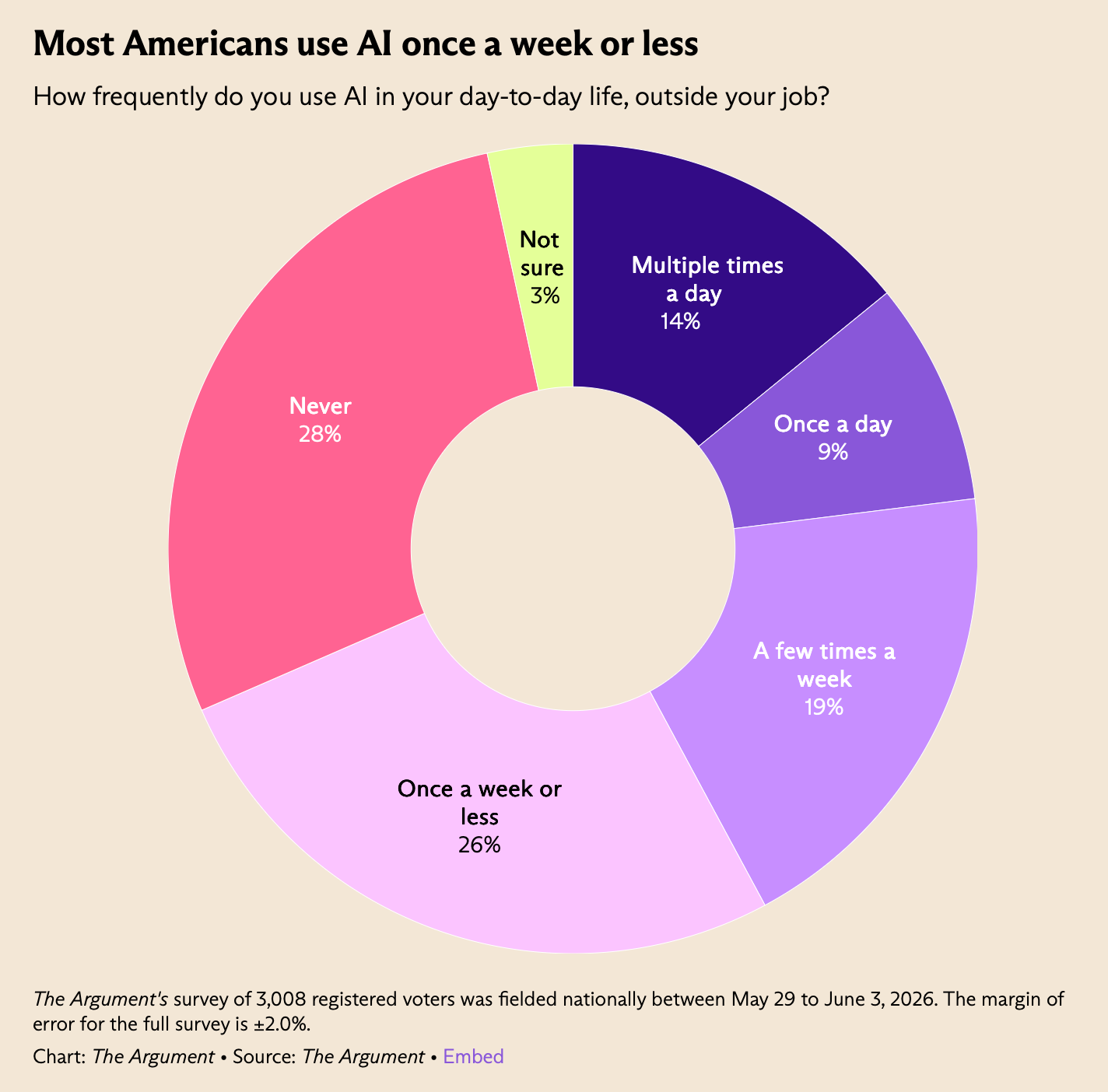
All of this triangulates to AI use in America at approximately one third actively using AI, one third occasionally using AI, and one third never using AI, with some movement depending on how you define those terms. In any case, this split is a far cry from “everyone is using AI for everything;” it’s much closer to “some people are using AI for some things.” AI use also hasn’t shifted that much in the past six months to a year. In fact, the only thing that has substantially changed is negative sentiment about AI has gone significantly up, for example the Gallup’s Gen Z poll reporting anger about AI jumping about 40% relative year over year.
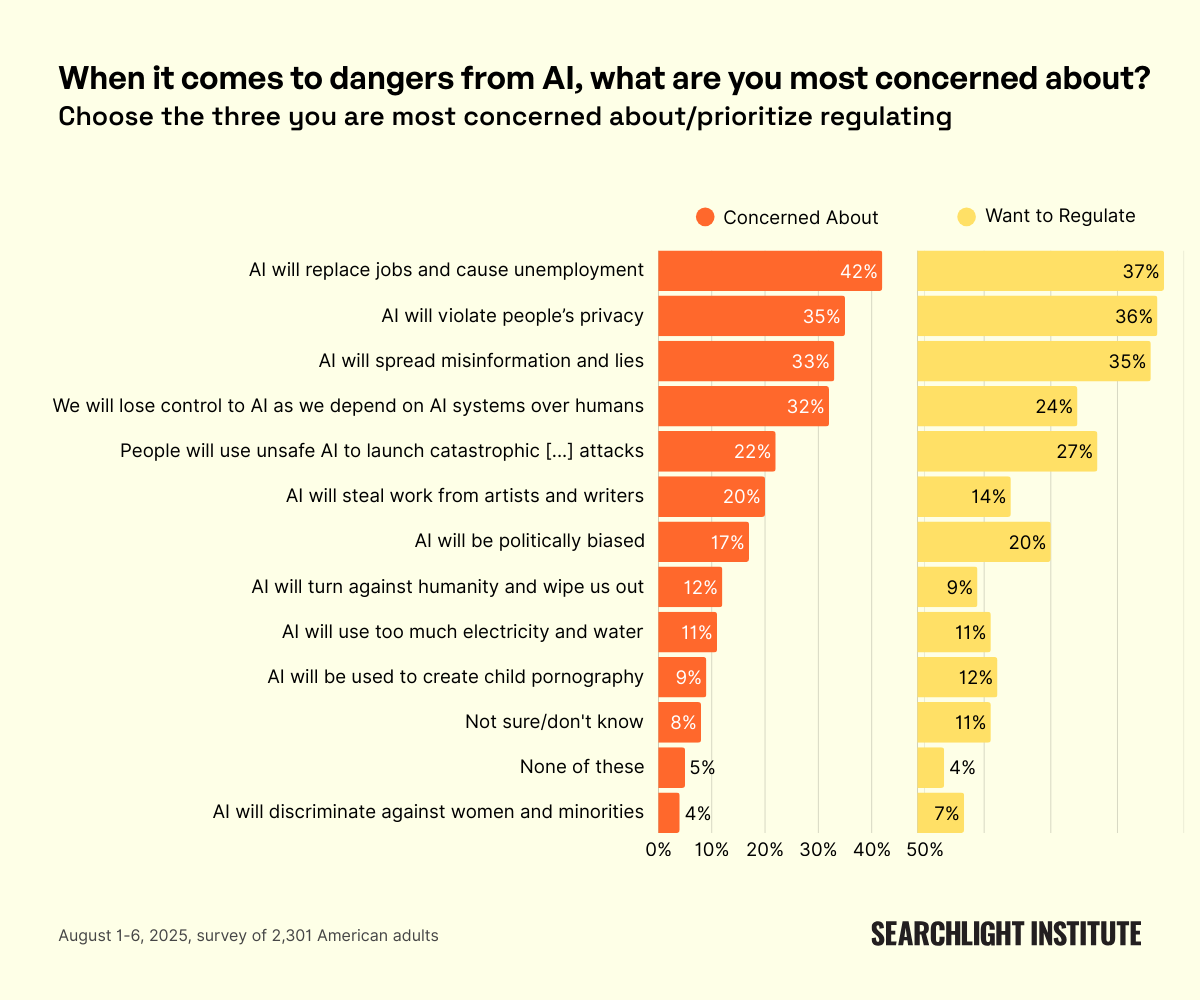
I think it is a reasonable conclusion to draw from all of this data that a significant percentage of the population is actively limiting their AI usage. The Searchlight study examines a big reason why: real concerns people have with AI. The top three concerns found are “AI will replace jobs and cause unemployment” (42%), "AI will violate people’s privacy” (35%), and “AI will spread misinformation and lies” (33%).
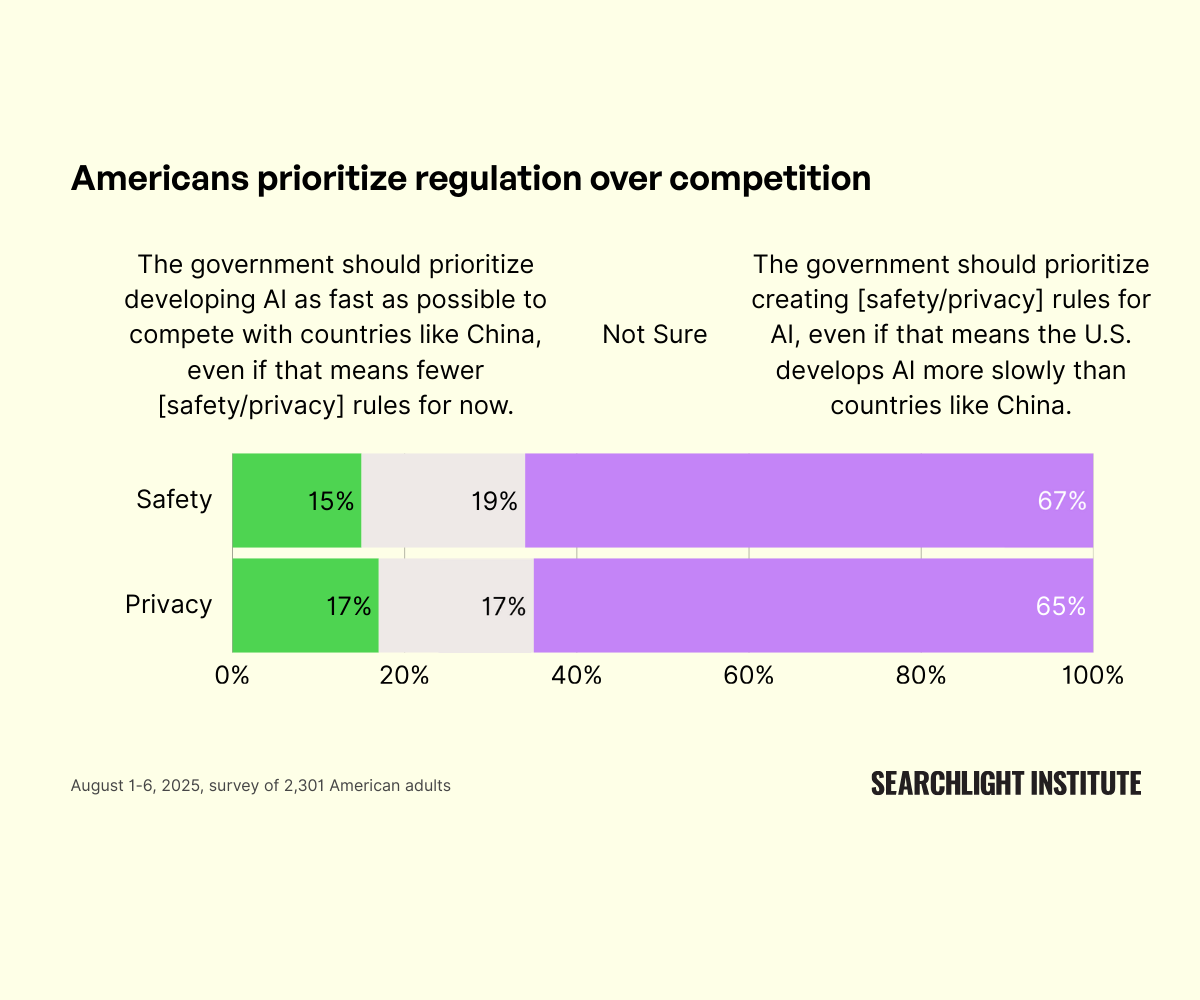
This sentiment also matches a strong desire for safety/privacy AI regulation. A solid majority thinks “the government should prioritize creating safety/privacy rules for AI, even if that means the U.S. develops AI more slowly than countries like China.”
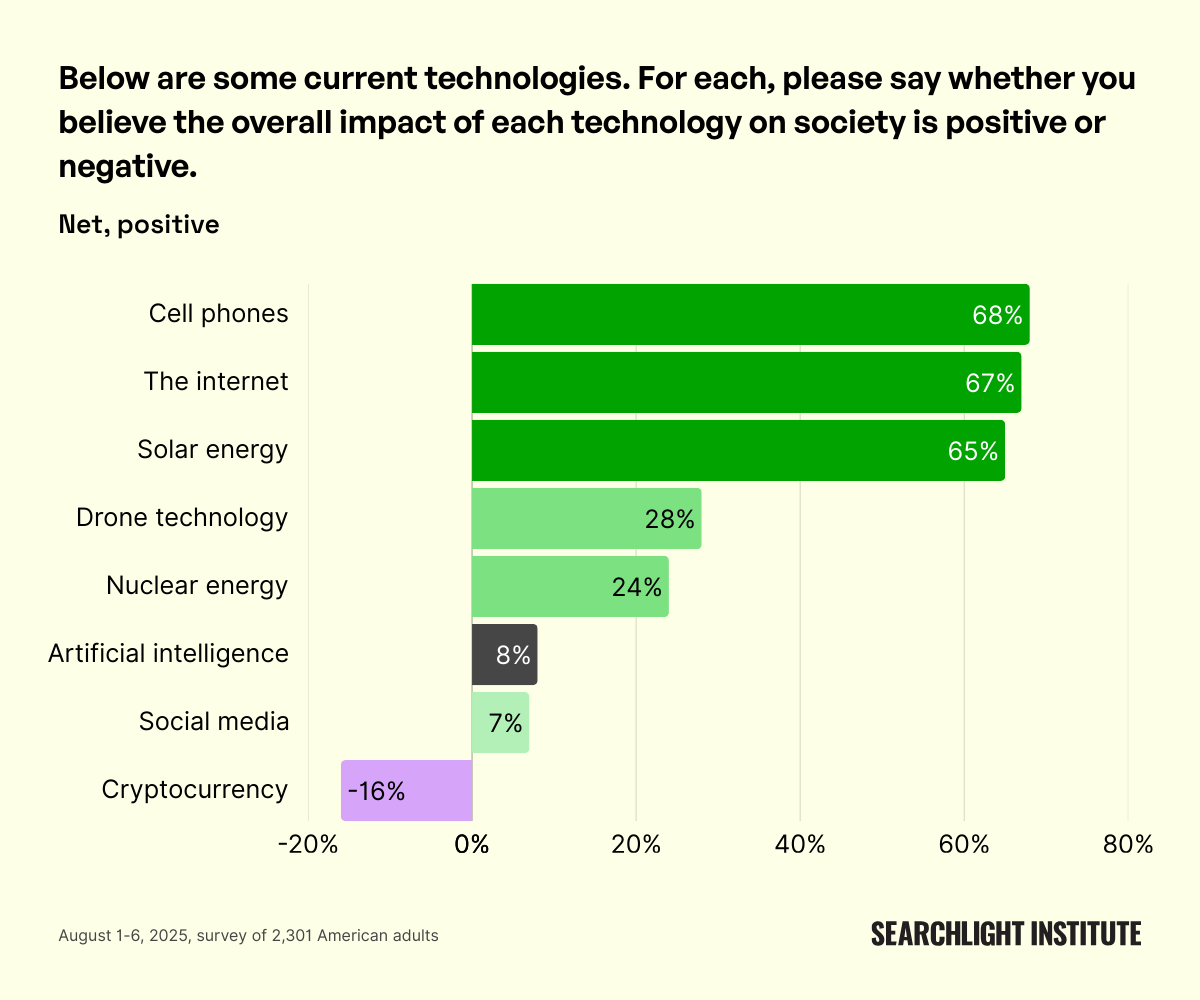
Another big reason is skepticism in AI usefulness. SearchLight asked about a range of technologies and to say “whether you believe the overall impact of each technology on society is positive or negative.” AI only has an +8% net positive rating right now, right next to +7% for social media, which were only greater than crypto at -17%. Meanwhile cell phones, the internet, and solar energy are at +68%, +67%, and +65%, respectively.
The Argument study broke this down further, asking about specific societal benefits from AI, finding broad skepticism and concluding “people aren’t really buying the bullish case for AI that CEOs and boosters alike are selling. In other words, the skepticism about AI’s effects is real and deep-running. And given how many people use it daily, this is not just an ill-informed set of opinions on something respondents have never seen before (like tariffs were before 2025).”
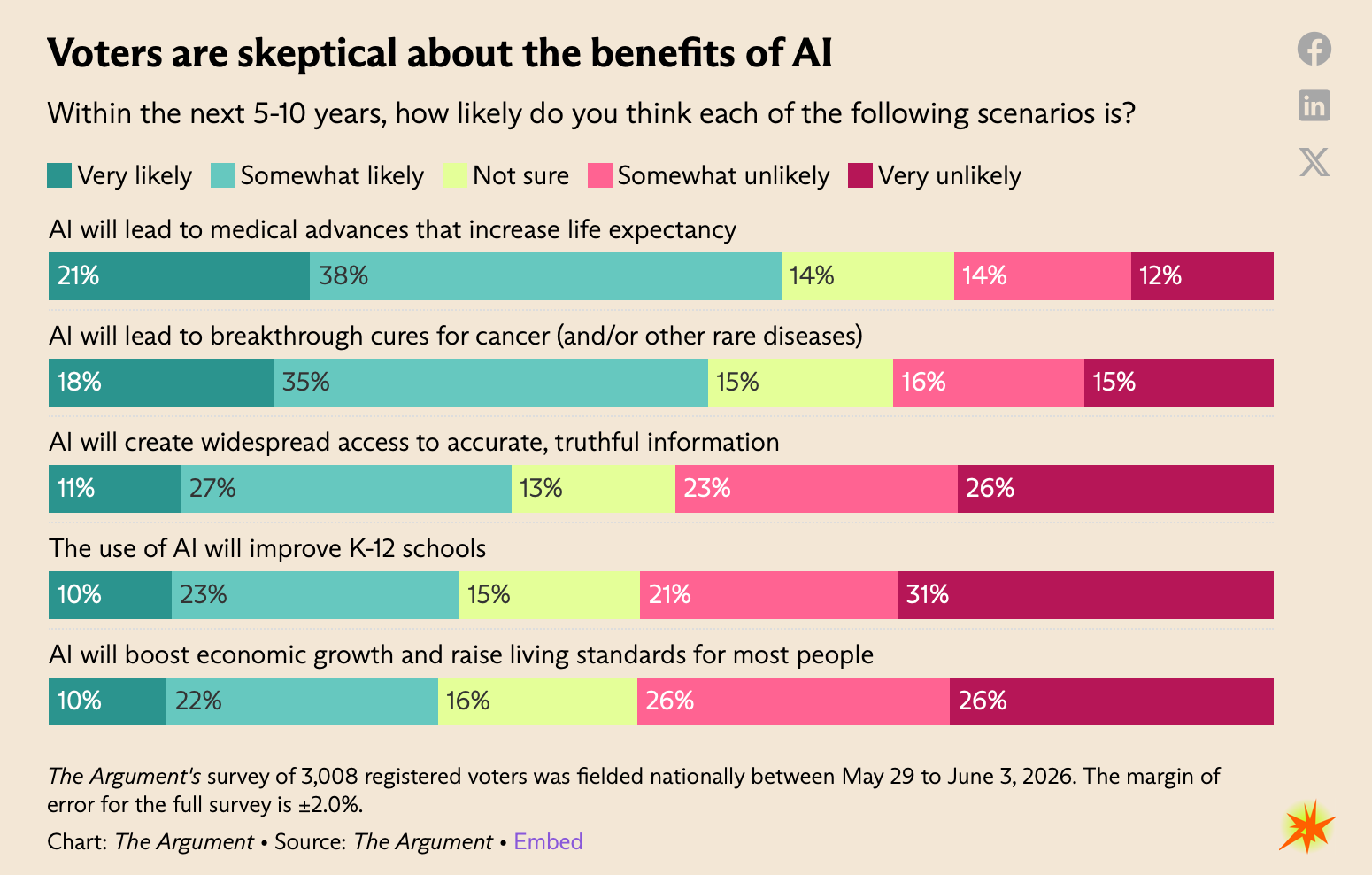
It is possible for people to have one view at a societal level and then act differently at an individual level, but that does not seem to be what we’re seeing here. The plurality occasional usage and large percentage of complete avoidance speaks to the fact that a lot of people seemingly aren’t yet finding enough individual value net of their concerns to justify daily or even weekly usage. The gap in media narrative (that everyone is using AI for everything) relative to the reality (that some people are using AI for some things) perhaps reflects a bubble around early-adopting knowledge workers that includes much of the tech press (and me for that matter, though I’m trying really hard to stay connected to reality).
It’s a mistake for companies, pundits, and policy makers to ignore how people are really feeling and acting about AI. It’s not all sunshine and rainbows. It’s also clearly not binary (all use or no use), but instead a continuum of AI opinions and use, with a lot of people in the middle.
I think there is an apt analogy to be made here to preferences around meat consumption. Another thing that seems to be everywhere right now is protein. Telling us how important protein is in our diet is analogous to telling us how useful AI is for productivity. And, meat being a primary source of protein is analogous to AI chat tools being a primary source of generative AI. And yet here’s how Americans break down in terms of their meat consumption preferences, based on a handful of U.S. studies from this decade:
95% eat meat (Gallup, 2023)
70% report reducing red meat consumption (Rutgers, 2024)
30% eat (all) meat only rarely/occasionally (Gallup, 2020)
12% don’t eat red meat (Nature, 2026)
4% don’t eat any meat, that is are vegetarian (Gallup, 2023)
1% don’t eat any animal products, that is are vegan (Gallup, 2023)
That is, not everyone eats meat, a majority actively curbs their consumption of red meat, and a significant percentage don’t eat it at all. Different people have different (not mutually exclusive) reasons for limiting their meat consumption, including health, cost, environment, and ethics. Those are all also primary concerns for AI consumption!
The analogy also highlights market opportunities to appeal to people across the continuum, speaking to their feelings on AI and addressing their particular AI concerns. For example, we (at DuckDuckGo) make all AI features optional and one of those features, duck.ai, is a private chatbot alternative that helps address AI privacy concerns. To extend the analogy in this way, we’re a restaurant with a variety of options on the menu, from healthy meat dishes (private AI) to vegetarian (turn down AI) to vegan dishes (turn off AI), which most eaters across the spectrum can appreciate.
Does this mean about one third of the population is bound to use AI only rarely/occasionally forever? No. Unlike with meat, the AI technology landscape is changing so rapidly that it is very unclear both where AI products and regulations will end up. Product evolution could make AI more useful to the average person, and regulations could reduce concerns. However, we can say that, as of right now, a meaningful percentage of the population has tried the current state of AI and has decided to actively limit their use of it.
此内容由惯性聚合(RSS阅读器)自动聚合整理,仅供阅读参考。 原文来自 — 版权归原作者所有。