

惯性聚合 高效追踪和阅读你感兴趣的博客、新闻、科技资讯
阅读原文 在惯性聚合中打开

推荐订阅源

让小产品的独立变现更简单 - ezindie.com
Microsoft Azure Blog
大猫的无限游戏
大猫的无限游戏
月光博客
月光博客
V
V2EX
PCI Perspectives
PCI Perspectives
Latest news
Latest news
博客园 - 三生石上(FineUI控件)
C
CERT Recently Published Vulnerability Notes
W
WeLiveSecurity
Last Week in AI
Last Week in AI
奇客Solidot–传递最新科技情报
奇客Solidot–传递最新科技情报
P
Palo Alto Networks Blog
T
The Exploit Database - CXSecurity.com
K
KPMG report finds enterprise disconnect between AI and its ROI | CIO
cs.AI updates on arXiv.org
WordPress大学
WordPress大学
V
Vulnerabilities – Threatpost
H
Heimdal Security Blog
Attack and Defense Labs
cs.CV updates on arXiv.org
Hacker News: Ask HN
Hacker News: Ask HN
博客园 - 叶小钗
V
Visual Studio Blog
Jina AI
Jina AI
P
Proofpoint News Feed
罗磊的独立博客
SecWiki News
SecWiki News
J
Java Code Geeks
freeCodeCamp Programming Tutorials: Python, JavaScript, Git & More
L
LINUX DO - 热门话题
Security Archives - TechRepublic
The Hacker News
The Hacker News
Hugging Face - Blog
Hugging Face - Blog
N
News and Events Feed by Topic
NISL@THU
NISL@THU
T
Tailwind CSS Blog
T
Tenable Blog
Recent Commits to openclaw:main
Recent Announcements
H
Hacker News: Front Page
Exploit-DB.com RSS Feed
T
Tor Project blog
宝玉的分享
宝玉的分享
Help Net Security
Help Net Security
S
Security Affairs
Microsoft Security Blog
Google DeepMind News
F
Fortinet All Blogs
G
GRAHAM CLULEY

Hacker News: Best

madhadron - The seven programming ur-languages GitHub - smol-machines/smolvm: Tool to build & run portable, lightweight, self-contained virtual machines. I Measured Claude 4.7's New Tokenizer. Here's What It Costs You. Introducing Claude Design by Anthropic Labs It Is Time to Ban the Sale of Precise Geolocation The creative software industry has declared war on Adobe Isaac Asimov: The Last Question Newly unsealed records reveal Amazon’s price-fixing tactics, California attorney general claims Clojure - Documentary Android CLI and skills: Build Android apps 3x faster using any agent Qwen3.6-35B-A3B on my laptop drew me a better pelican than Claude Opus 4.7 Codex for almost everything Introducing Claude Opus 4.7 Qwen Studio The Future of Everything is Lies, I Guess: Where Do We Go From Here? Virginia Bans Sale of Geolocation Data YouTube now lets you turn off Shorts Burgers | マクドナルド公式 ChatGPT for Excel Ask HN: Who is using OpenClaw? Live Nation illegally monopolized ticketing market, jury finds Google Broke Its Promise to Me. Now ICE Has My Data. Open Source Isn't Dead. The Future of Everything is Lies, I Guess: New Jobs Unexpected €54k billing spike in 13 hours: Firebase browser key without API restrictions used for Gemini requests IPv6 – Google Your Backpack Got Worse On Purpose Good sleep, good learning, good life Fixing a 20-year-old bug in Enlightenment E16. Does Gas Town 'steal' usage from users' LLM credits & paid services to improve itself? Tell HN: Fiverr left customer files public and searchable Cybersecurity Looks Like Proof of Work Now Getting the Flock out Release OpenSSL 4.0.0 · openssl/openssl Internet será irrespirable los días de fútbol y otros deportes. Telefónica extiende los bloqueos a Champions, tenis y golf. Automate work with routines - Claude Code Docs The Future of Everything is Lies, I Guess: Work Thousands of rare concert recordings are landing on the Internet Archive — listen now What is jj and why should I care? Backblaze has quietly stopped backing up your data Cal.com Goes Closed Source: Why AI Security Is Forcing Our Decision | Cal.com - Scheduling Software for Online Bookings Codex Hacked a Samsung TV The Future of Everything is Lies, I Guess: Safety GitHub - sterlingcrispin/nothing-ever-happens: Polymarket bot that buys "No" on all non-sports markets. For entertainment only, mostly a meme. Make tmux Pretty and Usable - Ham Vocke Microsoft isn't removing Copilot from Windows 11, it's just renaming it Servo is now available on crates.io - Servo aims to empower developers with a lightweight, high-performance alternative for embedding web technologies in applications. We May Be Living Through the Most Consequential Hundred Days in Cyber History, and Almost Nobody Has Noticed All elementary functions from a single binary operator 奈拜提耶市 Seven countries now generate 100% of their electricity from renewable energy Pro Max 5x Quota Exhausted in 1.5 Hours Despite Moderate Usage Tell HN: docker pull fails in spain due to football cloudflare block Bring Back Idiomatic Design @adlrocha - How the "AI Loser" may end up winning Apple update turns Czech mate for locked-out iPhone user Cache TTL silently regressed from 1h to 5m around early March 2026, causing quota and cost inflation The peril of laziness lost AI Will Be Met With Violence, and Nothing Good Will Come of It Center for Responsible, Decentralized Intelligence at Berkeley The disturbing white paper Red Hat is trying to erase from the internet – OSnews The Future of Everything is Lies, I Guess: Annoyances 447 Terabytes per Square Centimetre at Zero Retention Energy: Non-Volatile Memory at the Atomic Scale on Fluorographane Show HN: Pardonned.com – A searchable database of US Pardons 20 Years on AWS and Never Not My Job Artemis II crew splashes down near San Diego after historic moon mission Molotov Cocktail Is Hurled at Home of Sam Altman, OpenAI’s CEO France to ditch Windows for Linux to reduce reliance on US tech On filing the corners off my MacBooks Installing every* Firefox extension Chimpanzees in Uganda locked in vicious 'civil war', say researchers linux/Documentation/process/coding-assistants.rst at master · torvalds/linux GitHub - callumlocke/json-formatter: Makes JSON easy to read. A compelling title that is cryptic enough to get you to take action on it GitHub - Keychron/Keychron-Keyboards-Hardware-Design: Industrial design files for Keychron keyboards and mice. 100+ models with CAD assets in STEP, DXF, DWG, and PDF. Source-available, with commercial use allowed for original compatible accessories within the license terms. [ANNOUNCE] WireGuardNT v0.11 and WireGuard for Windows v0.6 Released 1D-Chess Helium Is Hard to Replace FBI used iPhone notification data to retrieve deleted Signal messages Microsoft suspends dev accounts for high-profile open source projects Why you can’t trust Privacy & Security Serenity Forge (@serenityforge.com) A new trick brings stability to quantum operations OpenAI Backs Bill That Would Limit Liability for AI-Enabled Mass Deaths or Financial Disasters Netflix Prices Went Up Again – I Bought a DVD Player Instead DOJ Wants to Scrap Watergate-Era Rule That Makes Presidential Records Public EFF is Leaving X How NASA built Artemis II’s fault-tolerant computer Meta removes ads for social media addiction litigation How Pizza Tycoon simulated traffic on a 25 MHz CPU Claude mixes up who said what, and that's not OK Reallocating $100/Month Claude Code spend to Zed and OpenRouter Help Keep Thunderbird Alive! Why Are Flock Employees Watching Our Children? The Pentagon Threatened Pope Leo XIV’s Ambassador With the Avignon Papacy Fragments: April 2 Native Instant Space Switching on MacOS Bitcoin miners are losing $19,000 on every BTC produced as difficulty drops 7.8% God sleeps in the minerals Apple Silicon and Virtual Machines: Beating the 2 VM Limit
Why TUIs are back by Alcides Fonseca
rickcarlino · 2026-05-04 · via Hacker News: Best

Terminal User Interfaces (TUIs) are making a comeback. DHH’s Omarchy is made of three types of user interfaces: TUIs, for immediate feedback and bonus geek points, webapps because 37signals (his company) sells SAAS web applications and the unavoidable gnome-style native applications that really do not fit well in the style of the distro.
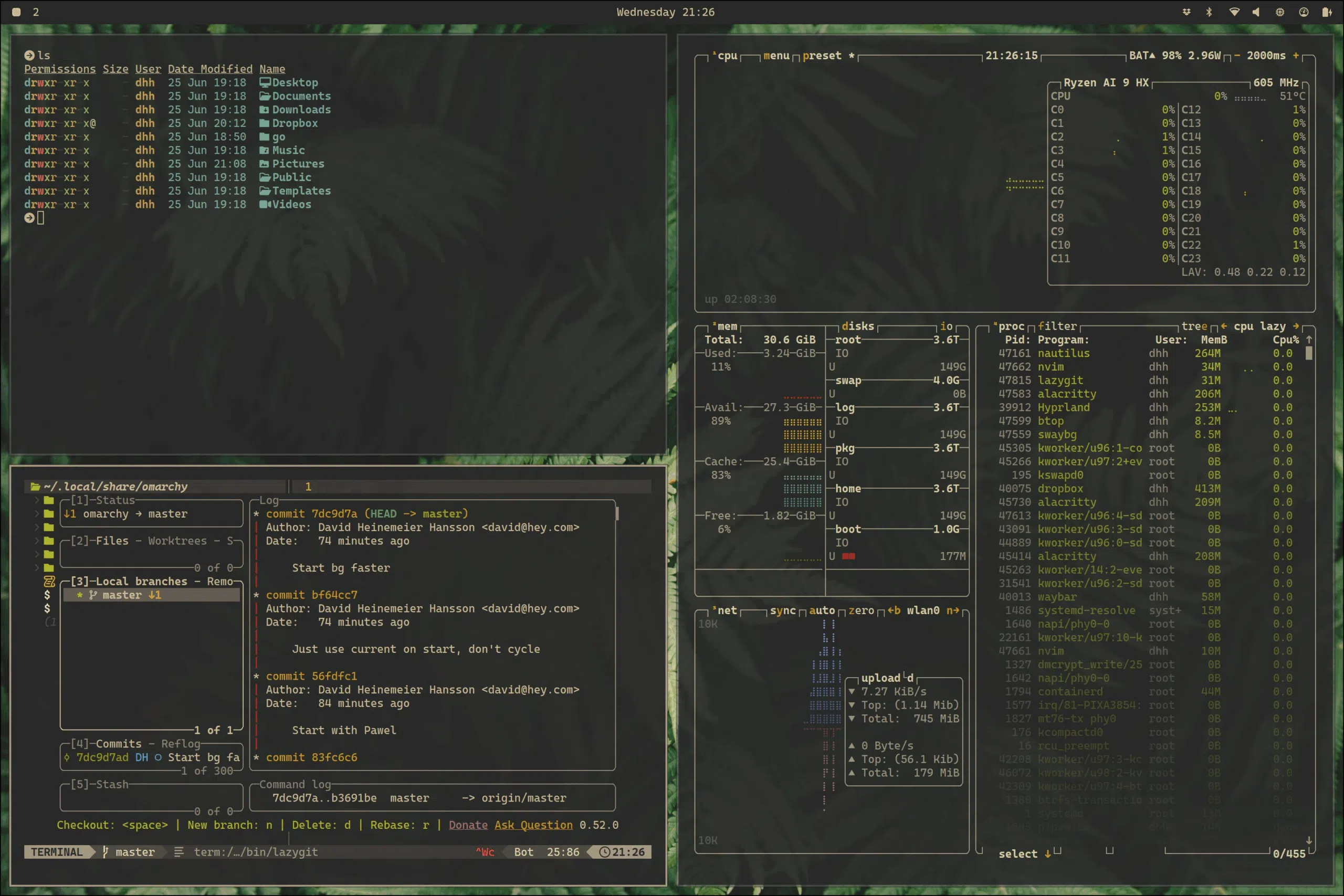
The same pattern occurred around 10 years ago in code editors. We came from the native editors of BBEdit, Textmate (also promoted by DHH), Notedpad++ and Sublime to Electro-powered apps like Atom, VSCode and all its forks. The hardcore, moved to vim or emacs, trading immediate feedback and higher usability for the steepest learning curve I’ve seen.

Windows

The lesson is clear: Native applications are loosing. Windows is doing the GUI library standard joke. Because one API does not have success, they make up another one, just for that one to fail within the sea of alternatives that exist.

MFC (1992) wrapped Win32 in C++. If Win32 was inelegant, MFC was Win32 wearing a tuxedo made of other tuxedos. Then came OLE. COM. ActiveX. None of these were really GUI frameworks – they were component architectures – but they infected every corner of Windows development and introduced a level of cognitive complexity that makes Kierkegaard read like Hemingway.

Jeffrey Snover, in Microsoft hasn’t had a coherent GUI strategy since Petzold

Since then, Microsoft has gone through Winforms, WPF, Silverlight, WinUIs, MAUI without success. Many enterprise and personal desktop application still rely on Electron Apps, and the last memory of coherent visual integration of the whole OS I have is of Windows 98 or 2000.

It turns out that it’s a lot of work to recreate one’s OS and UI APIs every few years. Coupled with the intermittent attempts at sandboxing and deprecating “too powerful” functionality, the result is that each new layer has gaps, where you can’t do certain things which were possible in the previous framework.

— Domenic Denicola, in Windows Native App Development Is a Mess

Linux

The UI inconsistency in Linux was created by design. Different teams wanted different outcomes and they had the freedom to do it. GTK and Qt became the two reigning frameworks. While Qt is most known for it, both aimed to support cross-platform native development (once upon a time, I successfully compiled gedit on Windows, learning a lot about C compilation, make files and environment variables in the process) but are only widely used in Linux land. Luckily, applications made in the different toolkits can look okay-ish next to each other, something that the different frameworks on Windows fail to achieve. How many engineer-hours does it take to redo the windows Control Panel?

Given the difficulty in testing the million different combinations of distros, desktop environments and hardware in general, most companies do not bother with a native Linux application — they either address it using electron (minting the lock-down), or they let the open-source community solve it self (when they have open APIs).

macOS

Apple used to be a one-book religion. Apple’s Human Interface Guidelines used to be cited by every User Interface course over the world. Xerox Park and Apple were the two institutions that studied what it means to have a good human interface. Fast forward a few decades, and Apple is doing the best worst it can to break all the guidelines and consistency it was known for.

Now, Apple has been ignoring Fitts’ law, making resizing windows near-impossible (even after trying to fix it) and adding icons to every single menu. MacOS is no longer the safe heaven where designers can work peacefully.

Electron

Everyone knows that the user experience of electron apps sucks. The most popular claim is the memory consumption, which to be fair has been decreasing over the last decade, but my main complaint (as I usually drive a 64GB RAM MacBook Pro) is the lack of visual consistency and lack of keyboard-driven workflows. Looking at my dock, I have 8 native apps (text mate and macOS system utilities) and 6 electron apps (Slack, Discord, Mattermost, VScode, Cursor, Plexampp). And that’s from someone who really wishes he could avoid having any electron app at all.

Let us take the example of Cursor (but would be true for VSCode as well). If you are in the agent panel, requesting your next feature, can you move to the agent list on the side panel with just the keyboard? Can you archive it? These are actions that should be the same across every macOS application, and even if there are shortcuts, they are not announced in the menus. And over the last decade, developers have been forgetting to add menus to do the same things that are available in their application (mostly because the application is HTML within its sandbox). For the record, Slack does this better than the others, but it’s not perfect.

Restarting from scratch

Together with Dart, Google wanted to design a new operating system, without all the legacy of Android, for new devices. It wanted a fresh UI toolkit (Flutter UI) but Google gave up on the project before a real product was launched. It’s one of those situations where having a monopoly (or a large enough slice of the market) is required to succeed.

Meanwhile, Zed did the same thing in Rust: they designed their own GPU-renderer library (wgpu) which is cross-platform. Despite the high-speed, it lacks integration with the host OS on itself, requiring the developers to add the right bindings. Personally, I would rather have a slow renderer that integrated with my OS than the extra speed.

TUIs

TUIs are fast, easy to automate (RIP Automator) and work reasonably well in different operating systems. You can even run them remotely without any headache-inducing X forwarding. When the native UI toolkits fail, we go back to basics. Claude and Codex have been very successful on the command-line: you focus on the interaction and forget about the operating system around you. You can even drive code and apps on cloud machines, or remote into your GPU-powered machine from your iPad. TUIs are filling the void left by Apple and Microsoft in the post-apocalyptic world where every application looks different. Which is good if you are doing art (including computer games), but not if your goal is to get out of the way of letting the user do their job.

What’s next

A checkbox is also part of an interface. You’re using it to interact with a system by inputting data. Interfaces are better the less thinking they require: whether the interface is a steering wheel or an online form, if you have to spend any amount of time figuring out how to use it, that’s bad. As you interact with many things, you want homogeneous interfaces that give you consistent experiences. If you learn that Command + C is the keyboard shortcut for copy, you want that to work everywhere. You don’t want to have to remember to use CTRL + Shift + C in certain circumstances or right-click → copy in others, that’d be annoying.

John Loeber in Bring Back Idiomatic Design

We need to go back to the basics. Every developer should learn the theory of what makes a good User Interface (software or not!), like Nielsen, Norman or Johnson, and stop treating User Design as a soft skill that does not matter in the Software Engineering Curriculum. In any course, if the UI does not make any sense, the project should be failed. And in the HCI course, we should aim for perfect UIs. It takes work, but that work is mostly about understanding what we need. The programming is already being automated.