





Most of us accept rats as a fact of life. They live in tunnels and sewers, gnaw through walls, contaminate food, and resist nearly every attempt to push them back. A 2023 estimate put New York City’s rat population at about three million animals, roughly one rat for every three human residents. Almost nowhere do authorities try to get rid of rats altogether. The goal is usually to reduce sightings of them, limit the damage they cause, and coexist as painlessly as possible.
That makes one place stand out. Alberta, a Canadian province, is rat free, and has been for more than seventy years. On a map of global rat distribution, Alberta is a blank spot in an otherwise unbroken sea of rodents.
Get the print magazine
Subscribe for $100 to receive six beautiful issues per year.
Subscribe
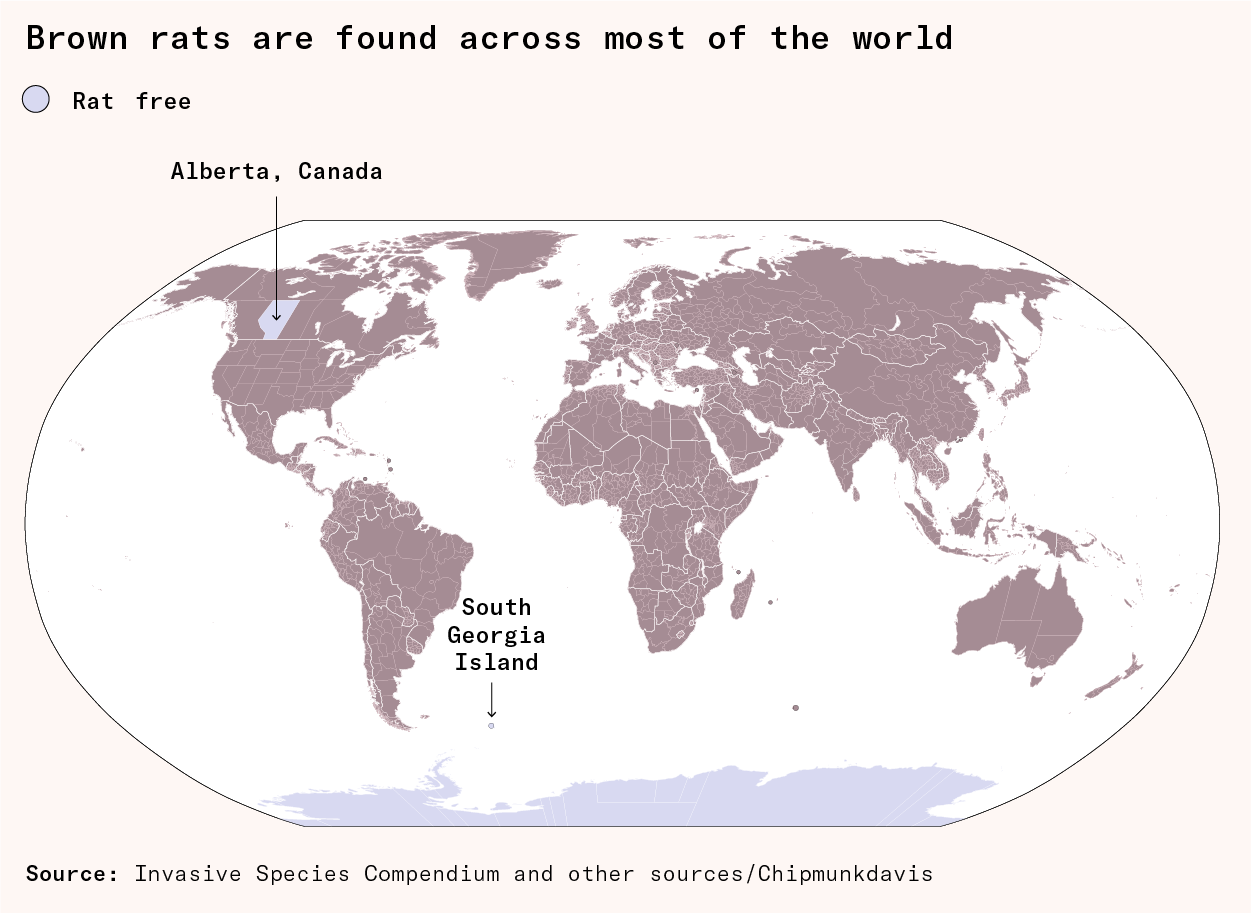
Other places have eliminated rats too: South Georgia and a handful of New Zealand islands have done so to protect endangered birds. But these are tiny, uninhabited landmasses surrounded by ocean, with no permanent human population to speak of. Alberta, by contrast, has almost five million people and two cities of over a million each. It shares land borders on all sides with provinces and states that rats colonized in the 1950s, and its farmland and trade links make it an obvious target. Yet it stopped them. After Antarctica, Alberta is the largest rat-free area on Earth.
This half a million square kilometres of rat-free land exists because Alberta acted fast. Rats could only enter the province through a narrow corridor along its eastern border, which the government sealed before they could establish themselves. Had it waited, the opportunity would have been gone for good – like its neighbors, Alberta would now be spending millions a year managing a permanent infestation. It’s also an example of the day-to-day maintenance that civilization is built of: Alberta’s rat control program is in a never-ending fight against new incursions. If it were to lapse, the province’s rat-free status would be lost forever.
An invasive species
Rats are not native to the Americas. The first rat, the black rat, travelled across the Atlantic with the conquistadors, and slowly spread through Central America and the Caribbean, and into the port cities of North America’s eastern seaboard. But around 1775, a stronger competitor showed up: the Norway rat, Rattus norvegicus, also known as the brown rat or sewer rat, carried across the Atlantic on European ships. Bigger, stronger, and better adapted to colder climates, it rapidly displaced the black rat as the dominant rodent in North America.
Once Norway rats move in alongside people, they are very hard to get rid of. They live in our buildings, eat what we throw away, and can have 50 to 80 surviving young a year. Rats can overrun an area in months, and once they have, controlling them becomes a permanent, expensive job. New York City, for instance, has a dedicated ‘rat czar’ and spends $4.7 million per year directly on rat mitigation, but this is not enough to prevent rat populations from growing.
In the decades after their arrival, Norway rats entrenched themselves in major Atlantic ports like New York, Boston, and Philadelphia, where they lived in dense housing, warehouses, and wharves. As cities grew during the industrial revolution, the animals moved along railroads, and settled across North America. By the end of the nineteenth century, the Norway rat was endemic in most large cities.
Norway rats reached the countryside more slowly, but just as surely. Beginning in the 1920s, Norway rats moved steadily westward across the North American prairie, advancing roughly 24 kilometers per year through the Canadian province of Saskatchewan by hitchhiking between towns with human travelers on cars, trucks, and trains.
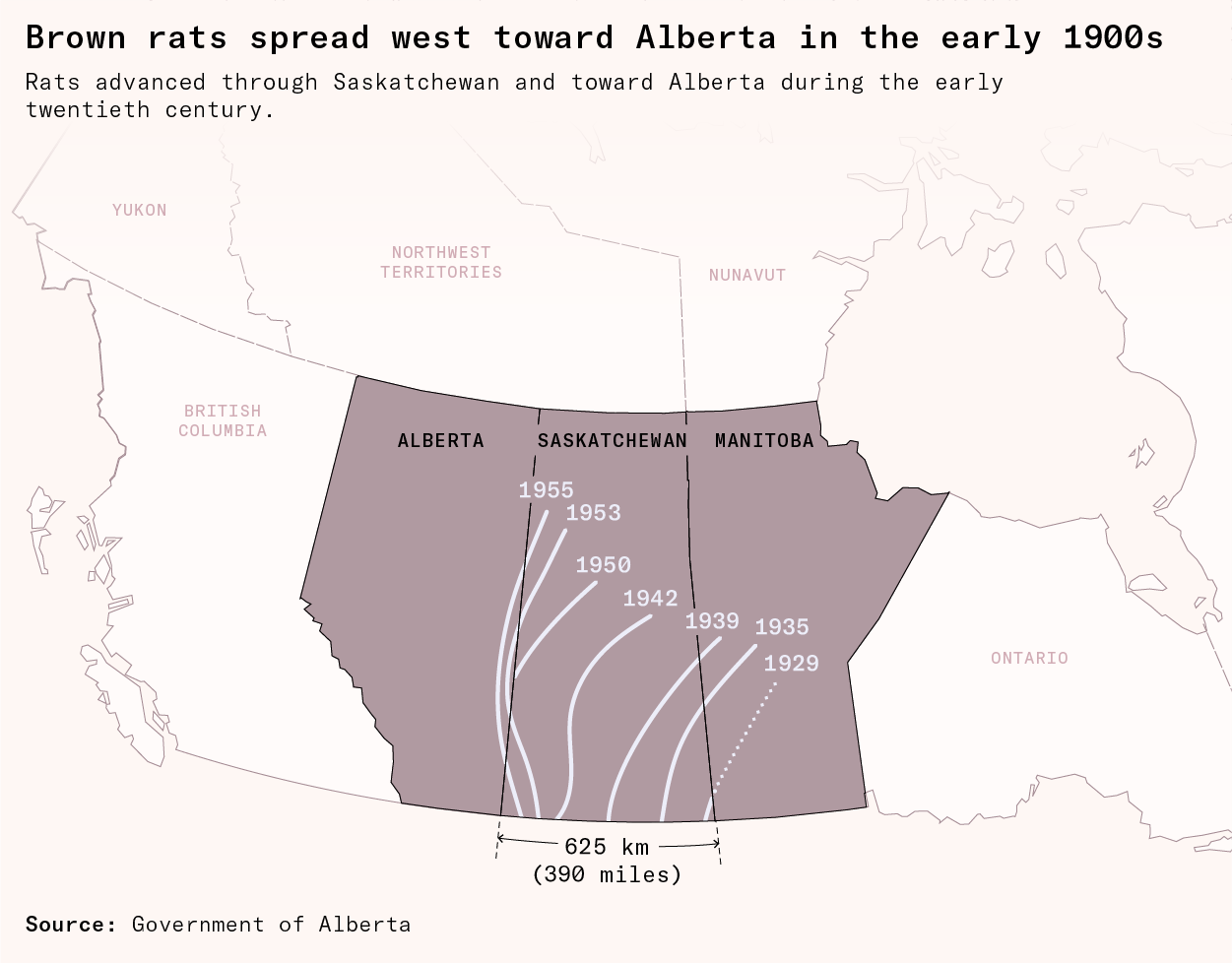
After crossing Saskatchewan, the rats would reach Alberta, whose farms were close to a perfect home: warm, full of grain, and almost free of predators. Once settled in Alberta, rat populations would have exploded and destroyed crops, gnawed through infrastructure, contaminated food, and spread disease.
So when field crews from Alberta’s Department of Health studying sylvatic plague (caused by the same bacterium responsible for bubonic plague in humans) in local gopher populations discovered Norway rats on a farm near the eastern border in 1950, the Alberta government declared an emergency and decided to try to stop the rats’ westward march.
The Rat Control Zone
Rather than attempting to manage rats everywhere, the Albertans concentrated their efforts where the rat invasion was most likely to originate. Rats could enter the province only from Saskatchewan, as Montana was too sparsely populated, the Northwest Territories were too cold, and the border with British Columbia was too mountainous.
William Lobay, a crop protection supervisor at the Alberta Department of Agriculture, came up with the idea of a buffer zone focused on the area of prairie and parkland that was most vulnerable to penetration. In late 1950, Albertan officials approved his Rat Control Zone, a roughly 600-by-29-kilometer strip along the part of its eastern border with Saskatchewan. In the zone, William Lobay and his colleagues surveyed cargo and vehicles that entered the province, and inspected vulnerable sites like farms, grain elevators, feed stacks, barns, sheds, and abandoned buildings, where food and shelter made rat establishment most likely.
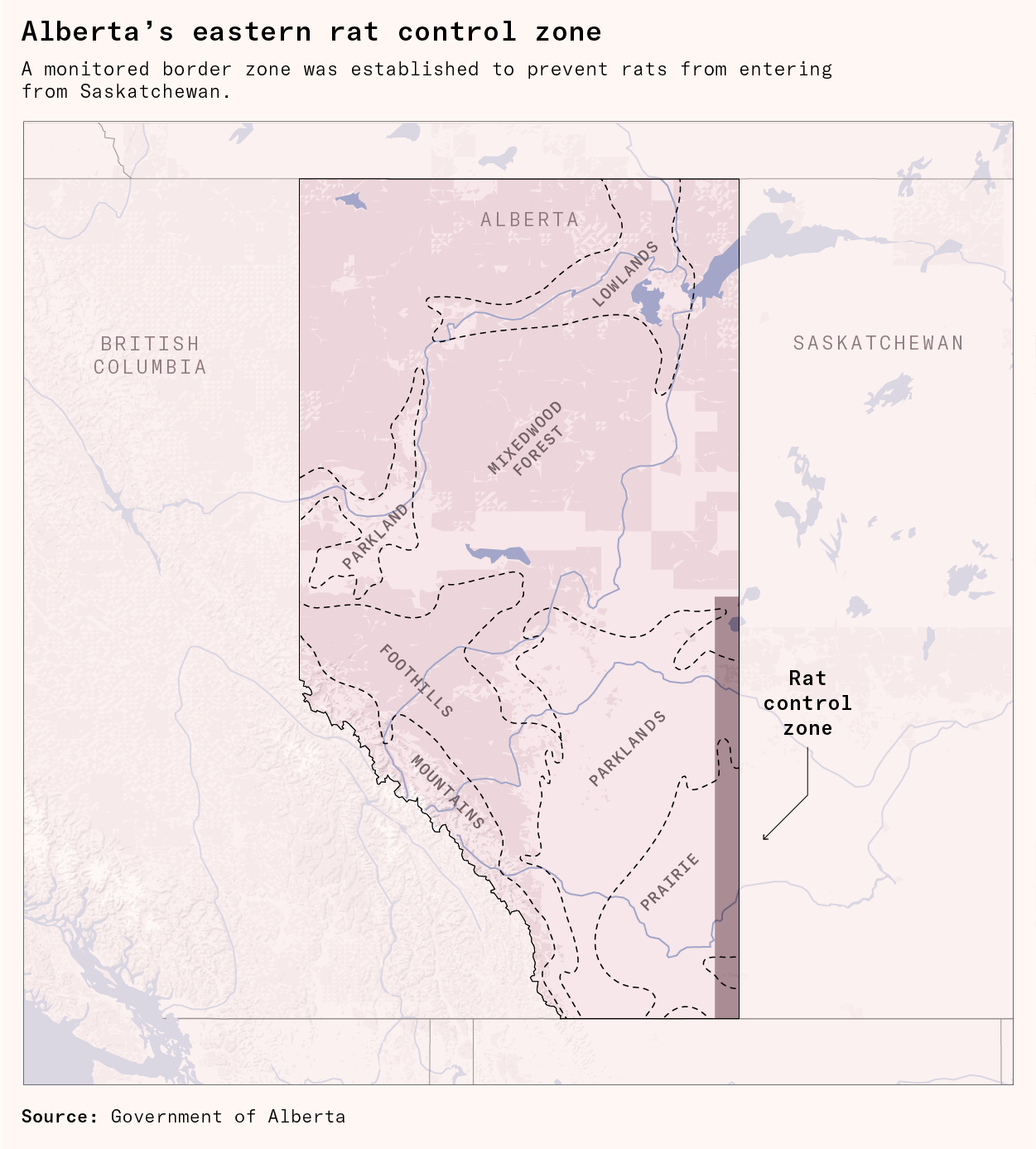
When the rats did appear in Alberta, they tried to enter where Lobay predicted. Officials identified 30 rat infestations along 180 kilometers of the state’s eastern border in the fall of 1951. By the following year, rats had spread across 270 kilometers of the border. While most infestations were found very near the border, staying within 10 to 20 kilometers, in three areas, rats had penetrated 50 kilometers into the interior.
In this case, the fact that Norway rats are so dependent on humans was an opportunity. Along much of the Alberta-Saskatchewan border, farms, grain yards, and towns are spaced far enough apart, and the intervening prairie is sufficiently harsh and exposed, that small groups of rats rarely survived long enough to hop naturally from one farm to the next and then into Alberta.
Most rats entering the province and spreading within it were traveling with people, hidden in trucks, trailers, rail cars, farm equipment, or shipments of hay or grain. The Rat Control Zone made regular inspections manageable. Instead of defending its entire land border, which would have spread Alberta’s resources over 100,000 square kilometers of zone, Albertan officials could target a single point of entry 17,400 square kilometers in size.
The rodent surveillance state
Yet a narrow border helps only if incursions are detected quickly, before the rats get a chance to spread past it. Early on, Alberta had almost no way of doing this. Albertan officials had to distribute preserved rat corpses to local train inspectors: most Albertans had never been in contact with rats before so needed to be shown what to look for. In 1951, the province reassigned five employees previously assigned to weed inspection to provide on-the-ground assistance to municipal pest control inspectors. Agents from the Saskatchewan Department of Health familiar with rats and rat control helped train them.
This arrangement raised a funding question. Initially, the rural municipalities along Alberta’s eastern border were responsible for funding most of the day-to-day costs of rat control, even though their work protected the entire province indirectly. In 1954, after significant pressure from these municipalities, the province agreed to cover half the salary and expenses of a full-time pest control inspector in each border municipality.
Once inspectors had been trained, officials could create what amounted to a rodent surveillance state. Its central pillar was a program of seasonal and annual visits to high-risk sites in the zone, even when nobody had reported a rat. The province also relied on the public to provide additional surveillance. It invested in posters, a radio show called ‘Call of the Land’ put on by the agriculture department, and hotlines for residents to report any suspected rat sightings. The aim was to catch the rats before they could breed and establish themselves.
The campaign borrowed Cold War rhetoric about ‘infiltration from the east’ and the need for constant vigilance against hidden enemies. Archival posters from the 1950s depict Alberta as a clean, clearly bounded province surrounded by swarms of ominous rats massed just beyond its borders, warning that disaster would follow if citizens ‘let down their guard’.
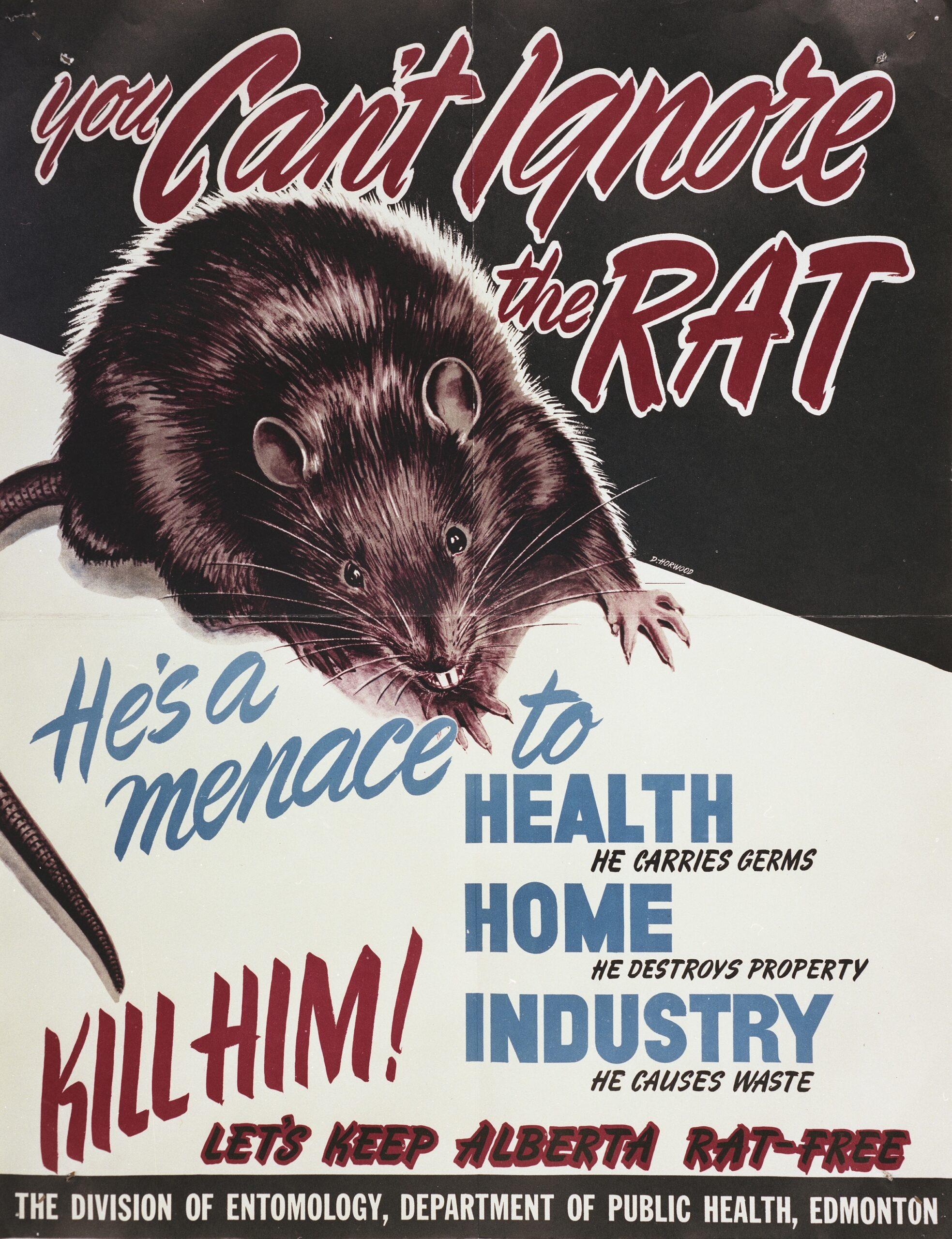
An Albertan anti-rat poster from the late 1940s.
Image
Government communications called Alberta’s eradication efforts a ‘War on Rats’, and official documents spoke of invaders and enemies, urging residents to report and eliminate rats on sight. Not everyone initially bought into rat eradication. One mayor refused to cooperate because he thought the program was a distraction cooked up by the ruling United Conservative Party. Another disagreed that rats were present at all, claiming he would eat any found in his town. He changed his mind when presented with a bushel of rats caught at a local slaughterhouse. Over time, public support for the effort grew, widening inspectors’ reach, especially in rural areas.
Eratication
Alberta introduced a law so that ‘every person and municipality’ was obliged to destroy rats they found, and local government was required to send out pest control inspectors to look for them. As the September 21 1955 issue of the Red Deer Advocate, a local paper in Alberta, reported:
Full-time Municipal and Provincial pest officers are engaged in an active rat war to control these pests and prevent their westward movement. Generally very good cooperation is obtained…Occasional indifference, however, may give the pest officer no option but to apply disciplinary measures.
The following year, the province issued 17 notices to control rats, leading to three convictions, the first of which was a farmer in the Altario district who was fined C$25, about C$290 today, for ‘failing to take action to control rats on his property…after repeated warnings and no positive work done’. After 1956, enforcement actions became rare, but so did sightings, suggesting the cases had had their intended effect.
Beginning in 1952, Alberta contracted a private pest control firm to preemptively deploy over 63,000 kilograms of arsenic trioxide tracking powder to treat 8,000 barns, sheds, granaries, and outbuildings across the Rat Control Zone. After treatment, the exterminators returned to kill any survivors.
Only enclosed, permanent structures were supposed to be treated, to ensure that the poison wouldn’t spread. In practice, powder was applied in temporary sheds and outbuildings which might later be moved, opened, or taken down. As a result, some livestock and pets were harmed or killed by the large-scale poisoning, particularly in the first few years of the program. Though there is no data from this period showing actual impact on humans, arsenic exposure is known to pose acute and chronic risks, including gastrointestinal illness, neurological effects, and increased cancer risk.
Some residents were reportedly told the poison posed risks only to rodents, even as Alberta Agriculture sent annual warning letters to all control zone residents until 1955 advising of the dangers of arsenic to humans, animals, and pets. In hindsight, some of this harm was avoidable: stricter controls on application, clearer labeling, and more aggressive site cleanup could likely have reduced exposure.
Warfaring
Alberta’s early campaign used very blunt tools in exchange for certainty that rats would not be allowed to establish a breeding population. Within a few years, reported infestations had halved, from about 600 in 1959 to 300 in 1963. But taking a preventative rather than a responsive approach meant higher upfront financial costs: the initial poisoning program cost C$152,670, or roughly C$1.75 million (USD $1.3 million) today. It also meant accepting a certain level of risk to human and animal health.
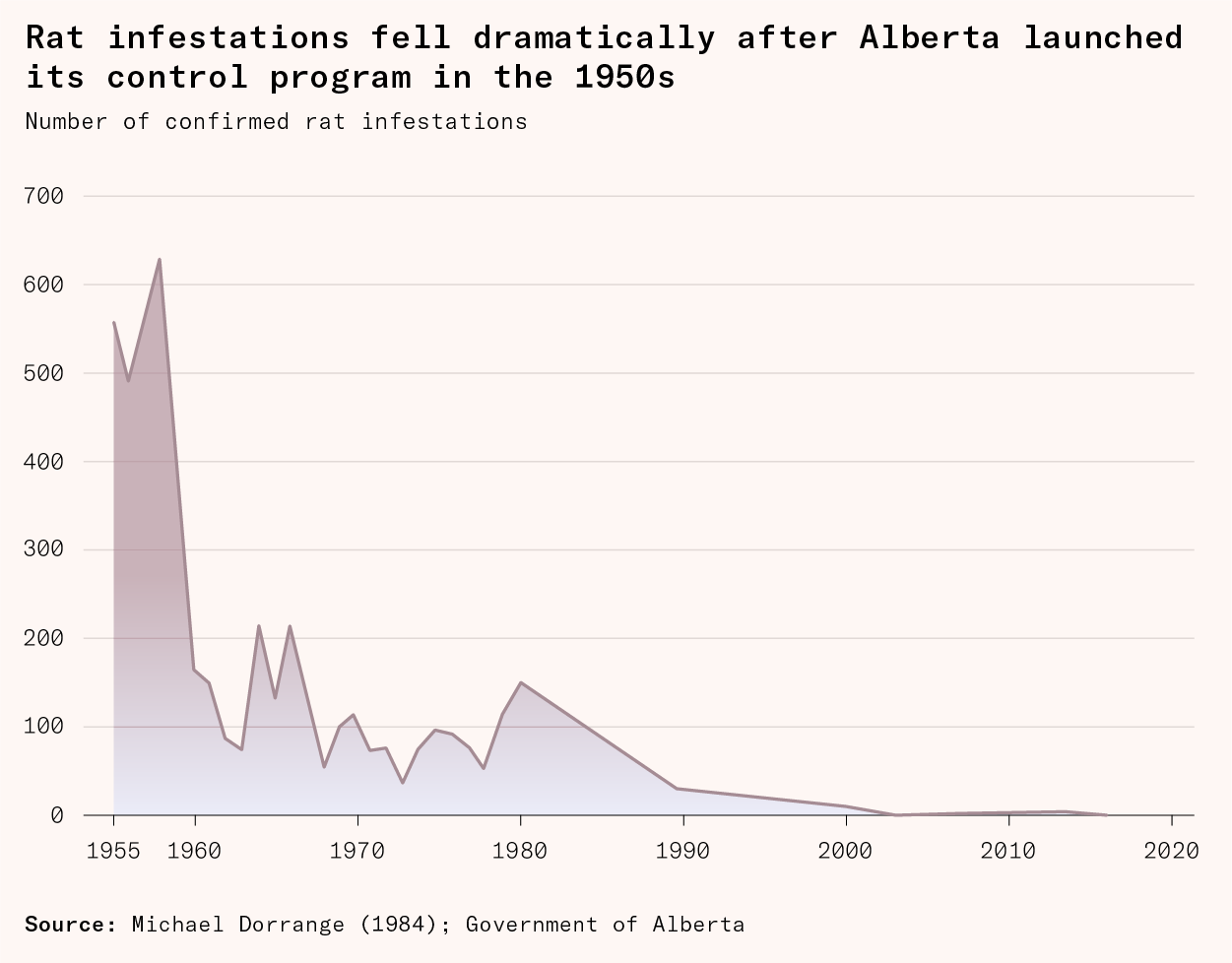
Going all out against rats in the first few years bought time to develop the capacity for long-term control. Today, the neighboring province of Saskatchewan spends about C$1.2 million each year on its rat control program, and yet it continues to be thoroughly infested with rats, which cause over C$15 million a year in agricultural damage. Alberta now spends only around C$500,000 per year on rat control, and has negligible costs from rat damage.
Eventually, arsenic was supplanted by the arrival of warfarin, a much better poison. Warfarin is a slow-acting anticoagulant which causes death by internal bleeding. This avoids the problem of rats associating the bait with sickness, so they eat until consuming a lethal dose. It is also significantly safer for other animals or humans who might accidentally ingest it; it is actually approved as a blood-thinning medicine in humans at doses that would be fatal to a rat.
Warfarin was developed in Wisconsin, where finely ground corn was the recommended pairing. As corn was not commonly grown in Alberta, rats rarely took the bait. A series of field trials showed that coarsely rolled oats with five percent icing sugar provided an equally toothsome alternative. Starting in 1953, the province supplied warfarin-laced rat bait to all municipalities in the control zone.
Alberta was lucky that warfarin was invented. Indigenous Canadians in particular were not fans of rats, but because they were only familiar with poisons like strychnine, which can cause serious health issues in humans, they removed baits stocked with warfarin out of fear of potential health harms. But it was easy to prove warfarin was safe: a pest control officer held a series of local meetings where he ate warfarin-treated rolled oats while discussing rat control.
The rat race
The last ingredient was, and still is, persistence.‘There’s this misconception when we say we’re rat free that rats don’t get in’, Karen Wickerson, the head of the Alberta Rat Control Program today, explains. ‘We have no way to prevent them from getting into the province. We can’t physically inspect every vehicle’. The province remains rat free only because it continues to do what worked in the 1950s.
Alberta’s rat reporting systems still operate. A resident who spots a rat in their yard can report it, and even a single such report can be enough to launch a wide investigation. Provincial officials have received unexpected tips of pet rats (which naturally are illegal in the province) from social media posts. In one case, officials tracked down an illicit pet rat by identifying its owner through photos posted online, eventually tracing the car in the background by its license plate. In another, they helped a woman who was reported by an ex-boyfriend for having a pet rat to rehome it in the neighboring province of British Columbia. But wild rats are rare. Albertans have grown so unaccustomed to rats that they frequently mistake squirrels, gophers, and other small animals for them: of the 875 reported sightings in 2025, only 47 turned out to be actual rats.
Seven municipalities along the Alberta-Saskatchewan border continue to have full-time pest control officers that inspect the thousands of buildings in the Rat Control Zone at least annually. Pest control officers respond to all reports. The only thing that has changed is the funding. Over time, the provincial government has picked up more and more of the bill. Although the costs have risen over time, from C$58,000 in 1969 to around C$500,000 today, rat control still costs each inhabitant less than C$0.11 each year.
New rats keep coming from infested neighbors, and cross-border coordination continues to play a big part in reducing rat numbers. Lloydminster straddles the Alberta-Saskatchewan border, and both provinces have extended Alberta's pest laws to cover the Saskatchewan half of the city. Saskatchewan launched its own rat control program in 1963, which cut the number crossing into Alberta. In exchange, Alberta shares municipal employees to work on rat control in Saskatchewan.
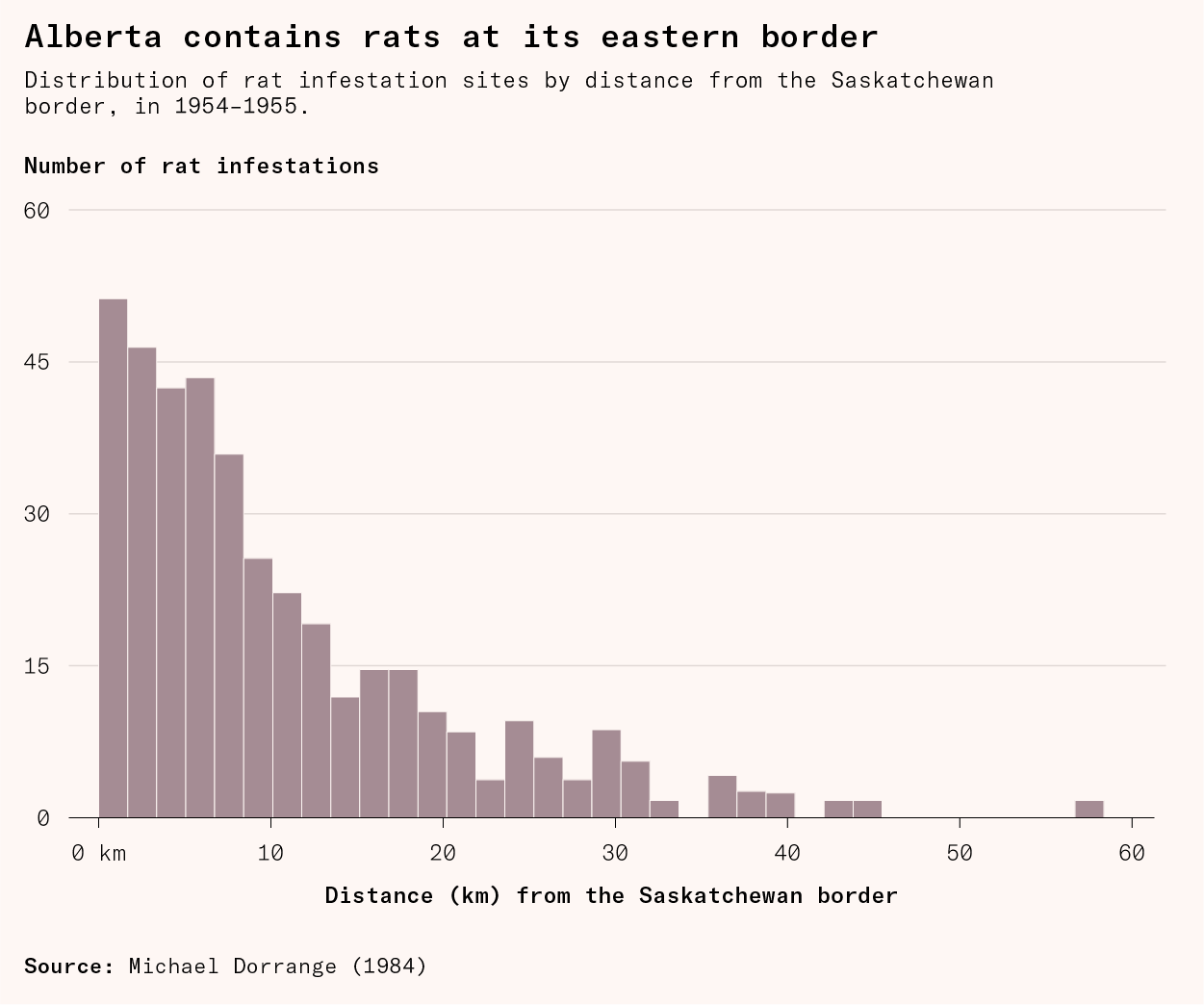
Alberta's war on rats never quite ends in victory. Even after years of no major sightings, the province has kept its surveillance, reporting systems, and legal powers active. Rats continue to cross into the province. But so long as none establish a breeding population, the program continues to work.