








Published: June 17, 2026
Featured Content
This year marks the fifth anniversary since Juneteenth became a Federal holiday in 2021

Juneteenth, also known as Freedom Day or Emancipation Day, is an important holiday celebrated annually on June 19th. It holds significant historical and cultural importance in the United States, marking the emancipation of enslaved African Americans.
Juneteenth commemorates 160 years since Union General Gordon Granger arrived in Galveston, Texas, on June 19, 1865, to announce the end of slavery. This proclamation, known as General Order No. 3 , declared that all slaves were now free almost two and a half years after the Emancipation Proclamation had been issued. Juneteenth symbolizes the belated arrival of freedom to the enslaved African American community and serves as a reminder of the struggles they endured.
On June 17, 2021, after decades of advocacy by activists and legislators, President Biden signed into law the Juneteenth National Independence Day Act, Public Law 117-17, making Juneteenth a Federal holiday. This landmark decision marked a crucial step in acknowledging and honoring the African American experience and the ongoing struggle for racial equality.
Search GovInfo for Presidential Statements and Remarks in the Congressional Record related to Juneteenth.
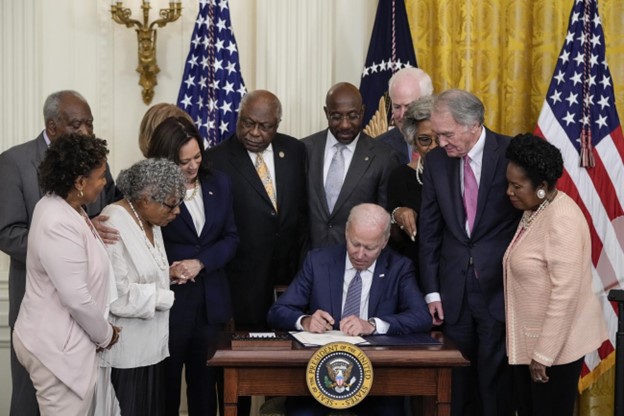
U.S. President Joe Biden signs the Juneteenth National Independence Day Act into law in the East Room of the White House on June 17, 2021. Source: National Museum of African American History and Culture
As Juneteenth gains widespread recognition, it provides an opportunity for education and reflection on the history of slavery and the ongoing struggle for racial equality. Schools, museums, and community organizations hold discussions, workshops, and exhibits to promote understanding and dialogue about the legacy of slavery and its impact on society.
Have you heard of Opal Lee, Grandmother of Juneteenth?
 Opal Lee has spent her life committed to liberty and justice for all. She is called "Grandmother of Juneteenth" because of her tireless efforts spent raising awareness for Juneteenth and the importance of recognizing this historic day. In September 2016, she walked from her home in Texas to Washington, D.C., to inspire others to support her cause. Along her journey, she celebrated her 90th birthday. In 2022, for her lifetime commitment to this effort, she was nominated for a Nobel Peace Prize. Read more about her story and her gardening at Opal's Farm to help feed her community on the United States Department of Agriculture's farmers.gov blog.
Read remarks in the Congressional Record acknowledging Opal Lee for her Juneteenth efforts.
Additional Resources
- Check out the National Archives' blog "Rediscovering Black History About Rediscovering Black History, Juneteenth: The Celebration of a New Freedom in America" to understand how geography, military occupation, timing, and the resilience of a proud people solidified June 19, 1865, as the date that symbolizes freedom for African Americans.
- Explore the Smithsonian’s Juneteenth website to learn more about the history of Juneteenth, share your Juneteenth story, and find activities for children and youth.
- Find additional resources related to African American History on the National Archives' website.
- Listen to "Voices Remembering Slavery: Freed People Tell Their Stories" on the Library of Congress website to hear recordings of those enslaved that took place between 1932 and 1975 in nine states. The individuals documented in this presentation share their accounts of living as African Americans from the 1870s to the 1930s and beyond.
About Featured Content Articles - This series of articles aims to highlight content available in GovInfo related to various national observances, commemorations, anniversaries and more. See more featured content articles.