惯性聚合 高效追踪和阅读你感兴趣的博客、新闻、科技资讯
阅读原文 在惯性聚合中打开

推荐订阅源

爱范儿
爱范儿
T
The Blog of Author Tim Ferriss
G
Google Developers Blog
博客园_首页
博客园 - 【当耐特】
量子位
S
SegmentFault 最新的问题
B
Blog RSS Feed
酷 壳 – CoolShell
酷 壳 – CoolShell
V
Visual Studio Blog
T
Tailwind CSS Blog
阮一峰的网络日志
阮一峰的网络日志
V
V2EX
Y
Y Combinator Blog
博客园 - 聂微东
The Cloudflare Blog
小众软件
小众软件
J
Java Code Geeks
freeCodeCamp Programming Tutorials: Python, JavaScript, Git & More
月光博客
月光博客
H
Help Net Security
Jina AI
Jina AI
钛媒体:引领未来商业与生活新知
钛媒体:引领未来商业与生活新知
宝玉的分享
宝玉的分享

ICLR Blog

Making Google’s Paper Assistant Tool (PAT) available to ICLR submitters Submission policies for ICLR 2027 Announcing the ICLR 2026 Outstanding Papers – ICLR Blog Announcing the Test of Time Awards from ICLR 2016 – ICLR Blog Announcing the ICLR 2026 keynotes – ICLR Blog A Retrospective on the ICLR 2026 Review Process – ICLR Blog ICLR’s Commitment to OpenReview – ICLR Blog ICLR 2026 Response to Security Incident – ICLR Blog ICLR 2026 Response to LLM-Generated Papers and Reviews – ICLR Blog Policies on Large Language Model Usage at ICLR 2026 – ICLR Blog ICLR 2025 Mentoring Chats – ICLR Blog
Workshops at ICLR 2026 – ICLR Blog
Carl Vondrick · 2026-01-13 · via ICLR Blog

Workshop Chairs: Andre Araujo, Adji Bousso Dieng, Nezihe Merve Gürel, Yanan Sui

TLDR:

  • 151 (135 valid) workshop proposal submissions
  • 40 accepted workshops
  • Efforts by ICLR 2026 Workshop Chairs & Reviewers
  • Workshops on April 26 and 27, 2026

Accepted Workshops at ICLR 2026 (ordered by submission ID)

ICLR 2026 Workshop on AI with Recursive Self-Improvement
Catch, Adapt, and Operate: Monitoring ML Models Under Drift
AI for Peace
AI for Mechanism Design and Strategic Decision Making (AIMS)
Workshop on Multi-Agent Learning and Its Opportunities in the Era of Generative AI
Representational Alignment (Re$^4$-Align)
The 2nd Workshop on Foundation Models for Science: Real-World Impact and Science-First Design
Learning Meaningful Representations of Life (LMRL) Workshop @ ICLR 2026
ICLR 2026 Workshop on Memory for LLM-Based Agentic Systems (MemAgents)
2nd Workshop on World Models: Understanding, Modelling and Scaling
Agentic AI in the Wild: From Hallucinations to Reliable Autonomy
Lifelong Agents: Learning, Aligning, Evolving
Latent & Implicit Thinking – Going Beyond CoT Reasoning
3rd Workshop on Navigating and Addressing Data Problems for Foundation Models (DATA-FM)
VerifAI-2: The Second Workshop on AI Verification in the Wild
New Frontiers in Associative Memories
Unifying Concept Representation Learning
ReALM-GEN: Real-World Constrained and Preference-Aligned Flow- and Diffusion-based Generative Models
Deep Generative Model in Machine Learning: Theory, Principle and Efficacy 2nd Workshop
Algorithmic Fairness Across Alignment Procedures and Agentic Systems
Geometry-grounded Representation Learning and Generative Modeling
4th ICLR Workshop on Machine Learning for Remote Sensing
AI&PDE: ICLR 2026 Workshop on AI and Partial Differential Equations
AI4MAT-ICLR-2026: ICLR 2026 Workshop on AI for Accelerated Materials Design
The 2nd Workshop on Advances in Financial AI Workshop: Towards Agentic and Responsible Systems
Workshop on Scaling Post-training for LLMs (SPOT)
Machine Learning for Genomics Explorations (MLGenX)
Agents in the Wild: Safety, Security, and Beyond
Integrating Generative and Experimental Platforms for Biomolecular Design
I Can’t Believe It’s Not Better: Where Large Language Models need to improve
1st ICLR Workshop on Time Series in the Age of Large Models
Scientific Methods for Understanding Deep Learning (Sci4DL)
The First Workshop on Efficient Spatial Reasoning (ES-Reasoning @ ICLR 2026)
Principled Design for Trustworthy AI: Interpretability, Robustness, and Safety Across Modalities
Generative AI in Genomics (Gen^2): Barriers and Frontiers
From Human Cognition to AI Reasoning: Models, Methods, and Applications
Post-AGI Science and Society Workshop
Workshop on Logical Reasoning of Large Language Models
ICLR 2026 Workshop on Multimodal Intelligence: Next Token Prediction and Beyond
The 3rd Workshop on Test-Time Updates (TTU)

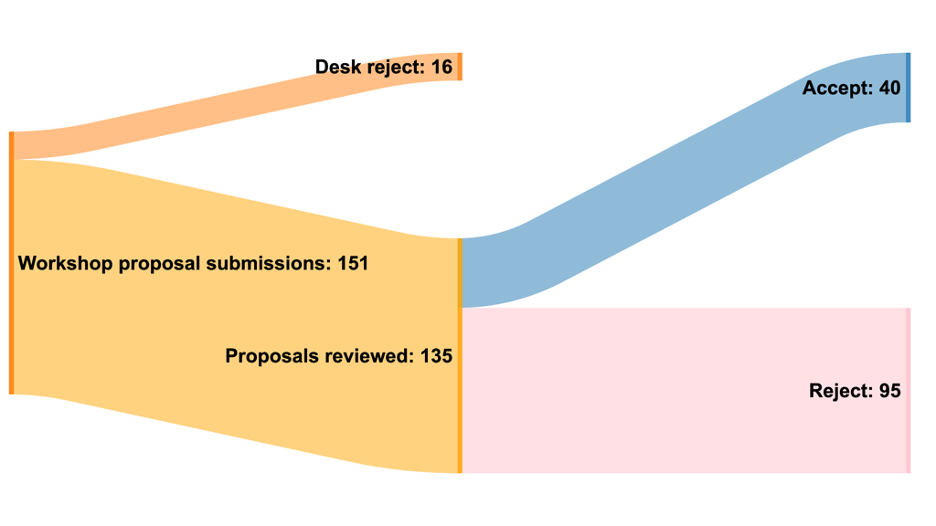
We thank everyone who prepared and submitted a workshop proposal to ICLR 2026. We were impressed by the quality of the proposals. This year, we received an unprecedented number of 135 valid submissions and were able to accept 40 proposals based on the number of available rooms in the conference venue. We particularly want to thank our team of reviewers.

Selection Process

Working within the workshop space allocation in Rio de Janeiro, the workshop chairs worked to balance multiple goals. Workshop organizers were provided with guidance criteria for proposals, including hard workshop requirements including COI management, participation limits, platforming contributed work, Tiny Paper track support, in-person planning, and LLM usage policy. Reviewers were asked to check these criteria. Each proposal received at least three reviews. All reviews and scores were checked by workshop chairs for fairness and errors. The high-ranking proposals were further evaluated on the softer selection criteria. In particular, workshop chairs aimed to ensure diversity – same topics, speakers, and organizers are not heavily recurring across multiple workshops. Final decisions and reviews were then released to authors. More details will be presented at the conference town hall.

All organizers are recommended to follow the honor code and do not add new organizers(proposal authors) or change titles after submission. We recommend workshops to follow the same LLM Usage Policies for ICLR 2026 main conference.

Figure 1: Flow of workshop decisions for ICLR 2026. Diagram made with support by Jonas Lorenz’s Sankey script.


The topics of ICLR 2026 workshops range over Agentic Systems, Alignments, Continual Learning, Generative Models, Memory, Reasoning, Applications, etc. – a diverse set of representation learning advances.

ICLR 2026 Workshops in Numbers

  • 151: workshop proposal submissions (vs 122 in 2025, 1.24x increase)
  • 417: reviews submitted by 74 workshop proposal reviewers

  • 40: accepted workshops 
  • 16: desk rejected proposals (incomplete/irrelevant proposals)
  • 95: reviewed and rejected proposals

Workshops will be held on April 26 and 27, 2026. We look forward to supporting you in making your workshop a success. See you all in Rio de Janeiro!

Figure 2: Comparison of proposal submissions and accepts ICLR 2024, 2025 and 2026.