

惯性聚合 高效追踪和阅读你感兴趣的博客、新闻、科技资讯
阅读原文 在惯性聚合中打开

推荐订阅源

L
Lohrmann on Cybersecurity
I
Intezer
M
MIT News - Artificial intelligence
博客园 - 【当耐特】
Martin Fowler
Martin Fowler
G
GRAHAM CLULEY
Jina AI
Jina AI
Engineering at Meta
Engineering at Meta
AI
AI
SecWiki News
SecWiki News
C
Cybersecurity and Infrastructure Security Agency CISA
IT之家
IT之家
D
Darknet – Hacking Tools, Hacker News & Cyber Security
T
The Blog of Author Tim Ferriss
P
Proofpoint News Feed
S
Security Affairs
CTFtime.org: upcoming CTF events
Microsoft Azure Blog
P
Proofpoint News Feed
cs.CV updates on arXiv.org
Google DeepMind News
H
Hacker News: Front Page
爱范儿
爱范儿
F
Fortinet All Blogs
大猫的无限游戏
大猫的无限游戏
V
V2EX
H
Help Net Security
The Hacker News
The Hacker News
G
Google Developers Blog
Latest news
Latest news
cs.CL updates on arXiv.org
T
Tor Project blog
宝玉的分享
宝玉的分享
博客园 - 司徒正美
H
Heimdal Security Blog
OSCHINA 社区最新新闻
OSCHINA 社区最新新闻
MyScale Blog
MyScale Blog
S
SegmentFault 最新的问题
C
Cisco Blogs
Blog — PlanetScale
Blog — PlanetScale
S
Security @ Cisco Blogs
B
Blog RSS Feed
B
Blog
奇客Solidot–传递最新科技情报
奇客Solidot–传递最新科技情报
Google Online Security Blog
Threat Intelligence Blog | Flashpoint
Cyberwarzone
Cyberwarzone
L
LINUX DO - 最新话题
K
Kaspersky official blog
MongoDB | Blog
MongoDB | Blog

Google adds end-to-end Gmail encryption to Android, iOS devices for enterprises | CSO Online

Die besten DAST- & SAST-Tools CISA mulls new three-day remediation deadline for critical flaws CISA pushes critical infrastructure operators to prepare to work in isolation CISOs step up to the security workforce challenge 10 Anzeichen für einen schlechten CSO Anthropic Mythos spurs White House to weigh pre-release reviews for high-risk AI models Security agencies draw red lines around agentic AI deployments The fake IT worker problem CISOs can’t ignore How CISOs should utilize data security posture management to inform risk Was ist ein Botnet? Human-centric failures: Why BEC continues to work despite MFA Just 34% of cyber pros plan to stick with their current employer Managing OT risk at scale: Why OT cyber decisions are leadership decisions 4 ways to prepare your SOC for agentic AI ‘Trivial’ exploit can give attackers root access to Linux kernel Bank regulator sounds warning over cybersecurity threat posed by AI models Dismantle implicit trust in OT networks, CISA tells critical infrastructure operators Max-severity RCE flaw found in Google Gemini CLI Stopping the quiet drift toward excessive agency with re-permissioning ODNI to CISOs on threat assessments: You’re on your own 10 wichtige Security-Eigenschaften: So setzen Sie die Kraft Ihres IT-Sicherheitstechnik-Teams frei Researchers unearth industrial sabotage malware that predated Stuxnet by 5 years AWS leans on prior ingenuity to face future AI and quantum threats What it takes to win that CSO role Third Party Risk Management: So vermeiden Sie Compliance-Unheil Critical Cursor bug could turn routine Git into RCE Securing RAG pipelines in enterprise SaaS What CISOs need to get right as identity enters the agentic era Stopping AiTM attacks: The defenses that actually work after authentication succeeds EDR-Software – ein Kaufratgeber Microsoft patched an ‘agent-only’ role that was not AI is reshaping DevSecOps to bring security closer to the code The 'manager of agents': How AI evolves the SOC analyst role 4 Wege aus der Security-Akronymhölle New US House privacy bills raise hard questions about enterprise data collection Scattered Spider co-conspirator pleads guilty Security-KPIs und -KRIs: So messen Sie Cybersicherheit Bitwarden CLI password manager trojanized in supply chain attack 3 practical ways AI threat detection improves enterprise cyber resilience The curious case of Sean Plankey’s derailed CISA nomination Google gets agent-ready for the Mythos age Google drafts AI agents secure systems against AI hackers CNAPP – ein Kaufratgeber Riddled with flaws, serial-to-Ethernet converters endanger critical infrastructure NFC tap-to-pay gets tapped by hackers Anthropic bets on EPSS for the coming bug surge SBOM erklärt: Was ist eine Software Bill of Materials? Thousands of Apache ActiveMQ instances still unpatched, weeks after an actively exploited hole discovered Prompt injection turned Google’s Antigravity file search into RCE Why identity is the driving force behind digital transformation Top techniques attackers use to infiltrate your systems today The thin gray line: Handala, CyberAv3ngers and Iran’s proxy ops Attackers abuse Microsoft Teams to impersonate the IT helpdesk in a new enterprise intrusion playbook CISOs reshape their roles as business risk strategists Copilot & Agentforce offen für Prompt-Injection-Tricks Claude Mythos – ist der Hype gerechtfertigt? Für Cyberattacken gewappnet – Krisenkommunikation nach Plan Critical sandbox bypass fixed in popular Thymeleaf Java template engine White House moves to give federal agencies access to Anthropic’s Claude Mythos Another Microsoft Defender privilege escalation bug emerges days after patch Palo Alto’s Helmut Reisinger sees a cyber sea change ahead as AI advances Positiv denken für Sicherheitsentscheider: 6 Mindsets, die Sie sofort ablegen sollten NIST cuts down CVE analysis amid vulnerability overload Was bei der Cloud-Konfiguration schiefläuft – und wie es besser geht The endless CISO reporting line debate — and what it says about cybersecurity leadership Behind the Mythos hype, Glasswing has just one confirmed CVE Insurance carriers quietly back away from covering AI outputs RCE by design: MCP architectural choice haunts AI agent ecosystem Critical nginx UI tool vulnerability opens web servers to full compromise Copilot and Agentforce fall to form-based prompt injection tricks The deepfake dilemma: From financial fraud to reputational crisis 7 biggest healthcare security threats The need for a board-level definition of cyber resilience Mallory Launches AI-Native Threat Intelligence Platform, Turning Global Threat Data Into Prioritized Action 13 Fragen gegen Drittanbieterrisiken April Patch Tuesday roundup: Zero day vulnerabilities and critical bugs 4 questions to ask before outsourcing MDR 5 trends defining the future of AI-powered cybersecurity EU regulators largely denied access to Anthropic Mythos China-linked cloud credential heist runs on typos and SMTP How AI is transforming threat detection The AI inflection point: What security leaders must do now Cyber-Inspekteur: Hybride Attacken nehmen weiter zu Anthropic’s Mythos signals a structural cybersecurity shift Seven IBM WebSphere Liberty flaws can be chained into full takeover CISOs tackle the AI visibility gap Was ist Federated Identity Management? Old Docker authorization bypass pops up despite previous patch Hacker Unknown now known, named on Europol’s most-wanted list The cyber winners and losers in Trump’s 2027 budget CMMC compliance in the age of AI Claude uncovers a 13‑year‑old ActiveMQ RCE bug within minutes Was CISOs von Moschusochsen lernen können Hackers have been exploiting an unpatched Adobe Reader vulnerability for months New ClickFix variant bypasses Apple safeguards with one‑click script execution Cloudflare ‘actively adjusting’ quantum priorities in wake of Google warning Patch windows collapse as time-to-exploit accelerates So geht Post-Incident Review 6 Winter 2026 G2 Leader Badges prove this DDoS protection stands out Arelion employs NETSCOUT Arbor DDoS protection products
The Winter Games effect: When gold meets DDoS
2026-05-05 · via Google adds end-to-end Gmail encryption to Android, iOS devices for enterprises | CSO Online

Major international events attract not just global audiences but also distributed denial-of-service (DDoS) attacks. The Milano Cortina 2026 Winter Games proved no exception: DDoS attack volume against Italian infrastructure in the country surged 181 percent over 2025 levels, which were themselves elevated by sustained NoName057(16) campaigns. Attackers treated the Winter Games calendar as an operational playbook, escalating two weeks before opening ceremonies and terminating abruptly after the event’s closing.

Key Findings

  • Attack volumes 6–10x historical levels during the Winter Games period (February 6–23, 2026)
  • Peak attack count reached more than 2,200 attacks on February 23
  • NoName057(16) dominated public DDoS hacktivist claims with 47, although ransomware groups (Qilin, LockBit 5.0) also claimed success in various attacks
  • Tactical shift from pre-Winter Games high-bandwidth attacks (412.89Gbps peak) to Winter Games-period high-throughput attacks
  • Geographic concentration on Milan (Winter Games cohost), Cortina infrastructure (hotels, ski sites), and symbolic targets (consulates, defense)

Temporal Analysis

Attack activity in Italy can be divided into three distinct periods:

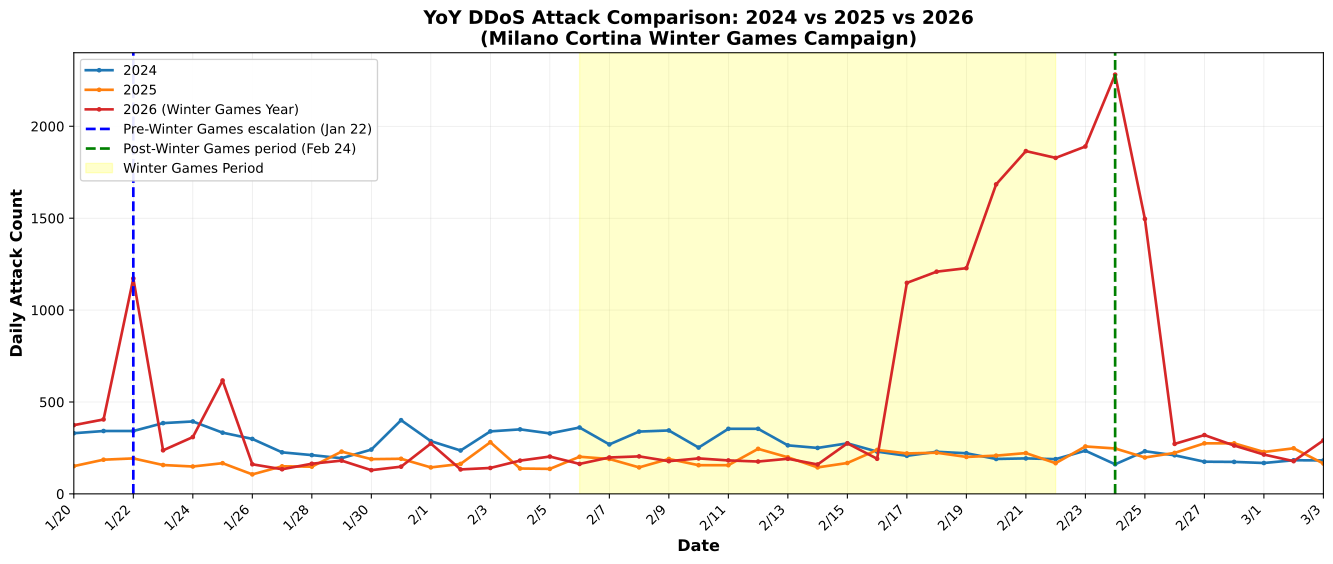
Pre-Winter Games (January 20–February 5): 4,963 attacks, averaging 300 daily. The first escalation occurred January 22, with triple the 2024 and 2025 levels for comparable dates. January 25 recorded maximum traffic intensity of 412.89Gbps, with average bandwidth per attack ranging from 0.74 to 5.45Gbps. These high-magnitude attacks suggest testing network capacity limits and defensive responses.

Winter Games period (February 6–23): 12,963 attacks, averaging 720 daily. This period accounted for 56 percent of total attack volume and 6x times higher attack activity compared with 2024 and 2025. Activity escalated from 191 attacks on February 16 to 1,890 on February 23. During the Winter Games, we can see tactical shifts in attack types to packet rate­–intensive patterns to sustain pressure via quantity over bandwidth knockouts.

Post-Winter Games (February 24–March 3): 5,315 attacks, peaking at 2,281 on February 24—a record-breaking single-day count representing the highest attack volume observed against Italy in the past three years. Activity declined 88 percent to 272 attacks by February 26.
NETSCOUT

Figure 1: Year-over-year DDoS attack comparison during Milano Cortina 2026

The temporal pattern with the Winter Games calendar shown in Figure 1 illustrates the dramatic escalation in attack frequency during 2026 compared with prior years. Notably, the five highest single-day attack counts recorded against Italy in the past three years all occurred during the February 17–25 period: February 24 (2,281 attacks), February 23 (1,890 attacks), February 21 (1,865 attacks), February 22 (1,828 attacks), and February 20 (1,684 attacks). Beyond attack volume, the intensity of individual attacks also showed significant variation throughout the observation period.

Attack Vector Analysis

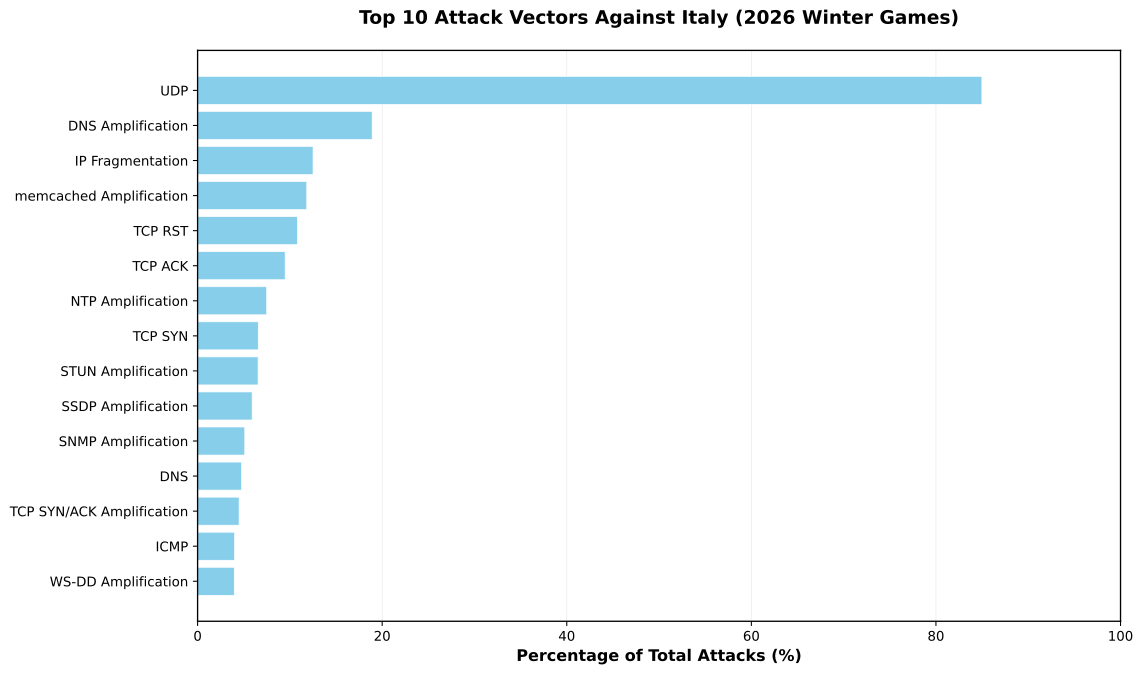
Attackers combined multiple techniques simultaneously, averaging more than two vectors per attack; UDP flooding was dominant, showing up in 85 percent of attacks, while additional DDoS attack vectors showed up in 87 percent, meaning most attacks mixed direct UDP flooding with amplified traffic from devices susceptible to reflection/amplification.
NETSCOUT

Figure 2: Attack vector distribution during Milano Cortina 2026

UDP flooding led attacks at 85 percent, followed by DNS amplification (19 percent), and memcached amplification (11.8 percent). The amplification toolkit extended to NTP (7.5 percent), STUN (6.6 percent), SSDP (5.9 percent), and SNMP (5 percent).

Threat Actor Claim Analysis

Between February 4 and February 24, 2026, threat actors publicly claimed responsibility for attacks targeting Italian infrastructure via social media and Telegram channels. These claims represent self-reported attribution and have not been independently validated against observed DDoS telemetry.

NoName057(16) dominated claims activity with 47 attacks claimed against Italy during this period, representing 40 percent of all the attribution. This represents notable concentration of NoName activity: The group claimed a total of 488 attacks globally during same time frame, meaning Italy accounted for 10 percent of NoName’s global targeting. Historical analysis shows that between December 1 and February 3, NoName057(16) claimed only one attack against Italy and made no claims toward Italy after February 28, 2026, indicating the Winter Games period attracting the threat actor.

Secondary actors generated 60 percent of the remaining claims, but in substantially lower claim volumes during the Winter Games period: Server Killers (8 claims), Z-Pentest Alliance (4 claims), Dark Storm Team (3 claims). The remaining 47 attacker claims were distributed among ransomware groups, individual actors, and various entities.

DDoSia Analysis

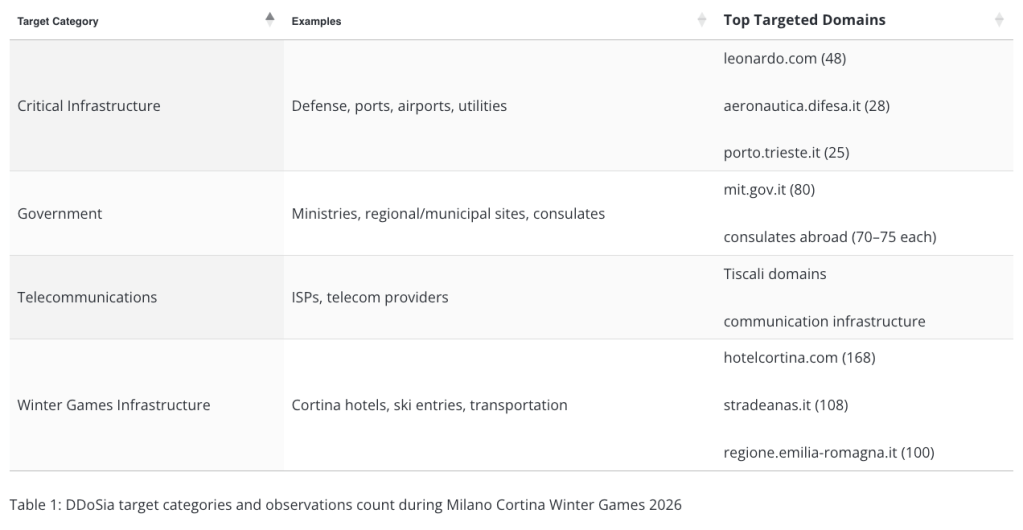
DDoSia is a homegrown DDoS platform developed by NoName057(16) operating since early 2022. DDoSia detection events by the NETSCOUT ASERT team recorded 3,491 attacks against 74 unique Italian domains during pre-Winter Games and Winter Games periods, aimed at disrupting the Winter Games infrastructure, government operations, and critical services. The primary vectors include HTTP/HTTPS/HTTP2 floods; TCP floods on port 80, 443, 2222, 8080; and slowloris-style resource exhaustion attacks.
NETSCOUT

Table 1: DDoSia target categories and observations count during Milano Cortina Winter Games 2026


Aisuru IoT Botnet Analysis
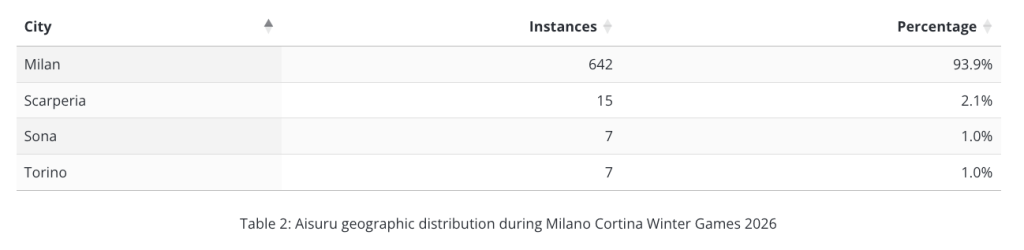
Aisuru operates as a Mirai-derivative Internet of Things (IoT) botnet first disclosed in August 2024, comprising of more than 1 million compromised consumer routers, cameras, and IoT systems. (Note: This analysis period is prior to the recent law-enforcement takedown action impacting the Aisuru botnet.) The botnet functions as DDoS-for-hire services, with attacks of up to 31Tbps purported. After observing dominance of direct-path UDP flooding—the most common Aisuru attack type—NETSCOUT’s ASERT team tracked more than 683 Aisuru-tagged instances against Italian cities, with Milan absorbing 94 percent of activity (642 instances).
NETSCOUT

Table 2: Aisuru geographic distribution during Milano Cortina Winter Games 2026
 

Conclusion

The DDoS campaign targeting Italy during the Milano Cortina 2026 Winter Games demonstrated how major international events create predictable windows for coordinated cyberthreat activity. The attack activity observed against Italy between January and March 2026 demonstrates an elevated DDoS threat landscape as compared with global DDoS trends during the same periods in prior years. The attacks represented a 181 percent frequency increase compared with 2025, when Italy was the target of NoName057 due to global geopolitical tensions reported by the ASERT team in the “Italy in the Crosshairs” campaign. 

Global visibility via NETSCOUT ATLAS threat intelligence and adaptive DDoS protection via NETSCOUT Arbor products equip organizations with robust and proactive defense strategies, ensuring the supporting infrastructure of major international events remains undisrupted.

To learn more, visit us here.