
惯性聚合 高效追踪和阅读你感兴趣的博客、新闻、科技资讯
阅读原文 在惯性聚合中打开

推荐订阅源

S
Schneier on Security
F
Fortinet All Blogs
B
Blog
GbyAI
GbyAI
P
Proofpoint News Feed
量子位
The Register - Security
宝玉的分享
宝玉的分享
大猫的无限游戏
大猫的无限游戏
云风的 BLOG
云风的 BLOG
V
Visual Studio Blog
B
Blog RSS Feed
WordPress大学
WordPress大学
Recorded Future
Recorded Future
Recent Announcements
V
Vulnerabilities – Threatpost
cs.CV updates on arXiv.org
cs.AI updates on arXiv.org
S
Secure Thoughts
雷峰网
雷峰网
Stack Overflow Blog
Stack Overflow Blog
C
Cybersecurity and Infrastructure Security Agency CISA
Webroot Blog
Webroot Blog
AWS News Blog
AWS News Blog
K
KPMG report finds enterprise disconnect between AI and its ROI | CIO
Exploit-DB.com RSS Feed
The GitHub Blog
The GitHub Blog
爱范儿
爱范儿
O
OpenAI News
月光博客
月光博客
H
Hacker News: Front Page
S
Security Affairs
W
WeLiveSecurity
The Hacker News
The Hacker News
aimingoo的专栏
aimingoo的专栏
freeCodeCamp Programming Tutorials: Python, JavaScript, Git & More
Help Net Security
Help Net Security
MongoDB | Blog
MongoDB | Blog
Cyber Security Advisories - MS-ISAC
D
Docker
T
The Blog of Author Tim Ferriss
Spread Privacy
Spread Privacy
Blog — PlanetScale
Blog — PlanetScale
J
Java Code Geeks
S
Securelist
Microsoft Azure Blog
TaoSecurity Blog
TaoSecurity Blog
T
Threat Research - Cisco Blogs
M
MIT News - Artificial intelligence
A
About on SuperTechFans

Replicate's blog

How to make remarkable videos with Seedance 2.0 – Replicate blog How to prompt Seedream 5.0 – Replicate blog Recraft V4: image generation with design taste – Replicate blog Run Isaac 0.1 on Replicate – Replicate blog Run FLUX.2 on Replicate – Replicate blog How to prompt Nano Banana Pro – Replicate blog Retro Diffusion's pixel art models are now on Replicate – Replicate blog Replicate is joining Cloudflare – Replicate blog Extract text from documents and images with Datalab Marker and OCR – Replicate blog How to prompt Veo 3.1 – Replicate blog IBM's Granite 4.0 is now on Replicate – Replicate blog Which image editing model should I use? – Replicate blog Introducing our new search API – Replicate blog Torch compile caching for inference speed – Replicate blog Announcing Replicate's remote MCP server – Replicate blog How to prompt Veo 3 with images – Replicate blog Open source video is back – Replicate blog Generate consistent characters – Replicate blog Bria is now on Replicate – Replicate blog How we optimized FLUX.1 Kontext [dev] – Replicate blog Compare AI video models – Replicate blog The FLUX.1 Kontext hackathon – Replicate blog How to prompt Veo 3 for the best results – Replicate blog Get the most from Google Veo 3 – Replicate blog FLUX.1 Kontext from the community – Replicate blog Use FLUX.1 Kontext to edit images with words – Replicate blog Generate incredible images with Google's Imagen 4 – Replicate blog Run OpenAI’s latest models on Replicate – Replicate blog NVIDIA H100 GPUs are here – Replicate blog Run 30,000+ LoRAs on Hugging Face with Replicate – Replicate blog Ideogram 3.0 on Replicate – Replicate blog Run MiniMax Speech-02 models with an API – Replicate blog Easel AI is now on Replicate – Replicate blog Stylized video with Wan2.1 – Replicate blog Creative roundup: avatars, lightsabers, and LoRA tricks – Replicate blog Wan2.1: generate videos with an API – Replicate blog Wan2.1 parameter sweep – Replicate blog You can now fine-tune open-source video models – Replicate blog Generate short videos with the Replicate playground – Replicate blog AI video is having its Stable Diffusion moment – Replicate blog FLUX fine-tunes are now fast – Replicate blog FLUX.1 Tools – Control and steerability for FLUX – Replicate blog NVIDIA L40S GPUs are here – Replicate blog Ideogram v2 is an outstanding new inpainting model – Replicate blog Stable Diffusion 3.5 is here – Replicate blog FLUX is fast and it's open source – Replicate blog FLUX1.1 [pro] is here – Replicate blog Using synthetic training data to improve Flux finetunes – Replicate blog Fine-tune FLUX.1 with an API – Replicate blog Fine-tune FLUX.1 to create images of yourself – Replicate blog Replicate Intelligence #12 – Replicate blog Replicate Intelligence #11 – Replicate blog Fine-tune FLUX.1 with your own images – Replicate blog Replicate Intelligence #10 – Replicate blog FLUX.1: First Impressions – Replicate blog Replicate Intelligence #9 – Replicate blog Replicate Intelligence #8 – Replicate blog Run Meta Llama 3.1 405B with an API – Replicate blog Replicate Intelligence #7 – Replicate blog Replicate Intelligence #6 – Replicate blog Replicate Intelligence #5 – Replicate blog How to get the best results from Stable Diffusion 3 – Replicate blog Run Stable Diffusion 3 on your Apple Silicon Mac – Replicate blog Push a custom version of Stable Diffusion 3 – Replicate blog Replicate Intelligence #4 – Replicate blog Run Stable Diffusion 3 on your own machine with ComfyUI – Replicate blog H100s are coming to Replicate – Replicate blog Run Stable Diffusion 3 with an API – Replicate blog Replicate Intelligence #3 – Replicate blog Replicate Intelligence #2 – Replicate blog Replicate Intelligence #1 – Replicate blog Shared network vulnerability disclosure – Replicate blog Run Snowflake Arctic with an API – Replicate blog Run Meta Llama 3 with an API – Replicate blog Run Code Llama 70B with an API – Replicate blog How to create an AI narrator for your life – Replicate blog Clone your voice using open-source models – Replicate blog Businesses are building on open-source AI – Replicate blog How to run Yi chat models with an API – Replicate blog Scaffold Replicate apps with one command – Replicate blog Using open-source models for faster and cheaper text embeddings – Replicate blog Generate music from chord progressions and text prompts with MusicGen-Chord – Replicate blog Generate images in one second on your Mac using a latent consistency model – Replicate blog How to use retrieval augmented generation with ChromaDB and Mistral – Replicate blog Fine-tune MusicGen to generate music in any style – Replicate blog Jet-setting with Llama 2 + Grammars – Replicate blog How to run Mistral 7B with an API – Replicate blog Make smooth AI generated videos with AnimateDiff and an interpolator – Replicate blog Fine-tuned models now boot in less than one second – Replicate blog Painting with words: a history of text-to-image AI – Replicate blog We're cutting our prices in half – Replicate blog A guide to prompting Llama 2 – Replicate blog Streaming output for language models – Replicate blog Fine-tune SDXL with your own images – Replicate blog Run Llama 2 with an API – Replicate blog Run SDXL with an API – Replicate blog A comprehensive guide to running Llama 2 locally – Replicate blog Fine-tune Llama 2 on Replicate – Replicate blog What happened with Llama 2 in the last 24 hours? 🦙 – Replicate blog Make any large language model a better poet – Replicate blog
Run FLUX with an API – Replicate blog
2024-08-01 · via Replicate's blog

FLUX.1 is a new open-source image generation model developed by Black Forest Labs, the creators of Stable Diffusion. It’s available on Replicate today, and you can run it in the cloud with one line of code.

Here’s an example of how to run FLUX.1 on Replicate using JavaScript:

You can try out FLUX.1 right in your browser, or run it programmatically in your language of choice.

What makes FLUX.1 special?

FLUX.1 models have state-of-the-art performance in prompt following, visual quality, image detail, and output diversity. Here are some particular areas where we’ve been impressed:

Text! Unlike older models that often messed up similar-looking letters, Flux can handle tricky words with repeated letters. This makes it great for designs where text needs to be accurate. Check out this Black Forest Flux Schnell gateau:

Cake with text

Complex composition. Flux is amazing at following complex instructions about where things should go in an image. For example, given the prompt “Three magical wizards standing on a yellow table, each holding a sign. On the left, a wizard in black robes holds a sign that says ‘AI’; in the middle, a witch in red robes holds a sign that says ‘is’; and on the right, a wizard in blue robes holds a sign that says ‘cool’”, Flux creates this scene perfectly:
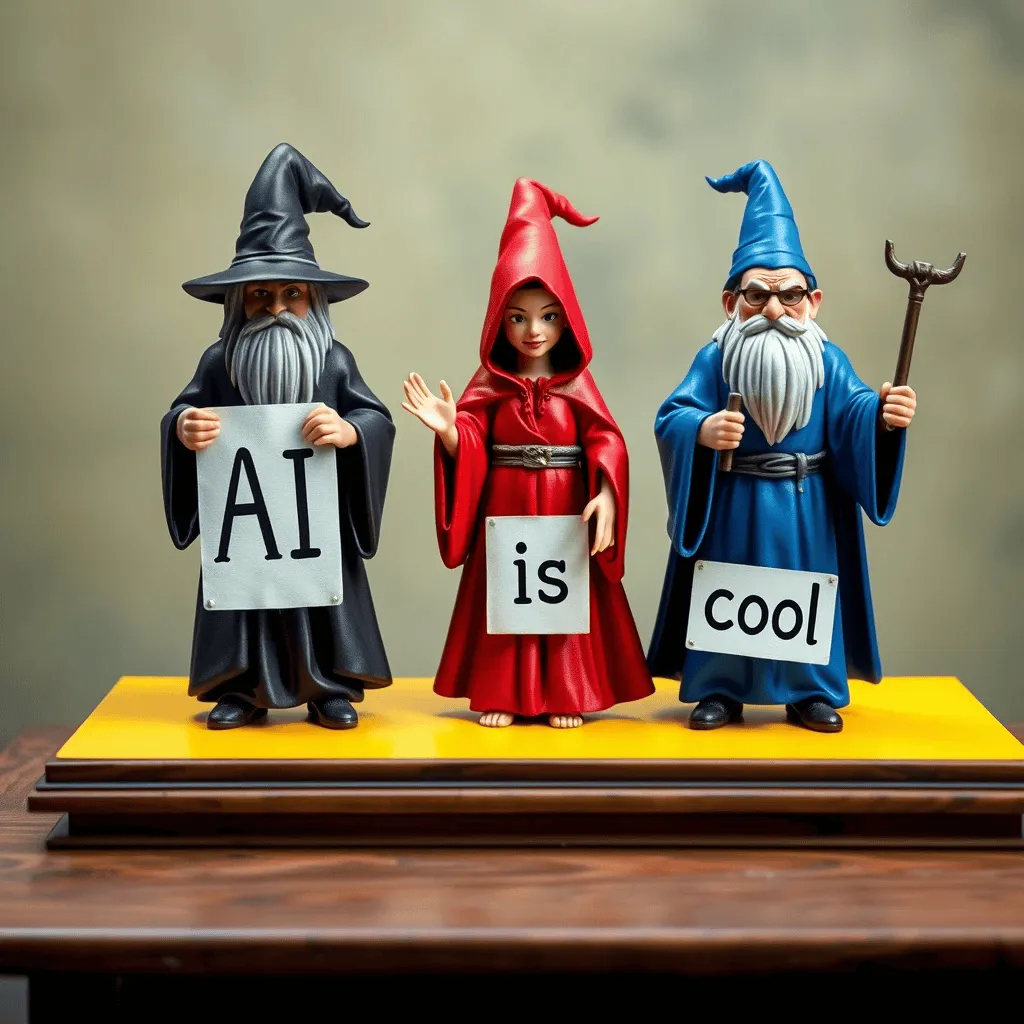
Complex scene

Hands that (mostly) look right. Hands are tough for AIs, but Flux does a pretty good job. You’ll usually get the right number of fingers in the right places. It’s not perfect, but it’s a big step up—it’s consistently better than any other open text-to-image model we’ve tried:

Cool hand

Model variants

FLUX.1 comes in three variants:

  • FLUX.1 [pro] The best of FLUX.1, state-of-the-art image generation model with top-of-the-line performance.
  • FLUX.1 [dev] An open-weight, guidance-distilled model for non-commercial applications. Directly distilled from FLUX.1 [pro], FLUX.1 [dev] has similar quality and prompt adherence capabilities, while being more efficient than a standard model of the same size.
  • FLUX.1 [schnell]: The fastest model, tailored for local development and personal use. Openly available under an Apache 2.0 license.

Pricing

FLUX.1 is priced per image:

  • FLUX.1 [pro] is $0.055 per image.
  • FLUX.1 [dev] is $0.030 per image.
  • FLUX.1 [schnell] is 0.003 per image.

Next steps

FLUX.1 is a fantastic model, so do try it out. And keep watching this space—now that the model is out in the wild, we are starting to work on features like fine-tuning for FLUX.1, so stay tuned.