








April 2, 2020
AI is “the future of growth” according to a recent Accenture research report, AI: Built to Scale. That report, based on a survey of 1500 C-suite executives at companies across 16 industries, was issued to answer a pressing question for firms pursuing AI-driven growth: “How do companies progress on their AI journey from one-off AI experimentation to organization-wide capability that acts as a source of competitive agility and growth?” [1]
The shorthand for that progress is scaling AI, which is defined — according to the report — as “the extension of the piloted capability across the full applicable scope with all relevant data, end users, customers, and processes.” [2]
In its mission to help clients use and scale AI, Accenture became a founding sponsor of the Vector Institute, establishing a close relationship with one of the world’s top centres for foundational AI research. This sponsorship puts Accenture’s own research and development professionals into the room with Vector researchers, and supports an important undertaking by Accenture Labs’ AI team: bridging the gap between foundational research and a library of models suitable for real business cases.
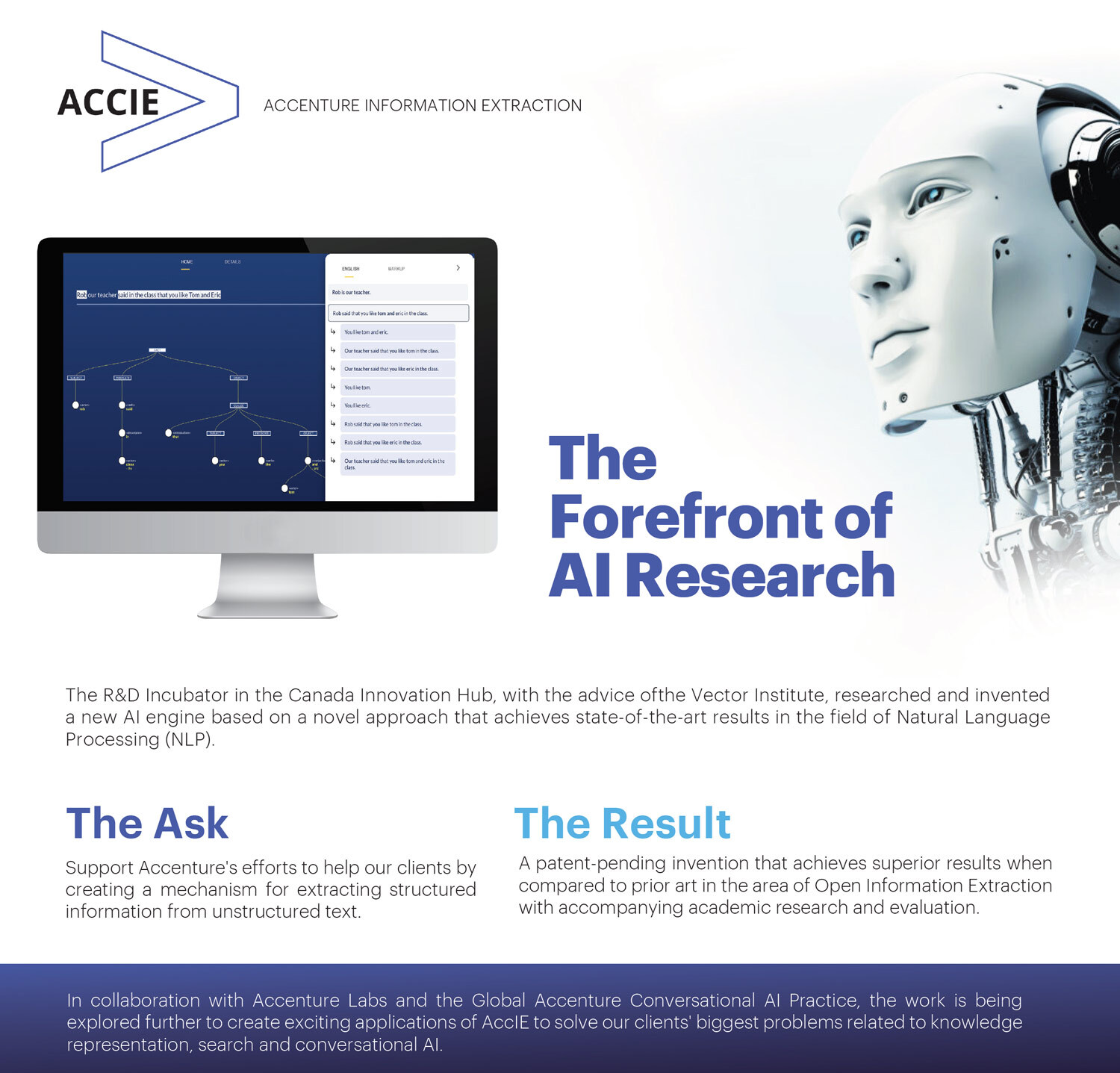
Accenture’s development of AccIE – the Accenture open information extraction engine — is an example of the business value that the firm is producing with AI and of the way it leverages the Vector sponsorship in doing so. Open information extraction involves models deriving accurate meaning from text by learning to identify facts and relationships among words and ideas. The benefit of a system like AccIE is that it can enhance intelligent search and logical reasoning, enabling organizations to efficiently analyze complex text in enormous bodies of documents, including those related to regulations and compliance.
To supplement their AccIE development efforts, Accenture engaged a leading researcher through Vector’s Face-to-Face program, which provides sponsors with an opportunity to get commentary from top researchers regarding highly-defined AI projects, problems, and opportunities. The Accenture team received feedback on benchmarks for AccIE development, suggestions regarding related research, and guidance on approaches to publishing AccIE’s outcomes in top academic journals. Conversations with Dr. Frank Rudzicz — a leading natural language processing scientist — contributed to Accenture’s mission of applying leading foundational AI research to real-world business situations.
There is another key area in which Accenture leverages Vector to help its clients scale AI: working through complex questions about AI interpretability and explainability, which in simple terms refers to the degree of clarity into how and why a model produces the output it does. These issues are particularly important to organizations in highly-regulated fields with strict compliance, audit, risk management, or corporate ethics responsibilities or that are using model outputs to inform judgments that affect people’s lives, like credit or hiring decisions.
A key point of conversation on these topics is that increased explainability may come at the expense of model accuracy, and questions about the appropriate calibration between accuracy and explainability remain unsettled. Enterprises seeking to scale AI should be mindful of current best practices and continue to update their approach as the discussion unfolds.
Accenture stays at the front edge of this conversation, in part, by sponsoring Vector and participating in its consortium projects. In Vector’s Banks Project, for instance, Accenture confers with industry peers and top researchers to work out concepts and techniques regarding responsible adoption, fairness, explainability, model robustness, and risk management of AI models in financial services. This is done in partnership with Vector researchers, putting Accenture at the table where the most sophisticated academic and private sector perspectives on these evolving topics are being shared and debated.
Enterprises seeking to scale AI will need to explore horizontal technical solutions — like AccIE — along with approaches on overarching AI-related topics — like explainability. This technical and philosophical foundation can enable the scaling of promising applications throughout the organization and inform principled governance, putting them in a position to capture the “future of growth.”
Learn more about Vector’s industry sponsorship opportunities – click here.
[1] Accenture. AI: Built to Scale. From experimental to exponential. 2019.
[2] ibid.
此内容由惯性聚合(RSS阅读器)自动聚合整理,仅供阅读参考。 原文来自 — 版权归原作者所有。