惯性聚合 高效追踪和阅读你感兴趣的博客、新闻、科技资讯
阅读原文 在惯性聚合中打开

推荐订阅源

Stack Overflow Blog
Stack Overflow Blog
V2EX - 技术
V2EX - 技术
Microsoft Azure Blog
I
InfoQ
Blog — PlanetScale
Blog — PlanetScale
MyScale Blog
MyScale Blog
The Register - Security
Threat Intelligence Blog | Flashpoint
CTFtime.org: upcoming CTF events
Y
Y Combinator Blog
N
News and Events Feed by Topic
SecWiki News
SecWiki News
U
Unit 42
T
Threat Research - Cisco Blogs
TaoSecurity Blog
TaoSecurity Blog
Webroot Blog
Webroot Blog
GbyAI
GbyAI
C
Cyber Attacks, Cyber Crime and Cyber Security
V
Vulnerabilities – Threatpost
Vercel News
Vercel News
A
About on SuperTechFans
P
Proofpoint News Feed
F
Fortinet All Blogs
T
The Blog of Author Tim Ferriss
M
MIT News - Artificial intelligence
H
Hackread – Cybersecurity News, Data Breaches, AI and More
H
Hacker News: Front Page
云风的 BLOG
云风的 BLOG
Schneier on Security
阮一峰的网络日志
阮一峰的网络日志
H
Help Net Security
T
The Exploit Database - CXSecurity.com
K
Kaspersky official blog
Security Archives - TechRepublic
P
Palo Alto Networks Blog
Help Net Security
Help Net Security
cs.AI updates on arXiv.org
MongoDB | Blog
MongoDB | Blog
Jina AI
Jina AI
L
LangChain Blog
博客园 - 三生石上(FineUI控件)
爱范儿
爱范儿
The GitHub Blog
The GitHub Blog
aimingoo的专栏
aimingoo的专栏
Project Zero
Project Zero
Engineering at Meta
Engineering at Meta
S
Schneier on Security
C
CXSECURITY Database RSS Feed - CXSecurity.com
B
Blog RSS Feed
Cyber Security Advisories - MS-ISAC

Vector Institute for Artificial Intelligence

Mohamad Moosavi: Accelerating the search for climate solutions with AI A strategic blueprint for safe health AI implementation: Your 2026 roadmap Vector Institute awards 100 scholarships to Ontario’s top AI graduate students Agentic AI evaluation strategies Hassan Ashtiani: Building trustworthy AI through mathematical foundations Vector researchers advance representation learning and deep learning research at ICLR 2026 Remarkable 2026 Poster Session: 60 research projects shaping AI’s future CRISPNAM-FG: An interpretable Fine-Gray deep survival model for competing risks in health care Demo Day: How the Vector Institute helps Canadian startups turn innovative ideas into commercial reality The New Cartography of the Invisible Vector researchers advance AI frontiers with 80 papers at NeurIPS 2025 New study reveals AI’s $100B economic impact across Canada, with Ontario leading the charge When smart AI gets too smart: Key insights from Vector’s 2025 ML Security & Privacy Workshop Vector Institute names 13 new Faculty Members, expanding core research leadership across Ontario Vector researchers dive into deep learning at ICLR 2025 When AI Meets Human Matters: Evaluating Multimodal Models Through a Human-Centred Lens – Introducing HumaniBench Vector Institute 2024-25 annual report: Where AI research meets real-world impact Vector researchers tackle real-world AI challenges at ICML 2025 Ontario’s AI ecosystem: fueling real economic growth with record number of jobs and private investments Transforming Youth Mental Health Support: FAIIR’s AI-Powered Crisis Response Model Vector Institute awards up to $2.1 million in scholarships to Ontario’s top AI graduate students AI Weather Forecasting Breakthrough: How Canadian Innovation is Transforming Climate Prediction | Aardvark Weather Exploring Intelligence: Vector Faculty Member Kelsey Allen’s Path from Particle Physics to Cognitive Machine Learning Vector Institute Announces the Appointment of Glenda Crisp as President and CEO Vector Institute Unveils Comprehensive Evaluation of Leading AI Models State of Evaluation Study: Vector Institute Unlocks New Transparency in Benchmarking Global AI Models Real World Multi-Agent Reinforcement Learning – Latest Developments and Applications Principles in Action: Introducing the Vector Institute’s Playbook for Responsible AI Product Development Leveraging Large Language Models for More Efficient Systematic Reviews in Medicine and Beyond Global AI Alliance for Climate Action funding announcement CEO Update Unilever Deepens Commitment to AI Innovation through Vector Institute Collaboration Responsible AI in Action: How Vector Institute Partnerships Drive Ethical Innovation Thought Cloning: Teaching AI to Think Like Humans for Better Decision-Making Recommender Systems: Where Academia Meets Industry AI Regulation Insights FairSense: Integrating Responsible AI and Sustainability My Visiting Researcher Term at Vector Institute Vector researchers presenting more than 98 papers at NeurIPS 2024 Unlocking the Potential of Prompt-Tuning in Federated Learning Navigating the AI Talent Landscape: How Vector Institute Partnerships Address the Skills Gap Canadian AI job market shifting, favouring specialized, in-demand skills New multimodal dataset will help in the development of ethical AI systems AI in action: Vector Institute revolutionizes its own internal workflows with generative AI Unveiling Alzheimer’s: How Speech and AI Can Help Detect Disease From Vector Institute Internship to Dream Job: A Success Story in Machine Learning Vector co-founder Geoffrey Hinton wins the Nobel Prize in Physics 2024 Empowering Air Travelers: A Chatbot for Canadian Air Passenger Rights Transforming user experiences with AI: OJ Onyeagwu’s internship success Vector Institute researchers reconvene for the second edition of the Machine Learning Privacy and Security Workshop Vector workshops give insights into responsible health AI deployment Vector researcher Wenhu Chen on improving and benchmarking foundation models Vector Researchers present papers at ACL 2024 AtomGen: Streamlining Atomistic Modeling through Dataset and Benchmark Integration Vector Institute 2023-24 annual report: advancing AI in Ontario Vector researchers presented more than 50 papers at ICML 2024 Climate change and AI-compute cap off the third and final day of Collision 2024 ChainML, Private AI, and Geoffrey Hinton underscore the importance of responsible AI development and governance at Collision 2024 Self-driving trucks will be on the road next year says Vector co-founder Raquel Urtasun at Collision 2024 Vector researchers are presenting over a dozen papers at CVPR 2024 Vector Institute Computer Vision Workshop showcases the field’s current capabilities and future potential Vector researcher Gautam Kamath breaks down the latest developments in robustness and privacy World-leading AI Trust and Safety Experts Publish Major Paper on Managing AI Risks in the journal Science Vector Institute announces nearly $2 million in scholarships for top Ontario AI graduate students Standardized protocols are key to the responsible deployment of language models The known unknowns: Vector researcher Geoff Pleiss digs deep into uncertainty to make ML models more accurate New global climate action initiative harnesses Canada’s AI expertise A change agent for AI workforce transformation: my time as a Vector Institute AI project management intern How businesses can balance AI innovation and cybersecurity Benchmarking xAI’s Grok-1 How to safely implement AI systems Breaking Ground: Natural language processing headlines Vector Institute’s latest workshop gathering Vector Research Blog: Is Your Neural Network at Risk? The Pitfall of Adaptive Gradient Optimizers Remarkable 2024 spotlights Canada’s flourishing ecosystem Merck Canada announces collaboration with Vector Institute How Vector Researcher Xi He uses differential privacy to help keep data private Harnessing AI For Sustainability Vector Research Blog: Structured Neural Networks for Density Estimation and Causal Inference Vector Research Blog: Causal Effect Estimation Using Machine Learning Vector Institute hosts first-of-its-kind Generative AI Leadership Summit Machine learning theory takes centre stage at Vector Institute workshop 12 AI Trends to watch for in 2024 Introducing FlexModel: Breakthrough Framework for Unveiling the Secrets of Large Generative AI Models Neutralizing Bias in AI: Vector Institute’s UnBIAS Framework Revolutionizes Ethical Text Analysis Vector researchers presenting more than 65 papers at NeurIPS 2023 Safe AI implementation in health: Why the right approach matters AI for Chemistry and Materials: blending old and new ways of thinking AI & public health: using natural language processing for clinical database management Patenting AI Models: Avoiding the Dreaded Subject Matter Objection ICML 2023: Developing an adaptive computation model for multidimensional generative tasks Protecting inventions related to improvements to data and novel inputs and outputs Vector Research Blog: Large Language Models, Prompting and PEFT Vector partners with IBET to increase the number of Indigenous and Black AI researchers Patent Searching: How to Find Out if You Really Invented Something Key takeaways from the All In 2023 conference Ownership of IP: Do You Own Your Invention? Dan Roy named Vector Research Co-Director Intellectual Property and Generative AI: Many Questions, Few Answers Unlocking AI-powered approaches to cancer treatment and detection Generative AI for Enterprise: Risks and Opportunities
When AI watches and listens: Introducing SONIC-O1 for real-world audio-video understanding - Vector Institute for Artificial Intelligence
Kylie Williams · 2026-06-24 · via Vector Institute for Artificial Intelligence

Authors: Ahmed Radwan, Shaina Raza

An AI system that summarizes a customer-service call, supports learning from a medical consultation, or reviews a video interview must do more than recognize objects or transcribe speech. It must understand what was said, how it was said, what happened, and when it happened, and it must perform reliably across different people and real-world settings.

Consider a job applicant asked to record video answers through an online hiring platform. An AI system may be used to summarize the interview, score responses, or help decide whether the applicant moves to the next stage. But when that system operates as a black box, it is difficult to know whether it understood the candidate fairly, interpreted their tone and communication style correctly, or performed consistently across people of different ages, genders, and racial backgrounds. A system involved in decisions that affect people’s opportunities should not be trusted simply because it produces an answer.

Yet most evaluations of multimodal AI still focus on static images, short clips, or text transcripts. They rarely test whether models can jointly reason over natural audio and video in longer conversations, identify the moment an important event occurs, or reveal whether performance differs across demographic groups.

That is why we created Social Natural Interaction Corpus, Omnimodal v1 SONIC-O1: an open, human-verified benchmark for evaluating multimodal large language models on real-world audio-video understanding. It is designed to help researchers and practitioners measure where today’s AI systems succeed, where they fail, and what those failures could mean when models are applied in socially important settings.

SONIC-O1 is built to address this gap.

A benchmark grounded in real interactions

SONIC-O1 contains approximately 60 hours of real-world audio-video content drawn from 231 human-reviewed videos across 13 conversational topics and five broader domains:

  • Professional interactions, including job interviews and workplace meetings
  • Educational conversations, including parent-teacher conferences
  • Legal and civic settings, including courtroom proceedings and community town halls
  • Service-oriented interactions, including customer service, restaurant encounters, and housing tours
  • Community and public-health settings, including patient-doctor consultations, emergency response, public-transit conflicts, mental-health counselling, and sports coverage

The videos range from short clips to conversations lasting up to an hour. This gives the benchmark a broader view of model capability than datasets focused only on brief, highly edited media. SONIC-O1 includes 4,958 human-verified annotations and associated metadata that supports group-wise analysis across observable demographic categories.
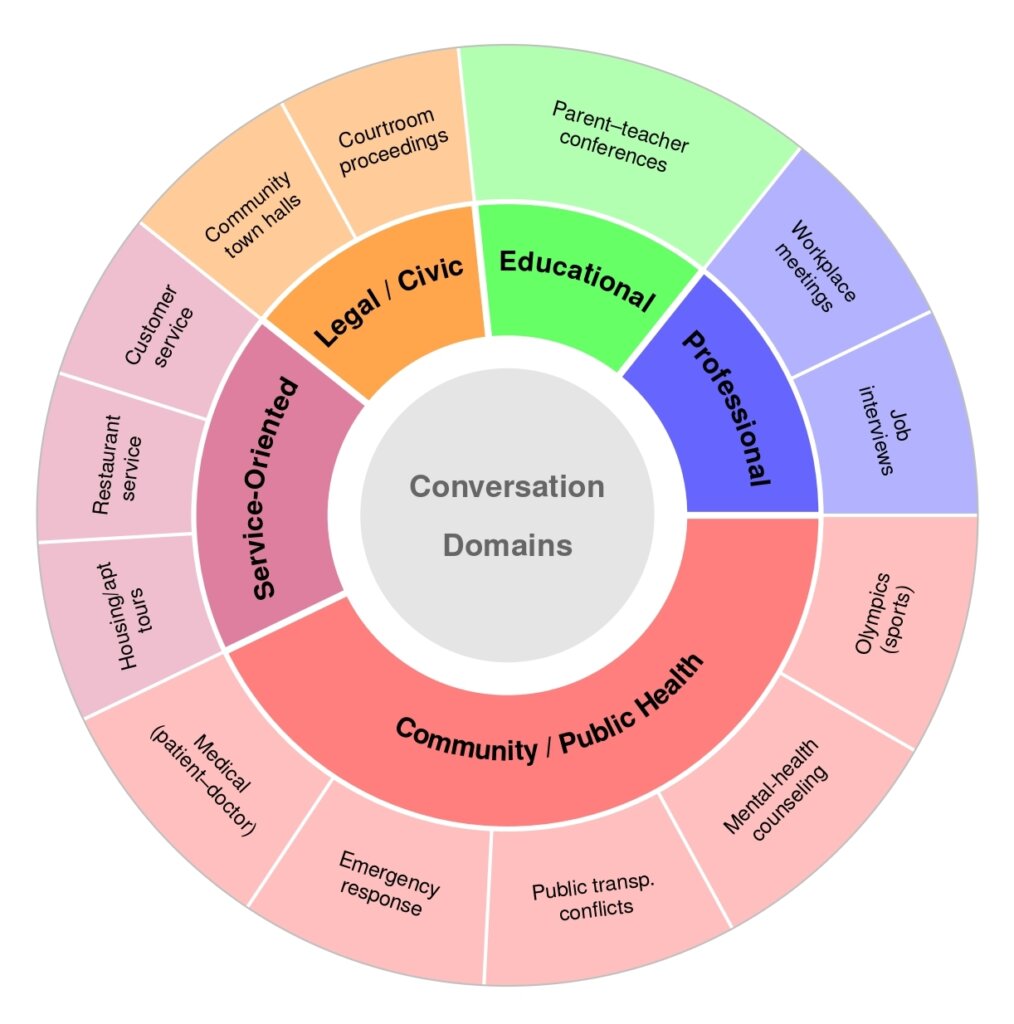
A circular sunburst diagram titled "Conversation Domains" at its centre. An inner ring displays five colour-coded domain categories and an outer ring shows their corresponding subcategories. The domains and their subcategories are as follows: Educational (green) – Parent-teacher conferences; Professional (blue) – Workplace meetings, Job interviews; Community / Public Health (red) – Olympics / sports, Mental-health counselling, Public transportation conflicts, Emergency response, Medical / patient-doctor; Service-Oriented (pink) – Housing / apartment tours, Restaurant service, Customer service; Legal / Civic (orange) – Community town halls, Courtroom proceedings.

Three tasks, one central question: Does the model truly understand the interaction?

SONIC-O1 evaluates three connected capabilities.

1. Video summarization: The first task asks models to produce a coherent summary of a full audio-video interaction.

2. Evidence-grounded multiple-choice questions: The second task tests fine-grained understanding through multiple-choice questions based on short audio-video segments.

3. Temporal localization with reasoning: The third task asks models to identify when an event happens. For example, a model may need to determine when a particular goal is scored in a sports clip, when a speaker makes a key statement, or whether one event occurs before or after another. The model must predict the start and end time of the target event and explain the evidence supporting its answer.
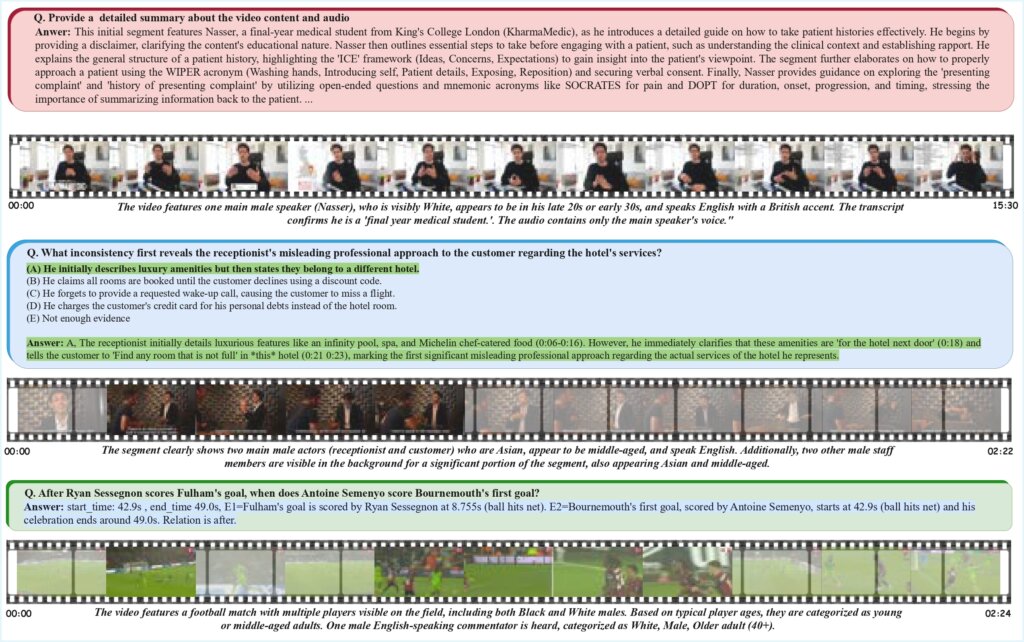
A figure showing three annotated video question-answering examples, each consisting of a question-answer pair, a horizontal filmstrip of video frames and a caption describing the demographic characteristics of visible speakers. Examples cover a medical education video, a hotel customer service scene and a football match clip.

For SONIC-O1, we selected openly licensed videos and reviewed them for quality, relevance, and clarity.

What we found: Audio-video understanding is still far from solved

We evaluated leading closed-source and open-source multimodal models across SONIC-O1’s three tasks: video summarization, evidence-grounded multiple-choice reasoning, and temporal localization.

The overall results show meaningful progress, but also clear limitations. Closed-source models performed best across the benchmark, particularly on open-ended summarization and temporal localization. The gap was smaller for multiple-choice questions, suggesting that current systems are relatively stronger when they can select from a fixed set of answers.
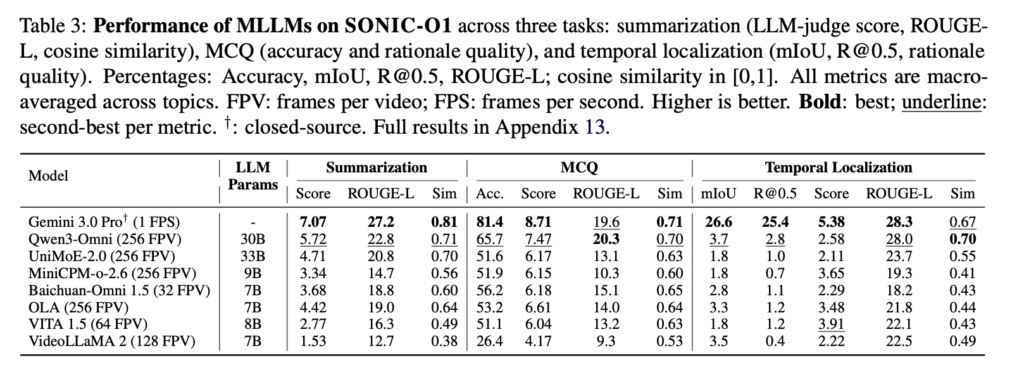
Table 3: A results table comparing eight multimodal large language models (MLLMs) on the SONIC-O1 benchmark across three tasks – summarization, multiple-choice question answering (MCQ) and temporal localization – using metrics including LLM-judge score, ROUGE-L, cosine similarity, accuracy, mIoU and R@0.5. Higher values are better. Bold indicates best per metric; underline indicates second-best. Gemini 3.0 Pro (closed-source) achieves the highest scores on most metrics.

The most difficult task was temporal localization, which requires models to identify precisely when an event occurs in a video. Gemini 3.0 Pro achieved 25.4% R@0.5, compared with 2.8% for the strongest open-source model, Qwen3-Omni. This is a 22.6% gap. Models can often describe what happened or answer a question about a clip, but still struggle to reliably identify when the relevant evidence appears.

Performance also varied across real-world settings. The Figure below shows that no model performed equally well across all 13 conversational domains. High-stakes interactions such as emergency response and mental-health counselling remain especially demanding because they require models to connect spoken language, visual context, timing, and subtle social cues.
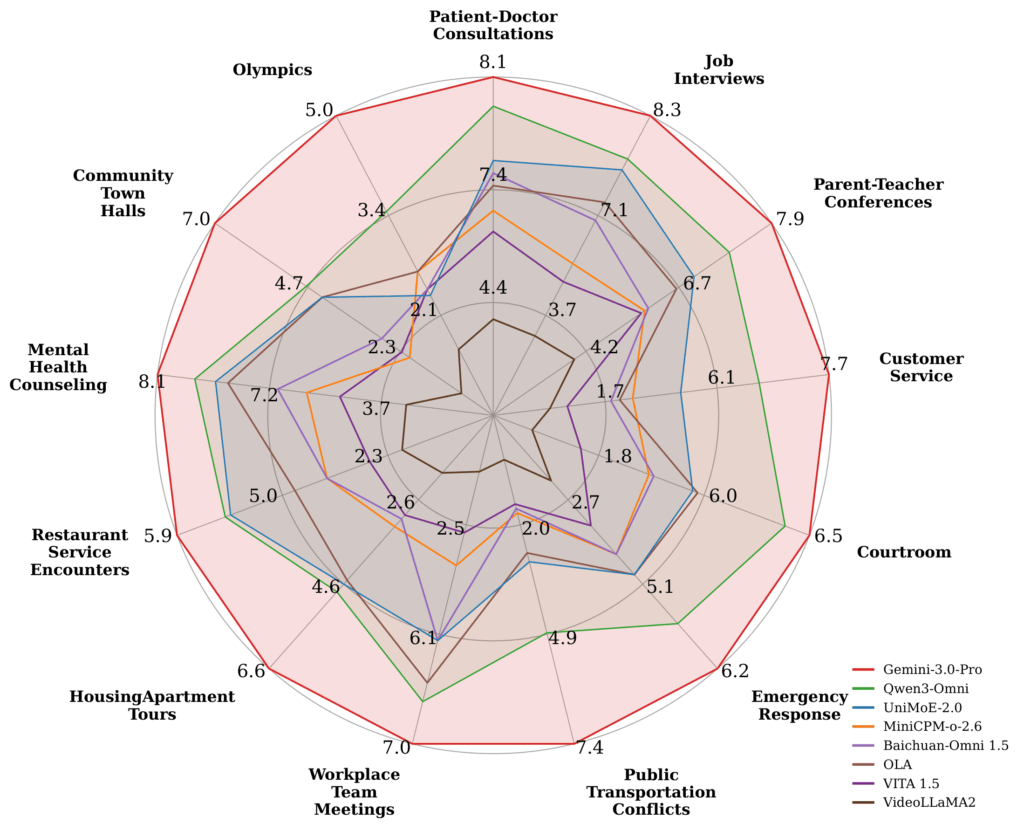
A radar (spider) chart comparing eight MLLMs across 13 conversation domain categories on LLM-judge scores. Gemini-3.0-Pro (red) forms the outermost polygon and consistently outperforms all other models. Qwen3-Omni (green) is the second-strongest performer, while the remaining six models cluster in a tighter inner region with notably lower scores.

Group-wise analysis revealed the largest disparities in temporal localization, including a 21.4% gap for Gemini 3.0 Pro between Indigenous and Black participants, showing that overall averages can mask uneven reliability across demographic groups.

SONIC-O1 gives researchers and developers a shared framework to investigate these questions.