


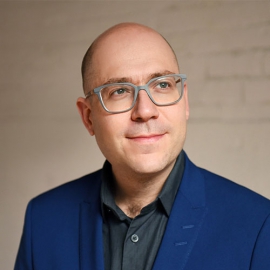
Alán Aspuru-Guzik has spent the last twelve years as a Professor at Harvard University, where his research group has been working at the intersection of computer science, chemistry and physics.
Now, his mission to accelerate the discovery of new molecules and materials has led Alán and his research team to Canada, where they will establish a new lab at the University of Toronto.
The move to Canada comes at an exciting time in Alán’s life. He is already recognized within Canada as a CIFAR Fellow, and in Ottawa today he was presented with a Canada 150 Research Chair in Theoretical & Quantum Chemistry. The move means Alán will be jointly appointed to the departments of chemistry and computer science at the University of Toronto, and the latest to join the growing team of faculty at the Vector Institute.
As he moves to Canada, Alán is looking forward to integrating robotics, machine learning, and high-throughput quantum chemistry to create what he refers to as “self-driving chemical laboratories,” also known as materials acceleration platforms. He believes these labs will enable the rapid discovery of new matter needed to solve some of the world’s most pressing problems. By simulating matter and automating experiments, he says, “Humans can co-design materials with computers.”
“We can have an evolution or a revolution of the field,” said Alán as he described his most recent paper, The Matter Simulation (R)evolution. “In the twenty-first century, we do not have time for slow improvements in chemistry. Think of all the problems like water pollution, energy needs, and batteries. We need to revolutionize chemical laboratories: AI and robotics can help us do that.”
Alán’s new lab at the University of Toronto, The Matter Lab, will have two locations. Students in the Sandford Fleming Building will research machine learning methods, quantum computing algorithms, and develop robotics systems. These advancements will be applied to discover new materials in the Lash Miller Building, where Alán will build a materials acceleration platform.
Alán’s interest in artificial intelligence is evident in his pioneering work on the development of algorithms for quantum computers to simulate molecules and materials. He recently introduced quantum machine learning algorithms such as the quantum autoencoder and the quantum neuron.
Asked about the significance of his appointment into the Vector Institute, Alán replied, “Vector will be a great partner – allowing my students to interact with people at the top of their respective fields.” He went on to explain that “machine learning is essential in this endeavor because it can help us better understand molecules by representing them as graphs or three-dimensional objects. Machine learning can also help develop methods that unlock pathways to create new molecules.” Alán and his group have developed and used machine learning algorithms for molecular and materials design.
Reflecting on his decision to advance his research in Toronto, Alán said that once he had narrowed his search to Canada, he found that the University of Toronto ranked among the top universities in his fields. He was also excited by the opportunity to work with faculty members at the Vector Institute and was encouraged by Canada’s history of support for quantum information science and recent investments in machine learning.
Richard Zemel is the Director of Research for the Vector Institute and leads recruitment.
“Alán has been leading in his field for many years,” said Dr. Zemel. “The opportunity to combine his expertise in chemistry and quantum computing with Vector’s expertise in machine learning is very exciting. I’m thrilled that the Vector Institute and its faculty are part of the ecosystem in Toronto that will allow Alán to pursue world-leading research here in Canada.”
University of Toronto News Release: U of T wins third prestigious Canada 150 Chair
CIFAR congratulates Canada 150 Research Chair joining U of T
此内容由惯性聚合(RSS阅读器)自动聚合整理,仅供阅读参考。 原文来自 — 版权归原作者所有。