

惯性聚合 高效追踪和阅读你感兴趣的博客、新闻、科技资讯
阅读原文 在惯性聚合中打开

推荐订阅源

云风的 BLOG
云风的 BLOG
V
Visual Studio Blog
人人都是产品经理
人人都是产品经理
The GitHub Blog
The GitHub Blog
月光博客
月光博客
T
Tailwind CSS Blog
小众软件
小众软件
Y
Y Combinator Blog
钛媒体:引领未来商业与生活新知
钛媒体:引领未来商业与生活新知
P
Proofpoint News Feed
B
Blog RSS Feed
博客园 - 司徒正美
A
About on SuperTechFans
Cyber Security Advisories - MS-ISAC
博客园 - 聂微东
Microsoft Security Blog
Recent Announcements
博客园 - Franky
U
Unit 42
奇客Solidot–传递最新科技情报
奇客Solidot–传递最新科技情报
Microsoft Azure Blog
T
The Blog of Author Tim Ferriss
GbyAI
GbyAI
Apple Machine Learning Research

Vector Institute for Artificial Intelligence

Mohamad Moosavi: Accelerating the search for climate solutions with AI A strategic blueprint for safe health AI implementation: Your 2026 roadmap Vector Institute awards 100 scholarships to Ontario’s top AI graduate students Agentic AI evaluation strategies Hassan Ashtiani: Building trustworthy AI through mathematical foundations Vector researchers advance representation learning and deep learning research at ICLR 2026 Remarkable 2026 Poster Session: 60 research projects shaping AI’s future CRISPNAM-FG: An interpretable Fine-Gray deep survival model for competing risks in health care Demo Day: How the Vector Institute helps Canadian startups turn innovative ideas into commercial reality The New Cartography of the Invisible Vector researchers advance AI frontiers with 80 papers at NeurIPS 2025 New study reveals AI’s $100B economic impact across Canada, with Ontario leading the charge When smart AI gets too smart: Key insights from Vector’s 2025 ML Security & Privacy Workshop Vector Institute names 13 new Faculty Members, expanding core research leadership across Ontario Vector researchers dive into deep learning at ICLR 2025 When AI Meets Human Matters: Evaluating Multimodal Models Through a Human-Centred Lens – Introducing HumaniBench Vector Institute 2024-25 annual report: Where AI research meets real-world impact Vector researchers tackle real-world AI challenges at ICML 2025 Ontario’s AI ecosystem: fueling real economic growth with record number of jobs and private investments Transforming Youth Mental Health Support: FAIIR’s AI-Powered Crisis Response Model Vector Institute awards up to $2.1 million in scholarships to Ontario’s top AI graduate students AI Weather Forecasting Breakthrough: How Canadian Innovation is Transforming Climate Prediction | Aardvark Weather Exploring Intelligence: Vector Faculty Member Kelsey Allen’s Path from Particle Physics to Cognitive Machine Learning Vector Institute Announces the Appointment of Glenda Crisp as President and CEO Vector Institute Unveils Comprehensive Evaluation of Leading AI Models State of Evaluation Study: Vector Institute Unlocks New Transparency in Benchmarking Global AI Models Real World Multi-Agent Reinforcement Learning – Latest Developments and Applications Principles in Action: Introducing the Vector Institute’s Playbook for Responsible AI Product Development Leveraging Large Language Models for More Efficient Systematic Reviews in Medicine and Beyond Global AI Alliance for Climate Action funding announcement
AI Research Symposium highlights new Vector research
Ian Gormely · 2023-04-25 · via Vector Institute for Artificial Intelligence

The Vector Institute held its fourth annual AI Research Symposium in February, showcasing new cutting-edge AI research from the Vector research community. The event brought together over 200 researchers, including some of the world-greatest minds in AI, to listen to keynote presentations, check out poster presentations from researchers, and socialize with friends and colleagues. This year’s event was the first partially in-person gathering of Vector’s research community in three years.

“The Research Symposium highlights the work of students and postdocs, connecting them with Vector’s faculty members and faculty affiliates,” says Vector’s research director Graham Taylor. “It’s an important touchpoint for the entire Vector community and a communications development opportunity for trainees.”

Talks from Vector researchers highlight new breakthroughs

Vector Postdoctoral Fellow Franziska Boenisch kicked things off with her talk, “What Trust Model is Needed for Federated Learning to be Private?” “There is always a severe risk of privacy leakage for the user,” she said after the talk. “And even if we protect the federated learning protocol with dedicated techniques, there is still a risk of privacy leakage because the companies or the services deploying the protocol have the upper hand in comparison to the users.” 

Visiting from Vancouver, Vector Faculty Member Vered Shwartz’s gave the talk “Incorporating Commonsense Reasoning into NLP Models.” “NLP has made a lot of progress over the last few years,” she said after her presentation, “but it still lacks common sense reasoning, which is required to understand language.” Where humans can understand the ambiguities of language through inferences and implicit understandings, NLP models for the most part still cannot.

Also onstage was Vector Faculty Member Shai Ben-David, who spoke about applying foundational models to the concept of fairness in his talk “Can Fairness be retained under distribution shift?” This year was also notable for the inclusion of a keynote from an external speaker: Colin Raffel, Assistant Professor in the Department of Computer Science at the University of North Carolina, Chapel Hill and Faculty Researcher at Hugging Face. Raffel spoke about “Building better language models.”
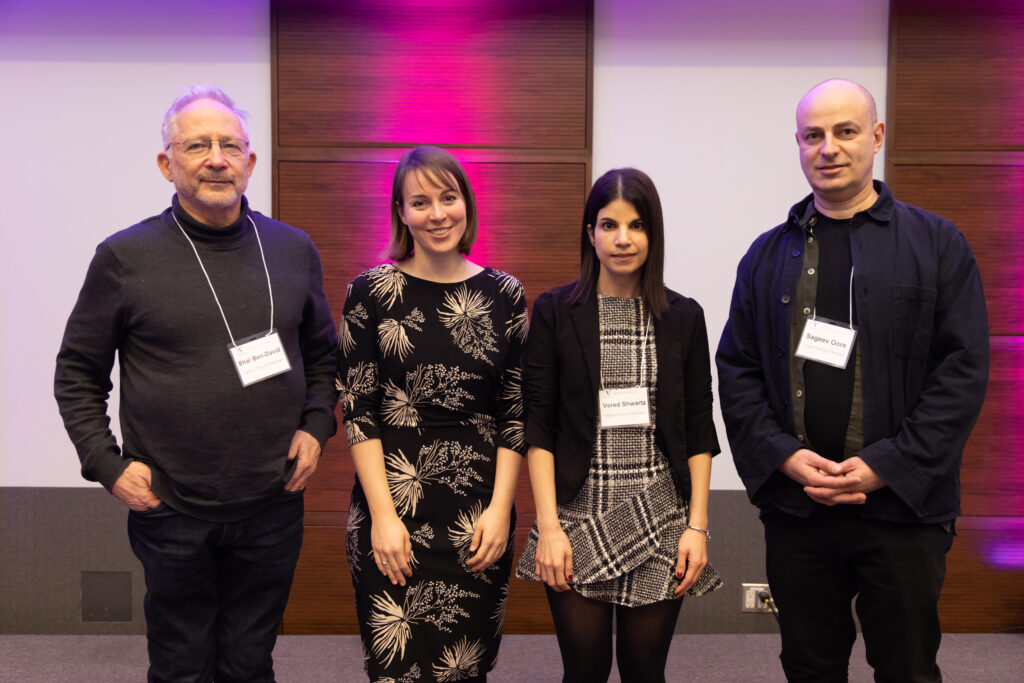
From left to right, Vector researchers Shai Ben-David, Franziska Boenisch, Vered Shwartz, and Sageev Oore at Vector's research symposium

Poster Presentations help Vector’s community reconnect

The event was capped off by 46 poster presentations from Vector researchers. Along with showcasing their work it also gave members of the community a chance to socialize with old and new friends. “I jumped at the opportunity to present here,” says Fasil Cheema, a student of Faculty Affiliate Ruth Urner at York University. “Even though we have a good community, we’ve become isolated. It’s been harder to reach out to other researchers because I work in a smaller lab. Seeing what other researchers in Canada are working on, it’s a nice way to introduce people. Cold calling, email works too, but this is different.” 

That was a sentiment echoed by many in attendance, including Tony Gaffney, Vector’s President and CEO. “What’s really important about this event is that it starts to bring us back together in person. When we collaborate in person, we’re that much more effective.

“The vibe in the room is really positive and exciting”
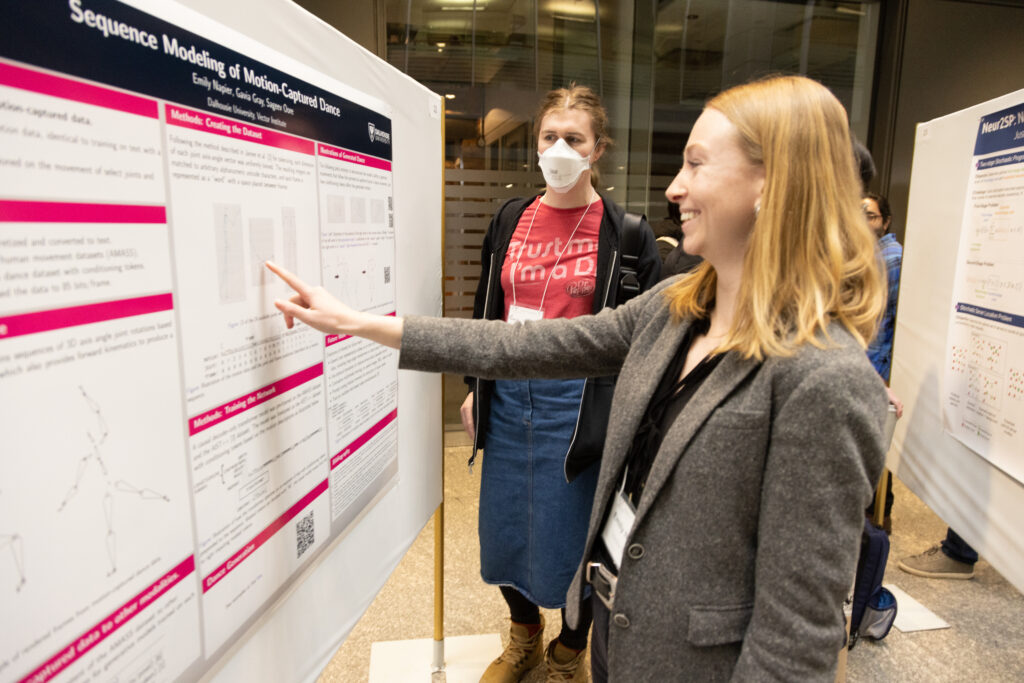
Vector researchers discuss a research posted at Vector's research symposium.
Vector researchers pose beside a research poster at Vector's research symposium
Vector researchers discuss a research posted at Vector's research symposium.