


By Natasha Ali
The Vector Institute recently held an all-day workshop to showcase recent research in quantum machine learning. Featuring presentations from Vector Faculty Members, graduate students, and postdoctoral fellows, the workshop emphasized the current and future potential of quantum computing in molecular chemistry and physics research.
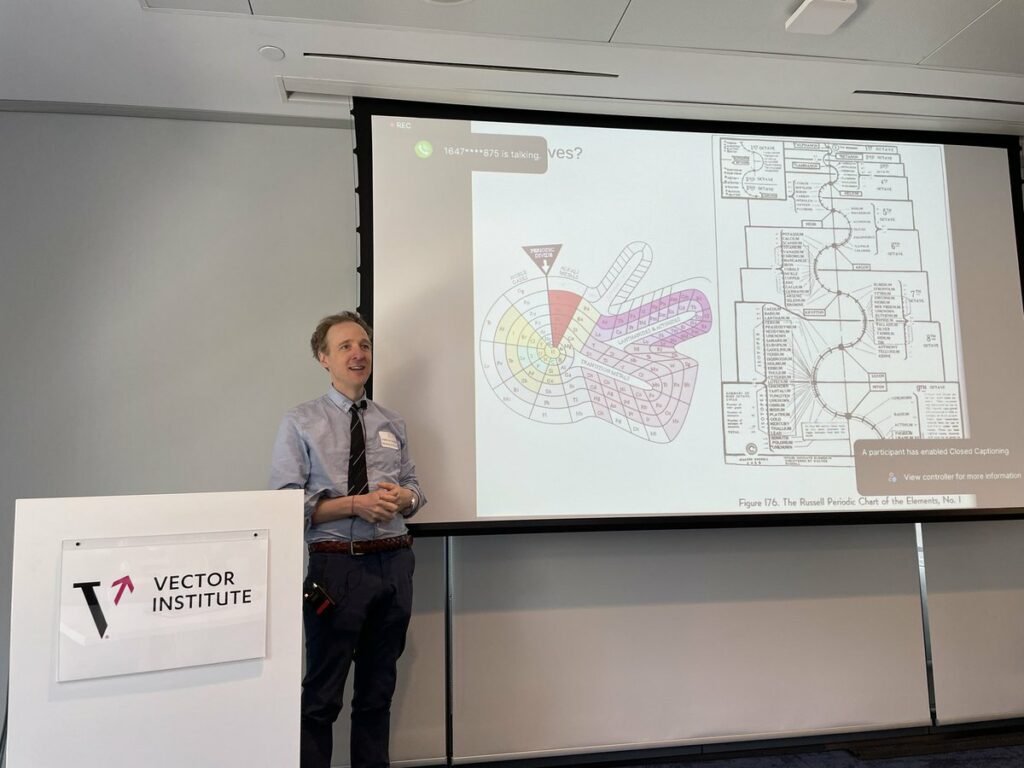


The speakers, a mix of computer science, chemistry, and physics experts, presented ways to leverage quantum computers to generate molecular simulations and test the limits of existing machine learning models.
An emerging field, quantum computing integrates machine learning with quantum mechanical concepts, such as molecular interactions and light wave behaviour, to develop “super computers” that perform at a much higher efficiency than classical computers. Quantum computers can process complex algorithms, recognize patterns in large datasets, and make predictions about physical spaces. They can also simulate quantum systems and chemical reactions.
Among the speakers at the workshop was Vector Faculty Member Alán Aspuru-Guzik, who is also a professor of Chemistry and Computer Science at the University of Toronto and the Director of the Acceleration Consortium. His research merges quantum chemistry with machine learning. He is interested in the applications of quantum computing in molecular simulation and energy system analysis.
Aspuru-Guzik spoke about the significant impact of machine learning in quantum optics. This rich field examines the behaviour and interactions of light particles in physical systems and provides insight about molecular energy states. He unveiled a machine learning generative model that can extract data from previous molecular simulations and optics experiments. He also showed that quantum computing methods considerably improved their understanding of light behaviour and energy systems. These generative models can process quantum algorithms more efficiently and make accurate predictions about light wave behaviour and energy states. This optical information can, in turn, be incorporated in real-life applications such as drug discovery and pharmaceutical development.
Addressing the future of machine learning in quantum optics, Aspuru-Guzik posed the question: “Can we experimentally implement a computer-dreamed quantum optics experiment?” Taking it a step further, he suggested the idea of using machine learning to develop quantum optical computer chips and program them to produce instantaneous molecular simulations. The ultimate goal is to expand the uses of quantum computing and transform how we exploit AI for Science.
Similar to Aspuru-Guzik, Nathan Wiebe, assistant professor in the Department of Computer Science at University of Toronto, proposed a generative quantum computing model that predicts molecular behaviour. His research focuses on the use of quantum neural networks to simulate molecular systems and physical interactions. In his presentation, he demonstrated the significance of generative quantum machine learning in predicting molecular behaviour and energy states.
Wiebe was able to develop extensive quantum neural networks — a cluster of generative models that integrate quantum mechanics with machine learning algorithms. He then used quantum computers to train these models with physical data (e.g, position and charge of electrons, location of atoms, energy states). This approach accelerated the performance of quantum generative models and resulted in optimized simulations of quantum mechanical states. Ultimately, Wiebe proved that neural network training, combined with quantum computing, can enhance the accuracy of generative models and produce accurate simulations of molecular behaviour.
As for bridging the gap between classical and quantum computing, Artur Izmaylov, Professor of Theoretical Chemistry, Department of Physical and Environmental Sciences University of Toronto Scarborough, proposed an approach to exploit the full potential of quantum computers in chemistry research. Izmaylov discussed quantum computing algorithms that can enhance classical algebraic models. His research focused on “classically hard and quantum easy systems” to further highlight the quantum advantage in machine learning.
By examining computational models for energy states and quantum mechanics, Izmaylov identified some of the challenges associated with algebraic functions, such as error optimization and cost. He also pointed out how quantum computers can be used to store quantum data and analyze functions through quantum algorithms.“The idea,” he said, “is to bring the quantum advantage into quantum chemistry.”
Although still in its infancy, the day’s presenters predict that quantum machine learning will be an instrumental piece in quantum chemistry research, providing a better understanding of the physical space, accelerating experimental processes, and reducing research costs. It also has the potential to transform how industries operate, which ultimately plays into Vector’s mission of establishing Canada as a leader in AI adoption and integration.
McClean, Jarrod & Huang, Hsin-Yuan. (2022). Quantum Advantage in Learning from Experiments. Google Blog. https://ai.googleblog.com/2022/06/quantum-advantage-in-learning-from.html
Taylor, Graham. (2022). Canada can lead in AI for Science. Vector Institute. https://vectorinstitute.ai/canada-can-lead-in-ai-for-science/
此内容由惯性聚合(RSS阅读器)自动聚合整理,仅供阅读参考。 原文来自 — 版权归原作者所有。