

惯性聚合 高效追踪和阅读你感兴趣的博客、新闻、科技资讯
阅读原文 在惯性聚合中打开

推荐订阅源

IT之家
IT之家
OSCHINA 社区最新新闻
OSCHINA 社区最新新闻
A
About on SuperTechFans
博客园 - 聂微东
奇客Solidot–传递最新科技情报
奇客Solidot–传递最新科技情报
freeCodeCamp Programming Tutorials: Python, JavaScript, Git & More
B
Blog RSS Feed
U
Unit 42
Stack Overflow Blog
Stack Overflow Blog
Recent Announcements
雷峰网
雷峰网
罗磊的独立博客
Microsoft Security Blog
Hugging Face - Blog
Hugging Face - Blog
L
LangChain Blog
人人都是产品经理
人人都是产品经理
The GitHub Blog
The GitHub Blog
F
Fortinet All Blogs
Cyber Security Advisories - MS-ISAC
H
Help Net Security
P
Proofpoint News Feed
The Cloudflare Blog
D
Docker
大猫的无限游戏
大猫的无限游戏

Vector Institute for Artificial Intelligence

Mohamad Moosavi: Accelerating the search for climate solutions with AI A strategic blueprint for safe health AI implementation: Your 2026 roadmap Vector Institute awards 100 scholarships to Ontario’s top AI graduate students Agentic AI evaluation strategies Hassan Ashtiani: Building trustworthy AI through mathematical foundations Vector researchers advance representation learning and deep learning research at ICLR 2026 Remarkable 2026 Poster Session: 60 research projects shaping AI’s future CRISPNAM-FG: An interpretable Fine-Gray deep survival model for competing risks in health care Demo Day: How the Vector Institute helps Canadian startups turn innovative ideas into commercial reality The New Cartography of the Invisible Vector researchers advance AI frontiers with 80 papers at NeurIPS 2025 New study reveals AI’s $100B economic impact across Canada, with Ontario leading the charge When smart AI gets too smart: Key insights from Vector’s 2025 ML Security & Privacy Workshop Vector Institute names 13 new Faculty Members, expanding core research leadership across Ontario Vector researchers dive into deep learning at ICLR 2025 When AI Meets Human Matters: Evaluating Multimodal Models Through a Human-Centred Lens – Introducing HumaniBench Vector Institute 2024-25 annual report: Where AI research meets real-world impact Vector researchers tackle real-world AI challenges at ICML 2025 Ontario’s AI ecosystem: fueling real economic growth with record number of jobs and private investments Transforming Youth Mental Health Support: FAIIR’s AI-Powered Crisis Response Model Vector Institute awards up to $2.1 million in scholarships to Ontario’s top AI graduate students AI Weather Forecasting Breakthrough: How Canadian Innovation is Transforming Climate Prediction | Aardvark Weather Exploring Intelligence: Vector Faculty Member Kelsey Allen’s Path from Particle Physics to Cognitive Machine Learning Vector Institute Announces the Appointment of Glenda Crisp as President and CEO Vector Institute Unveils Comprehensive Evaluation of Leading AI Models State of Evaluation Study: Vector Institute Unlocks New Transparency in Benchmarking Global AI Models Real World Multi-Agent Reinforcement Learning – Latest Developments and Applications Principles in Action: Introducing the Vector Institute’s Playbook for Responsible AI Product Development Leveraging Large Language Models for More Efficient Systematic Reviews in Medicine and Beyond Global AI Alliance for Climate Action funding announcement
New neural network models offer the potential for better ...
Ian Gormely · 2020-01-30 · via Vector Institute for Artificial Intelligence

Vector Faculty Member David Duvenaud and collaborators have published a new paper, “Scalable Gradients for Stochastic Differential Equations,” in Artificial Intelligence and Statistics. The paper uses backpropagation to fit stochastic continuous-time models and offers the potential for building more complex prediction models in fields like physics, finance, and human genetics. 

Stochastic differential equations (SDEs) — differential equations that account for uncertainty due to unseen interactions — have a long history in fields like finance where they help forecast how stock prices might evolve over time. However, they’ve been limited in the number of parameters (generally 10 or 20) that can be fit at any one time and, generally speaking, were not scalable to the large neural networks with millions of parameters that are used to fit data in other domains.

“Scalable Gradients for Stochastic Differential Equations” specifies the dynamics of these models with neural networks, and trains them with gradient-based optimization.

Duvenaud and his co-authors Ricky T. Chen, Ting-Kam Leonard Wong, and Xuechen Li combine these processes with deep neural networks.  Duvenaud had previously worked on the idea of switching from discrete time — data sampled at regular intervals — to continuous time — data sampled at any point in the flow, in the paper “Neural Ordinary Differential Equations,” which won a Best Paper Award at NeurIPS 2018. In this new paper, they generalized the math allowing for neural ODEs to be trained for SDEs, a much larger family of models.
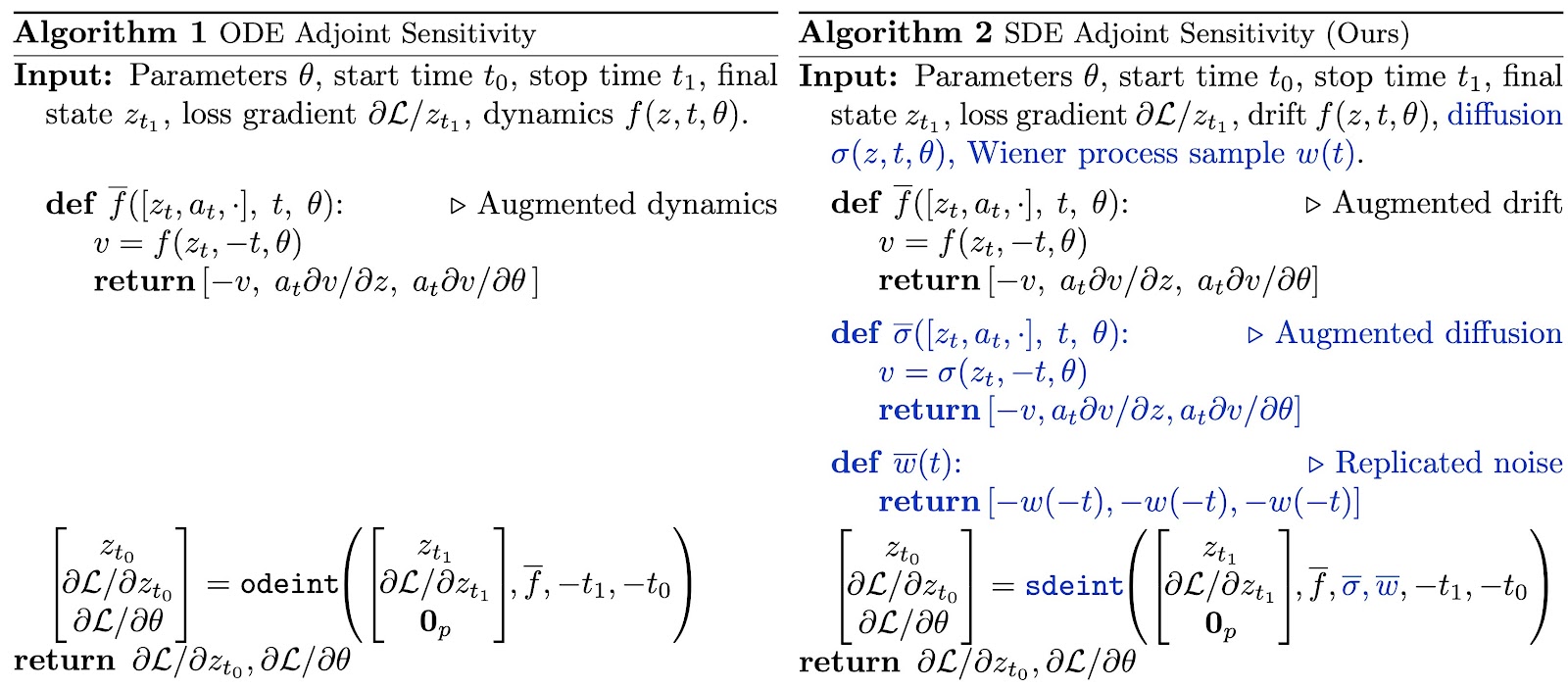
Neural network algorithm formulas

Continuous time backpropagation already existed for neural ODEs, but no such reverse mode method existed for SDEs. The algorithm ended up being a straightforward extension of the ODE method with fixed noise, a sort of continuous-time reparameterization trick.

These continuous time models offer a more fine-grained and flexible way to incorporate or sample data time series data.  They have the potential to help better model medical data, predict prices across the stock market, or track the evolution of populations over long periods of time.