

惯性聚合 高效追踪和阅读你感兴趣的博客、新闻、科技资讯
阅读原文 在惯性聚合中打开

推荐订阅源

MongoDB | Blog
MongoDB | Blog
大猫的无限游戏
大猫的无限游戏
H
Help Net Security
V
Visual Studio Blog
G
Google Developers Blog
Blog — PlanetScale
Blog — PlanetScale
Last Week in AI
Last Week in AI
C
Check Point Blog
D
Docker
M
MIT News - Artificial intelligence
P
Proofpoint News Feed
博客园 - 叶小钗
博客园 - 聂微东
The Cloudflare Blog
云风的 BLOG
云风的 BLOG
Martin Fowler
Martin Fowler
OSCHINA 社区最新新闻
OSCHINA 社区最新新闻
酷 壳 – CoolShell
酷 壳 – CoolShell
MyScale Blog
MyScale Blog
WordPress大学
WordPress大学
Engineering at Meta
Engineering at Meta
腾讯CDC
S
SegmentFault 最新的问题
博客园 - 【当耐特】

Vector Institute for Artificial Intelligence

Mohamad Moosavi: Accelerating the search for climate solutions with AI A strategic blueprint for safe health AI implementation: Your 2026 roadmap Vector Institute awards 100 scholarships to Ontario’s top AI graduate students Agentic AI evaluation strategies Hassan Ashtiani: Building trustworthy AI through mathematical foundations Vector researchers advance representation learning and deep learning research at ICLR 2026 Remarkable 2026 Poster Session: 60 research projects shaping AI’s future CRISPNAM-FG: An interpretable Fine-Gray deep survival model for competing risks in health care Demo Day: How the Vector Institute helps Canadian startups turn innovative ideas into commercial reality The New Cartography of the Invisible Vector researchers advance AI frontiers with 80 papers at NeurIPS 2025 New study reveals AI’s $100B economic impact across Canada, with Ontario leading the charge When smart AI gets too smart: Key insights from Vector’s 2025 ML Security & Privacy Workshop Vector Institute names 13 new Faculty Members, expanding core research leadership across Ontario Vector researchers dive into deep learning at ICLR 2025 When AI Meets Human Matters: Evaluating Multimodal Models Through a Human-Centred Lens – Introducing HumaniBench Vector Institute 2024-25 annual report: Where AI research meets real-world impact Vector researchers tackle real-world AI challenges at ICML 2025 Ontario’s AI ecosystem: fueling real economic growth with record number of jobs and private investments Transforming Youth Mental Health Support: FAIIR’s AI-Powered Crisis Response Model Vector Institute awards up to $2.1 million in scholarships to Ontario’s top AI graduate students AI Weather Forecasting Breakthrough: How Canadian Innovation is Transforming Climate Prediction | Aardvark Weather Exploring Intelligence: Vector Faculty Member Kelsey Allen’s Path from Particle Physics to Cognitive Machine Learning Vector Institute Announces the Appointment of Glenda Crisp as President and CEO Vector Institute Unveils Comprehensive Evaluation of Leading AI Models State of Evaluation Study: Vector Institute Unlocks New Transparency in Benchmarking Global AI Models Real World Multi-Agent Reinforcement Learning – Latest Developments and Applications Principles in Action: Introducing the Vector Institute’s Playbook for Responsible AI Product Development Leveraging Large Language Models for More Efficient Systematic Reviews in Medicine and Beyond Global AI Alliance for Climate Action funding announcement
Vector researcher Bo Wang develops a method for harmonizi...
Ian Gormely · 2020-03-10 · via Vector Institute for Artificial Intelligence

By Ian Gormely

Data is the fuel that makes AI algorithms work. But good, usable data is not always easy to come by. It’s a problem that Vector Faculty Member Bo Wang knows all too well. 

In order to build a set of medical data (such as medical images or clinical notes) big enough to make a machine learning model work, researchers like Wang often have to combine data from multiple hospitals. Specifically, Wang wanted to apply the classification model for cancer images collected from a group of hospitals to cardiac images. But the data hospitals collect, and the manner in which they collect and sort it, tends to vary from hospital to hospital and even department to department. Harmonizing them would be a difficult and time-consuming task. There had to be a better way. 

Methods for targeting a single source domain adaptation – transferring one hospital’s model to another – already existed. But this “neglects more practical scenarios where training data are coming from multiple sources,” he says. He wondered: “Can we force the model to be generalizable to different domains?” 

Moment Matching for Multi-source Domain Adaption,” co-authored by Xingchao Peng, Qinxun Bai, Xide Xia, Zijun Huang, and Kate Saenko, and published in Proceedings of the IEEE International Conference on Computer Vision in 2019, suggests that yes, they very much can. In fact, their model – which they shorthand as M3SDA – not only offers a way to bring information from multiple sources into a single one, it also annotates unlabelled internet images, resulting in a data set of 600,000 images distributed across 345 different categories. “I believe it’s the largest collection of multiset domain adaptation,” says Wang.
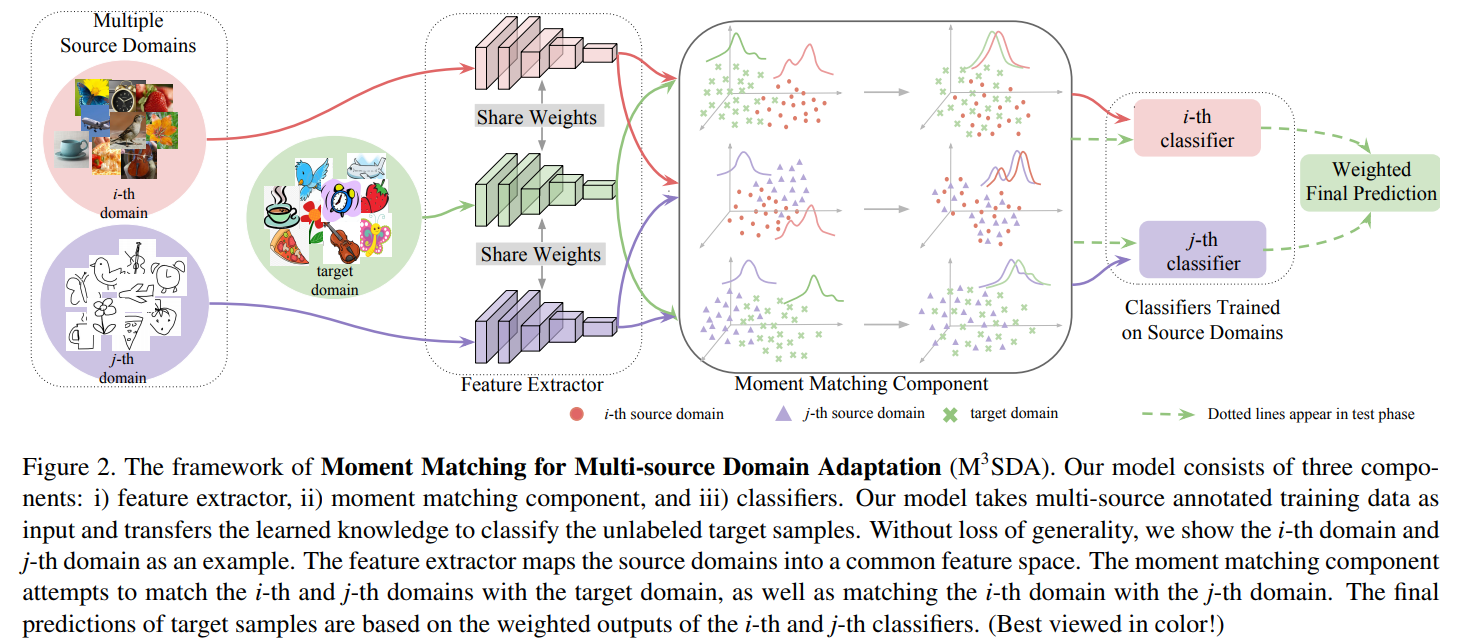
The framework of Moment Matching for Multi-source Domain Adaptation. Our model consists of three components i) feature extractor ii) moment matching component iii) classifiers. Our model takes multi-source annotated training data as input and transfers the learned knowledge to classify the unlabeled target samples. Without loss of generality, we show the i-th domain and  j-th domain as an example. The feature extractor maps the source domains into a common feature space. The moment matching component attempts to match the i-th and j-th domains with the target domain as well as matching the i-th domain with the j-th domain. The final predictions of target samples are based on the weighted outputs of the i-th and j-th classifiers.

And it’s already making an impact. Lauren Erdman, a Vector and SickKids Hospital PhD student under the supervision of Vector Faculty Member Anna Goldenberg, came across the paper while doing a literature review. “I immediately knew it would be useful in my work,” she says calling Wang’s approach “distinct” from others. Erdman is currently using’ Wang’s algorithm in two studies. The first uses M3SDA to harmonize differences in the data created by ultrasound machines. The other tweaks the algorithm — the outcome is a continuous-valued curve and alignment will be proportionate to curve similarity — to map the sound of uroflow (urination) to study its speed, volume and duration. 

“We developed a very simple approach that can do a better job,” Wang says noting that while he and his team tested the model in computer vision, they also see “huge potential” for medical applications, particularly medical image analysis as well. “Most of the current medical image projects suffer from a lack of annotated images and the fact that models trained on data from one hospital cannot be directly applicable for images in the other hospital. Our method has the potential to conquer these two limitations at the same time.”